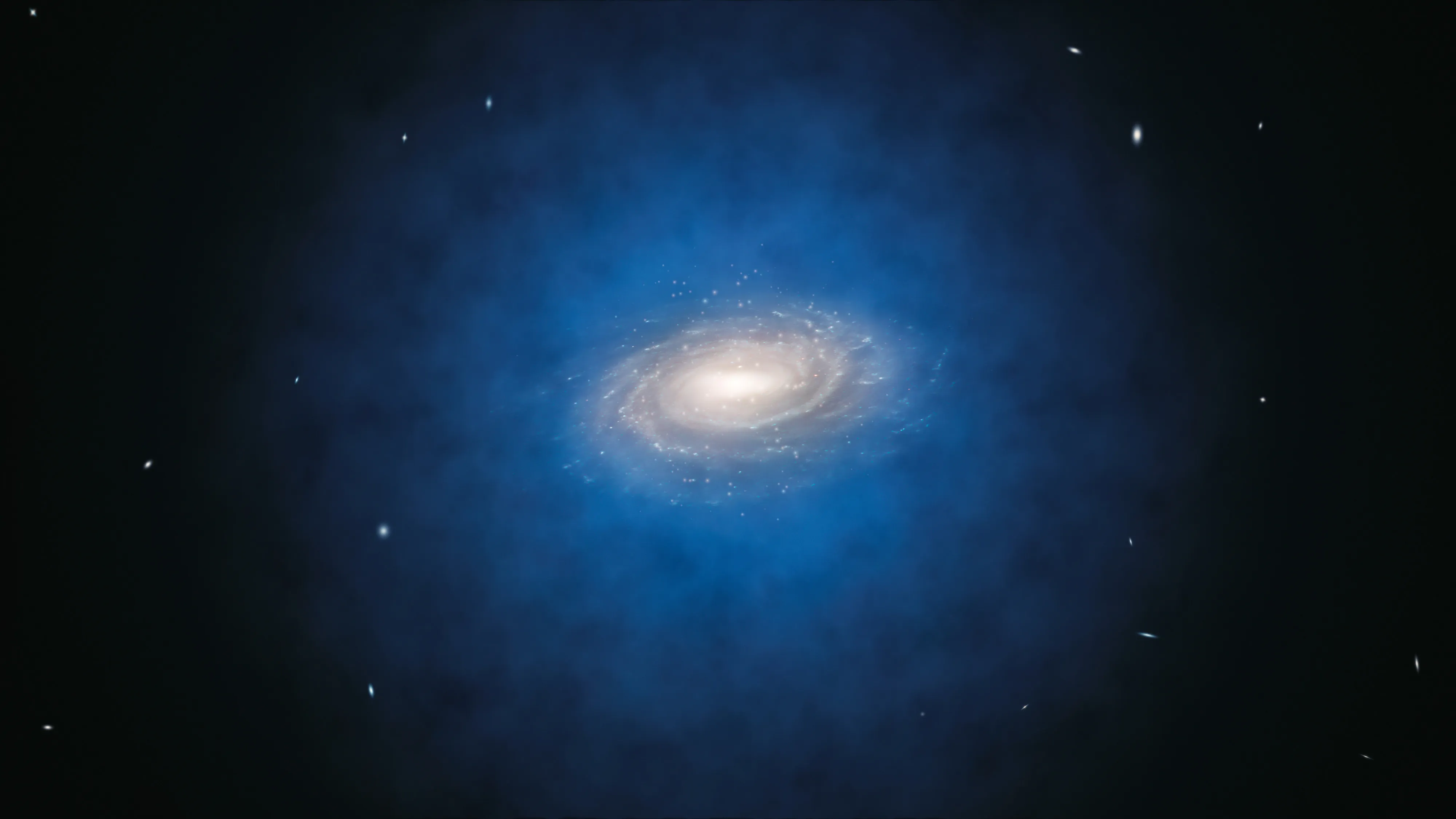
The Problem Zwicky Saw in 1933
In 1933, the Swiss-American astronomer Fritz Zwicky was measuring the velocities of galaxies in the Coma Cluster, a dense aggregation of about a thousand galaxies in the constellation Coma Berenices. By measuring how much the spectral lines of these galaxies were redshifted relative to the cluster's average, he could calculate how fast each galaxy was moving. What he found made no sense.
The galaxies in the cluster were moving at velocities ranging up to more than 2,000 kilometers per second relative to each other. By straightforward Newtonian gravity, the visible mass of the cluster, all the stars and gas in all the galaxies, totaled together, was not nearly enough to hold the cluster together at those velocities. By his calculations, the cluster needed approximately ten times more mass than was visible just to remain gravitationally bound. Without it, the galaxies should have flown apart eons ago.
Zwicky inferred that there must be some additional mass present that he could not see, what he called dunkle Materie, dark matter. The conclusion was so far ahead of its time that it was largely ignored for forty years. It was not until the 1970s, when Vera Rubin and Kent Ford observed the same problem in individual spiral galaxies, stars at the outer edges of galaxies orbiting faster than the visible mass should allow, that the astronomical community accepted that something unseen really did dominate the gravitational mass of the universe.
The modern picture, refined by Planck satellite measurements of the cosmic microwave background, is that approximately 27 percent of the universe's total energy density is dark matter, compared with only about 5 percent for ordinary atomic matter (the stars, gas, planets, and people we can see). Dark matter outnumbers ordinary matter by more than five to one. It is the dominant gravitational substance of the universe. And ninety-two years after Zwicky's paper, we still do not know what it is.
What Dark Matter Probably Is
Several proposals exist. The two most-studied candidates are axions and weakly interacting massive particles, or WIMPs. Other efforts probe whether dark matter interacts with ordinary particles at all, for instance by scattering off neutrinos.
Axions are hypothetical particles, originally proposed in the 1970s to solve a different problem in particle physics (the strong CP problem in quantum chromodynamics). They would be extremely light, perhaps a millionth the mass of an electron or less, and would interact almost imperceptibly with ordinary matter. Several experiments worldwide, notably ADMX in Washington State and HAYSTAC at Yale, have been searching for axions for years; no detection so far.
WIMPs are the alternative. The acronym stands for Weakly Interacting Massive Particle, but in physics jargon it usually denotes a specific class of hypothetical particle predicted by supersymmetric extensions of the Standard Model of particle physics. WIMPs would be heavy, somewhere between ten and a few thousand times the mass of a proton, and they would interact only via gravity and the weak nuclear force. They would not absorb, emit, or scatter light. They would be effectively invisible.
The key prediction about WIMPs is that they should occasionally annihilate. Every fundamental particle has an antiparticle: protons have antiprotons, electrons have positrons, and WIMPs would have anti-WIMPs. When a WIMP encounters its antiparticle, they would annihilate, converting their combined rest mass into a burst of high-energy radiation, gamma rays, in particular. The expected energy of these gamma rays is set by the mass of the WIMP itself, by Einstein's E = mc². For a WIMP in the 10 to 1000 GeV mass range, the resulting gamma rays should have characteristic energies of tens of GeV.
Where would these annihilations happen? Wherever dark matter is most concentrated. The Milky Way is surrounded by a roughly spherical halo of dark matter, extending out to several hundred thousand light-years from the galactic center. The halo is densest near the galactic center and falls off outward. The expected gamma-ray signal from WIMP annihilation should peak near the galactic center and extend across the entire halo in a roughly spherical distribution, distinct from the spectrum of gamma-ray emission from ordinary stellar processes, which is concentrated in the galactic disk.
Dark matter is invisible. It does not emit, absorb, or reflect light. The only way to see it would be to detect particles annihilating with their antiparticles. For ninety-two years, no one has been able to.
The Telescope That Has Been Looking for Twenty Years
The Fermi Gamma-ray Space Telescope, launched in 2008, has spent eighteen years scanning the gamma-ray sky. Its Large Area Telescope (LAT) instrument is sensitive to gamma-ray photons in the 20 MeV to 300 GeV energy range, exactly the range where WIMP annihilation signals would appear. The Fermi data archive contains more than fifteen years of continuous all-sky observations, totaling many petabytes of data.
From the day Fermi launched, multiple groups have been combing through that data looking for the dark-matter annihilation signal. The challenge is that the gamma-ray sky is noisy. Ordinary astrophysical sources, supernova remnants, active galactic nuclei, pulsars, the Sun, even cosmic ray interactions with the interstellar medium, produce vast amounts of gamma-ray emission that overwhelms any potential dark-matter signal. To find dark matter, you have to first cleanly subtract out all the known sources, then look for what is left.
This sounds easy in principle. In practice it is enormously difficult. Astrophysical gamma-ray sources are not all well-characterized. Some are variable in time. Some are at uncertain distances. Some are extended in shape and may overlap each other. The Fermi-LAT catalog of known sources contains thousands of entries, many of them imprecise. Subtracting them all accurately enough to see a putative dark-matter signal underneath has been the work of multiple research groups for over a decade, and until 2025, none had a clear detection.
Totani's Two-Year Project
Tomonori Totani at the University of Tokyo began the analysis that would become the November 2025 paper in early 2024. The approach was painstakingly conservative. Rather than building a model of all known gamma-ray sources and subtracting it from the data, Totani used a procedure called source masking. For every confirmed point source in the Fermi-LAT catalog within a five-degree radius of the galactic center, he simply excluded that region from the analysis entirely. The same was done for the galactic disk itself, too much astrophysical contamination, too poorly characterized. What was left was the gamma-ray emission from the rest of the sky: a wide patch of the high-latitude sky, well away from the galactic plane.
Then he asked: across that high-latitude region, is there an excess of gamma-ray emission that follows the shape of the predicted dark-matter halo?
Yes. The result, published in Physical Review D in November 2025, is a gamma-ray excess concentrated around the galactic center and falling off outward in the spherical pattern characteristic of a dark-matter halo. The excess has an energy spectrum that peaks at approximately 20 GeV, the range expected for WIMP annihilation with a particle mass in the 100 to 500 GeV range. The shape, the spectrum, and the spatial distribution are consistent with a single dark-matter explanation. Other astrophysical explanations, unresolved point sources, instrument artifacts, modeling errors in the diffuse galactic emission, have been tested and ruled out at high statistical significance.
The Cautious Reaction
Within days of the paper's publication, the physics community had a flurry of responses. Some were enthusiastic; some were cautious. The split is informative.
Carlos Frenk, a longtime dark-matter theorist at Durham University and one of the originators of the cold dark matter framework that includes WIMPs, told Physics World that the result was "potentially as important as the discovery of evolution by Darwin", if it holds up. Other groups, including teams led by Mariangela Lisanti at Princeton and Tracy Slatyer at MIT, have begun independent reanalyses of the Fermi data to see whether they can reproduce Totani's signal.
The cautious view focuses on three open questions. First, the population density of WIMPs that Totani's signal implies is somewhat higher than the standard cosmological estimate from cosmic microwave background data. The discrepancy is not enormous, but it is not zero. Either the standard cosmological estimate is slightly off, or the local density of dark matter near the galactic center is somehow enhanced beyond what the standard models predict, or the signal is partially from something else.
Second, no comparable signal has yet been seen in dwarf spheroidal galaxies, small, satellite galaxies of the Milky Way that are also dominated by dark matter. If WIMPs are annihilating in the Milky Way halo, they should also be annihilating in dwarf galaxy halos, producing a detectable gamma-ray signature there too. So far, dwarf-galaxy searches have produced only upper limits, not detections. The next round of dwarf-galaxy analyses, using deeper Fermi data, should confirm or rule out the Totani signal.
Third, even if the gamma-ray excess is real and is dark matter, it does not yet prove that the dark matter is specifically a WIMP. Other dark-matter candidates could produce similar signals. The full picture requires complementary detections from particle physics laboratories, most notably, direct-detection experiments like LZ at the Sanford Underground Research Facility and XENONnT at Gran Sasso, that try to catch WIMPs interacting with normal atoms in carefully shielded detectors deep underground. So far, those experiments have produced only null results.
What Will Settle It
The Totani 2025 paper is, on the current best understanding, the most plausible candidate for a direct astronomical detection of dark matter that has ever appeared. Whether it survives the next two to three years of independent reanalysis, dwarf-galaxy cross-checks, and complementary particle-physics experiments will determine whether the field's ninety-two-year-old central mystery is finally resolved.
The next decade has several relevant data sources. Fermi-LAT continues to take data; another five to ten years of integrated observation will allow Totani's signal to be tested at much higher statistical significance. The Cherenkov Telescope Array, currently under construction in Spain and Chile, will provide an independent gamma-ray dataset at higher energies. LZ and XENONnT are running, with sensitivity improving year over year. New colliders proposed for the late 2030s, the CERN FCC and the Chinese CEPC, would be able to produce WIMPs directly if they exist within the mass range Totani's signal implies.
Either Totani's signal will firm up across all these independent tests, in which case the discovery of dark matter will go down as one of the largest physics events of the century, or it will dissolve back into noise as the data improve, in which case the search continues with a clearer understanding of where the signal is not. In either case, the question that has been hanging over physics since 1933 is, for the first time, being attacked by an actual measurement rather than by theoretical speculation.
For 92 years we have known dark matter exists. For 92 years we have not been able to detect it directly. The Totani 2025 paper is the first time anyone has made a credible claim of seeing the annihilation signal of dark matter particles themselves. The next three years will tell us whether it survives the verification.
Frequently Asked Questions
What is dark matter?
Dark matter is a substance that exerts gravitational force on visible matter but does not emit, absorb, or reflect light. Its existence was first inferred by Fritz Zwicky in 1933 from the high velocities of galaxies in the Coma Cluster, which could not be explained by the visible mass alone. Modern measurements from the Planck satellite estimate that dark matter constitutes approximately 27 percent of the universe's total energy density, more than five times the contribution of ordinary atomic matter. What dark matter actually consists of remains one of the longest-standing unsolved problems in physics.
What is a WIMP?
WIMP stands for Weakly Interacting Massive Particle. In physics it usually refers to a hypothetical class of particles predicted by supersymmetric extensions of the Standard Model, heavy particles (10 to a few thousand times the proton mass) that interact with ordinary matter only via the weak nuclear force and gravity. WIMPs are the leading candidate for dark matter; they would be effectively invisible because they do not interact electromagnetically, but they would occasionally annihilate with their antiparticles, producing detectable gamma-ray signatures.
What did Totani 2025 find?
Tomonori Totani at the University of Tokyo published a paper in Physical Review D in November 2025 reporting a diffuse gamma-ray excess in 15 years of archival Fermi-LAT data. The excess is concentrated around the galactic center and falls off outward in the spherical pattern characteristic of a dark-matter halo. Its energy spectrum peaks at approximately 20 GeV, consistent with WIMP annihilation for a particle mass in the 100 to 500 GeV range. The result has not been independently confirmed but is being actively reanalyzed by multiple research groups worldwide.
Why is this potentially the biggest physics result in decades?
If confirmed, it would be the first direct astronomical detection of dark matter, a 92-year-old physics problem since Zwicky's 1933 paper. It would also be the first observational evidence for supersymmetric particles, which have been theorized since the 1970s but never directly detected. The implications would extend across cosmology (constraining the universe's structure and evolution), particle physics (validating supersymmetric models), and the search for a 'Theory of Everything' that unifies quantum mechanics and general relativity.
What are the concerns about the result?
Three main ones. First, the implied dark-matter density near the galactic center is somewhat higher than standard cosmological estimates predict. Second, comparable signals should appear in dwarf spheroidal satellite galaxies of the Milky Way, but those searches have so far produced only upper limits. Third, direct-detection experiments (LZ, XENONnT) trying to catch WIMPs interacting with ordinary atoms in deep underground detectors have produced only null results. All three concerns are being actively tested with new data; they may resolve or they may rule out the signal.
What experiments could confirm or deny this?
Several converging lines of investigation: continued Fermi-LAT data accumulating over the next 5 to 10 years (improving the statistical significance of the Totani signal); deeper analysis of dwarf-galaxy gamma-ray emission; the Cherenkov Telescope Array, currently under construction in Spain and Chile, which will provide independent high-energy gamma-ray observations; the LZ and XENONnT direct-detection experiments, which continue to take data with improving sensitivity; and proposed future colliders (CERN's FCC, China's CEPC) capable of producing WIMPs directly in the 2030s and 2040s. Within the next 3 to 5 years, the result should be either confirmed at higher statistical significance or ruled out by independent measurements.
Continue Exploring
- The Telescope Mapping the Dark UniverseOrdinary matter, everything we can see, is a rounding error in the cosmos. The rest is dark matter and dark energy. A...
- The Great Nothing: A Hole in the Universe 330 Million Light-Years WideIn 1981, a redshift survey turned up an emptiness so vast that if the Milky Way sat at its center, we might not have...
- Why There Is Something Instead of NothingThe Big Bang should have made matter and antimatter in perfectly equal amounts, and they should have annihilated each...
- The Universe May Be Sitting on a False FloorThe measured masses of the Higgs boson and the top quark place our universe a hair's breadth from a different state of...
- The Collision That Left Its Own Gravity BehindWhen two galaxy clusters smashed through each other, the visible matter slowed and the gravity kept going. The gap...
Sources
- Totani, T. "A gamma-ray excess in the Milky Way halo consistent with WIMP dark matter annihilation." Physical Review D, 112, 103015 (2025).
- Zwicky, F. "Die Rotverschiebung von extragalaktischen Nebeln." Helvetica Physica Acta, 6, 110 (1933).
- Rubin, V. C. & Ford, W. K. "Rotation of the Andromeda nebula from a spectroscopic survey of emission regions." The Astrophysical Journal, 159, 379 (1970).
- Fermi-LAT Collaboration. "Fermi-LAT 14-year catalog (4FGL-DR4)." The Astrophysical Journal Supplement, 269, 19 (2023).
- Planck Collaboration. "Planck 2018 results. VI. Cosmological parameters." Astronomy & Astrophysics, 641, A6 (2020).
- Bertone, G. & Hooper, D. "A history of dark matter." Reviews of Modern Physics, 90, 045002 (2018).
- LZ Collaboration. "First dark matter search results from the LUX-ZEPLIN (LZ) experiment." Physical Review Letters, 131, 041002 (2023).
- Frenk, C. S. & White, S. D. M. "Dark matter and cosmic structure." Annalen der Physik, 524, 507 (2012).
- Cover image: ESO / N. Bartmann artist's impression of the Milky Way dark matter halo. Public domain.