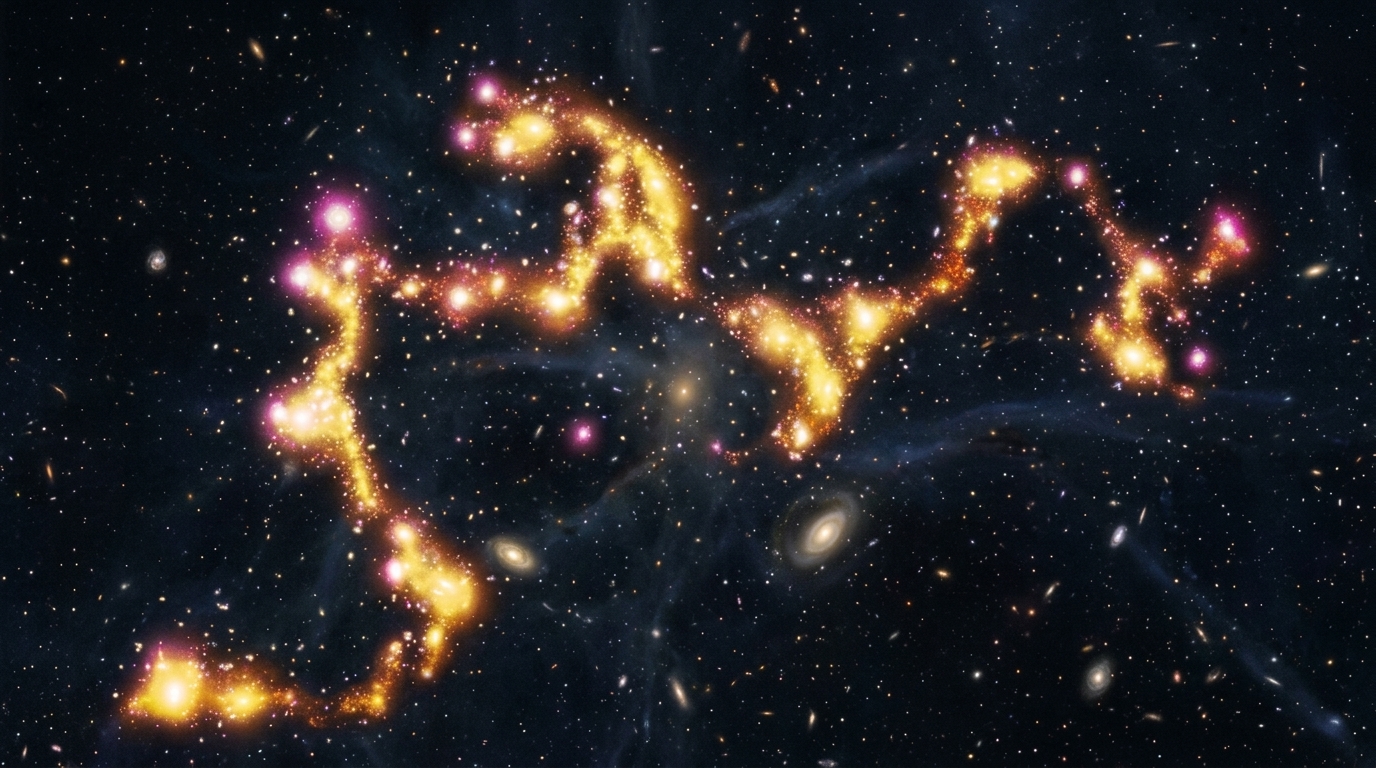
The Rule the Universe Was Supposed to Obey
The Cosmological Principle is a statement about how the universe is built. It says, in its modern form, that on scales larger than about a billion to 1.2 billion light-years, the universe is statistically homogeneous and isotropic. There should be no preferred location, no preferred direction, no clumping that persists at scales larger than the so-called "End of Greatness", the homogeneity scale at which structure is supposed to wash out into a smooth average density.
The principle is not just a philosophical preference. It is the assumption that makes general-relativistic cosmology tractable. The Friedmann, Lemaître, Robertson, Walker metric, the equation underlying the standard Big Bang model, assumes homogeneity and isotropy on average. Cosmic microwave background measurements from COBE, WMAP, and Planck have all confirmed homogeneity to high precision on scales close to the visible universe's full extent. The principle has, by most measurements, held up.
By most measurements. Over the past forty years, galaxy redshift surveys have produced four candidate structures whose existence, if confirmed at face value, the standard model cannot account for. Each is several times larger than the homogeneity scale. Each has been independently measured. None has been ruled out. The most extreme candidate is more than ten billion light-years across, comparable to the distance light has traveled since shortly after the Big Bang itself.
The Pisces, Cetus Supercluster Complex
The first systematic galaxy redshift surveys in the 1980s, Margaret Geller and John Huchra at Harvard, Brent Tully at the University of Hawaii, began producing maps of the local universe in three dimensions. The maps revealed that galaxies are not scattered uniformly but arranged in long, thin filaments and walls, separated by voids tens of millions of light-years across. The structure was a network. Tully gave the network a name: the cosmic web.
In 1986, Tully published a paper in The Astrophysical Journal tracing what he called the Pisces, Cetus Supercluster Complex, a flat, sheet-like distribution of galaxies extending across roughly one billion light-years and connecting our own Local Supercluster (Laniakea) to several other major superclusters. Pisces, Cetus was, at the time, the largest coherent structure mapped in the universe.
It is now understood as a wall: a region of higher-than-average density between two voids, threaded by filaments. Pisces, Cetus is, broadly, what cosmological simulations predict the universe should produce on those scales. Its size, about a billion light-years, is right at the edge of the homogeneity scale, but not in clear violation of it. The story would have stopped there if subsequent surveys had not found bigger objects.
The Sloan Great Wall
The Sloan Digital Sky Survey, beginning operations in 2000, produced a redshift catalog roughly twenty times larger than any predecessor, over a million galaxy spectra by the early 2010s. In 2003, J. Richard Gott and collaborators at Princeton announced, in The Astrophysical Journal, the discovery of a structure they named the Sloan Great Wall. It is roughly 1.4 billion light-years long.
The Sloan Great Wall stretches across a substantial fraction of the SDSS's Northern Galactic Cap survey volume. It is a wall in the same sense as the Pisces, Cetus complex, a high-density sheet of galaxies between voids, but it is meaningfully larger than the formal homogeneity scale predicted by the standard ΛCDM model. The structure has been confirmed by multiple independent groups and is not contested. What is contested is its significance.
The standard interpretation, defended by Norm Murray and others, is that the Sloan Great Wall is a statistical fluctuation. ΛCDM predicts the existence of structures of various sizes with various probabilities; the Sloan Great Wall is, on those probability distributions, an unusual but not impossible fluctuation, in the way that a one-in-a-thousand event is unusual but not impossible. The objection, raised by groups including István Horváth and Lajos Balázs, is that several such fluctuations exist, and the joint probability of all of them is much smaller than the probability of any one.
The Hercules-Corona Borealis Great Wall
In 2014, Horváth, Jon Hakkila, and Zsolt Bagoly published a paper in Astronomy & Astrophysics describing what is, on current measurements, the largest known structure in the universe. They named it the Hercules-Corona Borealis Great Wall. They did not find it by mapping galaxies. They found it by mapping gamma-ray bursts.
Gamma-ray bursts are brief, extraordinarily luminous events associated with stellar collapses and neutron-star mergers. Because they are so bright, for a few seconds, brighter than the rest of the universe combined, they can be seen across cosmic distances. They are also rare. A typical galaxy hosts perhaps one detectable gamma-ray burst per million years. The Hercules-Corona Borealis Great Wall was inferred from a statistically unexpected concentration of gamma-ray bursts in a particular region of the sky at redshifts between 1.6 and 2.1, corresponding to a time roughly nine to ten billion years ago.
The structure, if real, extends across roughly ten billion light-years, comparable to the size of the observable universe at the time the gamma-ray bursts went off. That is not a fluctuation in the standard sense. The probability of producing a structure of that scale by chance from the ΛCDM density field is, by the authors' calculation, less than 1 in 10,000.
The result has been challenged. Several follow-up papers have argued that the gamma-ray-burst sample is too small for the statistics to be meaningful, that what looks like a coherent structure may be a chance arrangement of bursts that simply happen to lie in the same direction at similar redshifts, without forming a physically connected object. Others, using Bayesian and clustering analyses on the same data, have reaffirmed the original detection. The structure has not been ruled out. The argument is whether the evidence for it is strong enough to take seriously.
The Hercules-Corona Borealis Great Wall is, if real, more than ten billion light-years across, large enough that the standard model is supposed to forbid it. The argument is not whether to believe the data. The argument is whether the data is enough.
The Eridanus Supervoid and the Cold Spot
In 2004, while astronomers were beginning to debate the Sloan Great Wall, a different anomaly emerged from a different direction. The Wilkinson Microwave Anisotropy Probe (WMAP), then mapping the cosmic microwave background, observed an unusual cold spot in the constellation Eridanus, a region of sky roughly five degrees across in which the CMB temperature was lower than the mean by a statistically improbable amount.
In 2007, Lauro Cruz at the Instituto de Astrofísica de Canarias, working with collaborators, published a paper in Science arguing that the cold spot was not just a temperature anomaly but a spatial one as well, that the underdensity of galaxies in the foreground, the Eridanus Supervoid, extended over roughly a billion light-years and was the largest void ever mapped. The two anomalies, the supervoid and the cold spot, were proposed to be the same phenomenon viewed two different ways: the cold spot was the imprint that traveling photons accumulated as they crossed the supervoid, and the supervoid was the structural signature visible in the galaxy distribution.
The Cruz et al. supervoid was challenged in 2016 by Ruari Mackenzie and collaborators using deeper galaxy maps, who reported that the foreground underdensity was not, in fact, large enough to fully account for the cold spot's depth. The cold spot remains. The supervoid remains. The connection between them remains contested. What is not contested is that both anomalies, considered separately, are individually unusual at the few-sigma level relative to standard ΛCDM predictions.
What These Things Mean, If They Are Real
The conservative interpretation is that the structures are real but the standard model is correct. ΛCDM predicts that, at the tail of its probability distribution, structures larger than the homogeneity scale will exist; the four anomalies, Pisces, Cetus, Sloan Great Wall, Hercules-Corona Borealis Great Wall, and Eridanus, are unusual fluctuations rather than violations. The probabilities of any one of them are individually small but not impossible. The joint probability is uncomfortable but not disqualifying.
The intermediate interpretation is that the structures are real and the homogeneity scale is wrong. Some recent analyses of large-scale velocity flows, including the work of Yehuda Hoffman and Daniel Pomarède on the local supercluster Laniakea, have argued that coherent flows extend across hundreds of millions of light-years in ways the standard simulations do not naturally produce. If the homogeneity scale is meaningfully larger than the standard estimate of about a billion light-years, several of the anomalies become less anomalous, but the standard model's calibration has to be re-examined.
The radical interpretation is that the structures violate the Cosmological Principle, and the principle itself needs to be revised. This view is defended by a minority of working cosmologists, including some of the original discoverers. Among the proposed alternatives are large-scale primordial perturbations from a pre-inflationary era, anisotropic dark-energy components, or modifications to general relativity at extremely large scales. None of these alternatives is mainstream. None has predicted anything specific about other observations that the standard model would not predict.
The radical interpretation is the one with the most to lose if the data turn out to be wrong. It is also the only one that, if vindicated, would change the standard model.
What Will Settle This
The most decisive ongoing test is the Euclid mission, which is currently mapping the three-dimensional galaxy distribution out to redshift two over more than a third of the sky. Euclid's catalog, when complete in 2030, will be more than fifty times larger than the Sloan Digital Sky Survey's. It will resolve the Hercules-Corona Borealis Great Wall, if it exists, with photons rather than gamma-ray bursts. It will independently measure the supervoid behind the cold spot. It will probe the homogeneity scale at a precision roughly an order of magnitude better than current measurements.
The Vera Rubin Observatory's main survey, beginning in 2025, will complement Euclid with deeper photometry over a wider volume of the southern sky. NASA's Roman Space Telescope, scheduled for 2027, will extend the redshift coverage to higher distances still. By the early 2030s, the question of whether the universe is homogeneous on scales above a billion light-years should be settled, either by confirming that the largest current anomalies are real, or by showing that with sufficient statistics they were never as anomalous as the smaller surveys had suggested.
The Cosmological Principle is the universe's defining humility, the assumption that no place, no direction, no observer is special. Four structures appear to violate it. The next decade will tell us whether the principle bends or breaks.
Frequently Asked Questions
What is the Cosmological Principle?
The Cosmological Principle states that on sufficiently large scales, typically taken as 1 to 1.2 billion light-years and above, the universe is statistically homogeneous (the same everywhere) and isotropic (the same in every direction). It is the assumption that makes general-relativistic cosmology tractable and underlies the Friedmann, Lemaître, Robertson, Walker metric used in the standard Big Bang model. Cosmic microwave background measurements from COBE, WMAP, and Planck have confirmed homogeneity at high precision on scales close to the size of the observable universe.
What is the Hercules-Corona Borealis Great Wall?
The Hercules-Corona Borealis Great Wall is the largest known structure in the universe, with a reported extent of roughly 10 billion light-years. It was identified by István Horváth, Jon Hakkila, and Zsolt Bagoly in a 2014 Astronomy & Astrophysics paper, on the basis of a statistically unexpected clustering of gamma-ray bursts at redshifts between 1.6 and 2.1. The structure violates the Cosmological Principle's homogeneity scale by roughly a factor of ten. Its reality is contested, but it has not been definitively ruled out.
What is the Sloan Great Wall?
The Sloan Great Wall is a galaxy filament roughly 1.4 billion light-years long, identified in 2003 by J. Richard Gott and collaborators using Sloan Digital Sky Survey data. It is one of the largest confirmed structures in the universe and slightly exceeds the standard estimate of the homogeneity scale. Most cosmologists treat it as a statistical fluctuation within ΛCDM rather than a violation of the standard model.
What is the CMB Cold Spot?
The CMB Cold Spot is an unusually cold patch in the cosmic microwave background, roughly five degrees across, in the direction of the constellation Eridanus. It was first identified in 2004 in WMAP data and has been confirmed by Planck. In 2007, Lauro Cruz and collaborators argued in Science that it is associated with the Eridanus Supervoid, a vast underdensity of galaxies in the foreground, and that the cold spot was caused by photons accumulating a temperature decrement as they crossed the supervoid. The connection between the supervoid and the cold spot remains contested.
Do these structures invalidate the Big Bang model?
No, not by themselves. The Big Bang model with ΛCDM cosmology is consistent with all current observations to high precision. What the largest structures challenge is one specific assumption embedded in the model, homogeneity above the ~1 billion light-year scale. Even if the anomalies survive scrutiny, the most likely outcome is a recalibration of the homogeneity scale rather than a wholesale replacement of the model. A more radical revision would require the anomalies to be demonstrated robustly with much larger surveys.
How will future surveys settle this?
ESA's Euclid mission, currently in operation, will map galaxies out to redshift two over more than a third of the sky and produce a catalog roughly fifty times larger than the Sloan Digital Sky Survey by 2030. The Vera Rubin Observatory's main survey, beginning in late 2025, and NASA's Roman Space Telescope (launch 2027) will extend the depth and coverage further. Together, these surveys will measure the homogeneity scale to roughly an order of magnitude better precision than is currently available, which should be sufficient to determine whether the anomalies are statistical or structural.
Continue Exploring
- The Great Nothing: A Hole in the Universe 330 Million Light-Years WideIn 1981, a redshift survey turned up an emptiness so vast that if the Milky Way sat at its center, we might not have...
- The Thing Pulling Us Across the UniverseThe Milky Way is falling toward a gravitational anomaly we cannot easily see, hidden behind the dust of our own galaxy....
- The Galaxy That Shouldn't Exist So SoonAt a redshift of 14.44, MoM-z14 is the farthest galaxy ever confirmed: a bright, nitrogen-rich beacon that switched on...
Sources
- Tully, R. B. "Alignment of clusters and galaxies on scales up to 0.1 c." The Astrophysical Journal, 303, 25 (1986).
- Gott, J. R. III et al. "A Map of the Universe." The Astrophysical Journal, 624, 463 (2005).
- Horváth, I., Hakkila, J. & Bagoly, Z. "Possible structure in the GRB sky distribution at redshift two." Astronomy & Astrophysics, 561, L12 (2014).
- Cruz, M. et al. "A cosmic microwave background feature consistent with a cosmic texture." Science, 318, 1612 to 1614 (2007).
- Mackenzie, R. et al. "Evidence against a supervoid causing the CMB Cold Spot." MNRAS, 470, 2328 (2017).
- Hoffman, Y., Pomarède, D., Tully, R. B. & Courtois, H. M. "The dipole repeller." Nature Astronomy, 1, 0036 (2017).
- Planck Collaboration. "Planck 2018 results. VII. Isotropy and statistics of the CMB." Astronomy & Astrophysics, 641, A7 (2020).
- Sylos Labini, F. "Inhomogeneities in the universe." Classical and Quantum Gravity, 28, 164003 (2011).
- ESA Euclid mission overview. esa.int/Euclid
- Cover image: IllustrisTNG simulation, Max Planck Institute for Astrophysics, Public domain.