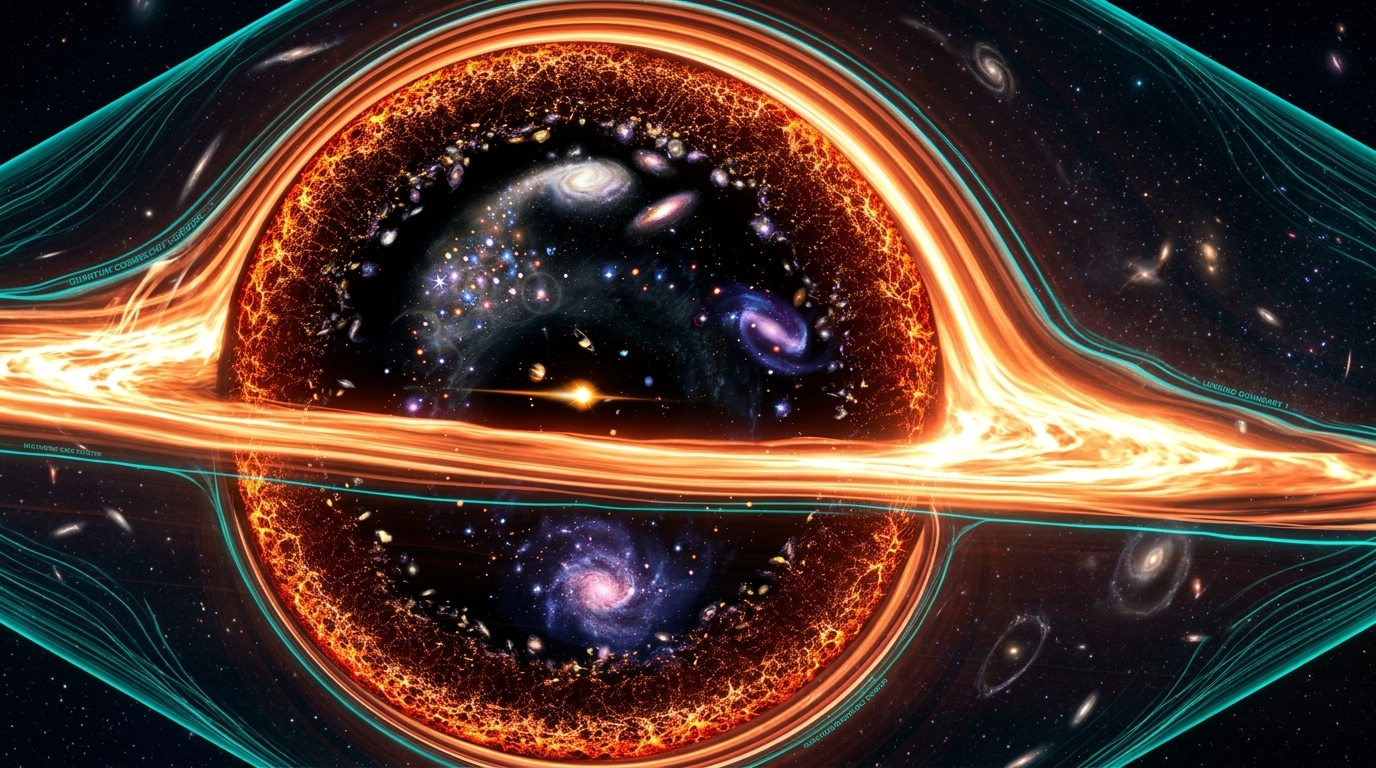
The Idea Nobody Could Quite Dismiss
The standard story of black holes goes like this. A massive star runs out of fuel, collapses under its own gravity, and produces a region of spacetime so deeply curved that nothing, not even light, can escape it. The boundary of that region is called the event horizon. What lies inside the horizon is, by construction, hidden from any observer outside. The mathematics suggests there is a singularity at the center: a point of infinite density at which the equations of general relativity stop making sense.
The standard story of the universe also begins with a singularity. Run the cosmic expansion backward in time and the equations say everything contracts to a single point of infinite density at which physics, again, breaks down. We call that point the Big Bang.
The two singularities, one at the heart of every black hole, one at the start of cosmic time, are usually treated as separate problems. The black hole singularity is something we cannot see. The Big Bang singularity is something we cannot reach. Both are markers placed by general relativity to flag where its description fails.
In 1972, Raj Kumar Pathria asked a simple question that the field had not seriously considered: what if they are the same singularity?
An Idea From 1972
Pathria's paper, "The Universe as a Black Hole," ran to a single page in Nature. It used the Schwarzschild metric, the standard general-relativity description of the spacetime around a non-rotating mass, and applied it to the universe as a whole. The argument was tight. If you take the total mass-energy contained inside the observable universe and ask what its Schwarzschild radius would be, you get a number that is, within observational uncertainties, equal to the radius of the observable universe itself.
By the formal definition of a black hole, a region in which the mass density is so high that the Schwarzschild radius equals or exceeds the size of the region, our entire observable universe satisfies that criterion.
This was not a metaphor. It was a numerical coincidence about which Pathria asked an obvious follow-up question: was it actually a coincidence, or was it telling us something? If the universe is a black hole, then "the inside of a black hole" and "the inside of a universe" are not separate places. They are the same place described twice, from inside.
The implications are uncomfortable. The Big Bang would not be a singular moment when reality began. It would be the white-hole side of a black hole that already existed in some larger, parent universe. The expansion we observe, including the redshift of distant galaxies, the cosmic microwave background, the growth of large-scale structure, would be the interior dynamics of a black hole as seen from inside its own event horizon. And our entire observable universe would be just the visible part of that interior.
If you take the mass of the observable universe and compute its Schwarzschild radius, the number you get is the radius of the observable universe. Pathria asked, in one page, whether that was a coincidence, or whether physics was telling us where we are.
The Mechanism Nobody Had Until 2010
For nearly forty years, Pathria's proposal sat in the literature as a striking observation without a mechanism. Yes, the numbers were suggestive. But how, physically, would a parent universe's black hole give birth to a child universe inside its own event horizon? General relativity, the theory underlying both the Schwarzschild metric and the Big Bang model, predicts that everything falling into a black hole inevitably collapses to the central singularity. There is no room in the equations for a new universe to nucleate inside.
The breakthrough came from the recognition that general relativity, as Einstein wrote it down in 1915, is not the only consistent classical theory of gravity. There is a closely related but slightly more general framework called Einstein-Cartan-Sciama-Kibble theory, often shortened to ECKS theory, which generalizes general relativity by allowing spacetime to twist as well as curve. The twist is called torsion, and it interacts with the intrinsic spin of fundamental fermions, quarks and electrons, in a way that ordinary general relativity does not capture.
At the densities of stars, planets, or laboratory experiments, ECKS theory and general relativity make essentially identical predictions. The torsion contribution is too small to matter. But at the unimaginable densities expected inside collapsing black holes, densities trillions of times that of an atomic nucleus, the spin-spin coupling generated by torsion produces a repulsive force that fights gravity. In a 2010 paper in Physics Letters B, and a longer 2016 paper in The Astrophysical Journal, the physicist Nikodem Popławski showed that this repulsion can become large enough, at large enough densities, to halt gravitational collapse before a singularity forms.
Instead of crushing to a point, the in-falling matter bounces. The bounce occurs inside the black hole's event horizon, beyond the reach of any outside observer. The post-bounce material then expands. Rapidly. From outside the black hole, nothing visible happens. From inside the bounce, the geometry of spacetime opens into something that looks, to inhabitants of the resulting region, exactly like a Big Bang followed by an inflating universe.
What This Would Predict
The bounce model has the appealing property of resolving two singularity problems at once. Black holes no longer end in singularities, they end in bounces. The Big Bang is no longer the absolute beginning of time, it is one such bounce viewed from inside. Both pathologies of general relativity disappear into the same mechanism.
It also offers a candidate explanation for cosmic inflation. Standard cosmology requires that the very early universe underwent a brief period of exponential expansion to explain why the cosmic microwave background is so smooth across regions that, in a non-inflating universe, would never have been in causal contact. The cause of that inflation is the most contested unsolved problem in modern cosmology. In Popławski's framework, the post-bounce expansion inside the black hole interior is itself the inflation. No exotic inflaton field is required. The geometry does the work.
And it implies, almost as a side effect, a multiverse. If every black hole hosts a universe inside it, and every universe is itself a black hole that contains other black holes, then universes nest within universes without limit. Each new collapse on each side of each event horizon spawns a new region of spacetime. The number of universes accessible to any given observer, meaning, contained inside the same event horizon, is one. The number of universes that exist is much larger.
The Problem With Testing It
Black hole cosmology has, on its face, a feature that makes it almost ideal as a theoretical playground and almost impossible as an experimental science: by construction, you cannot see in or out. The interior of a black hole is sealed from the outside by an event horizon. So is the interior of our universe, only the geometry of cosmic expansion separates us from regions whose light will never reach us.
If we live inside a black hole in a parent universe, that parent universe is unobservable to us in principle. Information cannot cross the event horizon. We cannot detect signals from outside, and outside observers cannot detect signals from us.
This means that any test of black hole cosmology has to be indirect. The model needs to predict something specific about our observable universe that distinguishes it from rival cosmological models. Popławski and others have argued that the non-singular bounce should leave a subtle imprint on the spectrum of primordial gravitational waves, a small but in-principle-detectable signature on the polarization of the cosmic microwave background that would distinguish a bounce from a singular Big Bang. No such signature has yet been confirmed or ruled out. The current generation of CMB polarization experiments, including the BICEP series in Antarctica and the LiteBIRD satellite expected to launch later this decade, may begin to push on the relevant parameter space.
Other proposed indirect tests look at the low-multipole anomalies in the CMB and at potential rotational signatures in the universe's large-scale structure. None has so far produced a clean signal favoring black hole cosmology over the standard inflationary model. The most honest summary is that the framework is consistent with current observations, and indistinguishable from the standard model on every test we can currently perform.
The model is, by construction, hard to test. The boundary that hides it from us is the same boundary it predicts.
Why Take It Seriously At All
Black hole cosmology is not, at the time of writing, the leading model of the early universe. The standard hot Big Bang picture, augmented with inflation, fits almost all available data and is the framework on which most of working cosmology is built. The proposition that we live inside a black hole is, fairly, treated as speculative.
What gives the idea its persistent grip on the imagination of working cosmologists, Popławski is far from alone, is that it solves real problems. The singularity at the heart of every black hole is a known failure of general relativity. The singularity at the start of the universe is the same failure. Inflation is the leading candidate explanation for the smoothness of the cosmic microwave background, but the field that drives it has never been independently observed. A single mechanism that disposes of both singularities and naturally produces inflation is, on grounds of theoretical economy alone, worth taking seriously.
The history of cosmology contains several examples of ideas that were treated as fringe for decades before becoming mainstream. The expansion of the universe was one. The accelerating expansion was another. Black hole cosmology is, at the moment, in roughly the same epistemic position as those ideas were before the data caught up to them.
The data may never catch up to it. The framework may turn out to be wrong, or unfalsifiable in any practical sense, or replaced by a still-better framework we have not yet thought of. Or one of the next-generation CMB experiments may detect a polarization signature that is consistent only with a non-singular bounce, and the question of where we are will quietly be answered.
For half a century, the idea that the universe is the inside of a black hole has been treated as a clever curiosity. The reason it has not gone away is that it is the only candidate, so far, that solves both singularities at once.
Frequently Asked Questions
What is black hole cosmology?
Black hole cosmology is a class of theoretical proposals in which our observable universe is the interior of a black hole that exists in some larger parent universe. The Big Bang is reinterpreted not as the absolute beginning of time, but as the post-collapse bounce of matter that fell into a parent black hole, viewed from inside the resulting interior region.
Where did the idea originate?
The earliest formal proposal is Raj Kumar Pathria's one-page 1972 paper "The Universe as a Black Hole" in Nature. Pathria observed that the Schwarzschild radius of the observable universe's mass is approximately equal to the radius of the observable universe itself, a numerical coincidence that he argued might not be a coincidence.
What is the bounce mechanism?
The leading modern formulation, developed by Nikodem Popławski in papers from 2010 onward, uses Einstein-Cartan-Sciama-Kibble (ECKS) gravity rather than standard general relativity. ECKS allows spacetime to carry torsion, which couples to the spin of fundamental fermions. At extreme densities inside collapsing black holes, this coupling generates a repulsive force that halts collapse before a singularity forms. The matter then bounces and expands, producing what would look, from inside, exactly like a new Big Bang.
What evidence supports it?
Currently, no observational evidence uniquely favors black hole cosmology over the standard inflationary Big Bang. The framework is consistent with all current data but has not yet predicted anything we can observe that the standard model does not. Proponents argue that next-generation cosmic microwave background polarization experiments (BICEP, LiteBIRD, CMB-S4) may eventually distinguish the bounce signature from inflation-era signatures.
Could we ever test it?
Direct tests are impossible by construction, if we are inside a black hole, the event horizon prevents any information about the outside from reaching us. Indirect tests are possible. The clearest candidates are subtle imprints on primordial gravitational waves and on the polarization spectrum of the cosmic microwave background, both of which would distinguish a non-singular bounce from a singular Big Bang. None has yet been detected.
Does this mean the Big Bang is a "white hole"?
In some formulations, yes. A white hole is the time-reversed counterpart of a black hole, a region from which matter and energy can only flow outward. In black hole cosmology, the Big Bang as observed from inside corresponds to the bounce-driven expansion of matter that originally collapsed through a black hole's event horizon in the parent universe. From inside, the bounce looks white-hole-like; from outside, the parent universe sees only an ordinary black hole.
Continue Exploring
- The Little Red Dots That Shouldn't ExistWhen JWST looked deep into the early universe, it found a swarm of tiny, intensely red points of light. The leading...
- The Black Hole Too Small to Be a Star's GhostStars cannot leave a black hole lighter than the Sun. In late 2025 a gravitational-wave detector caught a signal...
- The Collision That Came In SidewaysTheory assumed colliding compact objects settle into near-perfect circles before merging. Then astronomers reanalyzed a...
- The Star We Saw Before It DiedFor the first time, JWST identified the exact star that would become a supernova: a red supergiant hidden inside a...
- The Census of Colliding Black HolesIn one release, the number of gravitational-wave detections more than doubled. The fourth LIGO-Virgo-KAGRA catalog...
Sources
- Pathria, R. K. "The Universe as a Black Hole." Nature, 240, 298 to 299 (1972). nature.com
- Popławski, N. J. "Cosmology with torsion: An alternative to cosmic inflation." Physics Letters B, 694, 181 to 185 (2010).
- Popławski, N. J. "Universe in a black hole in Einstein-Cartan gravity." The Astrophysical Journal, 832, 96 (2016). adsabs.harvard.edu
- Popławski, N. J. "Universe in a black hole with spin and torsion." arXiv:1410.3881 (2014). arxiv.org
- Hehl, F. W. et al. "General relativity with spin and torsion: Foundations and prospects." Reviews of Modern Physics, 48, 393 (1976), the canonical reference on Einstein-Cartan theory.
- Planck Collaboration. "Planck 2018 results. X. Constraints on inflation." Astronomy & Astrophysics, 641, A10 (2020), current observational constraints on inflation models.
- BICEP/Keck Collaboration. "Improved Constraints on Primordial Gravitational Waves Using Planck, WMAP, and BICEP/Keck Observations." Physical Review Letters, 127, 151301 (2021).
- Cover image: Event Horizon Telescope's first image of M87*, from the EHT Collaboration. Public domain.