A Recipe From the First Three Minutes
The story of the universe's chemistry has, by modern standards, an embarrassingly precise opening. Three minutes after the Big Bang, the universe was a uniform soup of protons, neutrons, electrons, and photons at a temperature of approximately one billion degrees Celsius. The protons and neutrons were just energetic enough, just dense enough, and the universe was just cool enough, for nuclear fusion to begin.
The window did not stay open for long. Within twenty minutes, expansion had cooled the universe past the temperature at which fusion can sustain itself. What got fused in those minutes was, essentially, all that would ever get fused before the first stars lit up hundreds of millions of years later. The output of that brief cosmic-scale alchemy is what physicists call Big Bang nucleosynthesis, or BBN, and it is one of the most exhaustively studied predictions in modern cosmology.
The recipe is short. By mass, the universe should have come out of its first half-hour as roughly 75 percent hydrogen, 25 percent helium-4, and a vanishingly small trace of three other isotopes: deuterium (heavy hydrogen), helium-3, and lithium-7. The Standard Model of physics, combined with the cosmic microwave background data from the WMAP and Planck satellites, which give us the matter density of the early universe to extraordinary precision, produces specific numerical predictions for each of these isotopes.
For two of them, the prediction matches the observation almost perfectly. For one, it does not.
Hydrogen and Helium Checked Out
The hydrogen-to-helium ratio is the easiest to verify, because both elements are abundant and detectable across the universe. Spectra from primordial gas clouds, low-metallicity dwarf galaxies, and the diffuse intergalactic medium all give consistent readings. Helium-4 makes up about 24 to 25 percent of the universe's ordinary mass, exactly as BBN predicts. The agreement here is at the level of one or two percent, which, for an inference based on physics from the universe's first twenty minutes, is remarkable.
Deuterium is harder, because it is fragile. Stars destroy deuterium efficiently, so to measure the primordial value you need to look at clouds of gas that have not yet been touched by stellar processing. Astronomers do this by taking spectra of distant quasars whose light has passed through such clouds on its way to Earth. The deuterium-to-hydrogen ratio measured this way is also in agreement with BBN, to within a few percent.
Helium-3 is more difficult still, but the broad picture from intergalactic measurements remains consistent. Three out of the four isotopes BBN predicts arrive on Earth's telescopes at very close to the predicted abundance. Cosmology, in this corner, works.
Then we get to lithium.
Lithium Did Not
Lithium is, on the cosmic scale, almost not there. BBN predicts a primordial lithium-7 abundance, expressed as the ratio of lithium-7 nuclei to hydrogen nuclei, of approximately 4.94 × 10⁻¹⁰, with an uncertainty of about 15 percent. That is, for every ten billion hydrogen atoms produced in the early universe, there should be about five lithium-7 atoms.
To verify this, astronomers measure the surfaces of metal-poor stars in the halo of our own galaxy. These stars formed early in cosmic history, when the universe contained almost nothing but hydrogen, helium, and lithium, before generations of supernovae could pollute the material with heavier elements. Their atmospheres should reflect, more or less faithfully, the composition of the early universe.
In 1982, French astronomers François and Monique Spite measured the lithium content of these old halo stars and found something striking: across stars of widely different effective temperatures, the lithium abundance is essentially the same. This flat, level signature is now called the Spite plateau, and it has been replicated in hundreds of stars across decades of observation, most notably by Piercarlo Bonifacio and his collaborators in the 2000s.
The plateau value is approximately 1.6 × 10⁻¹⁰. That is between three and four times less lithium than BBN predicts.
This is the cosmological lithium problem. It has been with us for over forty years. It has not gone away.
The universe has too little lithium. Not by a small amount. By a factor of three. And the prediction is not negotiable, it falls out of the same physics that correctly tells us how much hydrogen and helium exist.
Methuselah, the Star That Shouldn't Be Possible
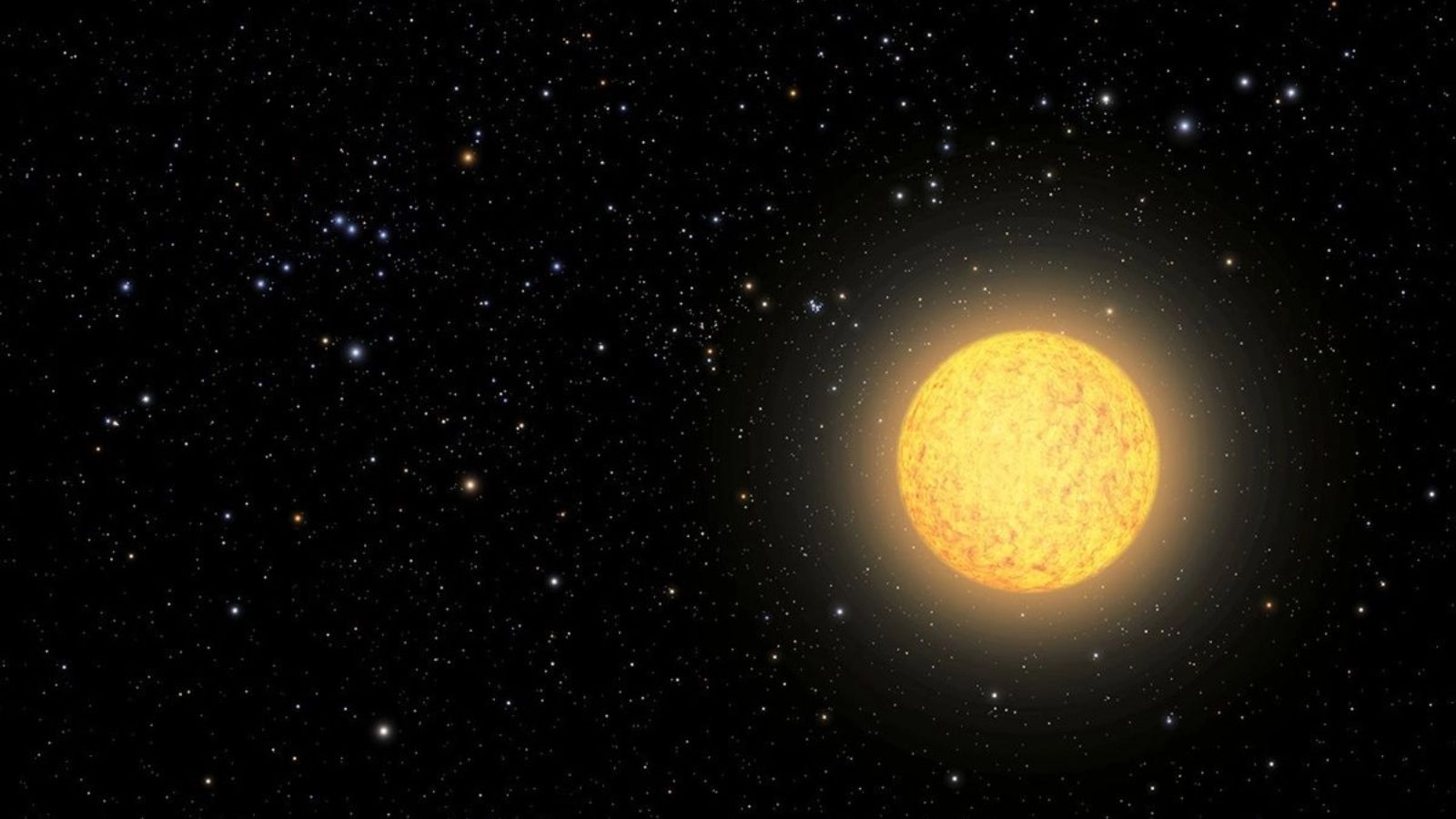
The lithium discrepancy is not the only piece of inherited stellar evidence that doesn't quite fit. About 200 light-years from Earth, in the constellation Libra, sits a faint subgiant star catalogued as HD 140283 and nicknamed, with some justification, Methuselah.
HD 140283 is the closest known example of an extremely metal-poor star. Its iron content is less than one percent that of the Sun. By the rules of stellar evolution, that makes it a relic, a survivor of a generation of stars that formed before there were many heavy elements available, and therefore before the universe had been heavily processed by supernovae. By those same rules, the older a metal-poor star is, the more interesting it is, because it is a chemical fossil from a precise moment in cosmic history.
In 2013, a team led by Howard Bond at Pennsylvania State University used the Hubble Space Telescope to refine the parallax distance to HD 140283 and re-derive its age from updated stellar evolution models. The result, published in The Astrophysical Journal Letters, was a best-fit age of 14.46 ± 0.8 billion years.
The accepted age of the universe, derived from the Planck satellite's cosmic microwave background measurements, is 13.797 ± 0.023 billion years.
The numbers do not quite work. Methuselah, on Bond's analysis, is older than the universe.
The discrepancy is well within the error bars of Bond's stellar age estimate, which is why nobody is rushing to rewrite cosmology. Subsequent work by Don VandenBerg and colleagues in 2014 reduced the central age slightly, to about 14.27 ± 0.38 billion years, by accounting more carefully for diffusion of helium in the star's interior. Other groups, varying assumptions about composition and stellar physics, have produced values closer to 13.5 billion years. The consensus is that Methuselah is one of the oldest stars known, extremely close to the age of the universe itself, with the central best-fit age sometimes nudging slightly above it. The error bars are large enough that Methuselah is not a contradiction. But it is a tight squeeze.
What Could Be Wrong
Two possibilities exist for any apparent disagreement between theory and observation. Either the theory is wrong, or the observation is wrong. The lithium problem and the Methuselah age problem are both serious enough to keep both possibilities in play.
For the lithium problem, three families of explanation have been pursued for decades.
The first is that primordial lithium really was created at the BBN-predicted abundance, but has been depleted from the surfaces of the metal-poor halo stars we observe by stellar processes operating over their long lives. Atomic diffusion, in which heavier elements gradually settle below the surface of a star, can in principle reduce the surface abundance of lithium by a factor of roughly two. That is in the right direction, but a factor of two is not a factor of three or four, and the diffusion explanation has had trouble fully reconciling the numbers.
The second is that the BBN prediction itself is wrong, but only because of nuclear physics that we have not yet measured precisely enough. The chain of reactions that produces lithium-7 in the early universe involves intermediate steps, particularly the destruction of beryllium-7, whose cross-sections are difficult to measure in laboratories. A previously-unknown nuclear resonance could, in principle, accelerate the destruction of lithium-7 precursors and reduce the predicted primordial abundance.
The third is more radical: the lithium problem is a window into physics beyond the Standard Model. Hypothetical particles from supersymmetric extensions of the Standard Model, or interactions between dark matter and ordinary matter in the early universe, could perturb BBN in ways that suppress lithium-7 production while leaving hydrogen, helium, and deuterium predictions intact. So far, no such particles have been detected.
For Methuselah, the picture is similar. Stellar age determination depends on assumptions about composition, mixing, opacity, and the history of mass loss, every one of which has irreducible uncertainty. The most likely answer to the Methuselah anomaly is that one or more of these assumptions is being slightly miscalibrated, and that HD 140283 is in fact a few hundred million years younger than the central best-fit suggests. But that conclusion has been the conclusion since 2013, and the error bars have stubbornly refused to shrink to the point where the numbers comfortably overlap.
The most likely answer is that we are slightly wrong about either the rocks we are weighing or the scale we are weighing them with. The least likely answer is that we are wrong about the universe.
Why It Matters
It is tempting, with anomalies of this kind, to either dismiss them as mere noise or to over-inflate them into evidence of something revolutionary. The lithium problem and the Methuselah age tension sit firmly in the middle ground. Neither is solved. Neither is a slam-dunk paradox. Both are reasons to keep doing the experiment.
What both anomalies have in common is that they live at the join between two enormously successful theoretical frameworks: the Standard Model of particle physics, which gives us BBN, and the standard model of cosmology, sometimes called Lambda-CDM, which gives us the age of the universe and the matter density that BBN takes as input. Most of the time, these two frameworks lock together with breathtaking precision. The hydrogen and helium abundances are the joint at the centre of that lock-in, and they hold.
Lithium and Methuselah are the joints that very nearly hold, and not quite. Resolving them, through better stellar models, better nuclear cross-section measurements, or, just possibly, new physics, is the kind of slow, uncomfortable work that science is best at when it is doing its real job.
For two of the four isotopes the early universe produced, our theory is exactly right. For one, it is exactly three times too high. The work of the next several decades is to figure out which of those facts is the more important one.
Frequently Asked Questions
What is the cosmological lithium problem?
Big Bang nucleosynthesis (BBN) predicts that the early universe should have produced lithium-7 at an abundance of approximately 4.94 × 10⁻¹⁰ relative to hydrogen. The actual lithium-7 abundance, measured in the atmospheres of ancient metal-poor halo stars (the so-called "Spite plateau"), is approximately 1.6 × 10⁻¹⁰, three to four times less than the theory predicts. This persistent discrepancy is the cosmological lithium problem.
What is the Spite plateau?
The Spite plateau is the observation, first reported by François and Monique Spite in 1982, that the lithium content of metal-poor halo stars is essentially constant across a wide range of stellar surface temperatures. Because these stars formed early in cosmic history before stars had enriched the universe with heavier elements, their lithium abundance is taken as a reasonable proxy for the primordial value produced by the Big Bang.
Could the lithium discrepancy be observational error?
Possible, but unlikely to be the full explanation. The Spite plateau has been confirmed in hundreds of stars over more than four decades by independent groups using different telescopes and analysis pipelines. Some refinement of stellar temperature scales could in principle shift the inferred lithium abundance upward, but not by enough to fully close the gap with BBN predictions. The discrepancy appears robust to the most plausible observational corrections.
Is the Methuselah star really older than the universe?
The most-cited age estimate for HD 140283, from a 2013 paper by Howard Bond and colleagues, is 14.46 ± 0.8 billion years, slightly older than the universe's accepted age of 13.797 ± 0.023 billion years. The discrepancy is within the error bars on the stellar age, which is why most astronomers regard this as a tension to be resolved rather than a paradox. Subsequent re-analyses have produced slightly lower values, in some cases compatible with an age below 13.8 Gyr.
What is the leading explanation for the lithium problem?
There is no consensus. Three main hypotheses are pursued: (1) primordial lithium was depleted from stellar surfaces by atomic diffusion or other stellar processes; (2) one or more nuclear reaction rates entering BBN are mismeasured, particularly involving beryllium-7 destruction; or (3) physics beyond the Standard Model, supersymmetric particles, dark matter interactions, perturbed BBN in ways that uniquely affect lithium. Each remains live, none has yet been confirmed.
Could the lithium problem and Methuselah have a single cause?
It is conceivable but not strongly supported. The lithium anomaly is a chemistry problem rooted in the first three minutes of the universe, while the Methuselah anomaly is a stellar-age modeling problem rooted in atomic diffusion and opacity calculations. Most working cosmologists treat them as separate puzzles. A unified explanation, for example, a systematic miscalibration in the temperature scale of metal-poor stars that simultaneously inflates ages and depresses inferred lithium, has been proposed but has not yet displaced the leading single-anomaly explanations for either problem.
Continue Exploring
- How We Measure the Distance to the StarsYou cannot lay a tape measure to a galaxy. Astronomers built a ladder instead, each rung a different method calibrated...
- The Galaxy That Shouldn't Exist So SoonAt a redshift of 14.44, MoM-z14 is the farthest galaxy ever confirmed: a bright, nitrogen-rich beacon that switched on...
Sources
- Cyburt, R. H., Fields, B. D., Olive, K. A., & Yeh, T.-H. "Big bang nucleosynthesis: Present status." Reviews of Modern Physics, 88, 015004 (2016).
- Spite, M. & Spite, F. "Lithium abundance at the formation of the Galaxy." Nature, 297, 483 (1982), the original Spite plateau paper.
- Bonifacio, P. et al. "First stars VII, Lithium in extremely metal-poor dwarfs." Astronomy & Astrophysics, 462, 851 (2007).
- Bond, H. E. et al. "HD 140283: A Star in the Solar Neighborhood that Formed Shortly after the Big Bang." The Astrophysical Journal Letters, 765, L12 (2013). iopscience.iop.org
- VandenBerg, D. A. et al. "Three Ancient Halo Subgiants: Precise Parallaxes, Compositions, Ages, and Implications for Globular Clusters." The Astrophysical Journal, 792, 110 (2014).
- Fields, B. D. "The Primordial Lithium Problem." Annual Review of Nuclear and Particle Science, 61, 47 (2011). ned.ipac.caltech.edu
- Planck Collaboration. "Planck 2018 results. VI. Cosmological parameters." Astronomy & Astrophysics, 641, A6 (2020), source of the 13.797 ± 0.023 Gyr universe age.
- "The cosmological lithium problem." Astronomy & Astrophysics review (2025). aanda.org
- Cover image: HD 140283, ESA/NASA Hubble Space Telescope. Public domain.