The Note in the Margin
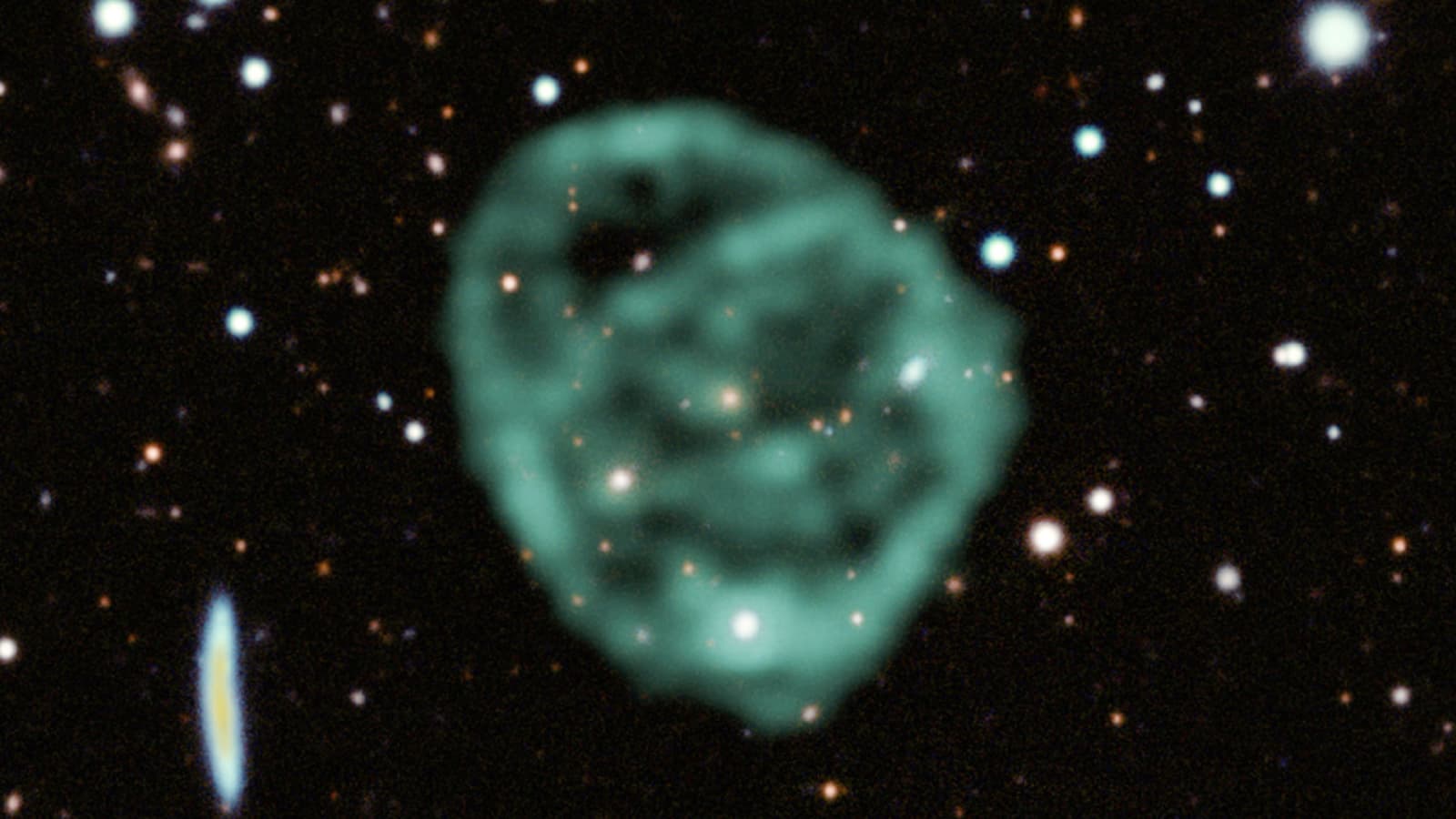
The discovery looks almost ordinary in the photograph. A blurry blue circle drifts across a black field, threaded with the brighter dots of background galaxies. There is no caption, no annotation, just the image and three letters scrawled in the corner: W·T·F.
The astronomer who wrote them was Anna Kapinska, then at the National Radio Astronomy Observatory. She had been working her way through preliminary data from the Australian Square Kilometre Array Pathfinder telescope, known as ASKAP, when the circle stopped her. She had no idea what she was looking at. She also had not yet realized what she had done. She had just discovered an entirely new kind of object in the universe.
Five years and five confirmed examples later, astronomers have a working name for them, Odd Radio Circles, or ORCs, but the question Kapinska wrote in the margin of that first image is, at the time of writing, still the most accurate summary of where the field stands.
A New Telescope, A New Kind of Mystery
To understand why ORCs were missed for as long as they were, you have to understand the telescope that finally found them.
ASKAP is operated by Australia's Commonwealth Scientific and Industrial Research Organisation. It is built from 36 individual radio dishes, each twelve meters across, working as a single instrument. Its defining feature is something called a phased array feed: a receiver design that lets each of those dishes look at thirty square degrees of sky simultaneously, an area roughly equivalent to one hundred and fifty full moons placed side by side. That is a field of view roughly an order of magnitude greater than older radio telescopes could manage in a single pointing.
The flagship project running on ASKAP, the Evolutionary Map of the Universe, abbreviated EMU and named after the Australian aboriginal "Emu in the Sky" constellation, is intended to multiply the number of known radio sources in the universe by a factor of about thirty. Where the entire history of radio astronomy had cataloged roughly two and a half million radio sources, EMU alone is expected to add another seventy million.
The project's principal investigator, Ray Norris of CSIRO and Western Sydney University, predicted from the start that an instrument this powerful, looking at this much sky, would find things nobody had thought to look for. He turned out to be right almost immediately.
What ORCs Aren't
The first instinct, when you see a perfectly circular halo of radio waves in deep space, is to assume you are looking at something familiar. The most common circular radio source we already know about is the supernova remnant, the expanding shockwave of a stellar explosion. Supernova remnants are radio-bright. They are often roughly circular. They were the natural first guess.
The natural first guess turned out to be wrong, on multiple grounds. Supernova remnants are concentrated near the plane of our own galaxy, where most stellar explosions occur. ORCs are found at high galactic latitudes, well off the plane. Supernova remnants are typically a few dozen light-years across at most. ORCs are hundreds of thousands of light-years across, large enough to swallow entire galaxies. And the ORCs that have been studied most carefully appear to have galaxies sitting at or near their centers, which is not a feature of supernova remnants.
The second instinct was that the circles might be artifacts of the telescope itself, perhaps an optical illusion in the data processing. Independent observations using completely different instruments, particularly the South African MeerKAT array, with its 64 receptors, confirmed that the rings were physically real. They were not artifacts.
What ORCs are not, then, is straightforward. What they are is the harder question.
Hundreds of thousands of light-years across, drifting at the edges of the universe, with no obvious cause and no comparable object on record. Astronomers had to invent a new category to file them under.
ORC 1 in High Resolution
In March 2022, Norris and his collaborators published the first detailed follow-up study of ORC 1, the original, in the Monthly Notices of the Royal Astronomical Society. They had targeted the object with MeerKAT for ten hours of integration time, producing a much deeper and sharper image than ASKAP's discovery scan.
The MeerKAT image revealed structure that had been invisible before. ORC 1 is not a uniform smoke ring. It contains internal arcs, brighter knots, and a complex filamentary geometry, features that any working hypothesis about its origin needs to explain. The image also confirmed an elliptical galaxy sitting near the geometric center of the ring, at a distance estimated at roughly five billion light-years from Earth.
If that central galaxy is the source of the ring rather than an unrelated foreground or background coincidence, then ORC 1 is enormous. The team's analysis put its diameter at approximately one million light-years, with later estimates extending up to twice that figure. By way of comparison, our entire Milky Way galaxy is roughly one hundred thousand light-years across. ORC 1 is at least ten times larger.
With this image in hand, Norris's team laid out three plausible scenarios for how an object on this scale could form, and modeled each one against the observations.
The Three Hypotheses
The first hypothesis is the merger of two supermassive black holes inside the central galaxy. When two such black holes spiral together, the energy released can drive a spherical shockwave outward through the galaxy and into the surrounding medium. That shock would accelerate electrons throughout a large volume of intergalactic space, producing a roughly spherical bubble of radio emission. From a sufficient distance, the brightened edge of that bubble would look, to a radio telescope, like a ring.
The second hypothesis is that we are looking down the barrel of a relativistic jet from an active galactic nucleus, or AGN. AGNs are the brightly radiating cores of galaxies powered by accretion onto a central supermassive black hole. They often launch twin jets of plasma in opposite directions. If you happened to be observing such a system end-on, with one jet pointed almost directly at you, the geometric appearance of the lobes superimposed on each other could create an ORC-like signature. ORC 1's central galaxy does show evidence of being a radio-loud AGN, which makes this scenario at least dimensionally plausible.
The third hypothesis is what the team called a starburst termination shock. In this scenario, the central galaxy underwent a brief but extremely intense burst of star formation in its past, millions of stars born in a window of only a few tens of millions of years. The combined stellar winds and supernova outflows from that burst would expand outward into the surrounding intergalactic medium for billions of years, eventually piling up into a spherical termination shock that lights up at radio wavelengths. The Norris team's mathematical model showed that this scenario could, in principle, produce a structure with the size and shape of ORC 1.
The 2022 paper concluded that all three hypotheses remained consistent with the data, and that none of them could yet be eliminated. Four years later, that is still essentially true.
The Cloverleaf Complication
The fourth ORC to be discovered, called ORC 4 or the Cloverleaf because of its irregular four-lobed shape, has become the most thoroughly studied of the bunch and the source of two newer competing explanations.
In 2024, two separate research teams turned different telescopes on the Cloverleaf and arrived at different conclusions. A team led by Alison Coil, an astronomer and astrophysicist at the University of California, San Diego, used the W. M. Keck Observatory in Hawaii to detect a vast region of fluorescent oxygen-2 emission stretching across more than 130,000 light-years of the Cloverleaf's structure. They argued that the geometry, age, and energetics of this oxygen nebula were best explained by an ancient starburst termination shock, supporting one of the original Norris hypotheses, now applied to a different ORC.
That same year, a team led by Esra Bulbul at the Max Planck Institute for Extraterrestrial Physics, working with Xiaoyuan Zhang and others, detected diffuse X-ray emission within the Cloverleaf using the European Space Agency's XMM-Newton telescope. Their interpretation was different: the X-rays implied a recent merger between two groups of galaxies, and the Cloverleaf was the radio fossil of that merger's shock front. Their model accounts well for the X-ray data, but, awkwardly, similar galaxy group mergers do not generally produce comparable radio rings, leaving the question of what makes the Cloverleaf special.
It is at this point that some astronomers have begun to suggest the Cloverleaf may not be a true ORC at all, but a related-but-distinct kind of object that simply got swept into the same descriptive umbrella. The category we call ORCs may turn out to contain more than one thing.
The simplest possibility is that ORCs all have a single explanation. The next-simplest possibility is that they don't.
What We Don't Know, And How We'll Find Out
As of 2026, five ORCs are confirmed. Several more are candidates, identified in archival data and awaiting follow-up. The continuing EMU survey is expected to push the catalog much higher, possibly into the dozens or hundreds, as ASKAP works through its share of the southern sky.
Two large surveys may, between them, cover the full range of possibilities. One is purely scientific: deeper observations with MeerKAT and ASKAP, and eventually the much larger Square Kilometre Array now under construction in Australia and South Africa, which will see fainter and more distant ORCs than current instruments can detect. The other is an unusual hybrid: a citizen-science project called the Radio Galaxy Zoo: EMU, where any volunteer with a browser can help classify radio sources in the EMU data and flag candidate ORCs for the professional team. As of 2025, the project had over two thousand volunteers and was processing tens of thousands of sources.
Whichever explanation eventually wins out, the merger of two supermassive black holes, an end-on jet from an AGN, an ancient starburst's expanding shockwave, or something nobody has thought of yet, the underlying lesson of ORCs is straightforward and important: when you build an instrument with enough field of view and enough sensitivity, you will find things you did not expect. The universe has more categories of object than the categories we currently have for it.
An astronomer wrote three letters on an image she did not understand, and accidentally named an entirely new branch of cosmic objects. The right reaction to a properly designed survey of the sky is, sometimes, exactly that.
Frequently Asked Questions
What are Odd Radio Circles?
Odd Radio Circles, or ORCs, are roughly circular halos of radio-wave emission detected in deep space, typically hundreds of thousands of light-years across, large enough to enclose entire galaxies. Each is bright at radio wavelengths but invisible at optical and X-ray wavelengths. They were first identified in 2019 in early data from the Australian ASKAP radio telescope, and as of 2026 only five are confirmed, although more candidates are under study.
Who discovered the first ORC, and how?
The first ORC was identified by radio astronomer Anna Kapinska in 2019, while she was visually inspecting preliminary images from the Evolutionary Map of the Universe survey on the ASKAP telescope. Kapinska famously labeled the image "WTF", and the label became part of the discovery's lore. Within days, colleagues including Ray Norris and Emil Lenc had identified additional ring-like objects in the same survey, and the new class of object was given a formal name.
How big are ORCs?
ORC 1, the original and best-studied, is approximately one million light-years across by current estimates, with some interpretations extending the figure to two million. The Milky Way is approximately one hundred thousand light-years across, so an ORC at that scale is at least ten times wider than our entire galaxy. They sit at distances on the order of several billion light-years from Earth.
What instruments are used to detect them?
The original detections came from the Australian Square Kilometre Array Pathfinder, or ASKAP, operating at 944 MHz. Detailed follow-up imaging has primarily used MeerKAT, a 64-receptor radio array operated by the South African Radio Astronomy Observatory. Multi-wavelength studies have also drawn on the W. M. Keck Observatory (optical and near-infrared) and ESA's XMM-Newton (X-ray).
What are the leading theories about what makes them?
Three primary scenarios have been proposed: (1) a spherical shockwave from the merger of two supermassive black holes inside the central galaxy; (2) the lobes of a relativistic jet from an active galactic nucleus, viewed end-on so that the jets superimpose into an apparent ring; or (3) a "starburst termination shock," the long-traveled outflow of an ancient burst of intense star formation in the host galaxy. A fourth, more recent suggestion, applied specifically to the Cloverleaf ORC, invokes the merger of two galaxy groups. Multiple ORCs may have different origins, and the field has not yet settled on a unified explanation.
How many ORCs do we know about, and how many are expected?
Five ORCs are confirmed as of 2026, with several more candidates under study. The continuing EMU survey on ASKAP, and eventually the much larger Square Kilometre Array currently under construction in Australia and South Africa, are expected to find tens or hundreds more. The Radio Galaxy Zoo: EMU citizen-science project is processing the survey data with help from over two thousand volunteers and machine learning to identify likely ORCs.
Continue Exploring
- The Dead Star That Emits a Mix of Radiation No One Has SeenA stellar corpse in the Scutum arm pulses in radio waves and X-rays every 44 minutes. It does not behave like a...
- The 72 Seconds That Still Haunt Radio AstronomyOn a summer night in 1977, an Ohio radio telescope recorded a narrowband burst near the frequency of hydrogen itself....
Sources
- Norris, R. P. et al. "MeerKAT uncovers the physics of an odd radio circle." Monthly Notices of the Royal Astronomical Society, 513, 1300 to 1316 (2022). academic.oup.com
- Coil, A. L. et al. "Ionized gas extending across a galaxy hosting an Odd Radio Circle." Nature, 630, 71 to 75 (2024).
- Bulbul, E., Zhang, X. et al. "The galaxy group merger origin of the Cloverleaf odd radio circle system." Astronomy & Astrophysics (2024). aanda.org
- Norris, R. P. et al. "Unexpected circular radio objects at high galactic latitude." Publications of the Astronomical Society of Australia, 38, e003 (2021), the original announcement of ORCs.
- Koribalski, B. S. et al. "Discovery of a new odd radio circle (ORC) in the MIGHTEE survey." MNRAS Letters, 537, L42 (2025). academic.oup.com
- CSIRO ASKAP and EMU project page. csiro.au
- Sky & Telescope news coverage: "New Image Reveals Possible Origins of Odd Radio Circles." skyandtelescope.org
- Cover image: ORC 1 imaged by MeerKAT, from Norris et al. 2022 (CC BY 4.0).