What Happens When a Star Dies
To understand why RXJ0528+2838 is so strange, you need to understand what it is, and what it isn't.
When a star like our Sun exhausts its nuclear fuel, it doesn't explode. It swells into a red giant, sheds its outer layers in a slow, luminous cloud, and leaves behind its core: a white dwarf. Dense, hot, and roughly the size of Earth despite containing the mass of a star, a white dwarf is the most common stellar corpse in the universe. It no longer fuses elements. It no longer generates energy. It simply radiates its remaining heat into space for billions of years, cooling toward darkness.
RXJ0528+2838 is a white dwarf with one unusual feature: it is not alone. A Sun-like star orbits it at close range, and the white dwarf's intense gravity is pulling material from its companion, stripping gas from its surface and drawing it inward.
In most binary systems like this, that stolen material forms an accretion disk, a swirling ring of gas spiraling slowly inward, heating as it falls, eventually releasing enough energy to drive powerful outflows that fling material back into space. Those outflows, when they collide with the surrounding interstellar medium, create bow shocks: curved arcs of glowing gas, like the wave that builds up in front of a ship pushing through water.
RXJ0528+2838, however, has no disk. It is what astronomers call a polar, a white dwarf with a magnetic field so strong that it channels the infalling gas directly onto its surface, preventing a disk from ever forming. Without a disk, the standard mechanism for generating outflows doesn't operate. Without outflows, there should be no bow shock.
And yet.
The Discovery That Shouldn't Have Happened
The object was first noticed by a final-year physics student during a project searching for the remnants of stellar explosions called nova shells. In images from the Isaac Newton Telescope in Spain, something glowed around RXJ0528+2838, a faint, unusual nebulosity that didn't fit the expected profile of a nova remnant.
The shape was wrong for an explosion. It was asymmetric, elongated in one direction, curved, exactly like a bow shock. But a bow shock from a diskless white dwarf was, according to everything physicists understood about these systems, impossible.
The team observed it in more detail with the MUSE instrument on ESO's Very Large Telescope. MUSE, the Multi Unit Spectroscopic Explorer, is one of the most powerful spectrographs ever built, capable of simultaneously recording light from thousands of points across an extended object and separating it into its component wavelengths. It allowed the team to map the bow shock in detail and analyze its chemical composition.
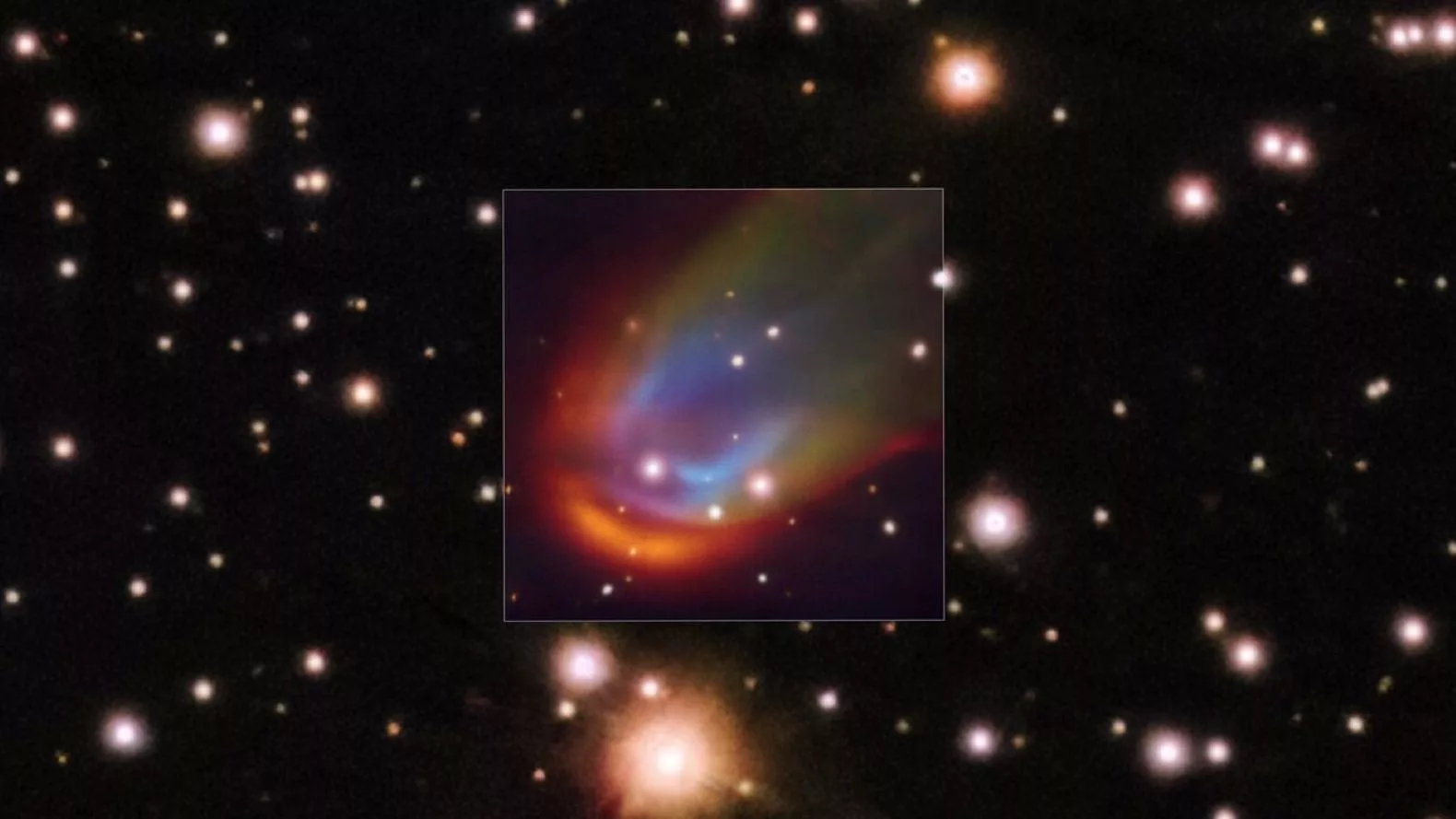
The colors in the resulting image are not false. Red, green, and blue represent hydrogen, nitrogen, and oxygen respectively, the actual emission lines of those elements, glowing as the shock heats the interstellar gas to temperatures where atoms shed electrons and light up. The structure was real. It was unambiguously associated with RXJ0528+2838, not with some unrelated background nebula. And its size was staggering: the bow shock extends roughly 3,800 times the distance between Earth and the Sun.
"We found something never seen before and, more importantly, entirely unexpected. Our observations reveal a powerful outflow that, according to our current understanding, shouldn't be there."
The Equations Don't Work
The team worked systematically through every known mechanism that could explain the bow shock, and eliminated them one by one.
A stellar wind from the white dwarf itself? White dwarfs don't fuse elements. They have no mechanism to drive stellar winds the way living stars do. A stellar wind from RXJ0528+2838 would be like a corpse exhaling.
A wind from the companion star? The companion isn't massive enough. Sun-like stars produce winds, but not powerful enough to sustain a bow shock of this scale for a thousand years.
An old nova explosion, a past thermonuclear eruption on the white dwarf's surface? The bow shock is the wrong shape for a nova remnant. And at a distance of 730 light-years, a nova would have been visible to the naked eye. There are no historical records of one at this location in the sky.
Nothing fits. Every explanation leaves the same problem: a glowing structure that requires a sustained, powerful outflow that has been operating for at least a thousand years, from a system that has no known way to produce one.
The Magnetic Hypothesis
There is one candidate left, and it is barely more than a suggestion.
This white dwarf hosts a strong magnetic field, confirmed by the MUSE data. That field is what makes it a polar in the first place, it channels the material stolen from the companion directly onto the white dwarf's surface, bypassing a disk entirely.
The leading hypothesis is that this same magnetic field is somehow powering the outflow. Perhaps the field lines, twisting as the white dwarf rotates, fling particles outward along paths that don't require a disk. Perhaps the interaction between the magnetic field and the infalling gas generates turbulence or instabilities that create an entirely different kind of outflow, one that existing models simply don't describe.
But the magnetic field appears too weak to fully account for the shock's scale and longevity. Scaringi has called it a "mystery engine", a hidden source of energy that remains unexplained. The physics is incomplete.
"The surprise that a supposedly quiet, discless system could drive such a spectacular nebula was one of those rare 'wow' moments."
A Discovery Made by a Student
One detail of this story deserves to be told clearly: the initial discovery was not made by a senior researcher scanning archives. It was flagged by a final-year physics student during a routine project searching for nova shells. The student noticed that a shape in the Isaac Newton Telescope data looked wrong, unusual enough to warrant a second look.
That second look became a VLT observation. The VLT observation became a paper in Nature Astronomy. The paper involved 12 institutions across seven countries.
Science often works this way, not through grand planned expeditions but through someone noticing that something doesn't match the template, that a glowing arc sits where no arc should be, that the shape is wrong. The student didn't know what they had found. Neither, for a while, did anyone else.
What Comes Next
The puzzle of RXJ0528+2838 is far from solved. To crack it, astronomers will need to study more binary systems like it, polars without disks, moving through the interstellar medium, to determine whether this bow shock is a unique anomaly or the first example of a class of phenomena that have simply never been looked for before.
The upcoming Extremely Large Telescope, currently under construction in Chile's Atacama Desert, will be the instrument most likely to advance the search. At 39 meters in diameter, it will collect more light in seconds than Hubble does in hours, allowing it to study faint structures like this bow shock with a level of spectral and spatial detail that current telescopes cannot approach.
Whether the answer lies in the magnetic field, in some undescribed instability in the accretion flow, or in a mechanism no one has yet thought to look for, the physics is waiting to be written.
For now, RXJ0528+2838 sits 730 light-years away, moving steadily through the interstellar medium, pushing a glowing arc of hydrogen, nitrogen, and oxygen ahead of it like a ship's bow wave, doing something that, as far as we know, it has no right to do.
A dead star doesn't breathe. RXJ0528+2838 didn't read that chapter.
Frequently Asked Questions
What is RXJ0528+2838?
RXJ0528+2838 is a white dwarf, the dense stellar remnant left when a Sun-like star exhausts its nuclear fuel, located 730 light-years from Earth. It is a "polar," meaning it has an extremely strong magnetic field that prevents an accretion disk from forming around it, despite having a companion star whose material it continuously steals.
What is a bow shock?
A bow shock is a curved arc of glowing gas that forms when a fast-moving object pushes through surrounding material, similar to the wave at the bow of a ship. In astronomy, bow shocks around stars are typically produced by powerful outflows of material colliding with the interstellar medium.
Why is the bow shock around RXJ0528+2838 so unexpected?
Standard bow shocks in binary star systems require an accretion disk to generate the outflows that produce them. RXJ0528+2838 has no disk, its magnetic field channels infalling material directly onto its surface. Without a disk, no known mechanism can explain the outflow. Yet the bow shock exists and has been operating for at least 1,000 years.
What could be powering the outflow?
The leading hypothesis involves the white dwarf's strong magnetic field, which may be flinging material outward in ways existing models don't describe. However, the magnetic field appears too weak to fully account for the shock's scale and longevity. Researchers have called it a "mystery engine", a hidden energy source with no confirmed explanation.
What instrument imaged the bow shock?
The bow shock was imaged in detail using the MUSE (Multi Unit Spectroscopic Explorer) instrument on the European Southern Observatory's Very Large Telescope in Chile. The colors in the image represent actual emission lines: red for hydrogen, green for nitrogen, and blue for oxygen.
Where was the research published?
The study, "A persistent bow shock in a diskless magnetised accreting white dwarf," was published in Nature Astronomy in January 2026. It was co-led by Dr. Simone Scaringi of Durham University and Dr. Krystian Iłkiewicz of the Nicolaus Copernicus Astronomical Center in Warsaw, Poland.
Continue Exploring
- The Dead Star That Emits a Mix of Radiation No One Has SeenA stellar corpse in the Scutum arm pulses in radio waves and X-rays every 44 minutes. It does not behave like a...
- The Star That Flickers Like Nothing Else in the SkyFor four years, a telescope watched one ordinary-looking star lose up to a fifth of its light in jagged, unpredictable...
- If You Stood on a World in the Pleiades, This Is What You'd SeeMessier 45 is the most photographed open cluster in the sky and one of the closest. No planet has ever been confirmed...
- The Millisecond Flash That Crosses the UniverseFor sixteen years, fast radio bursts arrived from nowhere and explained nothing. Then one of them came from inside our...
- The Sound That Shouldn't Exist on Mars, And What It ChangesFor decades, scientists sent instruments to Mars specifically designed to find lightning. They found nothing. Then...
Sources
- Iłkiewicz, K., Scaringi, S. et al. "A persistent bow shock in a diskless magnetised accreting white dwarf." Nature Astronomy, January 2026.
- ESO Press Release: "Astronomers surprised by mysterious shock wave around dead star." January 12, 2026. eso.org
- Durham University: "Astronomers discover mysterious shock wave around dead star." January 12, 2026. durham.ac.uk
- Space.com: "Mystery shockwave around dead star stuns astronomers." January 12, 2026.
- Image credit: ESO/K. Iłkiewicz and S. Scaringi et al. Background: PanSTARRS. Used under ESO public release terms.