A Tank Going to Space
On August 5, 2011, a rocket carrying one of the most unusual spacecraft NASA had ever built lifted off from Cape Canaveral. Juno was enormous, 20 meters across when its solar panels were fully extended, and yet it would generate just over 400 watts of electricity at Jupiter, where sunlight is only 4 percent as intense as it is at Earth. Every other deep-space probe had relied on radioisotope thermoelectric generators. Juno would run on sunshine, barely.
The journey to Jupiter took five years and covered 2.8 billion kilometers. Along the way, mission planners executed a maneuver that sounds almost too clever: Juno flew away from Jupiter first, looped back toward Earth, and used our planet's gravity to slingshot itself forward at an additional 14,000 kilometers per hour. It was more fuel-efficient than simply burning engines the whole way. It was also elegant.
When Juno finally entered polar orbit around Jupiter on July 4, 2016, no one was entirely sure how long it would survive. Jupiter's radiation belts, charged particle fields powerful enough to destroy most electronics, were expected to degrade Juno's instruments within months. Engineers had encased its most critical systems in a titanium vault a centimeter thick. They called it, without irony, a tank going to space.
"The radiation Juno encountered was ten times lower than expected, a stroke of luck that would eventually extend the mission by years and transform it into something no one had planned."
The Poles of Jupiter, Seen for the First Time
Before Juno, no spacecraft had ever given us a clear view of Jupiter's poles. The images that came back in 2016 left planetary scientists nearly speechless.
What they expected: the familiar banded structure of Jupiter's equatorial regions, stretched and distorted but recognizable. What they got: a chaotic, swirling ocean of cyclones unlike anything in the solar system. At the south pole, a cluster of enormous storms, each one larger than Earth, arranged in a geometric pattern around a central vortex. At the north pole, eight of them. The contrast with Saturn's famous polar hexagon couldn't have been more stark.
Juno's microwave radiometer, an instrument built specifically for this mission, could peer deeper into Jupiter's atmosphere than any previous sensor, to a depth of roughly 350 kilometers below the cloud tops. What it found there surprised everyone: a massive band of ammonia gas hugging the equator, plunging downward in a column that the instrument couldn't even reach the bottom of. Scientists had expected ammonia to distribute itself relatively uniformly across the planet. It doesn't.
Jupiter's Great Red Spot, that storm larger than Earth that has been raging for at least 400 years, turned out to extend far deeper into the atmosphere than anyone predicted, and to be colder than its surroundings near the top while dramatically warmer further down, suggesting the heat below may be driving the storm's extraordinary persistence.
What Lives at the Heart of Jupiter
The deepest and most consequential discovery Juno made was one that couldn't be seen directly at all.
For decades, two competing theories had tried to explain Jupiter's interior. The first held that Jupiter formed from the direct gravitational collapse of a gas cloud and had no solid core at all, just churning gas all the way down. The second argued for a dense, solid core of heavy elements at the center, around which hydrogen and helium had accumulated over millions of years. The second theory, known as core accretion, was the dominant model. It predicted a sharp boundary between the compact core and the surrounding gas layers.
Juno mapped Jupiter's gravitational field with a precision roughly 100 times better than any previous measurement. The method was almost absurdly sensitive: as Juno passed over regions of varying density, its velocity changed by amounts as small as 0.01 millimeters per second, detectable through the Doppler shift of the radio signal it continuously beamed back to Earth.
What the gravity map revealed was that both theories were wrong.
Jupiter has a core, but it isn't solid. It isn't absent. It is diffuse: a region where heavy elements gradually blend into the surrounding hydrogen layers with no clear boundary, extending outward to cover perhaps half the planet's total radius. It is enormous and it is fuzzy, and its existence overturned decades of planetary science.
"Both theories about Jupiter's core were wrong. A third possibility, one no one had seriously considered, was what Juno actually found: a vast, blurry region where the boundary between 'core' and 'planet' simply doesn't exist."
The most popular explanation that emerged was that Jupiter once had a solid core, which was destroyed by a catastrophic collision early in the solar system's history. But when researchers tried to model that collision on supercomputers, simulating every plausible variation of size, angle, and velocity, they kept getting the same result: after the initial impact, the heavy material settled back toward the center. The diffuse core wouldn't form. It didn't fit.
Saturn's Confession
In 2021, researchers studying wave patterns in Saturn's rings discovered that the planet's interior was also partially resistant to convection. In a fully convective planet, heat escapes by circulating fluids, continuously mixing the interior. But Saturn's interior showed evidence of compositional gradients, heavier elements concentrated toward the center, fading outward, exactly what you'd expect from a diffuse core.
If both Jupiter and Saturn have diffuse cores, the explanation can't be a unique collision. It has to be something fundamental about how giant planets form.
Scientists are now working toward a new theory of giant planet formation in which diffuse cores aren't accidents, they're the expected outcome. The old model of a solid seed that captures gas may be incomplete. The boundaries we drew between planetary interiors and envelopes may have always been too neat. The implications reach beyond our solar system: every giant exoplanet we've discovered and modeled has been interpreted through the lens of the old theory. That lens may need to be replaced.
Lightning, Mushballs, and Things That Don't Exist on Earth
When Voyager flew past Jupiter in 1979, it detected mysterious flashes in the atmosphere that looked like lightning. Juno solved a 40-year mystery, and replaced it with something stranger.
Juno's star reference unit camera, an instrument designed for navigation, not science, spotted flashes of light at altitudes far higher than any lightning should be able to occur. At those heights, temperatures drop below minus 88 degrees Celsius. Normal water-based storms can't exist there.
What Juno found was a form of precipitation that has no equivalent on Earth: storms powered by a mixture of water and ammonia that remains liquid well below water's normal freezing point. Ammonia acts as an antifreeze. These storms produce what scientists have started calling "mushballs", a slurry of ammonia and water ice that falls through Jupiter's atmosphere and may be responsible for the planet's unusual ammonia distribution. The term is whimsical. The phenomenon is not.
Io's Fury, Europa's Secrets, and Ganymede's Surprise
When Juno's original mission ended in 2021 with the spacecraft still functioning far beyond expectations, NASA extended the mission and turned the probe outward, toward Jupiter's moons.
Ganymede received Juno's closest attention first. In June 2021, the probe flew within 1,000 kilometers of the surface and returned images of unprecedented detail. Astronomers expected simultaneous Hubble ultraviolet observations to confirm oxygen in Ganymede's thin atmosphere. Instead, they found mostly water vapor, a discovery that forced a revision of the atmospheric model and raised new questions about the prevalence of water vapor on icy bodies throughout the outer solar system.
Europa's flyby in September 2022 revealed a surface of fractured ice ridges so complex they challenged the simple model of a deep ocean beneath a uniform shell. A dark, irregularly shaped region near the equator is interpreted as evidence of cryovolcanic activity, eruptions pushing material through more than 10 kilometers of ice. A 2023 paper proposed that the cause may not be pressure from the deep ocean at all, but from pockets of highly saline liquid trapped within the ice shell itself, expanding until they burst.
Io was last, and most dramatic. In 2023 and 2024, Juno made multiple close passes of the most volcanically active body in the solar system, approaching within 1,500 kilometers of a surface covered by hundreds of active volcanoes, lava lakes, and plumes rising tens of kilometers above the horizon.
On December 27, 2024, Juno witnessed something that had never been recorded anywhere in the solar system: a simultaneous eruption across a region of 65,000 square kilometers, involving hundreds of volcanoes firing in apparent coordination. The energy released was the most intense volcanic event ever observed beyond Earth. The synchronization strongly suggests these volcanoes are connected by shared subsurface lava channels, a geological network operating at scales that dwarf anything on our planet.
The Probe That Wouldn't Die
Juno was originally scheduled for decommissioning in 2018. Its extended mission was supposed to end in September 2025. Under NASA's planetary protection protocols, the plan was always to deorbit the spacecraft into Jupiter's atmosphere, ensuring it could never contaminate the potentially habitable moons below.
Then the United States government entered a period of budget uncertainty. NASA faced significant funding pressure. And Juno, which should have been gone, simply kept transmitting.
NASA's communications about the mission's status became notably sparse. Then, shortly before this article was prepared, the agency published new research using Juno's data to estimate the thickness of Europa's ice shell. The paper concluded with a brief, almost casual mention: Juno would perform its 81st Jupiter flyby on February 25.
Juno was sent to see through Jupiter's clouds. What it found was that the clouds were only the beginning, and that the planet beneath them was stranger, more complex, and more poorly understood than anyone had admitted.
Frequently Asked Questions
What is the Juno spacecraft and what was its mission?
Juno is a NASA spacecraft launched in August 2011 to study Jupiter from polar orbit. Its primary objectives were to measure the water content of Jupiter's atmosphere, map the planet's magnetic and gravitational fields, and study its auroras. Juno arrived at Jupiter in July 2016 and has been extended well beyond its original 2018 end date.
What did Juno discover about Jupiter's core?
Juno's precise gravitational measurements revealed that Jupiter's core is neither solid nor absent, it is diffuse, meaning heavy elements blend gradually into the surrounding hydrogen layers without a clear boundary. This diffuse core extends across roughly half the planet's radius, a finding that neither of the two leading theories about Jupiter's interior had predicted.
Why does Jupiter's diffuse core matter for planetary science?
The discovery, combined with similar findings about Saturn, suggests that diffuse cores may be a natural outcome of giant planet formation rather than the result of a unique catastrophic collision. This challenges the prevailing core accretion model and has implications for how we interpret giant exoplanets discovered elsewhere in the galaxy.
What did Juno find on Io in December 2024?
On December 27, 2024, Juno witnessed the most energetic volcanic event ever observed in the solar system, a simultaneous eruption across 65,000 square kilometers involving hundreds of volcanoes apparently connected by shared subsurface lava channels.
What are "mushballs" and why are they significant?
Mushballs are a form of precipitation unique to Jupiter, a mixture of ammonia and water that remains liquid at extremely low temperatures because ammonia acts as an antifreeze. Juno's discovery of these objects helps explain the unusual distribution of ammonia in Jupiter's upper atmosphere, and represents a weather phenomenon with no equivalent on Earth.
Is Juno still active in 2025?
As of early 2025, Juno remains operational despite having exceeded its original mission duration by years. Its status is officially uncertain following U.S. budget discussions, but NASA continues to publish scientific results from its data and referenced an upcoming 81st Jupiter flyby in February 2025.
Continue Exploring
- The Day We Left the Solar BubbleThe Sun blows a vast bubble in the gas between the stars, and everything we call home lives inside it. In 2012 a...
- The Spacecraft Built to Decide If an Alien Ocean Is HabitableEuropa Clipper, the largest spacecraft NASA has ever sent to another world, is racing toward a Jupiter moon that may...
- NASA Is Sending a Nuclear Drone to Fly Across Another MoonDragonfly, a car-sized rotorcraft powered by plutonium, will spend years flying between the dunes and craters of...
- The Mission to a World Made of MetalWe can never drill to the center of the Earth. So NASA sent a spacecraft to the next best thing: 16 Psyche, a metal...
- The Day a Refrigerator-Sized Spacecraft Punched an Asteroid Into a New OrbitOn September 26, 2022, a 610-kilogram spacecraft slammed into a 160-meter asteroid at 22,000 kilometers per hour. The...
Sources
- NASA Juno Mission, official mission documentation and flight updates. nasa.gov
- Bolton, S.J. et al. "Jupiter's interior and deep atmosphere: The initial pole-to-pole passes with the Juno spacecraft." Science, 2017.
- Mankovich, C. & Fuller, J. "A diffuse core in Saturn from ring seismology." Nature Astronomy, 2021.
- NASA Juno Extended Mission, Ganymede, Europa, and Io flyby results, 2021 to 2024. nasa.gov
- NASA/JPL-Caltech JunoCam image archive. missionjuno.swri.edu
- Io volcanic eruption event, December 27, 2024, NASA Juno mission updates.
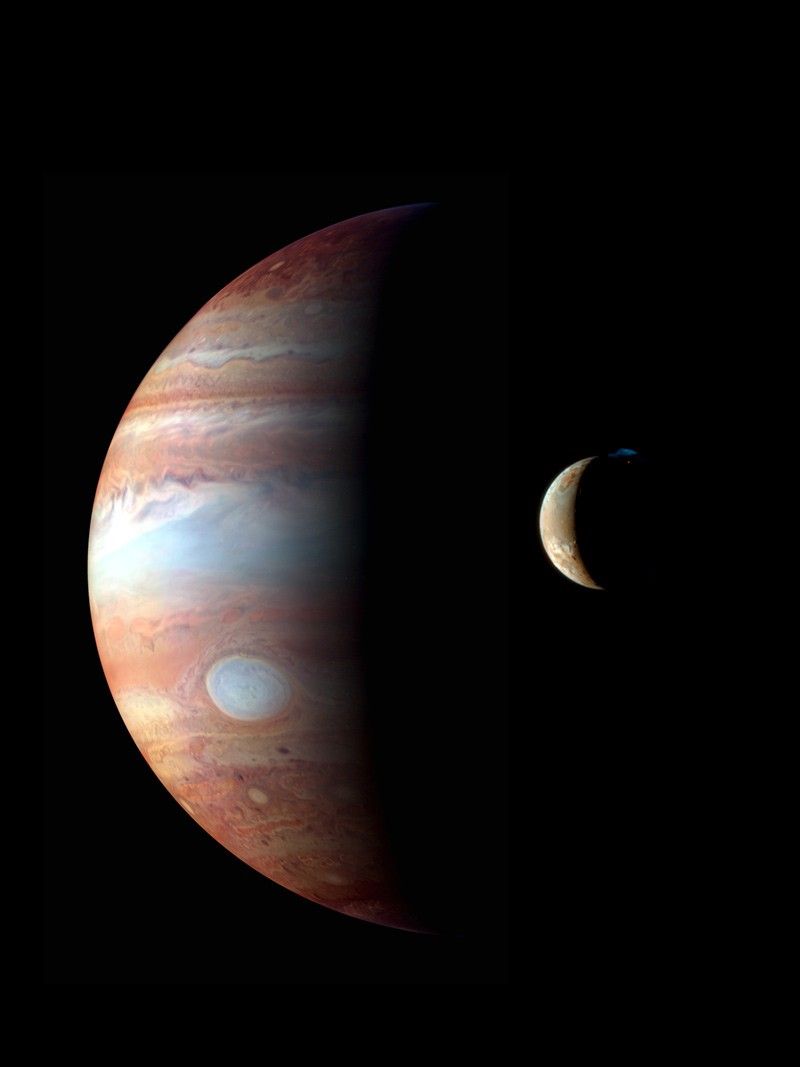
- Cover image: Jupiter and Io, New Horizons spacecraft, 2007. NASA/Johns Hopkins University Applied Physics Laboratory/Southwest Research Institute. Public domain.