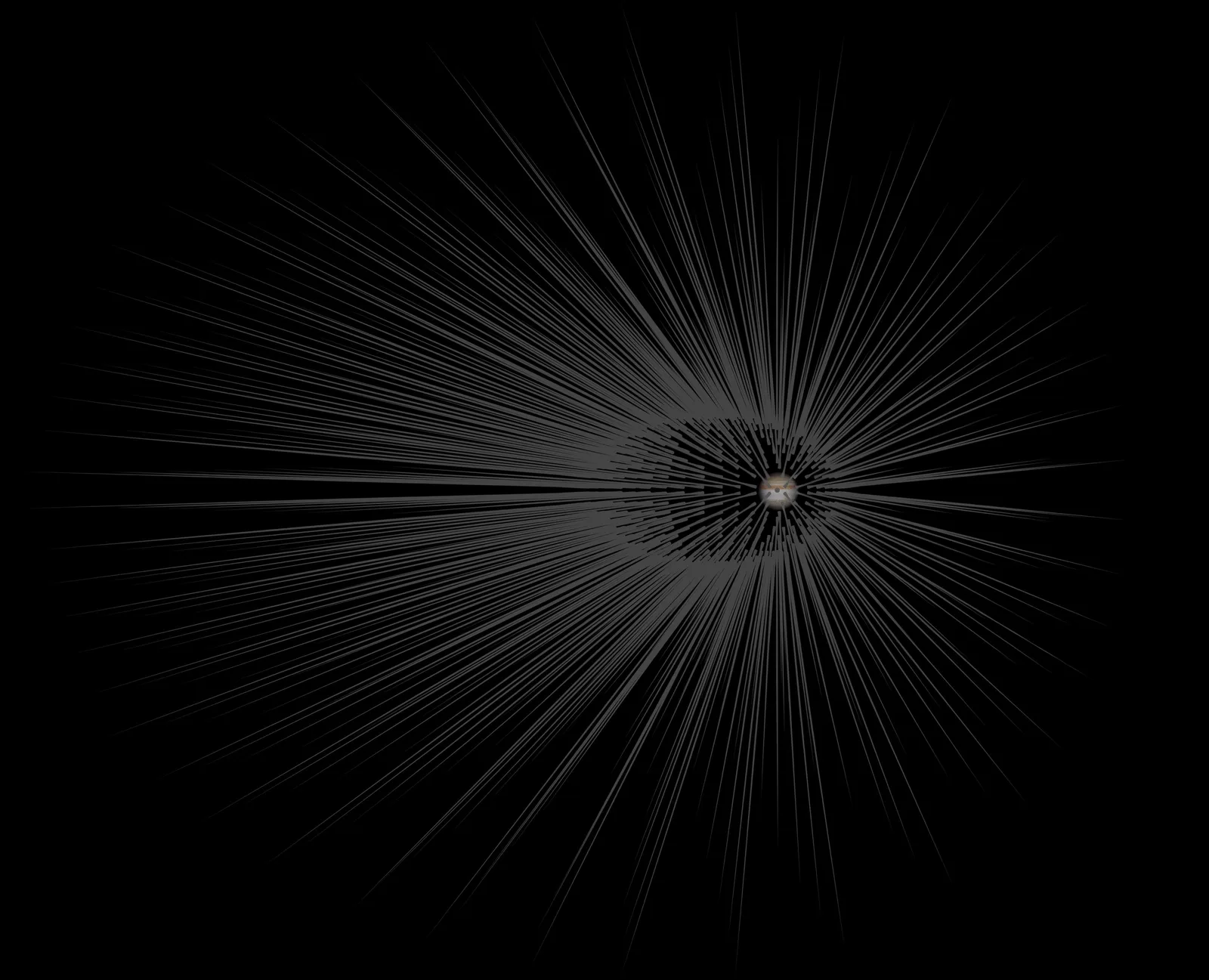
Two of the universe's residents are famous for almost never touching anything. Dark matter holds galaxies together yet emits no light, absorbs no light, and has never once registered in a detector built to catch it directly. Neutrinos stream out of the Sun by the trillions every second and pass through your body, the Earth, and the far side of the planet as if none of it were there. Each is a kind of cosmic ghost. The question physicists have started asking with new seriousness is whether these two ghosts, so indifferent to ordinary matter, might still feel each other.
It is not an idle thought. If dark matter and neutrinos exchange even the faintest whisper of momentum, the fingerprints would not be hidden in some exotic corner of physics. They would be smeared across the largest structures in existence: the cosmic microwave background, the web of galaxies, the very rate at which the universe grew clumpy. And in early 2026, a team working with telescope data from both the infant universe and the modern one reported something that made the idea harder to dismiss. The data, they argued, slightly prefers a universe in which these two ghosts are not strangers.
What a neutrino is, and why it barely exists
Neutrinos are the second most abundant particles in the universe after photons. The cosmic neutrino background, a relic from the first second after the Big Bang, fills space with roughly 336 of them per cubic centimeter. They were produced in staggering numbers when the cosmos was a dense plasma, then decoupled from that plasma about one second after the Big Bang, at a temperature near one mega-electronvolt. Since then they have been streaming freely, almost untouched, carrying a snapshot of the universe at one second old.
What makes them ghostly is their refusal to interact. Neutrinos feel only the weak nuclear force and gravity, and the weak force lives up to its name. A neutrino can cross a light-year of solid lead with a better-than-even chance of emerging on the far side. For decades they were assumed to be massless. Then experiments showed that neutrinos oscillate between flavors as they travel, which is only possible if they carry a tiny mass, smaller than a millionth of the electron's. That small mass turns out to matter enormously for cosmology, because neutrinos are light enough to have streamed across cosmic distances at nearly the speed of light, and in doing so they smoothed out the early universe's structure on small scales.
This free-streaming is the crucial point. As the universe expanded and matter began to clump under gravity, neutrinos refused to clump along with it. They zipped past the gravitational wells that were trying to form, draining a little of the universe's tendency to grow structure. Cosmologists have long known how to model this. It is one of the cleaner predictions of the standard picture.
A neutrino can cross a light-year of solid lead with a better-than-even chance of emerging on the far side. The question is whether dark matter is the one thing that gives it pause.
What dark matter is, and what it is not
Dark matter is the larger ghost. It outweighs all the ordinary matter in the universe, the atoms in every star, planet, and person, by roughly five to one. Its gravity is everywhere in the data: in the way galaxies rotate too fast to hold themselves together with visible matter alone, in the bending of light around galaxy clusters, in the precise pattern of hot and cold spots in the cosmic microwave background. Without dark matter, the universe we see could not have assembled in the time available.
Yet no one knows what it is made of. The leading candidates are new particles that do not appear in the Standard Model of particle physics, particles that feel gravity but otherwise keep to themselves. Direct-detection experiments, buried deep underground to escape cosmic interference, have spent decades waiting for a dark matter particle to bump into an atomic nucleus. So far the silence has been near total, which has steadily ruled out the simplest versions of the theory and pushed physicists to consider that dark matter's interactions, if it has any beyond gravity, may run through unexpected channels.
One of those channels could be the neutrino. In the standard model of cosmology, the two are kept entirely separate. Dark matter clumps; neutrinos stream; they share only gravity. But there is no deep law forbidding a small additional coupling between them. If such a coupling exists, the consequences would unfold not in a laboratory but across the sky.
Why an interaction would leave a mark
Imagine dark matter, in the hot early universe, not gliding freely toward the gravitational wells where galaxies will eventually form, but instead being jostled by a sea of neutrinos. Each collision transfers a little momentum. The dark matter is dragged along by the neutrinos' free-streaming motion, pulled out of the small clumps it was beginning to form. The smallest fluctuations, the seeds of the smallest structures, get washed out.
The technical name for this is collisional damping. The effect is to suppress the matter power spectrum, the mathematical description of how lumpy the universe is on different scales, and to do so most strongly on small scales. A universe with dark matter-neutrino interactions would look smoother, less granular, than one without. In the cosmic microwave background, the interaction would also alter the fine structure of the temperature and polarization patterns, because the neutrinos that normally free-stream away would instead be partly tied to the dark matter.
This is why cosmology, rather than a particle accelerator, is the natural laboratory for the question. The interactions being considered are far too feeble to produce a signal on Earth, but the early universe ran the experiment for us, at densities and over timescales no machine can match. The challenge is reading the result out of the faint imprints left behind.
The constraints, and how tight they already are
The modern effort to pin this down goes back more than a decade. In 2014, Ryan Wilkinson, Celine Boehm, and Julien Lesgourgues published one of the foundational analyses, using the cosmic microwave background and the distribution of matter on large scales to bound how strongly dark matter and neutrinos can scatter off each other. Their results were stringent. For an interaction whose strength does not change with temperature, they found the elastic scattering cross section must be smaller than roughly ten to the minus thirty-three square centimeters per gigaelectronvolt of dark matter mass. For an interaction that scales with the square of the temperature, the bound on its present-day value tightened to around ten to the minus forty-five. The strongest leverage came from the Lyman-alpha forest, the pattern of absorption lines that distant quasar light acquires as it crosses intervening hydrogen, which traces structure down to small scales where any damping would show.
These are upper limits, not detections. They say the interaction, if it exists, must be weak. But weak is not the same as zero, and a limit leaves room. Subsequent work extended the constraints using galaxy surveys, 21-centimeter cosmology, and forecasts for future radio telescopes, each narrowing the allowed window without closing it. The picture that emerged was of a tightly bounded but still open possibility.
These are upper limits, not detections. The interaction, if it exists, must be weak. But weak is not the same as zero, and a limit leaves room.
A 2026 hint hidden inside a cosmic tension
The renewed attention in 2026 came from a different direction. For several years, cosmologists have been wrestling with a stubborn mismatch called the S8 tension. The quantity S8 measures how clumpy the universe is, combining the amplitude of matter fluctuations with the overall matter density. When you infer S8 from the cosmic microwave background, the early-universe snapshot taken by the Planck satellite, you get about 0.834. When you measure it directly in the modern universe through weak gravitational lensing, the subtle distortion of distant galaxy shapes by intervening mass, you get a lower number. The Dark Energy Survey's three-year analysis found about 0.776. The KiDS-1000 survey found about 0.759. The late universe, in other words, looks slightly less clumpy than the early universe predicts it should be. The gap sits at the level of two to three standard deviations, large enough to be nagging, not yet large enough to be decisive.
In a study published in Nature Astronomy in early 2026, Lei Zu, William Giare, Eleonora Di Valentino, and their colleagues asked whether a dark matter-neutrino interaction could be the missing piece. The logic is direct. If neutrinos drag on dark matter and suppress the growth of structure, the late universe would end up less clumpy than the standard model predicts, which is exactly the direction the lensing surveys point. Combining early-universe data from the Atacama Cosmology Telescope with cosmic shear measurements from the Dark Energy Survey's third data release, the team reported that the combined data shows a preference for a non-zero interaction at nearly three standard deviations, with an interaction strength of roughly ten to the minus four in their chosen units.
It is worth being precise about what this is and is not. It is a statistical preference within a particular model, drawn from a particular combination of datasets. It is not a direct detection of dark matter touching a neutrino. Di Valentino framed the result around the puzzle it might solve, noting that measurements of the early universe predict cosmic structures should have grown more strongly than what astronomers actually observe today. Giare was equally careful about the stakes and the uncertainty: "If this interaction between dark matter and neutrinos is confirmed, it would be a fundamental breakthrough." The operative word is if.
The case for caution
A nearly three-sigma preference is intriguing, not conclusive. Particle physics convention reserves the word discovery for five sigma, and the history of cosmology is littered with two-and-three-sigma hints that faded as data improved. The S8 tension itself may yet turn out to have a more mundane explanation. Weak-lensing measurements depend on modeling how ordinary matter, gas blown around by exploding stars and feeding black holes, redistributes itself, and that baryonic feedback is genuinely hard to pin down. Some recent analyses have argued that better feedback modeling shrinks the tension on its own, with no new physics required.
There is also a competing concern from the high-energy frontier. In 2025, an unusually energetic neutrino event recorded by the KM3NeT detector in the Mediterranean was used by Toni Bertolez-Martinez and collaborators to place independent constraints on dark matter-neutrino interactions. A neutrino arriving from a great distance at extreme energy should be partly absorbed if it scatters off the dark matter it crosses along the way, so the mere fact that such a particle arrived at all limits how strong the interaction can be. These astrophysical limits probe a different energy regime than the cosmological ones, and keeping all the constraints mutually consistent is part of the ongoing work. The lesson is that any claimed interaction has to survive scrutiny from several independent directions at once.
This is how the field is supposed to work. A tension appears. A mechanism is proposed. The mechanism makes predictions that other instruments can test. If the dark matter-neutrino interaction is real, future weak-lensing surveys and next-generation cosmic-microwave-background experiments should sharpen the preference toward the discovery threshold. If it is an artifact of a particular dataset or a modeling choice, those same experiments should make it dissolve.
What it would mean, if it holds
Suppose the hint hardens. The implications would reach in two directions at once. For cosmology, it would mean the standard model is not wrong but incomplete, missing a small coupling that gently slows the growth of structure and reconciles the early and late universe. For particle physics, it would be more dramatic. A confirmed interaction would hand experimentalists a concrete property to hunt for, a clue about what dark matter is rather than merely what it is not. After decades of direct-detection experiments returning silence, a signal written in the geometry of the cosmos would point them toward a new place to look.
For now, the honest summary is restraint. The constraints are tight, the hint is real but modest, and the alternatives have not been ruled out. What has changed is that the question has moved from a theorist's hypothetical to something the data can address and, increasingly, seems to nudge. Two ghosts that ignore almost everything in the universe may, on the largest scales and across the deepest time, register each other's presence. The next decade of surveys will decide whether that whisper is a signal or a trick of the light.
Two ghosts that ignore almost everything in the universe may, on the largest scales and across the deepest time, register each other's presence. The next decade of surveys will decide whether that whisper is a signal or a trick of the light.
Frequently Asked Questions
Do dark matter and neutrinos actually interact?
There is no confirmed detection. A 2026 Nature Astronomy study found that cosmological data prefer a non-zero dark matter-neutrino interaction at nearly three standard deviations, which is suggestive but below the five-sigma threshold physicists require to claim a discovery. Standard cosmology assumes the two share only gravity.
What is the S8 tension?
S8 measures how clumpy the universe is, combining the amplitude of matter fluctuations with the matter density. The early universe, as seen by the Planck satellite, predicts S8 near 0.834, while modern weak-lensing surveys measure lower values, around 0.776 from the Dark Energy Survey and 0.759 from KiDS-1000. The mismatch sits at roughly two to three standard deviations.
How would an interaction change the universe?
If neutrinos jostle dark matter in the early universe, they drag it out of the small clumps it is starting to form, an effect called collisional damping. The result is a smoother universe with suppressed small-scale structure and altered patterns in the cosmic microwave background. That smoothing would make the late universe less clumpy, the direction the S8 tension points.
Why test this with telescopes instead of particle accelerators?
Any such interaction is far too feeble to produce a signal in a laboratory. The early universe, however, ran the experiment at densities and over timescales no machine can reproduce, leaving faint imprints in the cosmic microwave background and the distribution of galaxies. Cosmology is the only laboratory powerful enough to probe it.
How tightly is the interaction already constrained?
A foundational 2014 analysis by Wilkinson, Boehm, and Lesgourgues bounded the elastic scattering cross section to below about ten to the minus thirty-three square centimeters per gigaelectronvolt for a temperature-independent interaction, using the cosmic microwave background and the Lyman-alpha forest. Later work with galaxy surveys and high-energy neutrino events tightened the window further without closing it.
Could the S8 tension have a more ordinary explanation?
Yes. The tension may stem from the difficulty of modeling baryonic feedback, the way gas is redistributed by stellar explosions and feeding black holes, which affects weak-lensing measurements. Some analyses argue that improved feedback modeling reduces the tension without any new physics. Future surveys are needed to decide between the explanations.
Continue Exploring
- The Telescope Mapping the Dark UniverseOrdinary matter, everything we can see, is a rounding error in the cosmos. The rest is dark matter and dark energy. A...
- When Gravity Bends the SkyMass warps space, and light must follow the curves. Galaxies are smeared into arcs, multiplied into quartets, and bent...
- Why There Is Something Instead of NothingThe Big Bang should have made matter and antimatter in perfectly equal amounts, and they should have annihilated each...
Sources
- Zu, Giare, Di Valentino et al. (2026). "A solution to the S8 tension through neutrino-dark matter interactions, Nature Astronomy." link.
- Zu, Giare, Di Valentino et al. (2025). "A solution to the S8 tension through neutrino-dark matter interactions (preprint), arXiv:2501.13785." link.
- Wilkinson, Boehm & Lesgourgues (2014). "Constraining Dark Matter-Neutrino Interactions using the CMB and Large-Scale Structure, arXiv:1401.7597." link.
- Bertolez-Martinez et al. (2025). "The Highest-Energy Neutrino Event Constrains Dark Matter-Neutrino Interactions, arXiv:2506.08993." link.
- University of Sheffield (2026). "Scientists find evidence dark matter and neutrinos may interact." link.
- Live Science (2026). "Scientists may be approaching a fundamental breakthrough in cosmology and particle physics." link.