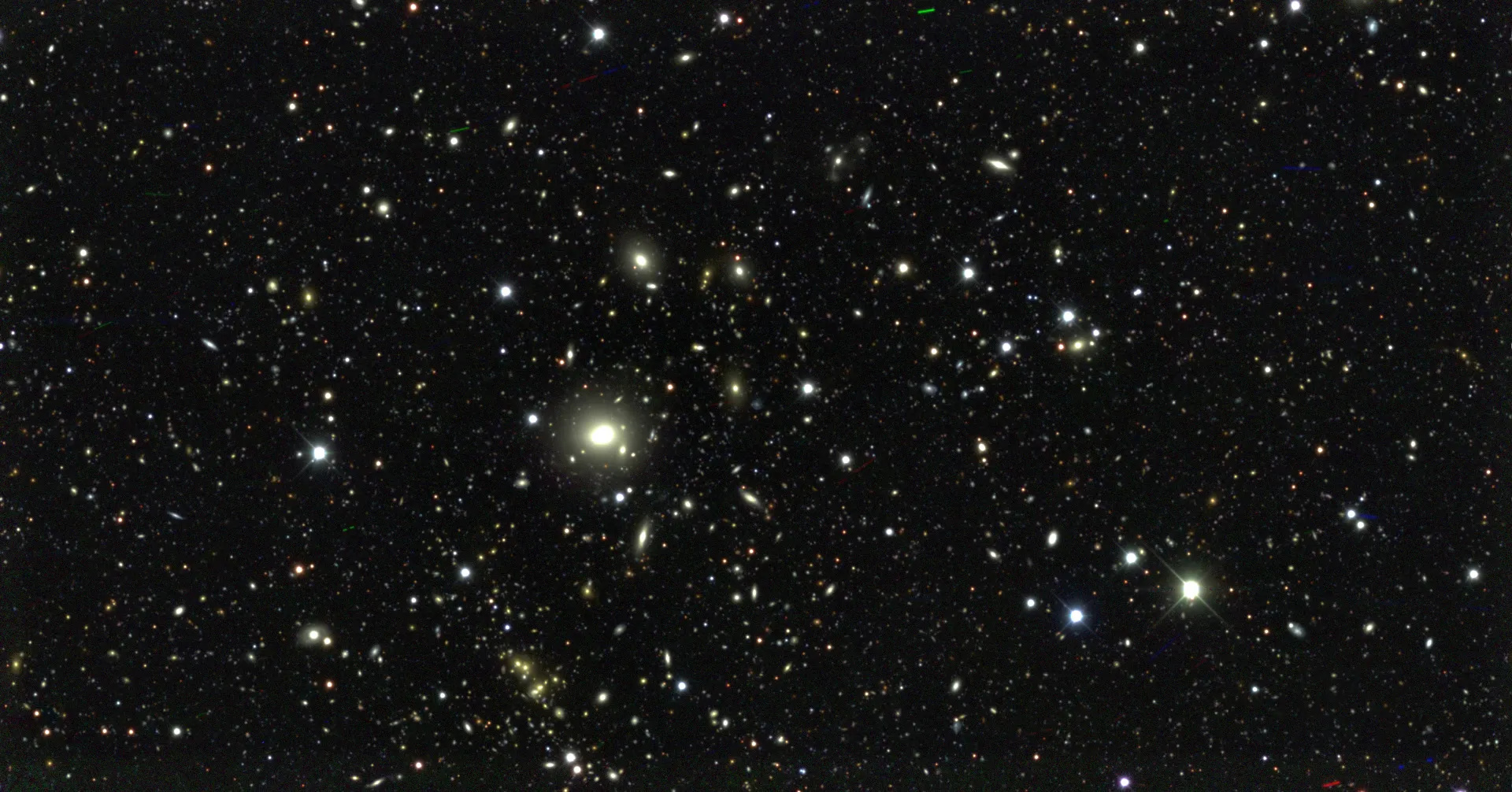
The first hint that something was wrong with the standard model of cosmology arrived quietly, in a Dark Energy Survey paper from 2024 reporting on 1,500 supernovae. The result was statistically borderline, easy to dismiss. It was not dismissed. In April 2025, the Dark Energy Spectroscopic Instrument, DESI, released the largest three-dimensional map of the universe ever assembled. Fourteen million galaxies, eleven billion years of cosmic history, measured to a precision no telescope before had achieved.
The map told the same story. Dark energy, the invisible component that makes up sixty-eight percent of everything in the universe, appears to be weakening. By the team's measurements, its strength has dropped roughly ten percent over the last 4.5 billion years.
If this is real, the universe is not heading toward the Big Freeze that physicists have predicted since 1998. It may be heading somewhere else entirely.
The discovery that named dark energy
Until 1998, most cosmologists expected the expansion of the universe to be slowing down. The Big Bang had set everything in motion 13.8 billion years ago, and gravity should have been pulling it gradually back. Two independent teams, one led by Saul Perlmutter, the other by Brian Schmidt and Adam Riess, set out to measure exactly how much the deceleration was.
They used Type Ia supernovae as standard candles. These explosions occur when a white dwarf in a binary system accretes enough mass to detonate, and they release almost identical amounts of light. By comparing the apparent brightness of a distant Type Ia supernova to its known intrinsic brightness, an astronomer can calculate exactly how far away it is. Combined with its redshift, the stretching of its light by cosmic expansion, that gives the rate of expansion at the moment that light was emitted.
Both teams found the same thing. The distant supernovae were fainter than expected, meaning they were farther away than the standard cosmological models predicted. The universe was not slowing down. It was accelerating.
Sixty-eight percent of the universe is made of something we do not understand and cannot measure directly.
The three astronomers shared the 2011 Nobel Prize. The unknown force pushing space apart was given a name, dark energy, and a placeholder in Einstein's equations. The result was the Lambda-CDM model, the cosmological theory of record for the next twenty-seven years.
What dark energy is, and what it might be
Nobody knows what dark energy actually is. The simplest interpretation, baked into the lambda symbol of Lambda-CDM, is that it is a property of the vacuum of empty space itself, a constant energy density that grows in total amount as the universe expands. Other physicists have proposed a fluid filling all of space, a field similar to the inflaton that drove cosmic inflation, or topological defects in the fabric of spacetime called cosmic strings.
A minority view holds that dark energy is not a thing at all, that the apparent acceleration is an artifact of applying general relativity at scales where it does not quite work. This has remained a minority view because every observation we have made for thirty years has fit the simple Lambda-CDM picture.
Under that picture, dark energy is constant. It has the same strength now that it had a billion years ago and that it will have a billion years from now. That constancy is what predicts the Big Freeze, galaxies receding forever, stars going out, black holes evaporating, the universe ending in cold, uniform near-vacuum after roughly a googol years.
DESI's map
DESI is installed on the four-meter Mayall Telescope at Kitt Peak in Arizona, and it does one thing extraordinarily well. It measures the optical spectra of five thousand galaxies simultaneously, building a three-dimensional map of the universe by combining each galaxy's position on the sky with its distance, inferred from its redshift.
The five-year survey, now four years in, is on track to measure fifty million galaxies and quasars. The April 2025 release covered fourteen million. It is, by an enormous margin, the most detailed picture of the large-scale structure of the universe ever produced.
What DESI is actually tracking are baryon acoustic oscillations, BAOs, the frozen imprints of sound waves that propagated through the hot plasma of the early universe. Those waves left a characteristic length scale, roughly five hundred million light-years, in the distribution of matter. By measuring how that scale has stretched at different cosmic epochs, the team can reconstruct the expansion history of the universe with precision no other technique has achieved.
The result the model could not absorb
DESI alone returns a measurement of dark energy that is consistent, at about the two-sigma level, with a varying strength. Two-sigma is interesting but not damning, there is roughly a five percent chance a result of that significance arises by accident. The team did what teams always do when a measurement is close to the threshold. They combined it with other independent datasets.
When DESI's BAO measurements are joined with the cosmic microwave background data from Planck, with Type Ia supernova samples from the Dark Energy Survey and the Pantheon+ catalog, and with weak gravitational lensing surveys, the combined significance rises sharply. In some combinations it reaches 4.2 sigma, a 99.997 percent probability that the result is not a statistical fluke.
The car is still accelerating. The foot is still on the gas pedal. But the pedal is being eased off.
The picture the combined data paints is that dark energy was stronger in the past and is gradually weakening. The expansion of the universe is still accelerating, galaxies are still receding faster every year, but the rate of that acceleration is itself decreasing. The ten-percent reduction in dark energy's influence over the last 4.5 billion years is the headline number.
What happens if it keeps weakening
If dark energy continues to decline at its current pace, the cosmic future changes shape. The Big Freeze depends on dark energy maintaining its outward push forever. A weakening dark energy means that push will eventually become zero, and then potentially negative.
A negative dark energy is gravity's opposite, except, instead of repelling, it attracts. If lambda crosses below zero in the deep future, expansion will stop and reverse. Galaxies that have been flying apart for thirteen billion years will begin moving toward each other. Over hundreds of billions of years, the cosmos would collapse, the so-called Big Crunch, the violent inverse of the Big Bang.
This is not a guaranteed outcome. DESI's measurement is consistent with several scenarios. Dark energy could level off at a lower value and stabilize. It could continue weakening at a constant rate and reach zero in a few tens of billions of years, leading to a static universe. Or it could keep declining and produce a crunch in roughly twenty to forty billion years, a long time on human scales, but well within the lifespan of long-lived red dwarf stars.
The sigma problem
Physicists do not declare discoveries at three or four sigma. The gold standard in particle physics and cosmology is five sigma, a one-in-3.5-million chance of a fluke. The history of cosmology contains several measurements that crossed three sigma and then turned out to be wrong when more data arrived, the most famous being the 2011 OPERA result claiming neutrinos travel faster than light, which reached six sigma before being traced to a loose fiber-optic cable.
DESI's combined result at 4.2 sigma is suggestive, not conclusive. The final two years of the survey will roughly double the dataset. The Euclid space telescope, launched in 2023, will provide an independent BAO measurement with different systematic errors. The Nancy Grace Roman Space Telescope, scheduled for launch in 2027, will measure supernovae out to redshift two. And the Vera C. Rubin Observatory, which began science operations in 2025, will catalog millions of new Type Ia supernovae in its ten-year LSST survey.
By the late 2020s, the combined evidence will either consolidate above five sigma, confirming that the standard model of cosmology is broken, or it will weaken as more data dilutes the current hint. Either way, the question that has been settled since 1998 is open again.
If dark energy is dying, then for the first time in twenty-seven years the future of the universe is unwritten.
Frequently Asked Questions
What is dark energy?
Dark energy is the unknown component that drives the accelerating expansion of the universe. It accounts for roughly 68 percent of the total energy density of the cosmos. The leading interpretation is that it is a property of the vacuum of empty space, an energy density that exists wherever space exists, but a fluid, a field, or a topological defect are all theoretical possibilities. No direct detection has ever been made.
What did DESI actually find?
DESI measured the baryon acoustic oscillation scale at multiple cosmic epochs by mapping 14 million galaxies and quasars. When combined with cosmic microwave background, supernova, and gravitational lensing data, the result indicates dark energy's influence has weakened by approximately 10 percent over the last 4.5 billion years. The combined statistical significance reaches 4.2 sigma in some analyses, strong evidence, but below the 5-sigma threshold for a confirmed discovery.
Does this mean the universe will not end in a Big Freeze?
Possibly. The Big Freeze scenario assumes dark energy is constant. If dark energy continues to weaken and eventually becomes negative, the expansion will stop and reverse, leading to a Big Crunch. If it weakens but stabilizes at a lower positive value, the universe will continue expanding but at a slower rate. The DESI data alone cannot yet distinguish between these scenarios.
How does DESI measure dark energy?
DESI uses baryon acoustic oscillations, frozen ripples from sound waves in the early universe. These ripples left a characteristic length scale of about 500 million light-years in the distribution of matter. By measuring how this scale has stretched at different cosmic epochs, DESI reconstructs the expansion history of the universe and infers the strength of dark energy at each epoch.
Could the DESI result be wrong?
Yes. The current significance is 4.2 sigma at best, which corresponds to a roughly one-in-30,000 chance of statistical fluke, strong but not conclusive. Physics history includes multiple 3-to-4-sigma results that did not survive larger datasets. The final two years of DESI data, combined with results from Euclid, the Nancy Grace Roman Space Telescope, and the Vera Rubin Observatory, will resolve the question within five to seven years.
Is dark energy related to dark matter?
No. Despite the shared adjective, the two are unrelated. Dark matter is non-luminous matter that interacts gravitationally, it makes up about 27 percent of the universe and is responsible for galactic rotation curves and the formation of cosmic structure. Dark energy is a force that pushes space apart, accounting for 68 percent of the total energy density. The "dark" in both names simply means we cannot see them directly.
Continue Exploring
- The Fastest Particles in the UniverseEvery second, particles from deep space slam into the atmosphere at nearly the speed of light. The most extreme carry...
- The Exploding Stars That Measure the UniverseA certain kind of stellar explosion always detonates at nearly the same brightness. That reliability turned dying white...
- The Quiet Suspect Behind the Universe's First Giant Black HolesSupermassive black holes appeared too early and grew too fast for standard physics to comfortably explain. A 2026 study...
Sources
- DESI Collaboration. "DESI 2024 VI: Cosmological constraints from the measurements of baryon acoustic oscillations." link.
- DESI Collaboration (2025). "DESI DR2 results: Evidence for evolving dark energy." link.
- Riess et al. (1998). "Observational Evidence from Supernovae for an Accelerating Universe." link.
- Perlmutter et al. (1999). "Measurements of Omega and Lambda from 42 High-Redshift Supernovae." link.
- Planck Collaboration (2020). "Planck 2018 results. VI. Cosmological parameters." link.