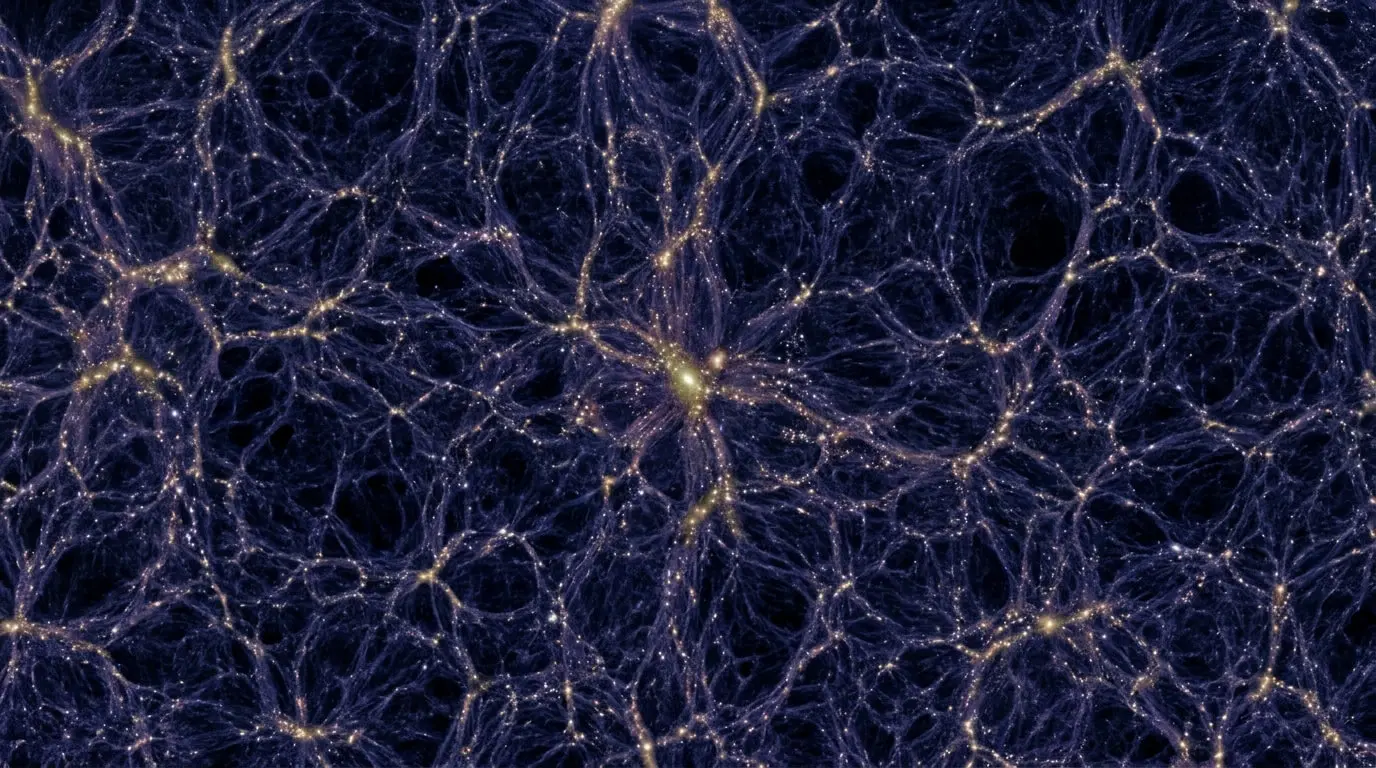
The Discovery That Changed the Cosmos
In 1929, the American astronomer Edwin Hubble published a paper in the Proceedings of the National Academy of Sciences that ran to barely six pages and changed the entire framework of astronomy. Hubble had been measuring the spectra of nearby galaxies, what at the time were called "extragalactic nebulae", at Mount Wilson Observatory in California. The spectra showed that almost all distant galaxies have their light shifted toward redder wavelengths. And the further away the galaxy, the more its light is shifted.
The standard interpretation of a redshift is that the source is moving away from the observer, the same Doppler effect that makes the pitch of an ambulance siren drop as it speeds past. Hubble's redshift data showed that almost every galaxy in the universe was moving away from Earth, and the more distant ones were moving faster. The relationship was linear: doubling the distance to a galaxy doubled its recession speed. This is now called Hubble's Law, and the rate of recession per unit distance is called the Hubble constant.
The immediate implication was that the universe was not static. Before Hubble's discovery, the consensus view, held by Einstein himself, who had introduced an ad hoc "cosmological constant" into his equations specifically to make the universe static, was that the cosmos was a permanent stage on which stars and galaxies played out their slow dances. After Hubble, the universe was unmistakably changing: getting bigger, on average, in every direction, every year.
This single observation forced the entire framework of cosmology to be rebuilt. If the universe is expanding now, it must have been smaller in the past. Run the clock backward and there must have been a moment when the universe was very small, and very dense, and very hot. This was the origin of what we now call the Big Bang model.
The Question That Won't Go Away
The natural next question, asked by almost everyone who hears the story for the first time, is the title question of this article: what is the universe expanding into? If galaxies are moving outward, they must be moving outward through some space that they were not occupying before. So there must be space "outside" the universe, empty room into which the universe is growing.
This intuition is wrong, but the way it is wrong takes some explanation. The problem is that we are imagining space the way we imagine a room: a fixed container that things can move through. If you push a piece of furniture across the floor, it moves through the room. The room is bigger than the furniture, and there is unoccupied space on either side. By analogy, if the universe is expanding, there must be unoccupied space outside of it.
But space, in general relativity, the theory that has correctly predicted every observation cosmology has made since 1915, is not a container. Space is a geometric structure of the universe itself. The metric, the mathematical object that describes how distances are measured, is part of the universe and changes with the universe. There is no exterior. The expansion is not the universe moving through space; it is the metric of space changing in such a way that the distance between any two galaxies (not gravitationally bound) increases over time.
The analogy that physicists often use is the surface of a balloon. Imagine ants on the surface of a balloon, with each ant representing a galaxy. As the balloon is inflated, the ants move apart from each other, not because they are walking, but because the surface they are standing on is stretching. From the ants' perspective, there is no "outside" of the balloon. The 2D surface is their entire universe. Each ant sees every other ant moving away, and the further apart two ants are, the faster they recede.
The balloon analogy is imperfect, real space is three-dimensional, not two, and it has an obvious flaw: the balloon does expand into the room, the room is the third dimension. But that flaw is not part of the analogy. In the actual mathematical structure of cosmology, there is no analogous third dimension into which the universe expands. The metric simply changes.
Asking what the universe is expanding into is like asking what is north of the North Pole. The question grammatically makes sense, but the geometry does not allow it to have an answer.
What Is Actually Happening
The correct way to describe the expansion is this: between every pair of points in the universe that are not gravitationally bound, the distance is increasing. Two galaxies that are 100 million light-years apart today will be 101 million light-years apart in some number of years from now (the exact number depends on the Hubble constant, currently estimated at approximately 70 kilometers per second per megaparsec). This is true everywhere. There is no center of the expansion. There is no edge of the expansion. From any galaxy, every other galaxy appears to be moving away, and the further away they are, the faster they recede.
Critically, the expansion is not motion through space. Individual galaxies are not flying outward like shrapnel from an explosion. They are, on cosmological scales, mostly stationary in their local frames. What is happening is that the space between them is stretching. The galaxies themselves do not stretch, they are held together by gravity, electromagnetism, and the other forces, but the empty regions between them grow.
This explains an important feature of the Hubble law that often confuses people: distant galaxies appear to be receding faster than the speed of light. This is true, and it does not violate special relativity. Special relativity prohibits anything from moving through space faster than light. It does not prohibit space itself from expanding faster than light. In fact, at sufficient distance (around 14 billion light-years), the apparent recession velocity due to cosmic expansion exceeds the speed of light. The light from those galaxies, traveling toward us at the speed of light, is being "carried away" by the expansion of intervening space faster than it can travel toward us. We will never see those galaxies in their current state.
Dark Energy and the Accelerating Expansion
Until 1998, the standard assumption among cosmologists was that the expansion of the universe was slowing down. Gravity, the dominant force on cosmic scales, attracts. So mass throughout the universe should be slowing the recession of galaxies, just as Earth's gravity slows a ball thrown upward. The interesting questions were how fast the deceleration was happening, and whether it was happening fast enough to eventually halt and reverse the expansion (in which case the universe would eventually re-collapse in a "Big Crunch") or whether the deceleration was insufficient to halt the expansion (in which case the universe would expand forever, slowing but never stopping).
In 1998, two independent teams, one led by Saul Perlmutter at Lawrence Berkeley National Laboratory, the other by Adam Riess at the Space Telescope Science Institute, published results that were not just unexpected but in some sense impossible. Both teams had been measuring the brightness of distant Type Ia supernovae (a kind of supernova with very consistent intrinsic brightness, useful as a "standard candle" for distance measurements). What they found was that supernovae more than a few billion years old were dimmer than they should have been if the universe's expansion were slowing down. The dimming meant they were farther away than expected, which meant the expansion had been speeding up, not slowing down, since they exploded.
This was wrong in the way that observational data is wrong: it had no theoretical explanation. Gravity slows things down. Acceleration of expansion requires something pushing outward, a repulsive force operating on cosmological scales. The 1998 results were initially met with deep skepticism, but they have since been confirmed by multiple independent observational techniques (cosmic microwave background measurements, baryon acoustic oscillations, gravitational lensing). The acceleration is real.
The cause has been given a name: dark energy. Whatever it is, it makes up approximately 68 percent of the total energy density of the universe today. It has the property of pushing space apart, accelerating the expansion. And nobody knows what it is. The leading hypothesis is Einstein's old cosmological constant, a constant energy density of empty space, baked into the structure of general relativity, but the value the constant would need to have is theoretically uncomfortable (it is about 120 orders of magnitude smaller than quantum field theory naively predicts), and that discrepancy is one of the largest unsolved problems in modern physics. Other hypotheses propose that dark energy is a dynamical field (sometimes called quintessence) that changes value over cosmic time. Recent results from the DESI survey (2024) hint at exactly this possibility but are not yet definitive.
What the Future Looks Like
The current best understanding is that the universe will continue to expand forever, and that the expansion will continue to accelerate. The implications are unsettling on cosmological timescales. And a stranger possibility lurks beneath the slow heat death: if our universe sits in a false vacuum, it could one day decay to a lower-energy state and rewrite physics in an instant.
In approximately 100 billion years, the accelerating expansion will have carried all galaxies outside our Local Group (the Milky Way, Andromeda, and a few dozen smaller galaxies, all of which are gravitationally bound to one another) beyond the cosmic event horizon. Their light will no longer be able to reach us. The night sky, from any planet within the Local Group, will show only stars and galaxies that are gravitationally bound to that local cluster. Everything else will have effectively disappeared.
An astronomer in that distant epoch, looking out from a habitable planet around a future star, would see what appears to be a single, isolated galactic system in an empty cosmos. They would have no observational way to know that the universe ever contained anything else. The cosmic microwave background, the relic radiation from the Big Bang that today is the most important observational tool in cosmology, will have redshifted out of detectability. The Big Bang itself, as a hypothesis, would be unprovable.
This is, in a sense, the most uncomfortable fact in modern cosmology. We exist at a particularly privileged epoch in the universe's history, when the universe is large enough to contain galaxies and old enough for them to have evolved interesting structures, but young enough that the cosmic horizon has not yet swallowed up the evidence of its origins. A trillion years from now, the universe will still exist, but it will be unknowable in a way that ours is not.
The universe is not expanding into anything. Space itself is being created between every pair of galaxies, faster every year, and one day there will be no other galaxies left to see.
Frequently Asked Questions
What is the universe expanding into?
Nothing, and the question itself is grammatically valid but geometrically wrong. In general relativity, space is not a container that the universe sits inside; space is part of the universe itself. The expansion is not the universe moving outward through some larger space. It is the metric of space changing such that the distance between every pair of gravitationally unbound objects increases over time. The standard analogy is the surface of a balloon being inflated, the 2D surface expands without expanding 'into' anything, from the perspective of an observer on the surface.
Who discovered the universe is expanding?
Edwin Hubble published the foundational paper in 1929 in the Proceedings of the National Academy of Sciences. Hubble measured redshifts (the stretching of light to longer wavelengths) of nearby galaxies at Mount Wilson Observatory and found that they were systematically receding from Earth, with more distant galaxies receding faster. This linear relationship, recession velocity proportional to distance, is now called Hubble's Law. The proportionality constant is the Hubble constant, currently estimated at approximately 70 kilometers per second per megaparsec.
How can galaxies recede faster than light?
They can, and it does not violate Einstein's special relativity. The special-relativistic speed limit applies to motion through space, no object with mass can be accelerated through space to or beyond the speed of light. It does not apply to the expansion of space itself. At cosmic distances beyond approximately 14 billion light-years, the cumulative stretching of intervening space exceeds the speed of light, meaning those galaxies appear to recede superluminally. Their light, traveling toward us at the speed of light, is being 'carried away' faster than it can travel toward us; we will never observe those galaxies in their current state.
What is dark energy?
Dark energy is the name given to whatever is causing the expansion of the universe to accelerate. The discovery that the expansion is accelerating came from observations of Type Ia supernovae in 1998 by two independent teams (Saul Perlmutter at LBNL, Adam Riess at STScI). The acceleration requires a repulsive component to the cosmic energy density, opposed to gravity's tendency to slow expansion. Dark energy makes up approximately 68 percent of the universe's total energy density today. Its physical nature is unknown, the leading hypothesis is Einstein's cosmological constant, but recent results from the DESI galaxy survey (2024) hint that dark energy may be changing over time rather than being constant. This is currently one of the largest open problems in physics.
Will the universe expand forever?
Almost certainly yes. The current best models, calibrated against cosmic microwave background data (Planck), baryon acoustic oscillations, gravitational lensing, and supernova data, all converge on a universe in which expansion continues forever and the rate of expansion accelerates over time. The eventual outcome is a 'Big Freeze' or 'heat death', galaxies outside our Local Group will gradually be carried beyond our cosmic horizon (over the next 100 billion years), stars will eventually exhaust their fuel (over trillions of years), and the universe will become an increasingly cold and empty place. There is no current evidence supporting alternative scenarios like the 'Big Crunch' (recollapse) or the 'Big Rip' (catastrophic ripping apart of structure).
What was Einstein's cosmological constant?
When Einstein first formulated general relativity in 1915, his equations naturally predicted that the universe should be either expanding or contracting, they did not allow a static cosmos. Believing the universe to be static (the consensus view at the time), Einstein added a term to his equations called the cosmological constant (Λ, lambda) specifically to balance the gravitational tendency to collapse and keep the universe stable. When Hubble discovered the expansion in 1929, Einstein removed the constant, calling its introduction 'the greatest blunder of my life.' Ironically, the cosmological constant came back in 1998 as the leading candidate explanation for the accelerating expansion, Einstein had originally introduced exactly the right mathematical term, just for the wrong reason.
Continue Exploring
- How We Measure the Distance to the StarsYou cannot lay a tape measure to a galaxy. Astronomers built a ladder instead, each rung a different method calibrated...
- The Exploding Stars That Measure the UniverseA certain kind of stellar explosion always detonates at nearly the same brightness. That reliability turned dying white...
- The Quiet Suspect Behind the Universe's First Giant Black HolesSupermassive black holes appeared too early and grew too fast for standard physics to comfortably explain. A 2026 study...
- The Universe Is Expanding at Two Different Speeds, and Cosmology Cannot Reconcile ThemTwo independent methods measure how fast the universe is expanding. They agree on the technique but disagree on the...
Sources
- Hubble, E. "A relation between distance and radial velocity among extra-galactic nebulae." Proceedings of the National Academy of Sciences, 15, 168 (1929).
- Riess, A. G. et al. "Observational evidence from supernovae for an accelerating universe and a cosmological constant." The Astronomical Journal, 116, 1009 (1998).
- Perlmutter, S. et al. "Measurements of Ω and Λ from 42 high-redshift supernovae." The Astrophysical Journal, 517, 565 (1999).
- Planck Collaboration. "Planck 2018 results. VI. Cosmological parameters." Astronomy & Astrophysics, 641, A6 (2020).
- DESI Collaboration. "DESI 2024 III: baryon acoustic oscillations from galaxies and quasars." arXiv:2404.03002 (2024).
- Carroll, S. M. Spacetime and Geometry: An Introduction to General Relativity, Cambridge University Press (2019), Ch. 8 on cosmology.
- Krauss, L. M. & Scherrer, R. J. "The return of a static universe and the end of cosmology." General Relativity and Gravitation, 39, 1545 (2007), on the future invisibility of cosmic expansion evidence.
- Cover image: IllustrisTNG simulation visualization, Max Planck Institute for Astrophysics. Public domain.