The Particle That Cannot Stand Alone
The neutron is one of the two particles that make up atomic nuclei. Together with the proton, it accounts for essentially all the mass of every atom you have ever encountered, including, by direct count, about half the mass of every atom inside your body. There are roughly seven octillion neutrons in an adult human, distributed across the carbon, nitrogen, oxygen, calcium, and iron in flesh and bone.
And every one of them, taken out of its nucleus and left alone in empty space, would decay into a proton, an electron, and an antineutrino in approximately ten minutes. The neutron's mean lifetime, measured from a beam of free neutrons or from neutrons trapped in a magnetic bottle, is currently quoted as 877.7 ± 0.7 seconds in the most precise modern experiments, with a corresponding half-life of about 611 seconds, or 10 minutes 11 seconds.
Ten minutes is, by the standards of fundamental physics, an enormous amount of time. The strong force, which holds the neutron together internally, operates on timescales of about 10−23 seconds. The electromagnetic force operates on timescales of about 10−16 seconds. Ten minutes is a billion billion times slower than electromagnetism. The decay of the free neutron is mediated by the weak force, the same fundamental interaction that governs radioactive beta decay throughout the periodic table, and is, by the standards of particle physics, a slow-motion event.
The decay product list is fixed by conservation laws. A neutron has charge zero. A proton has charge +1. To balance, the decay must produce something with charge −1: an electron. The electron's birth requires a partner antineutrino to balance lepton number. The total mass of the products is slightly less than the mass of the neutron, the deficit, 1.293 mega-electronvolts, is converted into kinetic energy of the outgoing electron and antineutrino.
The Quarks Inside
The neutron is not a fundamental particle. It is a composite object made of three quarks: two down quarks and one up quark, bound together by gluons through the strong force. The proton, by contrast, is two up quarks and one down. The chemistry-class picture of the neutron as a featureless ball is wrong; the reality is a roiling, dynamic system of three quarks plus a churning sea of gluons and short-lived virtual quark-antiquark pairs.
This was not the consensus picture before 1968. The composite structure of the neutron was first revealed by the SLAC-MIT deep inelastic scattering experiments led by Jerome Friedman, Henry Kendall, and Richard Taylor, the same experiments that led directly to the quark model and to the 1990 Nobel Prize in Physics for the three. The experiments showed that high-energy electrons fired at protons and neutrons did not bounce off the nucleon as a unit. They bounced off small, hard, point-like structures inside, just as Rutherford's alpha particles had bounced off atomic nuclei sixty years earlier. The point-like structures were quarks.
Roughly one percent of the neutron's mass comes from the masses of the three constituent quarks. The other 99 percent comes from the energy stored in the strong force binding them together. This is one of the deepest and most counterintuitive facts in modern physics: the mass of ordinary matter is not the sum of the masses of its parts; it is overwhelmingly the energy of the field that holds the parts together. When you step on a scale, you are weighing strong-force binding energy more than you are weighing the quarks themselves.
The Weak Force
The decay of a free neutron into a proton requires that one of its down quarks transform into an up quark. Among the four fundamental forces, only the weak force can do this. Gravity does not change quark flavor. Electromagnetism does not. The strong force, despite its name, can rearrange quarks but not change them from one type to another. Only the weak interaction can.
The mechanism, worked out in the framework of the Standard Model, is exchange of a W boson. The down quark inside the neutron emits a W−, becoming an up quark in the process. The W−, which has spin 1 and an enormous mass of about 80 GeV, roughly 85 times the mass of the entire neutron, is virtual: it exists for less than 10−24 seconds before it decays into the outgoing electron and antineutrino. The neutron's three-quark configuration is now two up plus one down: it is a proton.
The mass of the W boson is the reason the decay is slow. The weak force at low energies looks weak precisely because the carriers are heavy and the virtual exchange is energetically costly. At the higher energies of particle colliders, where W and Z bosons can be produced as real particles, the weak force is comparable in strength to electromagnetism. At the energies of neutron decay, it is a billion times weaker.
Why Bound Neutrons Live Forever
A neutron inside a stable atomic nucleus does not decay. The proton it would become is, after all, accommodated inside the same nucleus alongside the existing protons, and the new proton's energy state, including the electromagnetic repulsion from the other protons and the constraints of the Pauli exclusion principle, is higher than the energy state of the neutron it replaced. The decay would require, on net, an input of energy. Without that input, the decay simply does not occur.
This is the same principle that explains why some isotopes are stable and some are not. An isotope with too many neutrons relative to protons can lower its energy by converting one of the neutrons to a proton, that is, by undergoing beta decay. An isotope at the floor of the energy landscape cannot lower its energy by any allowed transition, and so it lives forever. Carbon-12, oxygen-16, calcium-40, iron-56, all stable nuclei contain neutrons in just this state. The neutrons in your body are essentially immortal, not because they have stopped wanting to decay but because there is nowhere energetically downhill for them to go.
The same particle that decays in ten minutes alone has been sitting unchanged inside iron nuclei for 4.6 billion years. The difference is not the particle. It is whether it has a place to fall to.
The Three Minutes That Defined the Universe
About 4.6 billion years ago, the neutron's 10-minute half-life decided how much helium the universe contains.
For the first second after the Big Bang, the universe was hot enough that protons and neutrons were freely interconverted by weak-force reactions. As the universe cooled, the rates of those reactions fell. By about one second after the Big Bang, the rates had dropped below the expansion rate of the universe and the proton-to-neutron ratio froze in at approximately seven to one. From that moment on, no significant proton-neutron interconversion happened, except for the slow decay of the neutrons themselves.
For the next two minutes, the universe was still too hot for deuterium, the simplest nucleus containing a neutron, to be stable. Any deuterium that formed was immediately broken apart by high-energy photons. This is the deuterium bottleneck. While the bottleneck held, the neutron clock was ticking. By the time the universe cooled enough for deuterium to survive, at about 100 seconds, a substantial fraction of the original free neutrons had already decayed into protons.
When the bottleneck finally opened, nucleosynthesis proceeded almost instantaneously. Surviving neutrons combined with protons to form deuterium, then deuterium with protons or other deuterons to form helium-3 and tritium, then those to form helium-4. Helium-4 is exceptionally stable, it has a high binding energy per nucleon, and once a neutron is locked into a helium-4 nucleus, it does not decay. The window of nucleosynthesis closed quickly. By about twenty minutes after the Big Bang, the universe was too cool for further fusion, and the chemistry of the cosmos was set.
The result, as calculated and verified to high precision by the Planck mission and earlier observations, is that approximately 25 percent of the universe's baryonic mass is helium-4, with the rest essentially all hydrogen and trace amounts of deuterium, helium-3, and lithium-7. This number, the helium-4 mass fraction, is one of the most precisely tested predictions of the Big Bang model and is in excellent agreement with observation.
The Half-Life as a Cosmic Knob
The 25 percent helium fraction depends on the neutron half-life through the deuterium-bottleneck calculation. If the half-life were significantly shorter, say, five minutes, many more neutrons would have decayed before deuterium could form, and the surviving neutron-to-proton ratio at the end of the bottleneck would have been smaller. The universe would have ended up with less helium, perhaps 15 to 20 percent by mass.
If the half-life were longer, say, half an hour, fewer neutrons would have decayed and more would have ended up locked in helium. The universe could have ended up 30 to 35 percent helium by mass. Either of those alternative universes would have produced different first generations of stars, with different masses, different lifetimes, and different yields of heavier elements when they exploded as supernovae. The chemistry available for forming planets and life would have been substantially different.
The 10-minute half-life is, in this sense, a parameter that the universe was extremely lucky to have. It is not fine-tuned in any deep theoretical sense, it follows from the values of the masses of the up and down quarks, the mass of the W boson, and the strength of the weak coupling. But its value, given everything else, is what produced the chemistry-friendly universe we live in.
Where the Heavy Elements Came From
Big Bang nucleosynthesis stopped at lithium. Every element from carbon to uranium was made later, in stars. The lighter elements through iron come from fusion in stellar cores, where neutrons play important roles as catalysts and as products. The elements heavier than iron, gold, platinum, lead, uranium, thorium, the lanthanides, and dozens of others, cannot be made by ordinary fusion. They are made by neutron capture: existing nuclei swallow free neutrons, then beta-decay (using the same weak-force mechanism that decays free neutrons) until they reach a stable configuration.
There are two flavors of neutron capture in nature. The slow process (s-process) operates over thousands of years inside aging stars, where the neutron flux is low and capture-decay timescales overlap. The rapid process (r-process) operates in seconds, where the neutron flux is so intense that nuclei can capture many neutrons before any of them have time to decay, building up the heaviest elements before stability has a chance to assert itself.
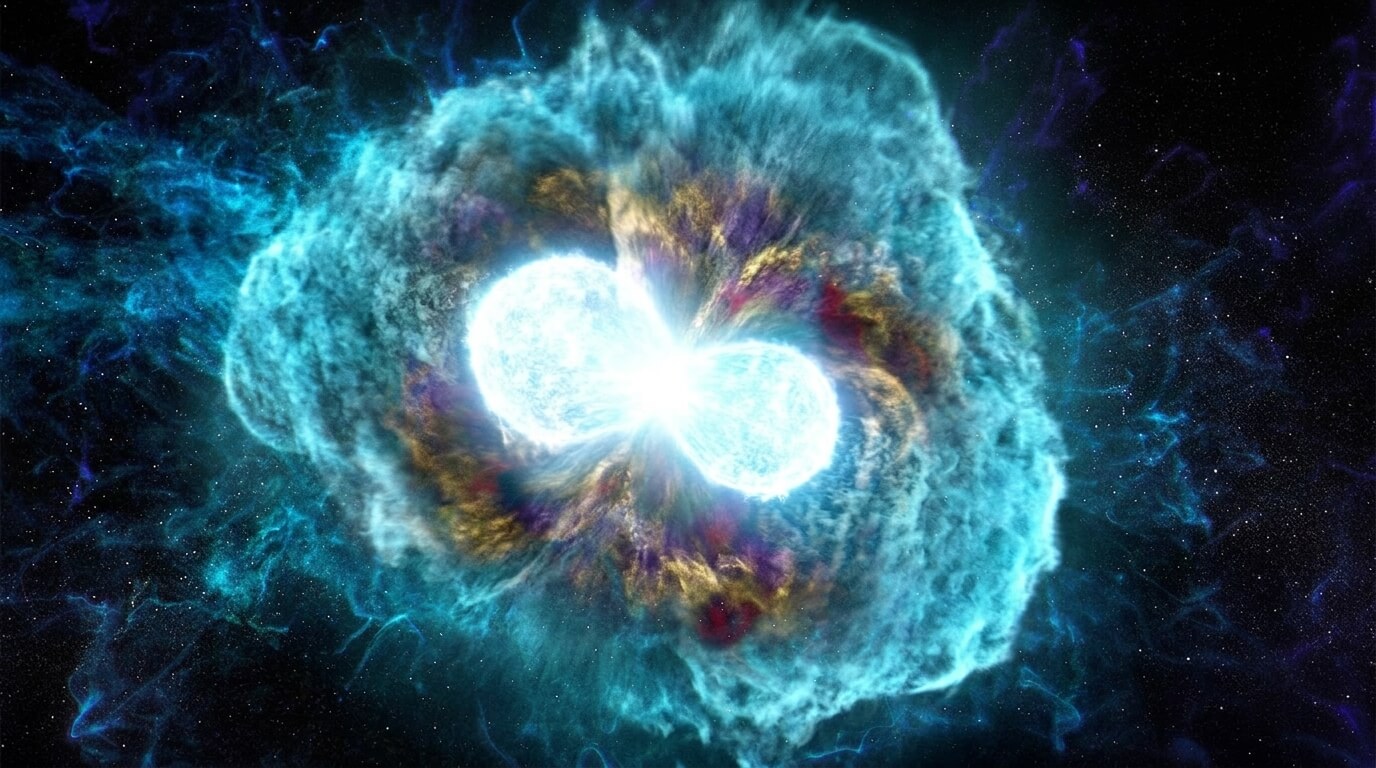
The r-process requires conditions extreme even by astrophysical standards. The leading candidate sites are supernova explosions and, more decisively, since the August 2017 detection of GW170817, the merger of two neutron stars. The kilonova that followed GW170817, observed across the electromagnetic spectrum, contained the spectral signatures of r-process elements being synthesized in real time. The amount of gold and platinum produced in that single merger event has been estimated by Pian and others at several Earth masses worth.
This is the supply chain for the heavy elements in the solar system. The gold in your wedding ring and the iodine in your thyroid were both produced by neutron-capture processes in dying stars and merging neutron stars billions of years ago. The free neutrons that drove the synthesis decayed within minutes of being captured, but the products, locked into stable nuclei, have remained ever since.
A free neutron lives ten minutes. A bound one lives forever. Between those two extremes is the entire history of how the universe filled itself with elements heavier than hydrogen.
Frequently Asked Questions
How long does a neutron live?
A free neutron, one not bound inside an atomic nucleus, has a mean lifetime of approximately 877.7 seconds, corresponding to a half-life of about 611 seconds, or 10 minutes 11 seconds. The two leading techniques used to measure this, beam experiments and ultra-cold neutron storage, currently disagree by about 8 seconds, an unresolved discrepancy known as the neutron lifetime puzzle. A bound neutron inside a stable atomic nucleus does not decay at all; the iron in your blood contains neutrons that have been stable since they were forged in supernovae billions of years ago.
What is the neutron made of?
A neutron consists of three quarks (two down quarks and one up quark) bound by the strong force, mediated by gluons. The composite structure was first established by the SLAC-MIT deep inelastic scattering experiments in 1968 (Friedman, Kendall, and Taylor; Nobel Prize 1990). About 1 percent of the neutron's mass comes from the masses of its constituent quarks; the other 99 percent comes from the energy of the strong force field binding them together, a striking demonstration that, at the most fundamental level, mass is mostly binding energy.
Why is the weak force called weak?
The weak force is mediated by the W and Z bosons, which have masses of about 80 and 91 GeV respectively. At low energies, including the energies relevant to neutron decay, exchanging such a heavy boson is energetically costly, which suppresses the interaction rate. The result is an effective coupling about a billion times weaker than electromagnetism. At higher energies (in particle colliders, for example), where W and Z bosons can be produced as real particles, the weak interaction is comparable in strength to electromagnetism. The 'weakness' is a feature of the low-energy regime.
How does the neutron lifetime affect cosmology?
Big Bang nucleosynthesis (BBN), the formation of helium and other light elements during the first few minutes after the Big Bang, depends sensitively on the neutron lifetime. After the proton-to-neutron ratio froze out at around 7:1 at one second post-Big Bang, the only way to lose neutrons was through their decay during the deuterium bottleneck. The 10-minute half-life means about 20 percent of the original neutrons decayed before they could be locked into helium-4 nuclei. The resulting helium fraction, roughly 25 percent of cosmic baryonic mass, is one of the most precisely tested predictions of the Big Bang model.
How are heavy elements like gold made?
Elements heavier than iron cannot be made by ordinary stellar fusion. They are made by neutron capture, in which existing nuclei absorb free neutrons and then undergo beta decay until they reach stability. The slow process (s-process) operates over thousands of years inside aging stars. The rapid process (r-process) operates in seconds during extreme events, supernovae and, decisively confirmed by the August 2017 GW170817 event, neutron-star mergers. The kilonova following that merger contained spectral signatures of r-process elements being synthesized, with several Earth masses worth of gold and platinum estimated as products.
Why don't neutrons inside iron nuclei decay?
Decay would require the neutron to transform into a proton, but the resulting proton would have to occupy an energy state in the nucleus that is higher (after accounting for electromagnetic repulsion from the existing protons and Pauli exclusion principle constraints) than the original neutron state. Decay would therefore cost energy rather than release it, and is energetically forbidden. Stable nuclei sit at the floor of the energy landscape; the neutrons inside them have nowhere energetically downhill to go, so they remain neutrons indefinitely.
Continue Exploring
- The Ghost Particles Passing Through YouRight now, trillions of them are streaming through your body every second, and almost none will touch a single atom....
- The Fastest Particles in the UniverseEvery second, particles from deep space slam into the atmosphere at nearly the speed of light. The most extreme carry...
- The Collision That Might Never HappenFor decades, astronomers told a confident story: in about five billion years, the Milky Way and Andromeda would crash...
- Sixty-Eight Dead Stars Just Detected the Background Hum of the UniverseEarth is bobbing up and down in a sea of gravitational waves that stretches from one end of the cosmos to the other. We...
Sources
- Cyburt, R. H. et al. "Big Bang nucleosynthesis: Present status." Reviews of Modern Physics, 88, 015004 (2016).
- Wietfeldt, F. E. & Greene, G. L. "Colloquium: The neutron lifetime." Reviews of Modern Physics, 83, 1173 (2011).
- Friedman, J. I., Kendall, H. W. & Taylor, R. E. "Deep inelastic scattering: Acknowledgements." Reviews of Modern Physics, 63, 573 (1991).
- Abbott, B. P. et al. (LIGO/Virgo). "GW170817: Observation of gravitational waves from a binary neutron star inspiral." Physical Review Letters, 119, 161101 (2017).
- Pian, E. et al. "Spectroscopic identification of r-process nucleosynthesis in a double neutron-star merger." Nature, 551, 67 (2017).
- Wagoner, R. V., Fowler, W. A. & Hoyle, F. "On the synthesis of elements at very high temperatures." The Astrophysical Journal, 148, 3 (1967).
- Planck Collaboration. "Planck 2018 results. VI. Cosmological parameters." Astronomy & Astrophysics, 641, A6 (2020).
- Burbidge, E. M. et al. "Synthesis of the elements in stars." Reviews of Modern Physics, 29, 547 (1957), the foundational B²FH paper on stellar nucleosynthesis.
- Cover image: NSF/LIGO/Sonoma State University/A. Simonnet, neutron star merger artist's impression. Public domain.