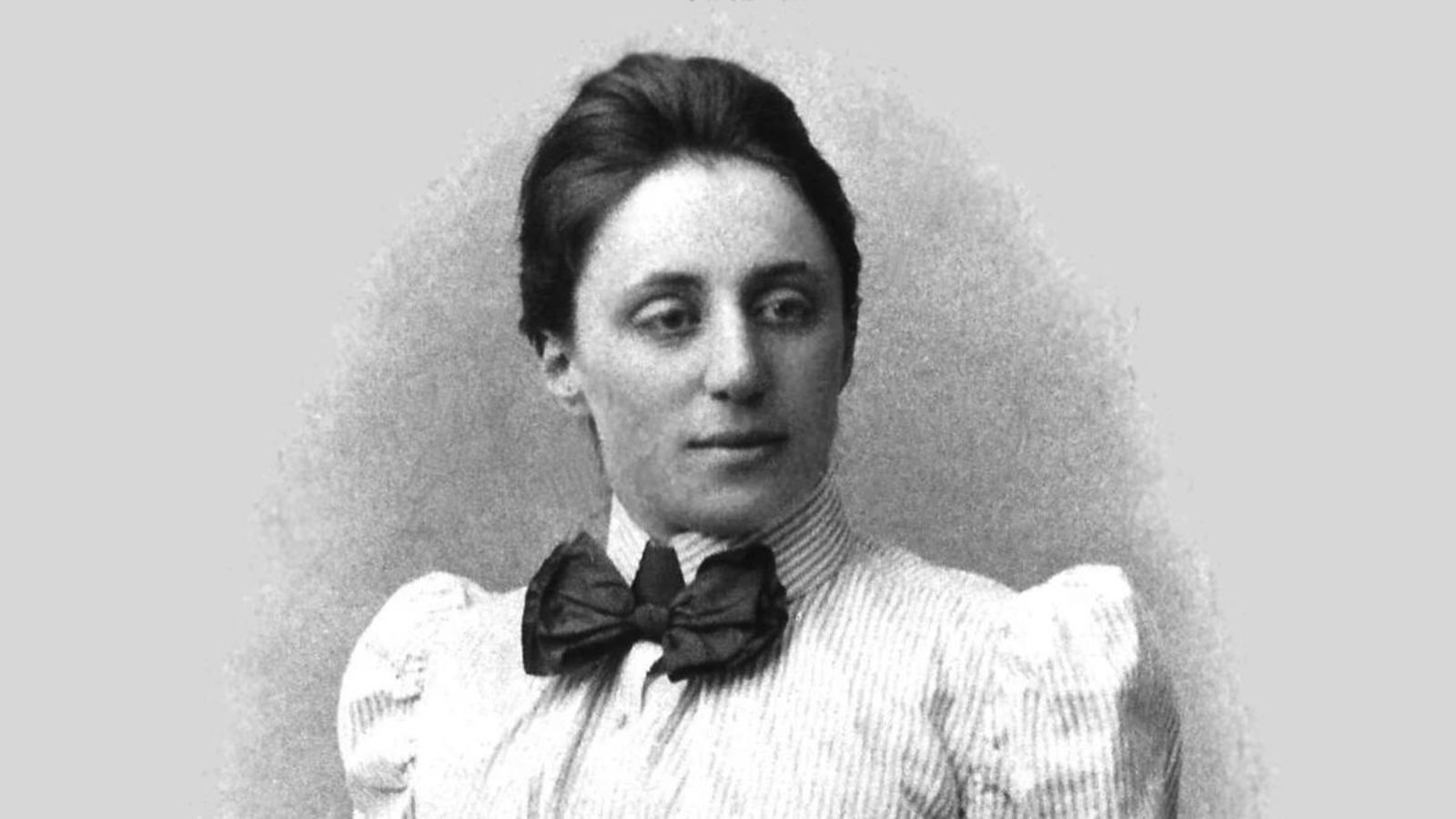
The Problem Hilbert Could Not Solve
In the summer of 1915, Albert Einstein traveled to the University of Göttingen to give six lectures on his nascent theory of gravity. The lectures were attended by, among others, the mathematician David Hilbert, at the time arguably the most powerful mathematician in the world. Hilbert was working on the same problem from a different angle and would, within a few months, publish field equations functionally identical to Einstein's, leading to a separate priority dispute that need not detain us here.
Both men ran into the same problem. The new theory of gravity, soon to be called general relativity, was beautiful but contained a foundational difficulty. In Newtonian mechanics, energy is conserved, a moving ball, undisturbed, retains its energy forever. In special relativity, energy is conserved. In general relativity, the situation was opaque. The mathematics seemed to require energy to be conserved only in a peculiar, restricted sense; the natural attempt to write down a global conservation law produced something that was not a tensor, that depended on the choice of coordinate system, and that some critics said was not really an energy at all.
Hilbert was bothered. He turned to a colleague at Göttingen, a young mathematician named Emmy Noether, whom he was actively trying to hire for a paid position. The university senate had refused, on the grounds that hiring women would, in the words of one senator, "overthrow all academic order." Noether had been giving lectures at Göttingen since 1915 under Hilbert's name on the syllabus. Hilbert handled this by announcing that he did not see why the candidate's gender mattered, since the university was not, after all, a bathhouse.
Who Emmy Noether Was
Amalie Emmy Noether was born in Erlangen, Bavaria, in 1882. Her father Max Noether was a professor of mathematics at the University of Erlangen. She was permitted to attend his lectures as a guest but not formally enrolled. In 1903, she spent a semester at Göttingen, where she encountered the work of Felix Klein on group theory and symmetry. She returned to Erlangen, finally enrolled formally when the rules changed, and in 1907 became only the second woman in Germany to earn a doctorate in mathematics.
For the next eight years she worked without pay at her father's institute, publishing original papers in algebra. By 1915 her reputation was strong enough that Hilbert and Klein invited her to Göttingen, again without a formal position. She lectured under their names. The university paid her nothing.
In 1923, five years after her foundational 1918 paper, the one this article is about, Göttingen finally created a paid position for her, of a non-tenured kind that paid less than the salary of a postdoctoral assistant in modern terms. In 1933, the Nazi government dismissed her under the law banning Jews from civil service positions. She emigrated to the United States and accepted a position at Bryn Mawr College. She died in 1935 from complications of surgery, age 53.
The First Theorem
Noether's 1918 paper, "Invariante Variationsprobleme," published in the proceedings of the Royal Society of Sciences at Göttingen, contained two theorems. The first is the more famous and the simpler to state. It says: every continuous symmetry of a physical system corresponds to a conservation law. And the converse: every conservation law in physics comes from a continuous symmetry.
The simplest examples are the foundational ones of classical mechanics. If the laws of physics are invariant under translations in space, meaning, an experiment performed here gives the same result as the same experiment performed a meter to the left, then linear momentum is conserved. If the laws are invariant under rotations, an experiment performed in one orientation gives the same result as the same experiment in a rotated orientation, then angular momentum is conserved. And, most consequentially: if the laws are invariant under translations in time, an experiment performed today gives the same result as the same experiment performed tomorrow, then energy is conserved.
This is not a coincidence and not an analogy. Noether proved it. The result was that conservation laws, which had been treated since Newton as fundamental empirical facts about the universe, were instead consequences of a deeper structural property: the symmetries of physical law. Take away the symmetry and you take away the conservation law.
Conservation of energy is not a fundamental fact about reality. It is what happens when the laws of physics do not change with time.
The Second Theorem
Noether's second theorem, less widely known but more relevant to general relativity, dealt with theories that have local, rather than global, symmetries. A local symmetry is one in which the transformation can vary from point to point in space and time. General relativity has exactly this property: the principle of general covariance says that the laws of physics must take the same form in any coordinate system, and the freedom to choose a different coordinate system at each point is a local symmetry.
The second theorem proved that for theories with local symmetries, the corresponding "conservation law" is not a clean global statement of conservation but a local continuity equation, a relation that says energy and momentum can flow into and out of any small region of spacetime in a balanced way, but does not extend to a global statement that the total energy of the universe is constant. This was exactly the structure Hilbert and Einstein had been struggling with. The thing that had looked like a broken conservation law in general relativity was, in Noether's framework, the correct conservation law for a theory with the symmetry general relativity has.
This resolved Hilbert's problem. It also revealed something most physicists at the time did not immediately grasp: in general relativity, there is no global conservation of energy in the Newtonian sense. The continuity equation holds locally everywhere, but the integrated total energy of a region of spacetime depends on the geometry of spacetime itself. In static, asymptotically flat spacetimes, you can recover something close to the classical conservation law. In our spacetime, the expanding cosmological one, you cannot.
The Cosmological Consequence
The implication for cosmology is straightforward and uncomfortable. Our universe has been expanding since the Big Bang. The expansion does not look the same at different times: thirteen billion years ago, the universe was smaller, denser, hotter, and qualitatively different from what it is now. There is no time-translation symmetry in cosmology at large scales. Per Noether's first theorem, that means there is no global energy conservation.
The cleanest illustration is the cosmic microwave background. Photons from the surface of last scattering, emitted approximately 380,000 years after the Big Bang, traveled freely through the expanding universe until they arrived at our detectors as microwaves. During the journey, the photons were stretched by cosmic expansion. They lost approximately 99.9 percent of their original energy. The energy did not go anywhere. It was not transferred to another particle, not radiated away, not converted to mass. It simply ceased to exist, because the universe in which energy could be conserved no longer obeyed the time-translation symmetry that would require it.
This argument was made forcefully by Sean Carroll in a series of widely read essays around 2010 and is mainstream in technical cosmology, although it remains a perennial source of confusion in popular accounts. The standard textbook treatment is to say that "energy is conserved if you include the gravitational potential energy of the cosmological field", which is true but circular, since defining gravitational potential energy in general relativity requires choices that depend on the geometry. Carroll's plain reading is the correct one: in a universe without time-translation symmetry, the conservation law that depends on that symmetry does not hold.
What Came After Her
Noether's 1918 theorem did not become a foundational tool in physics until decades later. The classical theorems on which she had been working were largely a tool for pure mathematics in the 1920s and 1930s. The full power of her framework only emerged in the 1950s and 1960s, when physicists began constructing theories of fundamental particles using local symmetry groups, what would become the gauge theories underlying the Standard Model.
The key insight, established by Yang and Mills in 1954 and developed by Glashow, Weinberg, Salam, and others through the 1960s and 1970s, was that the forces of nature are themselves consequences of local symmetries. Electromagnetism corresponds to a U(1) gauge symmetry; the weak force to SU(2); the strong force to SU(3). The conservation laws Noether identified, conservation of electric charge, of color charge, of weak isospin, turn out to be the conservation laws her first theorem predicts for those symmetries. The forces themselves emerge from the requirement that the symmetries be local rather than global.
Every major theoretical advance in fundamental physics since 1950, the unified electroweak theory, quantum chromodynamics, the Standard Model, every successful string-theory model, every loop-quantum-gravity construction, has been built on the framework Noether established in 1918. Her theorem is not a famous mathematical curiosity. It is the load-bearing structural element of modern physics.
The Recognition That Came Too Late
When Noether died in 1935, Albert Einstein wrote an obituary published in the New York Times. He called her "the most significant creative mathematical genius thus far produced since the higher education of women began." She had never held a paid full professorship. She had never been a member of any major scientific academy. The University of Göttingen had not formally appointed her until 1923, and only then to a position so junior it was barely a position at all. The Nazi regime had revoked even that.
The Göttingen Mathematical Institute named a street after her in 1981, almost half a century after her death. The road is short and quiet and runs through a residential neighborhood near the campus. The institute itself has, in recent years, named lectures, lecture halls, and travel grants in her honor. The University of Erlangen, her birthplace, the same university that had once denied her formal admission, has named its mathematics building Emmy-Noether-Hörsaalzentrum. The recognition has come, slowly, in the decades since.
The standard physics undergraduate curriculum, in most countries, mentions Noether's theorem in passing during a lecture on Lagrangian mechanics. The deeper version, the second theorem, the one that organizes the conservation structure of general relativity and gauge theory, is usually deferred to a graduate course. The historical context, the senate that refused to hire her, the unpaid years at Göttingen, the Nazi exile, the early death at 53, is rarely mentioned at all.
Every conservation law in physics comes from a symmetry. The mathematician who proved this was a Jewish woman who could not get a paid teaching job in 1918, was fired from her unpaid one in 1933, and died in exile two years later. Modern physics is built on her theorem.
Frequently Asked Questions
What is Noether's theorem?
Emmy Noether's 1918 theorem states that every continuous symmetry of a physical system corresponds to a conservation law. Translation in space corresponds to conservation of momentum; rotation to conservation of angular momentum; translation in time to conservation of energy. The theorem also runs in reverse, every conservation law in physics comes from an underlying symmetry. Published in Nachrichten von der Königlichen Gesellschaft der Wissenschaften zu Göttingen as 'Invariante Variationsprobleme,' it is the foundational structural principle of modern physics.
Why did Hilbert ask Noether to look at general relativity?
In 1915, David Hilbert and Albert Einstein were working on what would become general relativity. They could not formulate a satisfactory law of energy conservation for the new theory: the natural attempts produced quantities that depended on the choice of coordinate system and that some critics said were not really energies at all. Hilbert turned to Noether, who at the time was working at Göttingen without a paid university position. Her resulting paper resolved the conceptual problem and established a framework that has organized fundamental physics ever since.
Is energy really not conserved in the universe?
In its strict global form, total energy of the universe being a conserved constant, energy is not conserved in our cosmology. This is a direct consequence of the absence of time-translation symmetry in an expanding universe. The clearest illustration is the cosmic microwave background: photons emitted roughly 380,000 years after the Big Bang have lost approximately 99.9 percent of their original energy due to cosmic redshift, and that energy is not transferred elsewhere, it simply ceases to exist. Local conservation laws (continuity equations) still hold everywhere; only the global integral does not.
Why was Emmy Noether refused a faculty position?
The University of Göttingen academic senate, in 1915, refused to hire Noether on the grounds that admitting women to the Privatdozent rank would 'overthrow all academic order.' She lectured anyway, under Hilbert's and Klein's names on the syllabus, without pay, until 1923, when Göttingen finally created a paid but junior position for her. In 1933, the Nazi government dismissed her under the law banning Jews from civil service. She emigrated to Bryn Mawr College in the United States, where she taught for two years until her death in 1935.
How does Noether's theorem connect to the Standard Model?
Every force in the Standard Model of particle physics is built on a local symmetry group: U(1) for electromagnetism, SU(2) for the weak force, SU(3) for the strong force. By Noether's first theorem, each symmetry produces a conservation law (electric charge, weak isospin, color charge). By Noether's second theorem, the requirement that these symmetries be local rather than global is what introduces the force-carrying particles, photons, W and Z bosons, gluons, into the theory. The structure of fundamental physics since 1950 is essentially an elaboration of the framework she established in 1918.
What did Einstein say about her?
In an obituary published in the New York Times in May 1935, Einstein wrote that Emmy Noether was 'the most significant creative mathematical genius thus far produced since the higher education of women began.' He had been a vocal advocate for her academic appointment and her recognition during her lifetime, including writing letters of support during the Göttingen senate debates.
Continue Exploring
- The Two Ghosts of the Cosmos May Be TouchingDark matter and neutrinos are the universe's most elusive residents, each almost incapable of feeling anything. A...
- The Universe May Be Sitting on a False FloorThe measured masses of the Higgs boson and the top quark place our universe a hair's breadth from a different state of...
Sources
- Noether, E. "Invariante Variationsprobleme." Nachrichten von der Königlichen Gesellschaft der Wissenschaften zu Göttingen, Mathematisch-physikalische Klasse, 235 to 257 (1918).
- Brading, K. & Brown, H. R. "Symmetries and Noether's theorems." In Symmetries in Physics: Philosophical Reflections, Cambridge University Press (2003).
- Carroll, S. M. "Energy is Not Conserved." Cosmic Variance, 22 February 2010. Reprinted and expanded in The Big Picture, Dutton (2016).
- Wald, R. M. General Relativity, University of Chicago Press (1984), §11.2 on energy in general relativity.
- Yang, C. N. & Mills, R. L. "Conservation of isotopic spin and isotopic gauge invariance." Physical Review, 96, 191 (1954).
- Einstein, A. "The Late Emmy Noether." The New York Times, 5 May 1935.
- Dick, A. Emmy Noether 1882 to 1935. Birkhäuser, 1981.
- Schücker, T. "Forces from Noether's theorem." European Journal of Physics, 17, 261 (1996).
- Cover image: Emmy Noether photographic portrait, ca. 1930, Bryn Mawr College Archives. Public domain.