A Theorem Its Own Author Disproved
The standard image of a black hole, in the popular imagination, is something like an immortal predator. It feeds. It grows. Anything that crosses its event horizon is gone forever, light, matter, information, all swallowed without recourse. By that picture, a black hole, once formed, would persist indefinitely.
Stephen Hawking himself contributed to this picture. In 1971, building on earlier work, he published a result now known as the area theorem. It established a remarkable fact about black hole horizons: the total surface area of the event horizons of a system of black holes, measured by the geometry of general relativity, not by any particular coordinate system, can never decrease over time. Black holes, by this theorem, can swallow each other. They can grow. But they cannot shrink.
Three years later, in a one-page paper published in Nature in 1974, Hawking changed his mind. The full argument was developed in detail the following year in a longer paper in Communications in Mathematical Physics. The argument took the area theorem seriously as a statement of classical general relativity, but pointed out that classical general relativity is not the only relevant physics at the boundary of a black hole. There is also quantum mechanics. And quantum mechanics, applied carefully near an event horizon, predicts that the horizon is not perfectly absorbing after all.
It leaks.
The Quantum Vacuum Is Not Empty
To follow Hawking's argument, you have to abandon one of the most persistent intuitions in classical physics: that empty space is empty.
In quantum field theory, the vacuum, the lowest possible energy state of a region of space, is not a state of nothing. It is a state full of fluctuations. Pairs of virtual particles, made of matter and antimatter, are constantly appearing out of the energy of the vacuum and annihilating each other again before any external observer could detect them. The Heisenberg uncertainty principle permits this, on the condition that the pairs annihilate fast enough that their borrowed energy is paid back within the limits of the uncertainty relation.
This is not a hypothetical effect. Its most famous experimental signature, the Casimir effect, was predicted in 1948 and has been measured many times since: two flat metal plates held very close together in a vacuum experience an attractive force from the unequal pressure of vacuum fluctuations between and outside them. The vacuum, in real laboratories, behaves exactly the way quantum field theory says it should.
What Hawking realized was that something happens to that constant churn of virtual pairs when one is generated very close to a black hole's event horizon.
At the Edge of the Event Horizon
Picture a virtual pair appearing near the horizon. Most of the time, the two particles re-annihilate within a vanishingly short interval and the universe is none the wiser. But occasionally, by sheer geometry, the pair forms in such a way that one particle is just outside the horizon and the other is just inside.
The particle inside the horizon cannot escape. The particle outside the horizon, however, is free to fly away into space. From the perspective of an observer far from the black hole, this looks like a particle being emitted from the black hole, radiation. The energy carried away by that emitted particle has to come from somewhere; conservation of energy demands it. The somewhere is the black hole itself. The black hole, in effect, has paid for the emission with a tiny fraction of its own mass.
Repeat this process across the entire event horizon, continuously, for very long timescales, and the black hole loses mass. By Einstein's equivalence of mass and energy, the loss of mass is also a loss of gravitational field strength. The Schwarzschild radius, the size of the event horizon, shrinks correspondingly.
Hawking's calculation produced a specific prediction. The radiation should have a thermal spectrum, with a temperature inversely proportional to the black hole's mass. A small black hole is hot; a large one is cold. For a black hole the mass of the Sun, the predicted Hawking temperature is approximately 60 nanokelvin, far colder than the cosmic microwave background that bathes it, which is why we have not yet been able to detect the effect directly in any astrophysical black hole. The cosmic microwave background, at about 2.7 kelvin, dominates entirely.
The standard story said black holes only get bigger. Hawking's correction said they only get bigger as long as the universe around them is colder than they are. Once the universe is colder, they begin, very slowly, to evaporate.
A Black Hole's Lifetime, In Numbers
If a black hole is left alone in an empty universe, no infalling matter, no surrounding cosmic microwave background, it loses mass to Hawking radiation at a rate that depends very sharply on its size. Smaller black holes evaporate fast. Larger ones evaporate slowly. The dependence is steep enough that, for the largest known black holes, the timescales are almost incomprehensibly long.
For a black hole of one solar mass, comparable to the smallest stellar-mass black holes detected by gravitational-wave observatories, the predicted evaporation time is approximately 10⁶⁷ years. The current age of the universe, by contrast, is about 1.4 × 10¹⁰ years. The Sun-mass black hole would need to wait roughly ten thousand quadrillion quadrillion quadrillion times the current age of the universe to disappear.
For a supermassive black hole of one billion solar masses, the kind found at the centres of galaxies, including Sagittarius A* at the heart of the Milky Way, the evaporation time stretches to approximately 10¹⁰⁰ years. That number is large enough to comfortably exceed any conventional timescale in physics.
For very small black holes, primordial ones, hypothesized to have formed in the early universe with masses far smaller than a star's, the timescales become much shorter. A primordial black hole with the mass of a small mountain (about 10¹² kilograms) would have a lifetime comparable to the current age of the universe. Such a black hole, were it to exist, would be in its final death throes today, emitting an intense burst of high-energy gamma radiation as its mass falls below a critical threshold and the radiation runs away. Several gamma-ray observatories, including the High Energy Stereoscopic System (HESS) in Namibia and the Fermi Gamma-ray Space Telescope, have searched for such bursts. None has been detected, putting upper limits on the abundance of primordial black holes in this mass range.
The Lab That Glimpsed It
For four decades after Hawking's prediction, the radiation that bears his name remained a purely theoretical effect. The temperature of any astrophysical black hole is so low that no instrument has ever detected its Hawking radiation directly, and the most accessible signature, primordial black hole evaporation in gamma rays, has not been seen. This left an uncomfortable gap. A theoretical prediction this important should ideally be tested.
The breakthrough came not from looking at the sky, but from building a black hole in a laboratory.
Jeff Steinhauer, an experimental physicist at the Technion-Israel Institute of Technology, did so. The trick was to use a system in which sound, rather than light, plays the role of the emitted particles. Sound has a finite speed, the speed of sound, and within a flowing medium, regions where the flow exceeds the local speed of sound become acoustic equivalents of black holes. Sound waves attempting to travel "upstream" cannot escape from such regions. The boundary at which the flow speed equals the speed of sound is an acoustic event horizon.
Steinhauer cooled rubidium atoms to nanokelvin temperatures, putting them into a quantum state called a Bose-Einstein condensate, and then used carefully tuned laser beams to accelerate the atoms past the local speed of sound. The result was a microscopic acoustic black hole, sitting in a chilled vacuum chamber, with a clearly defined acoustic horizon. Quantum fluctuations of the condensate at the horizon should produce phonons, quantized sound waves, playing the role of Hawking particles.
In a 2016 paper in Nature Physics, Steinhauer reported the observation of those phonons. The radiation was thermal, as Hawking had predicted. The high-energy phonon pairs were entangled, also as predicted, indicating that the radiation was genuinely quantum-mechanical in origin and not classical noise. A follow-up 2019 paper, also in Nature Physics, refined the measurement and added detail. A further 2021 paper in Physical Review Letters studied the time evolution of the analog black hole as it formed.
This was not a direct test of Hawking's prediction for astrophysical black holes, the physics of acoustic horizons is not literally the physics of gravitational horizons. But it was a clean demonstration that the underlying mechanism Hawking had identified, quantum fluctuations at a horizon producing thermal radiation, is real and observable when the conditions are arranged carefully enough. The theoretical bridge, in other words, holds.
The first laboratory observation of Hawking's mechanism did not come from a telescope. It came from a chamber the size of a microwave oven, full of rubidium atoms cooled almost to absolute zero, with sound waves standing in for light.
When the Last Black Hole Dies
If Hawking radiation is real, and the laboratory analog is consistent with it, then black holes are not eternal. They are very, very long-lived. But on a long enough timescale, every black hole in the universe will evaporate.
Picturing what that endpoint looks like requires letting go of human-scale time. Stars will burn out within trillions of years. Galaxies will lose their bound matter within a few hundred trillion years. By 10²⁰ years, the universe will contain mostly white dwarfs, neutron stars, and black holes, all of which slowly cool, decay, or in the black-hole case, evaporate. Stellar-mass black holes will reach their final death throes around 10⁶⁷ years, going out in a burst of high-energy radiation as their masses fall below a critical limit. Supermassive black holes will linger past 10¹⁰⁰ years before doing the same.
After that, in the framework physicists call the dark era of the universe, almost nothing remains. The dominant contents of spacetime are diffuse photons, neutrinos, and gravitons, all redshifted to extremely low energies. The cosmic backdrop is dark, cold, and effectively empty.
The universe began with a Big Bang. It ends, on this picture, with the slow disappearance of black holes, the only known astrophysical objects whose final exit is governed by the very same quantum-vacuum physics that started Hawking thinking about them in 1974.
Hawking's contribution was not to discover that black holes are predators. It was to prove they are mortal. They eat for a very long time. Then, one quantum fluctuation at a time, they vanish.
Frequently Asked Questions
What is Hawking radiation?
Hawking radiation is the prediction, derived by Stephen Hawking in 1974, that black holes are not perfectly absorbing. Quantum fluctuations of the vacuum at the event horizon allow particles to be emitted from a black hole, with a thermal spectrum whose temperature is inversely proportional to the black hole's mass. The prediction implies that black holes slowly lose mass over time and, eventually, evaporate.
How does Hawking radiation make a black hole shrink?
Energy carried away by the emitted radiation must come from somewhere. By energy-mass equivalence, that somewhere is the black hole itself, which loses an equivalent amount of mass for every unit of energy radiated. As the mass decreases, the Schwarzschild radius, the size of the event horizon, shrinks accordingly. The smaller the black hole becomes, the hotter and faster it radiates, in a runaway process that ends in a final burst.
Has Hawking radiation been observed?
Not in any astrophysical black hole. The Hawking temperature of stellar-mass and supermassive black holes is far below the temperature of the cosmic microwave background, making direct detection impossible with current instruments. However, in 2016, the physicist Jeff Steinhauer published in Nature Physics the first observation of an acoustic analog: a Bose-Einstein condensate configured to produce a sonic event horizon, with thermal entangled phonons emitted in the manner Hawking's mechanism predicts.
How long do black holes take to evaporate?
The evaporation time depends very steeply on the black hole's mass. A black hole the mass of the Sun would take approximately 10⁶⁷ years to evaporate. A supermassive black hole of one billion solar masses would take approximately 10¹⁰⁰ years. By contrast, the universe is currently about 1.4 × 10¹⁰ years old. Smaller hypothetical primordial black holes could in principle have lifetimes comparable to the current age of the universe.
Will every black hole eventually die?
If Hawking's prediction is correct, yes. Every black hole, given enough time, will radiate away its mass and disappear. The timescales are vast, for the largest black holes, tens of orders of magnitude longer than the current age of the universe, but the process is, in principle, irreversible. The "dark era" of cosmology, beginning around 10¹⁰⁰ years from now, is the period after the last supermassive black holes have evaporated.
What did the 2016 Steinhauer experiment actually show?
Steinhauer used cold rubidium atoms in a Bose-Einstein condensate, accelerated past the local speed of sound by laser beams, to create an acoustic analog of a black hole event horizon. He observed thermal phonon emission from the analog horizon, with the high-energy emitted phonons quantum-entangled with their inside-horizon partners. The observation matches Hawking's predicted spectrum and entanglement structure for an analog system. It does not directly prove the prediction for astrophysical black holes, but it confirms the mechanism Hawking identified, quantum fluctuations at a horizon producing thermal radiation, is real in a laboratory-controllable system.
Continue Exploring
- The Supernova a Machine Saw Before Anyone ElseA star 730 million light-years away brightened for four years, exploded, then exploded again. No human flagged it. An...
- The Supernova That Chirped Like a Black Hole MergerA billion light-years away, one of the brightest explosions in the universe pulsed with a rhythm that kept speeding up....
- The Star That Vanished Without an ExplosionSome massive stars do not end in a supernova. They flicker, fade, and quietly fall into the black hole they have just...
- How AI Is Quietly Rewriting Astronomy, From Gravitational Waves to a New Einstein RingThe Vera Rubin Observatory will produce 20 terabytes of imaging per night. Astronomy still functions as a science only...
- The Closest Star About to Explode Has a Hidden CompanionBetelgeuse is 650 light-years away, one thousand times the diameter of the Sun, and visibly twinkling above your head...
Sources
- Hawking, S. W. "Black hole explosions?" Nature, 248, 30 to 31 (1974), the original announcement of Hawking radiation.
- Hawking, S. W. "Particle creation by black holes." Communications in Mathematical Physics, 43, 199 to 220 (1975), the full derivation.
- Hawking, S. W. "Gravitational radiation from colliding black holes." Physical Review Letters, 26, 1344 (1971), the area theorem (which Hawking later refined).
- Steinhauer, J. "Observation of quantum Hawking radiation and its entanglement in an analogue black hole." Nature Physics, 12, 959 to 965 (2016). nature.com
- Muñoz de Nova, J. R., Golubkov, K., Kolobov, V. I., Steinhauer, J. "Observation of thermal Hawking radiation and its temperature in an analogue black hole." Nature, 569, 688 to 691 (2019).
- Kolobov, V. I., Golubkov, K., Muñoz de Nova, J. R., Steinhauer, J. "Observation of stationary spontaneous Hawking radiation and the time evolution of an analogue black hole." Nature Physics, 17, 362 to 367 (2021).
- Carr, B. J. & Hawking, S. W. "Black holes in the early universe." Monthly Notices of the Royal Astronomical Society, 168, 399 (1974), primordial black hole hypothesis.
- Casimir, H. B. G. "On the attraction between two perfectly conducting plates." Proceedings of the Royal Netherlands Academy of Arts and Sciences, 51, 793 (1948).
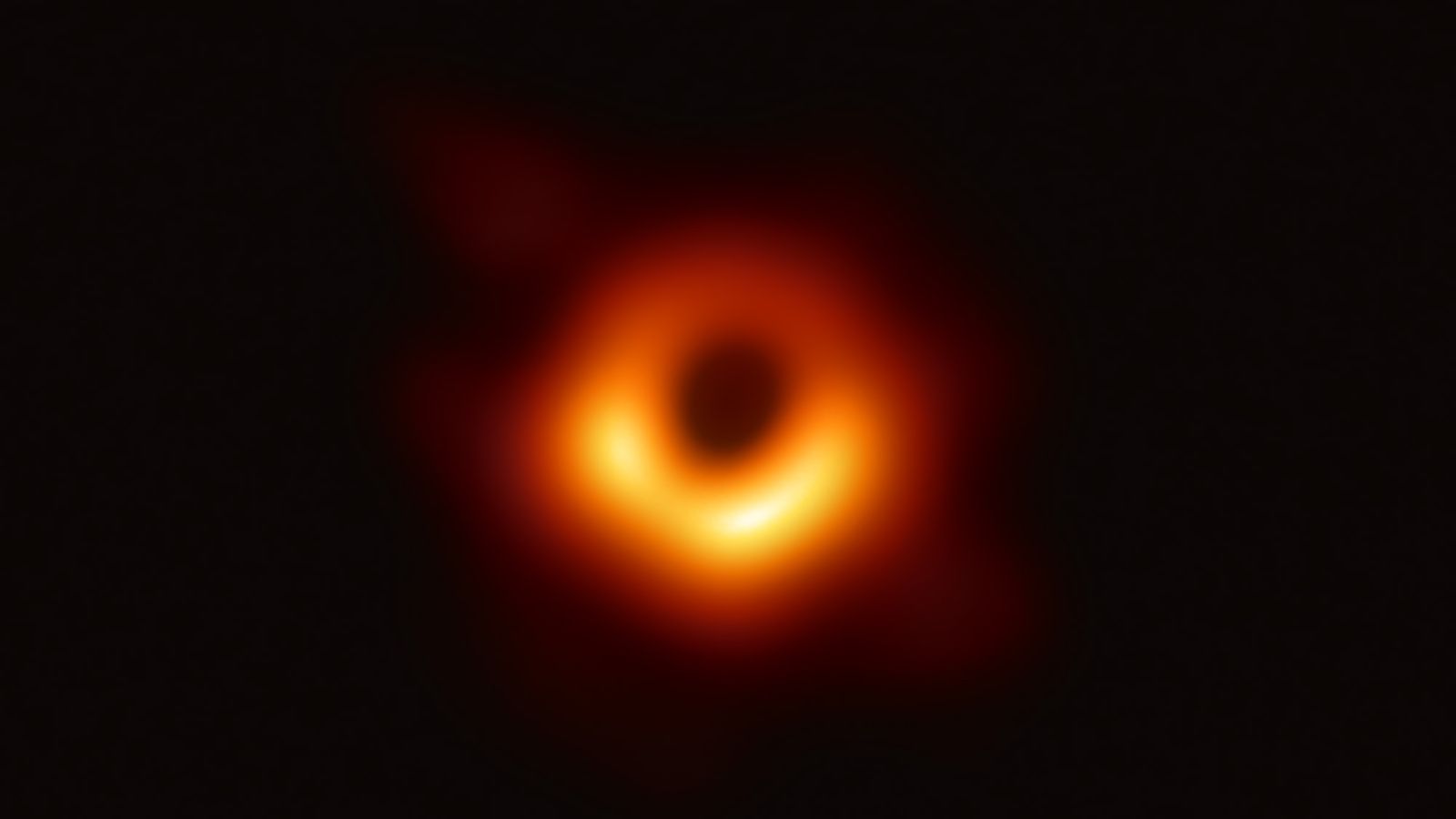
- Cover image: Sagittarius A* by the Event Horizon Telescope Collaboration (2022). ESO/Public domain. eso.org