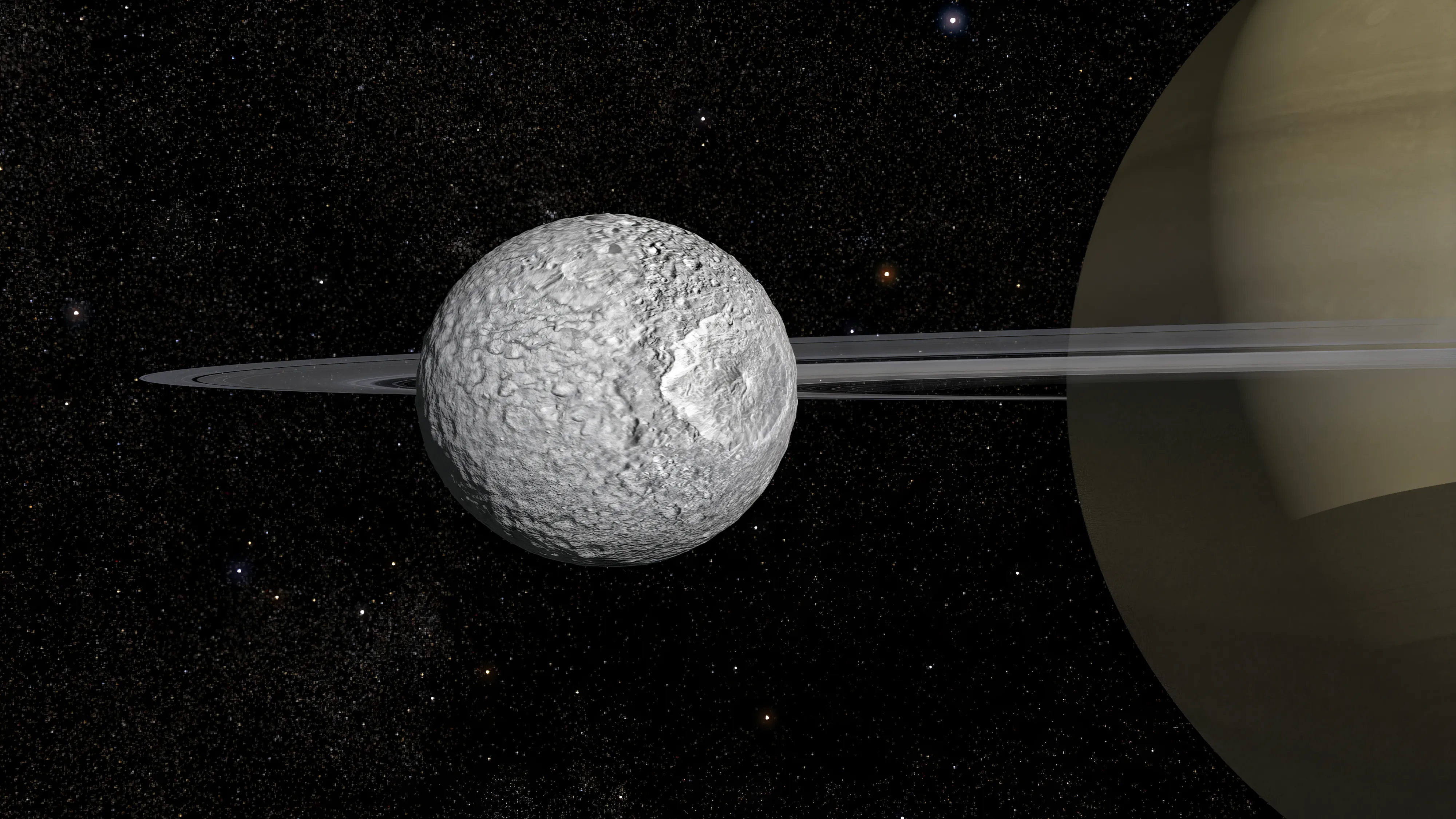
Saturn has 274 moons. Most of them are anonymous chunks of ice that nobody has ever seen close-up. A few are famous. Enceladus, with its tiger-stripe fractures and water-vapor geysers. Titan, with its hydrocarbon lakes and dense atmosphere. Iapetus, with its bizarre two-toned coloring and an equatorial ridge no one can explain.
Mimas, until recently, was famous for one thing: it looks like the Death Star. A 130-kilometer impact crater, Herschel, dominates one hemisphere, with a central peak rising six kilometers above the floor. The impact that produced it nearly shattered the moon entirely. For decades, scientists looked at this battered surface and concluded that Mimas must be frozen solid all the way through. A geologically dead, mid-sized icy moon. A cosmic fossil.
In February 2024, Nature Astronomy published a paper that overturned that view. Mimas has a global subsurface ocean. And the ocean is less than 25 million years old.
The Mimas paradox
Of all the mid-sized moons in Saturn's system, Mimas was the one that, on paper, should have been the most active. It is the closest of the major moons to Saturn, orbiting at just 186,000 kilometers, less than half the Earth-Moon distance, and its orbit is significantly eccentric.
Both of these factors should produce intense tidal heating. As Mimas swings closer to and farther from Saturn during each orbit, the planet's gravity stretches and squeezes it. The friction from that flexing converts orbital energy into heat. The math says that Mimas should be experiencing substantially more tidal heating than its larger and slightly more distant neighbor Enceladus.
And yet, Enceladus is the active one. Enceladus has the tiger-stripe fractures, the south-polar geysers, the subsurface ocean that has been confirmed for over a decade. Mimas has the Death Star crater and apparently nothing else.
By every model of tidal heating, Mimas should have been Enceladus. It looked, instead, like a frozen rock.
The standard explanation was that Mimas froze early. Once a moon's ice shell becomes too cold and rigid to flex, the tidal forces no longer dissipate energy as friction, they just stretch the moon elastically, like ringing a bell. The energy bounces back rather than converting to heat. In this picture, Mimas missed its window. By the time it might have warmed up enough to develop an ocean, Saturn's orbital configuration had stabilized and the tidal heating dropped below the threshold needed to do anything.
The wobble
In 2014, a careful measurement of Mimas's libration, the slight wobble in its rotation as it orbits Saturn, showed something unexpected. The wobble was nearly twice as large as it should have been for a solid body.
Two possibilities existed. The first was that Mimas had a strangely elongated core, shaped like a rugby ball, that produced the extra wobble through its asymmetric mass distribution. The second was that Mimas's ice shell was decoupled from its rocky interior by a layer of liquid water, a subsurface ocean that allowed the shell to slip relative to the core, amplifying the libration.
At the time, most scientists bet on the rugby-ball core. The Herschel crater is too well preserved for the ice shell to be thin or warm. A 20-30-kilometer-thick ice shell with no underlying liquid was consistent with both the crater's preservation and the moon's thermal history.
The orbital drift
The decisive measurement came from a different direction. Valéry Lainey and colleagues at the Paris Observatory analyzed the precise position of Mimas's orbit using thirteen years of Cassini data. The orbit of Mimas does not just trace an ellipse; the ellipse itself slowly rotates around Saturn, a phenomenon called precession. The rate of that precession depends sensitively on the distribution of mass inside the moon. A rugby-ball core and a liquid ocean predict different precession rates.
The Cassini data showed a precession rate that matched the ocean hypothesis exactly. The rugby-ball model was excluded at high statistical significance. Mimas has a global subsurface ocean, beneath an ice shell 20 to 30 kilometers thick.
But the most striking feature of the result was the ocean's age. To preserve the Herschel crater in its current state, sharp walls, a tall central peak, no slumping or relaxation, the ice shell above the ocean must be cold and thick. That means the ocean cannot have existed for long enough to thermally couple with the surface. The modeling indicated that the ocean is between 2 and 25 million years old. Geologically, this is essentially yesterday.
How does a moon develop an ocean in 25 million years?
The answer, the Lainey team proposes, is recent orbital chaos. Sometime in the past 25 million years, Mimas entered a brief chaotic resonance with one of its larger neighbors, possibly Tethys or Dione. The resonance increased Mimas's orbital eccentricity, increasing the amplitude of the tidal flexing, and triggering enough heating to melt the interior.
That same heating mechanism is now slowly winding down. As the ocean dissipates orbital energy through internal friction, Mimas's orbit will become more circular, the tidal stretching will decrease, and eventually the heat source will turn off. The ocean will then begin to refreeze. As water turns to ice, it expands, and that expansion will fracture the ice shell from below, producing the kinds of canyons and ridges visible on moons like Charon and Dione.
In other words, what we are seeing on Mimas today is not a stable equilibrium. It is a snapshot of a moon in mid-transition, on its way to becoming something different. The Death Star face will eventually be replaced by a network of cracks and ridges as the refreezing ocean reshapes the surface.
Mimas is an Enceladus in waiting. Or perhaps an Enceladus on its way out. The window in which the ocean exists may close in a few tens of millions of years.
What this means for habitability
A subsurface ocean is one of the necessary conditions for life as we understand it. Liquid water provides a medium for chemistry to happen. If the ocean has access to chemical disequilibrium, from hydrothermal vents on its sea floor, for instance, it could in principle support metabolism.
Mimas's ocean is young. Twenty-five million years is far too short for life to have evolved from scratch, the comparable interval on Earth, after the Moon-forming impact, was about 200 million years before LUCA appears in the fossil record. But Mimas could in principle inherit organic chemistry from earlier impacts on its surface, and the freshly formed ocean could be doing prebiotic chemistry right now.
More importantly, the discovery of an ocean on Mimas, a moon nobody expected to have one, reshapes the question of where else we should be looking. If a small, ancient-looking moon like Mimas can hide a global ocean for 25 million years before any surface activity reveals it, then the population of "ocean worlds" in the outer solar system is almost certainly larger than the population we have currently identified.
The candidates
The current confirmed ocean worlds in the solar system are: Europa, Ganymede, and Callisto (all Galilean moons of Jupiter); Enceladus and Titan (Saturn); Triton (Neptune, tentatively); Pluto and Charon (tentatively, based on geological evidence); and now Mimas. That is at least eight, possibly more, ocean-bearing worlds within our own solar system. Most of them are smaller than Earth's continents.
The moons of Uranus, Miranda, Ariel, Umbriel, Titania, and Oberon, are largely unexplored, with all close-range data coming from Voyager 2's brief 1986 flyby. Modeling suggests several of them, particularly Ariel, may host subsurface oceans of their own. A dedicated Uranus orbiter is the highest-priority planetary science mission of the next decade, with a possible 2031-2032 launch window.
Mimas's surprise ocean changes the prior. Before 2024, ocean worlds were thought to require obvious surface activity, fractures, plumes, recent geology. After 2024, that requirement is gone. Any sufficiently large icy moon with a recent history of orbital chaos could be hiding one.
The Death Star moon was hiding an ocean it did not have a million years ago. The frozen worlds are not all what they appear.
Frequently Asked Questions
Why is Mimas called the Death Star moon?
Mimas's most prominent feature is the Herschel crater, a 130-kilometer impact basin with walls 5 kilometers high and a central peak rising 6 kilometers from the crater floor. The crater dominates one hemisphere of the 400-kilometer moon, giving it a striking resemblance to the Death Star battle station from the Star Wars films. The impact that created Herschel was so violent that simulations show Mimas would have shattered entirely if the impactor had been only slightly larger or faster.
How was the Mimas ocean detected?
The detection came from precise measurements of Mimas's orbital precession, the slow rotation of its elliptical orbit around Saturn. Valéry Lainey and colleagues analyzed thirteen years of Cassini data and found that the precession rate could only be explained by a global subsurface ocean beneath an ice shell 20-30 kilometers thick. A previously proposed alternative, that Mimas has an elongated "rugby ball" rocky core, was excluded by the data at high statistical significance.
How old is the Mimas ocean?
The modeling indicates that the ocean is between 2 and 25 million years old, geologically very young. The preservation of the Herschel crater's sharp features requires a thick, cold ice shell above the ocean, which means the ocean cannot have existed long enough to thermally relax the surface. This makes Mimas's ocean the youngest known subsurface ocean in the solar system.
What caused Mimas to develop an ocean?
The leading explanation is a recent chaotic orbital resonance with one of Mimas's larger neighbors, possibly Tethys or Dione. The resonance increased Mimas's orbital eccentricity, which amplified tidal heating from Saturn enough to melt the moon's interior. The same mechanism is now slowly dissipating, as the ocean's internal friction circularizes Mimas's orbit. Eventually the heating will drop below the threshold needed to maintain the ocean, and it will begin to refreeze.
Could life exist in Mimas's ocean?
The ocean is too young, 25 million years at most, for life to have evolved from scratch within it. By comparison, life on Earth required at least 100-200 million years after stable liquid oceans formed. However, Mimas could in principle inherit organic chemistry from impacts on its icy surface, and the freshly formed ocean could be hosting prebiotic chemistry. The chemistry alone, however, does not yet make this a strong target for astrobiology compared to Europa or Enceladus.
What does the Mimas discovery mean for other moons?
Before 2024, ocean worlds in the solar system were expected to show some form of surface activity, fractures, plumes, or recently resurfaced terrain. Mimas's ocean is hidden beneath an ancient, cratered surface with no obvious surface signature. The discovery suggests that other small icy moons, particularly the largely unexplored moons of Uranus, may also harbor subsurface oceans that we have not yet detected. The population of ocean worlds in our solar system is likely larger than the eight we have currently confirmed.
Continue Exploring
- NASA Is Sending a Nuclear Drone to Fly Across Another MoonDragonfly, a car-sized rotorcraft powered by plutonium, will spend years flying between the dunes and craters of...
Sources
- Lainey et al. (2024). "A recently formed ocean inside Saturn's moon Mimas." link.
- Tajeddine et al. (2014). "Constraints on Mimas' interior from Cassini ISS libration measurements." link.
- Rhoden et al. (2017). "Obliquity tides may drive heat production on Saturn's moon Mimas." link.
- Hemingway et al. (2018). "The interior of Enceladus." link.
- Cassini Mission Final Report (2018). "NASA / JPL Cassini Solstice Mission Final Report." link.