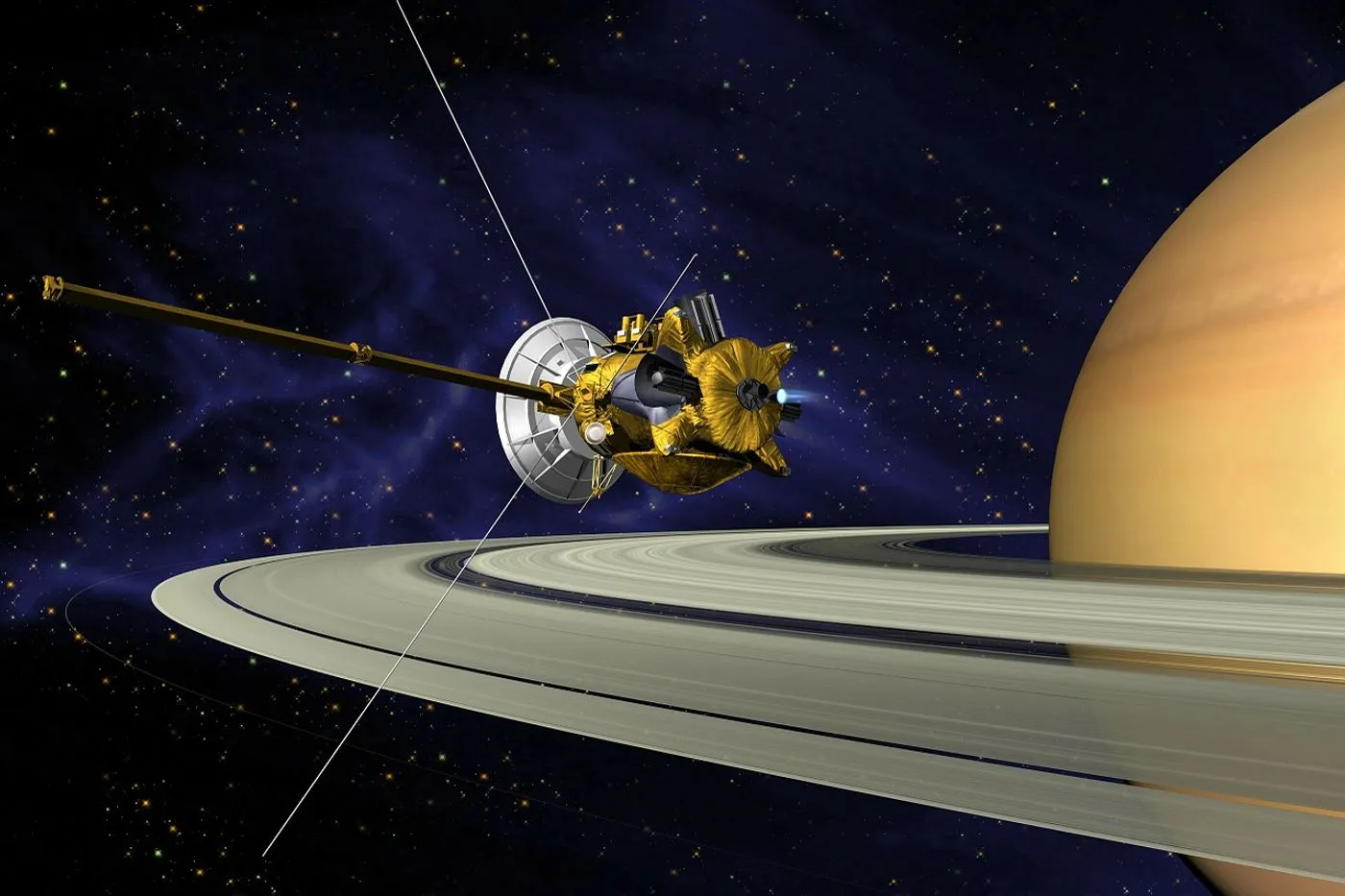
A planet cannot change how fast it spins. The bulk rotation of a world the mass of Saturn is one of the most stable quantities in nature, a flywheel of ninety-five Earths that no wind, no storm, no passing comet could nudge in a human lifetime. And yet, for forty years, every time a spacecraft measured the length of Saturn's day, it came back with a different number. Voyager said one thing in 1980. Cassini said another in 2004. Then Cassini changed its mind again, and the two hemispheres of the planet disagreed with each other. Saturn appeared to be breaking one of the simplest rules in physics.
It was not. The planet had been keeping perfect time all along. The error was in the clock we were reading, and untangling it took two of the most ingenious measurements in modern planetary science: one that listened to waves rippling through Saturn's rings, and one, completed in 2026, that mapped the faint infrared glow of its aurora with the James Webb Space Telescope.
The Clock That Would Not Keep Time
The trouble began with radio. Like Earth and Jupiter, Saturn emits a pulsing burst of low-frequency radio waves from its polar regions, a phenomenon called Saturn Kilometric Radiation, or SKR. On the gas giants, this emission is tied to the magnetic field, and the magnetic field is anchored deep in the metallic, electrically conducting interior where the bulk of the planet rotates. Track the radio pulse, the reasoning went, and you track the spin of the deep interior. It is the trick that gives us the rotation rates of every giant planet, because their visible cloud tops are not solid and offer nothing fixed to time.
When Voyager 1 swept past Saturn in 1980, Michael Desch and Michael Kaiser timed the SKR pulse and published a figure that would stand as the planet's official day for a generation: 10 hours, 39 minutes, and 24 seconds, give or take seven seconds. It was precise, it was repeatable across the encounter, and it seemed unassailable.
Then Cassini arrived in 2004, carrying instruments far more sensitive than anything Voyager had flown. It listened to the same radio pulse over months, then years. And the period drifted. By the time the dust settled, Cassini was measuring a day roughly six minutes longer than Voyager's, a difference of about one percent. Six minutes does not sound like much. For the bulk rotation of a planet, it is a catastrophe. There is no physical mechanism that can slow a gas giant's spin by six minutes in twenty-four years. Something was wrong with the assumption, not with Saturn.
Six minutes does not sound like much. For the bulk rotation of a planet, it is a catastrophe.
A Magnetic Field Too Perfect to Read
The deeper problem is geometry, and it is unique to Saturn. On Earth and Jupiter, the magnetic axis is tilted away from the rotation axis, by about eleven degrees in Earth's case. That tilt is what makes the radio clock work: as the planet turns, the offset magnetic pole sweeps around like the beam of a lighthouse, producing a clean once-per-rotation pulse. Saturn has almost no tilt at all. Its magnetic axis is aligned with its spin axis to better than a tenth of a degree, the most axisymmetric planetary magnetic field known.
This is itself a deep mystery, one that brushes against a theorem by the physicist Thomas Cowling stating that a perfectly axisymmetric field cannot sustain itself through dynamo action. Saturn's field skirts impossibly close to that limit. But for our purposes the consequence is simpler and more frustrating: a perfectly symmetric magnetic field has no feature to track. The lighthouse has no beam. Whatever periodic signal SKR carries cannot be coming cleanly from the deep rotating interior, because that interior, as far as the magnetic field is concerned, looks the same from every angle.
So what was producing the radio pulse, and why did it keep changing? Cassini's longer baseline delivered the decisive clue. In 2009, Donald Gurnett and his colleagues at the University of Iowa reported something that should have been impossible if the signal traced the interior: Saturn's northern and southern hemispheres were broadcasting at different rates. The south pulsed with a period near 10.8 hours, the north near 10.6 hours. A single rigid interior cannot rotate at two speeds at once. The radio clock was not timing the planet's body at all. It was timing something in the atmosphere above each pole, and those two somethings were independent.
The Seasons Give It Away
The hemispheres did not just disagree. They traded places. As Saturn approached its August 2009 equinox, the two SKR periods drifted toward each other, briefly converging near 10.7 hours, and then crossed over. The hemisphere that had been faster became the slower one. Whatever was setting the radio period was responding to sunlight, to the slow march of Saturn's thirty-year seasons. A planet's deep rotation does not care what season it is. An atmosphere does.
This was the moment the field accepted that SKR could not deliver the true length of Saturn's day. The radio period was a property of the upper atmosphere and the magnetosphere riding on top of it, a seasonal, hemispheric, drifting signal that merely lived near the rotation rate without being it. The honest conclusion was uncomfortable: after three spacecraft and three decades, no one actually knew how fast Saturn rotated. The single most basic number about the planet, the length of its day, was missing.
After three spacecraft and three decades, no one actually knew how fast Saturn rotated.
Listening to the Rings
The answer, when it came, arrived from an unexpected direction. If you cannot read the rotation off the magnetic field, perhaps you can feel it through gravity. Saturn, like a struck bell, oscillates. Sound waves and gravity waves ring through its interior at specific frequencies set by its internal structure and its spin. These oscillations are far too subtle to see on the planet's face. But Saturn happens to be wrapped in the most sensitive seismograph ever built: its rings.
As the planet pulses, its gravitational field flickers ever so slightly in a pattern that rotates with it. Out in the rings, individual particles in their orbits feel that flickering. At the precise radius where a particle's orbit resonates with one of Saturn's internal oscillations, energy accumulates and organizes itself into a spiral wave, a permanent ripple frozen into the ring, its tightness and its rotation speed encoding the frequency of the planetary mode that made it. The rings are a recording of the planet's own vibrations.
In 2019, Christopher Mankovich, then a graduate student at the University of California, Santa Cruz, working with Jonathan Fortney, Mark Marley, and Naor Movshovitz, read that recording. Using Cassini's Visual and Infrared Mapping Spectrometer to watch stars wink behind the rings, the team resolved more than twenty fine spiral density waves in the C ring and matched a set of them to fundamental oscillation modes of Saturn itself. From the pattern speeds of those waves, they extracted the one quantity that had eluded radio for forty years: the rotation period of Saturn's deep interior.
The number was 10 hours, 33 minutes, and 38 seconds, with an uncertainty of about two minutes either way. Saturn's true day was several minutes shorter than even Voyager had claimed. The planet had never been slowing down or speeding up. It had simply never been measured correctly, because the only instrument we had trusted, the magnetic field, was the one instrument Saturn had rendered mute. As the Cassini project scientist Linda Spilker put it, they used the rings to peer inside the planet, and out popped a fundamental quantity everyone had assumed was lost.
Webb Finds the Engine
Ring seismology settled what the real rotation rate is. It did not explain why the radio signal misbehaves in the first place, why the two hemispheres pulse at their own drifting, season-following rhythms. To answer that, you have to watch the atmosphere where the radio period is actually born, in the thin, electrically active upper layers near the poles. And in 2026, a team led by Tom Stallard at Northumbria University did exactly that, turning the James Webb Space Telescope on Saturn's northern aurora.
Webb's near-infrared spectrograph, NIRSpec, is sensitive to a molecule that serves as a natural probe of conditions in Saturn's upper atmosphere: the trihydrogen cation, H3+. This ion forms where auroral particles slam into the atmosphere, and the infrared light it emits acts as a combined thermometer and density gauge. By staring at the northern auroral region continuously for a full Saturnian day, the team built the first high-resolution maps of temperature and ion density across the entire auroral zone, observations roughly ten times more precise than anything achieved before, published in the Journal of Geophysical Research: Space Physics in March 2026.
What the maps revealed was not a smoothly glowing ring but a patchwork of localized hot and cold regions, places where the atmosphere was being actively heated and cooled in step with the aurora. The aurora deposits heat unevenly. That uneven heating drives winds. Those winds, sweeping charged particles through Saturn's magnetic field, generate electrical currents. Those currents feed the aurora, which deposits more heat, which drives more wind. Stallard's team described it as a planetary heat pump, a self-sustaining feedback loop running in the upper atmosphere of each pole.
The aurora heats the atmosphere, the winds make the currents, the currents power the aurora, and so it goes on.
This loop is the source of the rogue clock. The pattern of auroral heating and the winds it drives set the rhythm of the radio emission, and because the heating depends on sunlight, the rhythm shifts with the seasons and differs between the sunlit and shadowed hemispheres. The SKR period is the heartbeat of an atmospheric engine, not the spin of a planet. Voyager and Cassini had been timing the weather above Saturn's poles and mistaking it for the turning of the world below.
Why the Distinction Matters
It would be easy to treat all this as a long correction to a footnote, the length of a day adjusted by a few minutes. But the rotation rate of a giant planet is not a footnote. It anchors nearly everything else we calculate about the interior. The planet's oblateness, the slight squashing of its poles, depends on how fast it spins. So does the interpretation of its gravity field, the depth of its winds, and the boundary between the molecular outer envelope and the deep metallic layers where the magnetic field is generated. Get the rotation wrong by a percent and the inferred internal structure shifts with it.
The faster period from ring seismology implies a particular distribution of mass and a particular depth for Saturn's powerful east-west jet streams, refining models that had been built on the flawed radio value. Meanwhile, the JWST result reaches in the opposite direction, outward into the magnetosphere, explaining how the upper atmosphere and the space environment couple together in a feedback loop that may operate on other magnetized planets too. The two measurements bracket Saturn: one fixes the planet's true spin from the inside, the other explains why our oldest instrument for measuring spin was lying to us from the outside.
There is a quiet lesson in the whole affair. The most basic-seeming numbers can be the hardest to pin down, and the right answer sometimes requires abandoning the obvious instrument entirely. To learn how fast Saturn turns, no one ended up watching Saturn turn. They watched its rings ring and its aurora breathe.
A planet cannot change how fast it spins. Saturn never did. It only waited four decades for us to stop reading the wrong clock, and to learn instead to listen to its rings and watch its aurora breathe.
Frequently Asked Questions
How long is a day on Saturn?
The best measurement of Saturn's true interior rotation period is 10 hours, 33 minutes, and 38 seconds, with an uncertainty of about two minutes, derived from ring seismology by Mankovich and colleagues in 2019. This is several minutes shorter than the older Voyager radio value of 10 hours, 39 minutes, 24 seconds.
Why did Saturn appear to change its rotation rate?
The measurements relied on Saturn Kilometric Radiation, a pulsing radio signal from the poles. That signal is produced by Saturn's upper atmosphere and magnetosphere, not its deep interior. Because atmospheric conditions shift with the seasons and differ between hemispheres, the radio period drifted and even differed north to south, giving the false impression that the planet itself was changing speed.
Why can't Saturn's magnetic field reveal its rotation rate?
On Earth and Jupiter, the magnetic axis is tilted relative to the spin axis, so it sweeps around like a lighthouse beam and produces a clean once-per-rotation signal. Saturn's magnetic axis is aligned with its rotation axis to better than a tenth of a degree, making the field essentially axisymmetric. With no offset to track, the field provides no usable timing signal for the bulk rotation.
How did the rings reveal Saturn's true spin?
Saturn oscillates internally like a bell, and these vibrations create a rotating pattern in its gravitational field. Ring particles at resonant orbital radii respond by forming spiral density waves. By measuring the speeds of these waves in the C ring with Cassini's VIMS instrument, researchers worked backward to the frequencies of Saturn's internal modes and thereby its interior rotation rate.
What did the James Webb Space Telescope actually find?
In 2026, a team led by Tom Stallard used JWST's NIRSpec to map the infrared emission of the H3+ ion across Saturn's northern aurora over a full Saturnian day. The maps showed localized auroral heating that drives winds, which generate electrical currents, which power the aurora in a self-sustaining feedback loop. This atmospheric engine sets the variable radio period, explaining why the apparent rotation rate kept changing.
Does this mean Saturn's rotation is actually constant?
Yes. The bulk rotation of Saturn's interior is effectively constant on human timescales, as physics requires. Only the atmospheric and magnetospheric signals that earlier missions timed were variable. The planet was never speeding up or slowing down; the instruments were measuring its weather rather than its spin.
Continue Exploring
- The Collision That Might Never HappenFor decades, astronomers told a confident story: in about five billion years, the Milky Way and Andromeda would crash...
- Hubble's Look Inside the Largest Planet Nursery Ever FoundA young star 1,000 light-years away is wrapped in a disk so vast it could swallow forty solar systems. When Hubble...
- The Planet We Have Never SeenA handful of frozen worlds in the far outer solar system trace orbits that point the same way, as if pulled by...
Sources
- Stallard et al. (2026). "JWST/NIRSpec Reveals the Atmospheric Driver of Saturn's Variable Magnetospheric Rotation Rate, J. Geophys. Res. Space Physics." link.
- Northumbria University (2026). "Scientists solve decades-long mystery about why Saturn appears to change its spin." link.
- Mankovich et al. (2019). "Cassini Ring Seismology as a Probe of Saturn's Interior. I. Rigid Rotation, ApJ 871, 1." link.
- UC Santa Cruz News (2019). "Waves in Saturn's rings give precise measurement of planet's rotation rate." link.
- Gurnett et al. (2009). "Discovery of a north-south asymmetry in Saturn's radio rotation period, Geophys. Res. Lett. 36, L16102." link.
- Desch & Kaiser (1981). "Voyager measurement of the rotation period of Saturn's magnetic field, Geophys. Res. Lett. 8, 253." link.
- NASA/JPL (2011). "Cassini Finds Saturn Sends Mixed Signals." link.