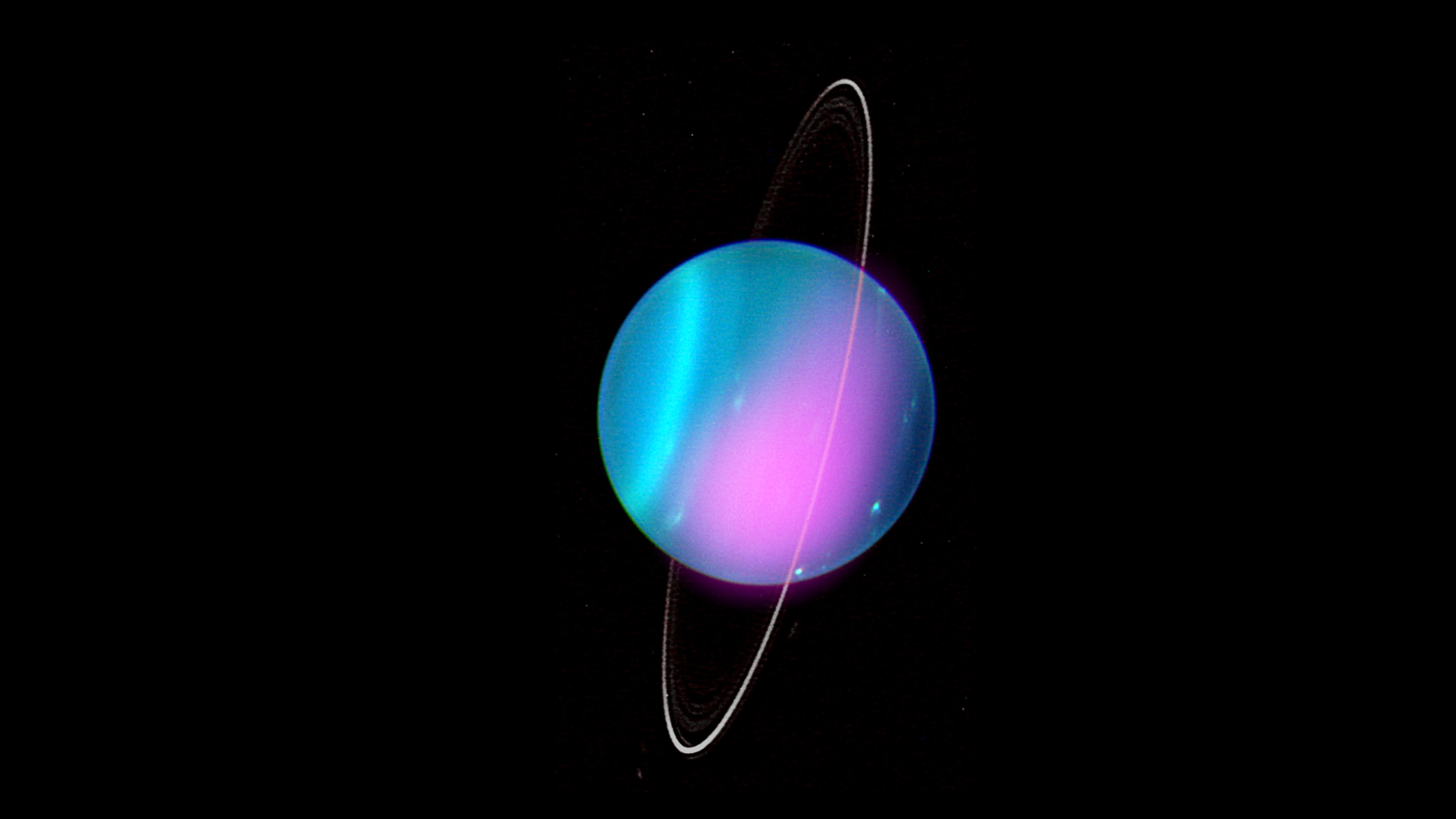
The Encounter That Defined a Planet
On January 24, 1986, NASA's Voyager 2 spacecraft passed within 81,500 kilometers of Uranus's cloud tops. The spacecraft had been launched in 1977 on a Grand Tour of the outer solar system; by the time it reached Uranus, it was nine years into its mission. The Uranian encounter lasted, for the purposes of close observations, only a few hours. After the flyby, Voyager 2 continued on toward Neptune, which it would reach in 1989. It has not been back. No other spacecraft has visited Uranus before or since.
The 1986 flyby returned what is, to this day, almost the entirety of the close-up data we have on the seventh planet. The cameras revealed a pale blue-green sphere, almost featureless to the eye, a planet apparently lacking the dramatic storms and banded cloud patterns of Jupiter, Saturn, or Neptune. The magnetometer recorded a strangely tilted and offset magnetic field. The instruments cataloged five new moons (bringing the total to fifteen at the time) and two previously unknown rings. The temperature measurements placed Uranus at the coldest atmosphere of any planet in the solar system: roughly minus 224 degrees Celsius at the cloud tops, colder than even Neptune despite being closer to the Sun.
For four decades, these observations have been the foundation. Every textbook description of Uranus, every artist's rendering, every model of its interior and atmosphere has descended from those hours of data. The problem is that Voyager 2 arrived during, as we now understand, one of the rarest possible moments to study the planet, and the picture we built from that snapshot was systematically distorted.
The Magnetic Field We Got Wrong
Among the strangest things Voyager 2 found at Uranus was its magnetic field. On most planets, Earth included, the magnetic field is roughly aligned with the rotational axis and centered on the planet's core. At Uranus, Voyager 2 measured a magnetic field tilted at 59 degrees from the rotational axis and offset from the planet's center by roughly one-third of its radius. This produced an oddly asymmetric magnetosphere that, in the Voyager 2 data, appeared smaller and more compressed than any model had predicted.
This puzzled scientists for thirty-eight years. Why would a planet have such a malformed magnetic field? Theories proliferated. Maybe Uranus had been struck early in its history by an impactor that disrupted its core. Maybe its magnetic field originated not in the central core but in an electrically conducting mantle layer. Maybe its interior structure was fundamentally different from the other gas giants in a way no one had anticipated.
In 2024, a team led by Jamie Jasinski at NASA's Jet Propulsion Laboratory revisited the original Voyager 2 magnetometer data and asked a question that nobody had thought to ask: what was the solar wind doing during the flyby? The solar wind is the constant stream of charged particles flowing outward from the Sun, and the pressure it exerts on a planet's magnetosphere determines that magnetosphere's shape. Most of the time, the solar wind is steady. Occasionally, the Sun produces a coronal mass ejection or other transient event that compresses every magnetosphere in the solar system by a substantial fraction.
Jasinski's team reconstructed the solar conditions during January 24, 1986, by correlating archive data from other instruments operating at the time. Their conclusion, published in Nature Astronomy in November 2024, was that Voyager 2 had crossed Uranus's magnetosphere at a moment when the solar wind was unusually strong, among the strongest 4 percent of observations recorded over the past four decades. The magnetosphere of Uranus had been compressed by this transient event to roughly 20 percent of its typical size during the few hours Voyager 2 was measuring it.
The implication is that the Voyager 2 picture of Uranus's magnetosphere is not what the planet usually looks like. It is what the planet looks like during a once-in-decades space-weather event. Under normal conditions, the magnetosphere is larger, more variable, and almost certainly more complex than the 1986 data suggested. Forty years of textbook descriptions need to be revised.
For thirty-eight years, every model of Uranus's magnetic field was trying to explain a measurement made during the worst possible four hours to make it. The planet looks nothing like that the rest of the time.
The Atmosphere That Was Not as Quiet as It Looked
The other defining image of Uranus from 1986 was its blandness. Where Jupiter has the Great Red Spot, where Neptune has the Great Dark Spot, Uranus appeared almost featureless, a smooth blue-green ball with only the faintest of cloud structures. This was real, but it was also a function of timing. Uranus's axis is tilted nearly 98 degrees from vertical; the planet essentially rolls along its orbit on its side. In 1986, Uranus was near solstice, with its south pole pointing almost directly at the Sun. One hemisphere was in eternal daylight; the other was in 42-year night. The atmospheric circulation patterns we observed were the quiescent ones of a hemisphere baking in a stagnant pole-on solar heating.
Subsequent observations from the Keck Observatory, Hubble, and the James Webb Space Telescope have shown that as Uranus has rotated toward equinox over the past four decades, its atmosphere has become substantially more active. A 2014 Keck observation by Imke de Pater and colleagues documented eight enormous storms in the northern hemisphere, the largest of which was so bright that amateur astronomers could observe it in their backyards. Hubble has tracked the slow accumulation of hazes and aerosols at the north pole as it has rotated toward the Sun; the polar cap, which appeared dark in 2002, was brightly reflective by 2022.
The conclusion of two decades of accumulating Earth-based observations, published most rigorously in a 2025 Hubble paper by Erich Karkoschka and collaborators, is that Uranus has well-defined seasonal cycles driven by its extreme axial tilt. Cloud activity peaks near equinox (the most recent one was in 2007). Aerosol distribution shifts dramatically with the seasons. The planet is, in the technical sense of the word, dynamic, just on a 42-year-per-season schedule that no flyby could resolve.
What the Interior Probably Looks Like
The standard story has been that Uranus and its sibling Neptune are "ice giants", distinct from the "gas giants" Jupiter and Saturn by their composition. The standard model has them as rocky cores surrounded by deep mantles of water, ammonia, and methane ices, with thin envelopes of hydrogen and helium above. The pressures in the mantle are high enough that the methane molecules are theorized to dissociate into carbon, which then crystallizes, producing the famous "diamond rain" inside the planet.
A 2025 paper in Astronomy & Astrophysics by Luca Morf and Ravit Helled at the University of Zurich revisited this picture using a Bayesian model that generates random interior compositions and tests them against the available observational constraints (gravity, magnetic field, atmospheric chemistry, rotation rate). Their conclusion was that the standard ice-giant picture is one possibility, but the data permit a much wider range of compositions. The rock-to-water ratio of Uranus, on their analysis, could be anywhere from 0.04 (almost all water, basically a giant comet) to 3.92 (almost all rock, a giant terrestrial planet with a thin hydrogen atmosphere). The standard 50/50 estimate sits in the middle of an enormous spread that the data simply cannot distinguish.
This matters because Uranus and Neptune are the only examples of "ice giant" planets we can study up close. They are also one of the most common types of exoplanet, Kepler showed that "sub-Neptunes" and "mini-Neptunes" are everywhere in the galaxy. If we do not know what Uranus is actually made of, we do not know what most exoplanets in the galaxy are made of either.
The 29 Moons
Uranus had five known moons before Voyager 2 arrived. Voyager 2 added ten more. Subsequent observations from ground-based telescopes added more, and the James Webb Space Telescope identified one more in February 2025 (currently designated S/2025 U1, awaiting an official name). The current total is 29.
The five largest, Miranda, Ariel, Umbriel, Titania, and Oberon, are the most studied. Voyager 2 returned grainy images of all five. The terrain on Miranda in particular has long been one of the more peculiar features of the outer solar system: a small icy body with grooved, terraced regions that look as though they were stitched together from incompatible pieces. The leading explanation is that Miranda may have been shattered by an impact early in its history and then reassembled, with the original fragments tumbling into their current geological positions.
More recent observations, including infrared spectroscopy from JWST and adaptive-optics imaging from the Very Large Telescope, have hinted that several of the larger Uranian moons may host internal liquid-water oceans beneath their icy crusts. Modeling suggests that Ariel, in particular, has both the tidal heating budget and the chemical conditions to potentially maintain a subsurface ocean. This is not yet confirmed; it would require a future spacecraft to verify. But it raises the prospect that Uranus is not just a planet with unusual axial tilt and a weird magnetic field; it may also be a system of potentially habitable icy moons.
The Window That Is About to Open
The most pressing fact about future Uranus exploration is that there is a launch window opening in 2031 and 2032 that will not return for another twelve years afterwards. A spacecraft launched during this window could use Jupiter for a gravity assist, reducing the travel time from Earth to Uranus by several years. After 2032, the planetary alignment closes and any future mission would face a much longer cruise.
NASA's most recent Planetary Science Decadal Survey, published in 2022, identified a Uranus orbiter and probe as the top-priority planetary mission for the coming decade. The science return is comparable to what a Jupiter or Saturn orbiter has delivered: characterize the magnetic field over a full orbital cycle, sample the atmospheric composition, image the moons in detail, search for subsurface oceans. The China National Space Administration has also announced interest, with a proposed Tianwen-4 mission to Uranus.
Whether either mission will actually launch in the 2031 to 2032 window is uncertain. The complexities of a Uranus mission are formidable: the cruise alone would take roughly twelve years (with the Jupiter assist; longer without). The radioisotope power source required for an outer-solar-system mission is in limited supply globally. The funding profile for such a mission has historically been hard to sustain across multiple U.S. administrations.
What is certain is that if we do not launch in 2031 or 2032, we lose a window of decades. And the planet we are missing out on, on the latest reanalyses of all available data, is much more interesting than the bland 1986 picture suggested.
Uranus is rolling toward equinox. Its hidden seasons are about to flip. We have a launch window in five years. The planet we have been mostly ignoring for forty years deserves a second look, and the second look is now or never for another decade.
Frequently Asked Questions
When was the only spacecraft visit to Uranus?
NASA's Voyager 2 flew past Uranus on January 24, 1986, passing within 81,500 kilometers of the planet's cloud tops. The encounter lasted only a few hours. No other spacecraft has visited Uranus before or since. The data from that single flyby has been the basis of essentially everything we knew about the planet for the past four decades.
Why was the Voyager 2 data potentially misleading?
A 2024 reanalysis by Jamie Jasinski and colleagues at NASA JPL, published in Nature Astronomy, found that Voyager 2 crossed Uranus's magnetosphere during one of the strongest solar wind events recorded over the past four decades, in the top 4 percent of all observations. The magnetosphere was compressed to roughly 20 percent of its typical size during the flyby. Almost every conclusion drawn about Uranus's magnetic environment from the 1986 data therefore reflects a once-in-decades transient event rather than the planet's normal state.
What is unusual about Uranus's axial tilt?
Uranus's rotational axis is tilted approximately 97.77 degrees from its orbital plane, nearly horizontal. The planet essentially rolls along its orbit on its side. This produces extreme seasons: each pole is in continuous daylight for 42 years, followed by 42 years of total darkness. It is the most extreme axial tilt of any planet in the solar system; Neptune, the second-most-tilted, sits at 28 degrees. The leading explanation is an ancient collision with a Mars-sized body roughly 3 to 4 billion years ago.
How many moons does Uranus have?
29 confirmed moons as of February 2025. The most recent addition, designated S/2025 U1, was discovered by the James Webb Space Telescope and is not yet officially named. The five largest, Miranda, Ariel, Umbriel, Titania, and Oberon, were known before the Voyager 2 flyby. Voyager 2 added ten more. Subsequent ground-based and space-telescope observations have added the rest. Modeling suggests that several of the larger moons, particularly Ariel, may host subsurface liquid-water oceans beneath their icy crusts.
Is Uranus actually an 'ice giant'?
A 2025 study by Luca Morf and Ravit Helled at the University of Zurich, published in Astronomy & Astrophysics, showed that the standard 'ice giant' picture (rocky core, deep water-ammonia-methane mantle, thin hydrogen-helium envelope) is consistent with the observational data, but so are many other possibilities. The rock-to-water ratio of Uranus, on their Bayesian analysis, could be anywhere from 0.04 (almost entirely water) to 3.92 (almost entirely rock). The honest answer is that we do not know what Uranus is actually made of.
When could a new mission to Uranus launch?
A favorable launch window opens in 2031 to 2032, allowing a Jupiter gravity-assist that would reduce travel time to Uranus by several years. After 2032, the planetary alignment closes for over a decade. NASA's 2022 Planetary Science Decadal Survey identified a Uranus orbiter and probe as the top-priority planetary mission. The China National Space Administration has also proposed a Uranus mission (Tianwen-4). Neither has yet been formally funded for the 2031 to 2032 window. The travel time once launched would be approximately 12 years; arrival in the late 2040s.
Continue Exploring
- The Comet That Was Almost GreatIt was billed as the great comet of 2026, a naked-eye visitor from the deep. It delivered a modest glow instead, and in...
- The Third Zone of the Solar SystemBeyond Neptune lies a broad ring of icy worlds that no one confirmed until 1992. It reset the definition of a planet...
- Saturn Kept Changing Its Day, and the Planet Was Never the CulpritFor four decades, every spacecraft that visited Saturn seemed to clock a different length of day, an impossibility for...
- The Death Star Moon Was Hiding an Ocean. Nobody Saw It Coming.Mimas is 400 kilometers across, dominated by a crater so large the impact nearly broke it apart, and looks exactly like...
- The Planet We Have Never SeenA handful of frozen worlds in the far outer solar system trace orbits that point the same way, as if pulled by...
Sources
- Jasinski, J. M. et al. "The anomalous state of Uranus's magnetosphere during the Voyager 2 flyby." Nature Astronomy, 8, 1450 (2024).
- Morf, L. & Helled, R. "Bayesian inference of the interior structure of Uranus." Astronomy & Astrophysics, 694, A123 (2025).
- Karkoschka, E. et al. "Two decades of Hubble observations of Uranus's seasonal atmospheric changes." Icarus, 421, 116035 (2025).
- de Pater, I. et al. "Record-bright storms on Uranus observed by Keck." Icarus, 252, 121 (2015).
- Stone, E. C. & Miner, E. D. "The Voyager 2 encounter with the Uranian system." Science, 233, 39 (1986).
- National Academies. Origins, Worlds, and Life: A Decadal Strategy for Planetary Science and Astrobiology 2023 to 2032. National Academies Press (2022).
- Helled, R. & Fortney, J. J. "The interiors of Uranus and Neptune." Annual Review of Astronomy and Astrophysics, 58, 357 (2020).
- NASA / ESA James Webb Space Telescope observations of the Uranian system, public data release 2024 to 2025.
- Cover image: NASA / JPL, Voyager 2 view of Uranus, January 1986. Public domain.