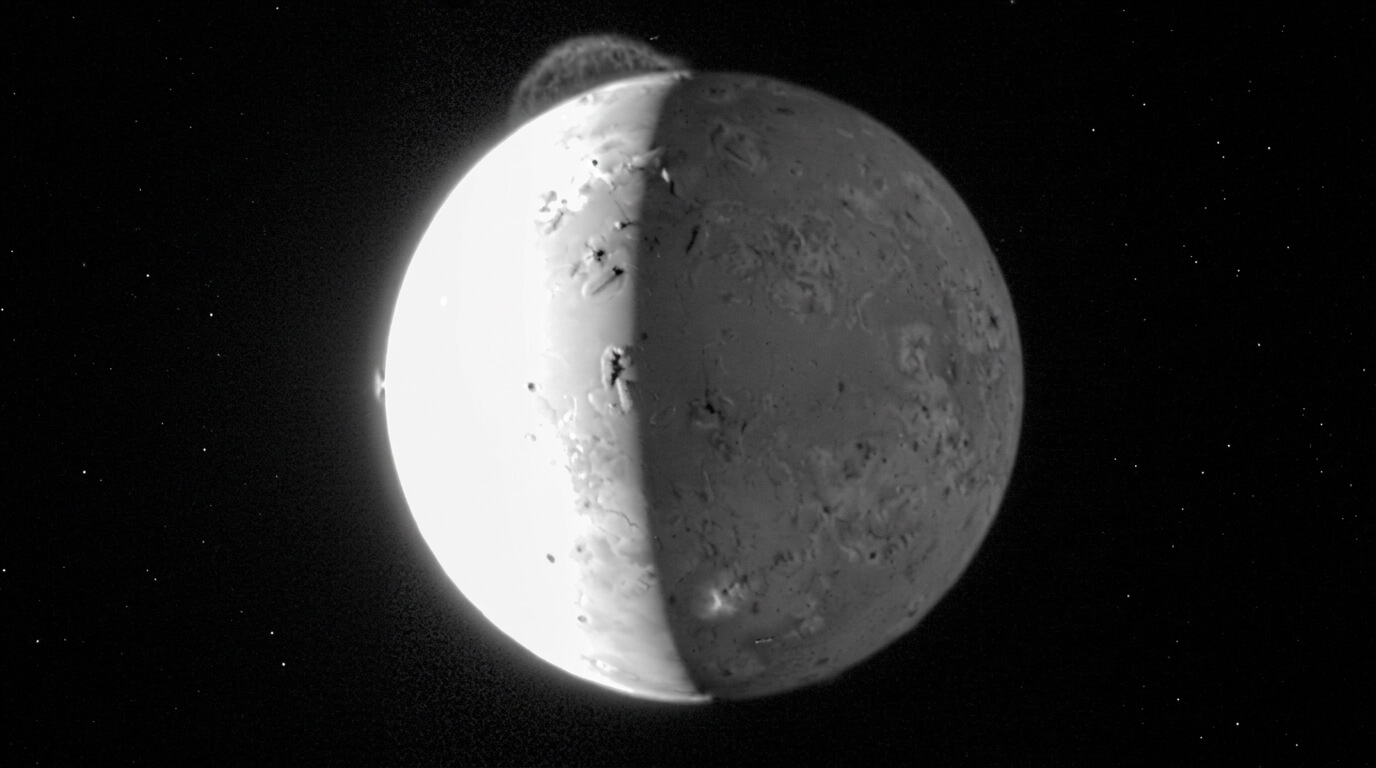
The Plume Linda Morabito Was Not Looking For
On the morning of March 9, 1979, Linda Morabito was processing navigation images at NASA's Jet Propulsion Laboratory. Voyager 1 had completed its closest approach to Jupiter four days earlier, and the spacecraft was now using the giant planet as a gravitational slingshot to redirect itself toward Saturn. Morabito's job was unglamorous and essential: cross-reference the positions of Voyager's images against the positions of background stars to verify the spacecraft's trajectory.
One of the calibration frames was a long-exposure image of Io, the innermost of Jupiter's four large Galilean moons. Morabito brightened the image to bring out the background stars she needed to measure. As the contrast came up, she noticed something at the edge of Io's disk that should not have been there: a crescent-shaped feature rising about three hundred kilometers above the moon's surface, off into space.
She called over her supervisor. Together they ruled out the possibilities. It was not a star. It was not a moon behind Io. It was not an artifact of the camera. It was, by elimination, a column of material erupting from Io's surface and rising to an altitude that no terrestrial volcano has ever achieved. The plume was published in Science in June 1979 with Morabito as first author. It was the first active extraterrestrial volcanism ever observed.
The eruption Morabito had caught was named Pele, after the Hawaiian volcano goddess. By the time Voyager 2 arrived four months later, Pele had stopped erupting and a new plume had appeared somewhere else. Eight more were active simultaneously. Whatever was driving Io's volcanism, it was not a single event. It was the steady state of the moon.
Why Io Should Be Frozen
Io receives roughly 4 percent of the sunlight that reaches Earth. Its equilibrium temperature, calculated from solar input alone, would be approximately minus 143 degrees Celsius, about the same as the surface of Pluto. There is no atmospheric greenhouse to speak of. By every prediction available before 1979, Io should have been a cold, dead, cratered world like our own Moon, geologically inactive for billions of years.
And yet the surface of Io has, on average, fewer impact craters than any other object in the solar system. Not zero, a body sitting in the middle of Jupiter's gravitational field is bombarded by infalling material constantly, but vanishingly few. The reason is that something is resurfacing Io faster than craters can accumulate. Volcanic flows are erasing them. The current best estimate, from Galileo-era and Juno-era imagery comparisons, is that Io's entire surface is repaved on a timescale of roughly one to ten million years. By geological standards, that is real-time turnover.
Whatever is heating Io is not the Sun. It is not the decay of long-lived radioactive isotopes, Io is too small for that to matter. It is not residual heat of formation, small rocky bodies cool quickly. The energy source had to be something the textbooks did not yet contain.
The Equation That Predicted It Days Before Voyager Arrived
On March 2, 1979, one week before Morabito identified the Pele plume, three planetary scientists at the University of California, Santa Barbara published a one-and-a-half-page paper in Science. The authors were Stanton Peale, Patrick Cassen, and R. T. Reynolds. The title was "Melting of Io by Tidal Dissipation."
The argument was elegant. Io orbits Jupiter every 1.77 days, but its orbit is not perfectly circular. The next two Galilean moons, Europa and Ganymede, are locked in a 4:2:1 orbital resonance with Io, and their gravitational pulls keep Io's orbit slightly elliptical. Over each orbit, Io's distance from Jupiter changes by a few percent. The tidal bulge that Jupiter raises in Io's solid body, analogous to the ocean tides on Earth, but in rock, therefore grows and shrinks twice every orbit.
Peale, Cassen, and Reynolds calculated the energy dissipated by this constant flexing. The number they got was enormous: of order 1014 watts spread over the moon's volume, or roughly forty times the heat flux out of Earth. They concluded with what is now one of the most famous predictions in modern planetary science: "Consequences of a largely molten interior may be evident in pictures of Io's surface returned by Voyager 1." The paper was published days before Morabito found the Pele plume. The prediction was correct in the strongest possible sense.
Io's surface flexes by approximately 100 meters every orbital period. Not the ocean, there is no ocean. The rock itself rises and falls by 100 meters, twice every 1.77 days. That is the energy budget that runs the volcanoes.
Loki Patera and the Lakes of Lava
The largest single feature on Io is a lava lake called Loki Patera. It is roughly two hundred kilometers across, comparable in area to the Great Salt Lake, and is filled with molten silicate lava. From orbit, Loki appears dark when its surface is solidified into a crust and bright when the crust founders, exposing fresh hot lava beneath. The cycle repeats roughly every 540 days. The mechanism, worked out by Ashley Davies at JPL and others, is that the crust thickens until its weight exceeds its buoyancy and it sinks, dragging the surface down and exposing fresh magma.
Juno's December 30, 2023 close flyby brought the spacecraft within about 1,500 kilometers of Io's surface, the closest approach by any working spacecraft since Galileo's final orbits in 2001. Juno's instruments imaged Loki Patera at higher resolution than had ever been achieved. The lake's surface, the data showed, is so smooth that it must be liquid, or, for the solidified portions, solidified glass-smooth like obsidian. Davies and the Juno science team published the results in Communications Earth and Environment in 2024.
Loki is not unique. There are dozens of similar lava lakes scattered across Io. Some are larger than others, some erupt more vigorously, some go dormant for decades and then reactivate. Together they constitute a system of magma plumbing more active than anything else known in the solar system.
The Mountains That Are Not Volcanoes
Io has mountains too, but they are different from terrestrial mountains in a way that has confused planetary scientists for thirty years. The tallest, Boösaule Montes, is approximately 17.5 kilometers high. Olympus Mons on Mars is comparable in height, but Olympus Mons is a shield volcano, built up over millions of years by successive lava flows. Boösaule Montes is not a volcano. None of Io's mountains are.
The Galileo and Juno imagery shows the mountains as steep, isolated, jagged peaks distributed essentially at random across the surface, not in volcanic chains, not aligned with any tectonic feature, just standing alone. The current best explanation, developed by Paul Schenk at the Lunar and Planetary Institute and others, connects them to the lava lakes. As a lake's surface collapses inward, the surrounding crust gets pushed laterally and upward. Over enough cycles, this lateral compression squeezes blocks of crust into the air. Boösaule was apparently squeezed up over geologic time by this process.
The strange consequence is that on Io, mountains are evidence of nearby volcanism. Find a peak; look for a depression next to it.
The Plasma Torus
Io's volcanism does not stay on Io. The eruptions throw sulfur and oxygen ions into space at velocities high enough to escape Io's gravity. Once free of the moon, those ions are picked up by Jupiter's enormous magnetic field and accelerated to speeds that turn them into plasma. The result is a doughnut-shaped torus of charged particles surrounding Jupiter at Io's orbital distance. The torus glows in the ultraviolet and feeds the most intense aurorae in the solar system, visible at Jupiter's poles.
The Hubble Space Telescope and the Juno spacecraft have both imaged the auroral footprint of Io, the bright spot at Jupiter's pole that traces the magnetic field line connecting Io to Jupiter's atmosphere. The footprint moves with Io's orbit and dims and brightens with the volcanic activity. It is, in a real sense, an aurora controlled by a moon's volcanoes.
What Comes Next
The major planetary missions of the next decade are focused on Jupiter's icy moons, not Io. NASA's Europa Clipper, launched in October 2024, will arrive in 2030 and spend years studying Europa's subsurface ocean. ESA's JUICE mission, launched in 2023, will reach Jupiter in 2031 and focus on Ganymede, Callisto, and Europa. Both missions will pass through the Io plasma torus repeatedly, and both will return Io observations in passing, but neither has Io as its primary target.
Io is, in this generation, the orphaned moon of Jupiter. The world most likely to teach us about volcanism, magma chemistry, and tidal heating in our own solar system has no dedicated mission. Juno's flybys in December 2023 and February 2024 are, on current schedules, the closest Io will be observed for some time. The science from those flybys is still being processed; new papers are appearing every few months as the team works through the data.
The strangeness of Io is that it should not exist. A world receiving 4 percent of Earth's sunlight, with no atmosphere, no internal radioactive heat budget worth speaking of, and no oceans, should be a frozen rock. Instead, it is the most geologically active body humans have ever observed, anywhere. The mechanism is not internal. It is gravitational. Jupiter and the resonance partners are flexing Io to death, slowly, on a scale of meters per orbit, for billions of years.
The most violent place in the solar system is not driven by heat from inside. It is driven by gravity from outside, in real time, for as long as the orbital resonance holds.
Frequently Asked Questions
Why does Io have so many volcanoes?
Io is locked in a 4:2:1 orbital resonance with Jupiter's other large moons Europa and Ganymede. The resonance keeps Io's orbit slightly elliptical, so the tidal bulge Jupiter raises in Io's solid body grows and shrinks every 1.77-day orbit. The friction from this constant flexing dissipates roughly 1014 watts of heat throughout the moon, enough to keep its interior partially molten and to drive about 400 active volcanoes. The mechanism was predicted by Peale, Cassen, and Reynolds in Science in 1979, days before Voyager 1 confirmed it.
Who discovered Io's volcanism?
Linda Morabito, a navigation engineer at NASA's Jet Propulsion Laboratory, identified the first plume, Pele, in a Voyager 1 calibration image on March 9, 1979. The discovery was published in Science later that year. Morabito was not looking for volcanism, she was using the image to verify the spacecraft's trajectory by reference to background stars.
What is Loki Patera?
Loki Patera is the largest active lava lake in the solar system, a roughly 200-kilometer-wide pool of molten silicate magma on Io's surface. Its brightness changes on a roughly 540-day cycle as a thickening crust founders into the lake, exposing fresh hot lava beneath. Juno's December 2023 flyby imaged Loki at higher resolution than any previous mission, with results published in Communications Earth and Environment in 2024.
How tall are Io's mountains?
Boösaule Montes, the tallest peak on Io, is approximately 17.5 kilometers high, almost twice the height of Mount Everest. Crucially, Io's mountains are not volcanoes. The leading explanation is that they are pushed up by lateral compression as nearby lava lakes collapse and pull surrounding crust inward and upward over geological time.
How close did Juno get to Io?
Juno's December 30, 2023 flyby brought the spacecraft within approximately 1,500 kilometers of Io's surface, the closest approach by any working spacecraft since Galileo's final orbits in 2001. A second close flyby followed on February 3, 2024. Both were primarily designed to image Io's volcanism and surface features at unprecedented resolution. The science from these flybys is still being processed.
Will any future mission focus on Io?
No mission currently in planning has Io as its primary target. NASA's Europa Clipper (launched 2024, arriving 2030) and ESA's JUICE (launched 2023, arriving 2031) both focus on the icy moons, Europa, Ganymede, Callisto, and will pass through the Io plasma torus during their orbits but not study Io directly. Several Io-focused mission concepts have been proposed, including the Io Volcano Observer (IVO), but none has been selected for flight.
Continue Exploring
- The Third Zone of the Solar SystemBeyond Neptune lies a broad ring of icy worlds that no one confirmed until 1992. It reset the definition of a planet...
- The Dust That May Solve the Sun's Hottest MysteryThe Sun's outer atmosphere is hundreds of times hotter than its surface, and nobody is sure why. Parker Solar Probe...
- Saturn Kept Changing Its Day, and the Planet Was Never the CulpritFor four decades, every spacecraft that visited Saturn seemed to clock a different length of day, an impossibility for...
- The Death Star Moon Was Hiding an Ocean. Nobody Saw It Coming.Mimas is 400 kilometers across, dominated by a crater so large the impact nearly broke it apart, and looks exactly like...
- We Have Only Visited Uranus Once, and Almost Everything We Learned That Day Was WrongVoyager 2 flew past Uranus in 1986 during a freak solar event. A 2024 reanalysis shows that what we have believed about...
Sources
- Morabito, L. A. et al. "Discovery of currently active extraterrestrial volcanism." Science, 204, 972 (1979).
- Peale, S. J., Cassen, P. & Reynolds, R. T. "Melting of Io by Tidal Dissipation." Science, 203, 892 to 894 (1979).
- McEwen, A. S. et al. "High-temperature silicate volcanism on Jupiter's moon Io." Science, 281, 87 to 90 (1998).
- Davies, A. G. et al. "Loki Patera in 2024: New views from the Juno mission." Communications Earth & Environment, 5, 322 (2024).
- Lopes, R. M. C. et al. "Lava lakes on Io: observations of Io's volcanic activity from Galileo NIMS during the 2001 fly-bys." Icarus, 169, 140 (2004).
- Schenk, P. et al. "The mountains of Io: Global and geological perspectives from Voyager and Galileo." Journal of Geophysical Research, 106, 33201 (2001).
- Bolton, S. J. et al. (Juno Team). "Microwave observations of Io." Conference presentations, AGU Fall Meeting 2024.
- NASA Juno mission overview. science.nasa.gov/juno
- Cover image: NASA / JPL / University of Arizona, Voyager 1, Io with Pele plume. Public domain.