The First Witness in the Abyss
On January 23, 1960, the Swiss engineer Jacques Piccard and the U.S. Navy lieutenant Don Walsh climbed into a steel sphere bolted to the underside of the bathyscaphe Trieste, deep in the western Pacific. They closed the hatch behind them and began a five-hour descent into the Challenger Deep at the southern end of the Mariana Trench, the deepest known point on Earth. The sphere had a single small acrylic window. They reached the seafloor at approximately 10,916 meters below sea level. The pressure on the hull at that depth was about 1,100 atmospheres.
Through the window, in the beam of the bathyscaphe's lights, Piccard reported seeing a flatfish-like creature on the silty bottom. Whether the identification was correct has been debated since, modern surveys suggest no flatfish lives that deep, but other observations from the descent, including sea cucumbers and similar bottom-dwelling invertebrates, have been confirmed by subsequent expeditions. Whatever Piccard saw, the lesson was unambiguous. Life exists at the bottom of the ocean. The conditions there, cold, pitch dark, crushing pressure, are not, by themselves, a barrier to biology.
Walsh and Piccard's descent was the first of only a handful of crewed visits to the Challenger Deep. James Cameron made a solo descent in the Deepsea Challenger in 2012; Victor Vescovo's expeditions, beginning in 2019, returned multiple times in the DSV Limiting Factor. Each visit added to the catalog of organisms living at depths where, until 1960, biology was not thought possible.
Hydrothermal Vents and Chemosynthesis
The deeper revelation came seventeen years later, on a different expedition. In February 1977, the submersible Alvin dove on the Galápagos Rift, a mid-ocean spreading center about 2,500 meters below sea level. The geologists on board were looking for hot water, they expected to find vents driven by the spreading ridge, and they found them. The vents were spectacular: chimneys of mineral precipitate building up to three meters tall, water emerging from the seafloor at temperatures of 350 degrees Celsius, dramatic plumes black with dissolved sulfides.
What they did not expect was the biology. Around each vent was an ecosystem. Two-meter-long tube worms (Riftia pachyptila) clustered against the chimneys. Giant clams the size of dinner plates. Mats of bacteria. Crabs, shrimp, snails, and fish in densities the geologists had never seen on the abyssal seafloor.
None of this should have been possible by the standard understanding of marine biology. The biology textbooks of 1977 said that almost all life on Earth ultimately depends on the Sun. Photosynthesizing organisms convert sunlight into chemical energy at the surface; that energy works its way down the food chain, supporting everything else. Below the photic zone, typically a few hundred meters, life is supported by the steady rain of dead organic matter sinking from above. By 2,500 meters, that rain is a trickle. The ecosystems around the Galápagos vents had no business being there.
The mechanism, worked out by Holger Jannasch at Woods Hole and others through the late 1970s, is chemosynthesis. The bacteria living at the vents derive their energy not from sunlight but from the chemical disequilibrium between the reduced compounds in the vent fluid (especially hydrogen sulfide) and the oxidized compounds in the surrounding seawater. The bacteria fix carbon using that chemical energy. The tube worms, clams, and other invertebrates host the bacteria as endosymbionts and live off them.
The discovery was published in Science in 1979 by John Corliss and his colleagues. It rewrote the textbooks. Life on Earth, it turned out, did not require sunlight at all. The chemistry of the planet provides enough energy, in the right places, to support entire ecosystems independently of the Sun.
For three billion years, life on Earth was thought to depend on the Sun. In 1977, a submersible found ecosystems that did not.
The Implication
The astronomical implication of chemosynthetic life was clear by the early 1980s. If sunlight is not required for life, then life can exist in places where sunlight cannot reach. The most natural candidates in the solar system are bodies with subsurface liquid water heated by tidal forces or radioactive decay, bodies whose surface conditions are inhospitable but whose interiors are not. The icy moons of the outer solar system became the leading candidates for life beyond Earth almost overnight.
Of those moons, two have emerged as the most promising. Jupiter's moon Europa is roughly the size of Earth's Moon, with a smooth icy surface heavily fractured by tidal stresses. Saturn's moon Enceladus is much smaller, about 500 kilometers across, but is, on its south polar region, actively venting liquid water from its interior into space. Both are powered by tidal heating from their host planets, the same mechanism, ultimately, that drives Io's volcanism a few moons inward.
Europa's Ocean
The case for Europa's subsurface ocean was assembled gradually through the 1990s and 2000s by NASA's Galileo mission. The first hints were in surface imagery: the ice shell is fractured into chaotic terrain, with patches that look like ice rafts that have refrozen in place. The features make sense if the ice is thin and floating on liquid water. The decisive evidence came from Galileo's magnetometer, which found an induced magnetic field at Europa, exactly the signature predicted if the moon's interior contained a global, salty, electrically conducting liquid.
The current best estimates, refined by Galileo data and post-Galileo modeling, are that Europa's ocean is approximately 100 kilometers deep, lies beneath an ice shell of 10 to 30 kilometers, and contains roughly twice the total liquid water of Earth's oceans. The ocean has been there, by the most plausible thermal histories, for most of Europa's 4.6 billion-year lifetime. The seafloor of that ocean, Europa's silicate mantle, in contact with liquid water for billions of years, is the strongest candidate site for extraterrestrial life in the solar system.
If hydrothermal vents exist on Europa's seafloor, and there is no obvious reason they should not, given the moon's size, age, and tidal heating budget, then the same kind of chemosynthetic ecosystems found on Earth's mid-ocean ridges could exist there. They have had four billion years to evolve.
Enceladus's Plumes
Enceladus made its dramatic appearance in the modern astrobiology literature in 2005, when NASA's Cassini spacecraft, while flying past the moon, observed plumes of water vapor and ice particles erupting from fractures at the south pole. Cassini eventually flew through the plumes seven times, sampling their chemistry directly with on-board mass spectrometers.
The results, published progressively from 2006 through 2018, established that Enceladus has a global subsurface ocean of liquid water; that the ocean is in contact with rocky seafloor with active hydrothermal chemistry; and that the plume material contains organic molecules of substantial complexity. The 2018 Postberg et al. paper in Nature reported the detection of organic compounds with masses up to 200 atomic mass units, large enough that they could be biological in origin, although abiotic chemistry can produce molecules of similar complexity.
The Iess et al. 2014 paper in Science established the existence of the global ocean by gravitational measurements; the Hsu et al. 2015 paper in Nature established the active hydrothermal chemistry by detecting silica nanoparticles characteristic of high-temperature water-rock interactions. Together, the Cassini findings made Enceladus the only world other than Earth where we have directly sampled material from a habitable subsurface environment. The samples are organically interesting and chemically right, but contain no unambiguous biosignature.
Europa Clipper
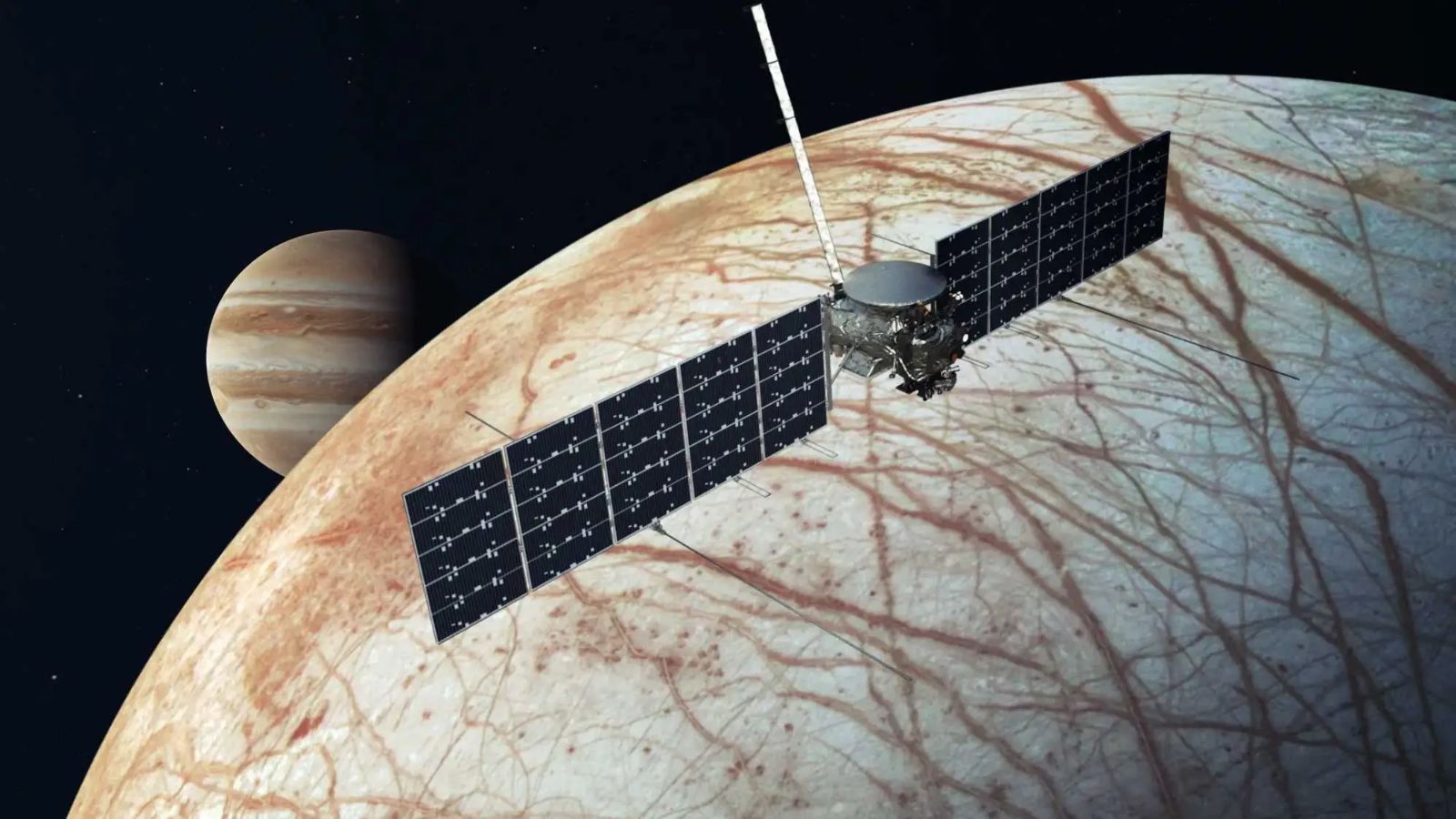
NASA's Europa Clipper mission launched in October 2024 and is scheduled to arrive in the Jupiter system in April 2030. Clipper will not enter Europa's orbit, Jupiter's intense radiation environment makes that prohibitively damaging, but will instead make approximately 50 close flybys of Europa over a multi-year mission. The instrument suite includes a magnetometer to refine the ocean's parameters, an ice-penetrating radar to map the shell thickness directly, a mass spectrometer to sample any plumes (Hubble has reported tentative evidence of plumes at Europa, although none as well-confirmed as Enceladus's), and high-resolution imagers and spectrometers.
Clipper will not directly look for life. It is a habitability mission: it is designed to determine whether Europa's ocean contains the chemical and physical conditions that life would need. A definitive search for life would be a follow-up mission, most plausibly a lander that drills through the ice and samples the ocean directly. No such mission is currently funded; the engineering challenges of getting through 10 to 30 kilometers of ice without contamination are formidable. The Europa Clipper results, expected in the early 2030s, will heavily influence the case for the next mission.
The Honest Answer
The honest answer to whether there is life beyond Earth is: we do not know, but for the first time in the history of the question, we have specific places to look and specific instruments on their way to look at them. The Mariana Trench experiments and the Galápagos Rift discoveries told us that life on Earth does not need the Sun. Europa Clipper and the proposed Enceladus follow-up missions will tell us whether life exists in the places where the Sun cannot reach.
If the answer is yes, if life is present on Europa or Enceladus or both, it would mean that life arises wherever the conditions are right, and the universe is plausibly full of it. If the answer is no, if these worlds are sterile despite having had four billion years and all the right ingredients, it would mean that the Earth's biology is much rarer than the chemistry alone would suggest, and the Great Filter for the origin of life sits roughly where we are. Both answers are consequential. The instruments are now real and on their way.
The Mariana Trench taught us that life can live without the Sun. Europa is where we will find out whether it does.
Frequently Asked Questions
How deep is the Mariana Trench?
The Challenger Deep, the deepest known point in the Mariana Trench (and on Earth), is approximately 10,935 meters below sea level. The pressure at that depth is about 1,100 atmospheres. The first crewed visit was Jacques Piccard and Don Walsh in the bathyscaphe Trieste in January 1960. James Cameron's 2012 solo descent in the Deepsea Challenger and Victor Vescovo's 2019-onward expeditions in the DSV Limiting Factor are among the few subsequent crewed visits.
What is chemosynthesis?
Chemosynthesis is the production of organic compounds from inorganic carbon (typically CO₂) using chemical energy rather than light. It was discovered as the basis of an ecosystem in 1977, when scientists aboard the submersible Alvin found dense communities of tube worms, clams, and bacteria around hydrothermal vents on the Galápagos Rift, 2,500 meters deep. The energy comes from chemical disequilibria, typically between reduced compounds in vent fluid (such as hydrogen sulfide) and oxidized compounds in seawater. The discovery established that life on Earth does not require sunlight.
How big is Europa's ocean?
Estimates from NASA's Galileo mission and subsequent modeling place Europa's subsurface ocean at approximately 100 kilometers deep, beneath an ice shell of 10 to 30 kilometers. The total volume of liquid water is roughly twice that of Earth's oceans combined. The ocean is salty (necessary to produce the induced magnetic field Galileo measured) and has likely existed for most of Europa's 4.6-billion-year history.
What is Europa Clipper?
Europa Clipper is a NASA mission launched in October 2024 and scheduled to arrive at Jupiter in April 2030. It will make approximately 50 close flybys of Europa over several years, equipped with a magnetometer, an ice-penetrating radar, a mass spectrometer, and imagers. Its goal is to characterize Europa's ice shell and ocean and determine whether the moon could support life. It is not designed to detect life directly; that would be a follow-up mission, plausibly a lander.
What did Cassini find at Enceladus?
NASA's Cassini spacecraft, in orbit around Saturn from 2004 to 2017, made multiple flybys of Enceladus and directly sampled the plumes of water vapor and ice particles erupting from the moon's south pole. The 2014 Iess et al. Science paper used gravitational measurements to establish a global subsurface ocean. The 2015 Hsu et al. Nature paper used the detection of silica nanoparticles to establish active hydrothermal chemistry. The 2018 Postberg et al. Nature paper detected organic molecules of mass up to 200 atomic units in the plume material, chemically suggestive of habitability, although not by itself proof of biology.
If we find life on Europa, what does that mean?
If life is found on Europa (or Enceladus), it would substantially increase the probability that life arises wherever the chemical and physical conditions allow it. Combined with our existence on Earth, that would suggest the universe is plausibly populous with life. If, on the other hand, four billion years of warm, organic-rich subsurface ocean on Europa proves to have produced no biology, it would suggest the origin of life is rarer than the available chemistry would predict, and the Great Filter for life's origin sits at roughly the step our planet successfully crossed.
Continue Exploring
- The Habitable World Next Door That Its Star May Have SterilizedProxima Centauri b orbits the closest star to the Sun, inside the zone where liquid water could exist. The problem is...
- Every Living Thing on Earth Descended From One Cell. We Now Know Roughly Where It Lived.Three billion years ago, perhaps four, a single cell at the bottom of an ocean was the ancestor of every plant, animal...
- The Planets That Drift Through the DarkUntethered to any star, rogue worlds may outnumber the suns of the Milky Way. Here is how astronomers find the...
- The Asteroid Sample That Brought Back Almost Every Ingredient for LifeFifteen of the twenty amino acids life uses. All five DNA and RNA bases. Ribose. Glucose. And a polymer never seen...
Sources
- Corliss, J. B. et al. "Submarine thermal springs on the Galápagos Rift." Science, 203, 1073 (1979).
- Iess, L. et al. "The gravity field and interior structure of Enceladus." Science, 344, 78 (2014).
- Hsu, H.-W. et al. "Ongoing hydrothermal activities within Enceladus." Nature, 519, 207 (2015).
- Postberg, F. et al. "Macromolecular organic compounds from the depths of Enceladus." Nature, 558, 564 (2018).
- Khurana, K. K. et al. "Induced magnetic fields as evidence for subsurface oceans in Europa and Callisto." Nature, 395, 777 (1998).
- Hand, K. P. et al. Report of the Europa Lander Science Definition Team, NASA (2017).
- Pappalardo, R. T. et al. "Does Europa have a subsurface ocean? Evaluation of the geological evidence." Journal of Geophysical Research, 104, 24015 (1999).
- NASA Europa Clipper mission overview. europa.nasa.gov
- Walsh, D. Trieste: The Final Eight Hours, U.S. Naval Institute (2010).
- Cover image: NASA/JPL/DLR, Galileo spacecraft, Europa global view. Public domain.