Fermi's Lunch
The setting was the Fuller Lodge at Los Alamos National Laboratory, summer 1950. Enrico Fermi was visiting from the University of Chicago. He sat down to lunch with three colleagues, Edward Teller, Emil Konopinski, and Herbert York, and conversation turned, as it sometimes did, to flying saucers, then to interstellar travel, then to the inhabitants of other worlds. The talk drifted on. Then, in the middle of an unrelated remark, Fermi suddenly interjected: "But where is everybody?"
The question came out of nowhere and was instantly understood by the others. Fermi had been thinking, in the background of his mind, about the implications of cosmic time scales. The galaxy is roughly 13 billion years old. Stars older than the Sun by billions of years are common. Civilizations capable of interstellar travel, even at sublight speeds, would be able to colonize the entire galaxy in a fraction of its lifetime, at most a few tens of millions of years. If life and intelligence are at all common, the galaxy ought to be saturated by now. Earth ought to have been visited, colonized, signaled, or contacted. None of those things has happened.
York later wrote up a memoir of the lunch. The conversation was not the first time anyone had asked the question, Konstantin Tsiolkovsky raised similar concerns in 1933, and Olaf Stapledon's 1937 novel Star Maker explored related ideas, but Fermi's framing was the one that stuck. The Fermi paradox, as it came to be called, was the paradox of cosmic abundance and observational silence.
The Drake Equation
The first systematic attempt to quantify the paradox was made by the radio astronomer Frank Drake in 1961, at a small meeting at the Green Bank Observatory in West Virginia. Drake wrote down on a blackboard a now-famous formula for the number of currently active, communicating extraterrestrial civilizations in the Milky Way. The Drake equation factors that number into a chain of probabilities: the rate of star formation, the fraction of stars with planets, the fraction of those that are habitable, the fraction on which life arises, the fraction on which life becomes intelligent, the fraction that develop interstellar communication, and the fraction of a civilization's lifetime spent communicating.
Each factor is poorly known. Some are now better known than they were in 1961, the fraction of stars with planets, for instance, has been substantially constrained by the Kepler mission, which has shown that planets are roughly as common as stars. Others, the fraction of habitable planets on which life arises, the average lifetime of a communicating civilization, remain almost entirely unknown. Plug in plausible point estimates for each and the Drake equation produces a number anywhere from much less than one to many millions, depending on how you guess.
For sixty years, the Drake equation has functioned as a structured way of expressing total ignorance. It is also the foundation of every variant of the Fermi paradox: if the equation gives a number much greater than zero, then the absence of observed civilizations is a puzzle. If it gives less than zero, a calculation that does not literally make sense, but expresses the idea that the expected number is much less than one, then the absence is not a puzzle. The point of the equation is not to give a number; it is to identify which factors matter most.
The Great Filter
In 1996, the economist Robin Hanson at the Institute for Advanced Study (and later George Mason University) published an essay titled "The Great Filter." Hanson's argument was that the Fermi paradox suggests there is at least one extremely difficult step somewhere in the chain from non-life to communicating civilization, a step that almost no biosphere makes it through. The filter could be at any stage: the origin of life from chemistry; the development of complex multicellular life; the development of intelligence; the development of stable civilizations; the survival of a civilization past the point of acquiring weapons capable of self-destruction.
The location of the Great Filter, in Hanson's framing, is the question that matters. If the filter is in our past, say, the origin of life is rare, or the transition to complex cells is rare, then humanity has already made it through, and our future is comparatively bright. If the filter is in our future, say, civilizations reliably destroy themselves within a few centuries of acquiring industrial technology, then the silence of the universe is a warning. The discovery of life on Mars or Europa, perversely, would be bad news: it would suggest the filter is not behind us, and therefore must be ahead.
Hanson's essay was never formally published in a peer-reviewed journal but circulated as a preprint and was widely cited in the technical and philosophical literature on existential risk. It has been the dominant framing of the Fermi paradox in philosophical discussions for the past two decades.
The Dark Forest Hypothesis
A separate hypothesis emerged from a different intellectual tradition. The Chinese science-fiction writer Liu Cixin's 2008 novel The Dark Forest proposed that the silence of the universe is not the result of empty space or extinction but of game-theoretic caution. Civilizations stay silent because revealing their location to other civilizations is dangerous: an unknown alien neighbor may interpret a signal as a threat and respond with preemptive elimination. Better, then, to listen and not transmit, and if you detect a signal from elsewhere, the prudent response is to destroy the source before they destroy you.
The dark-forest hypothesis is fiction in origin but has been taken seriously in the academic literature as a possible game-theoretic equilibrium in interstellar communication. Several papers have analyzed the conditions under which silence would dominate as a strategy. The most rigorous analyses conclude that the equilibrium is unstable in detail, communication would still emerge under most plausible assumptions about utility, time delays, and information asymmetry, but the hypothesis remains a serious contender as a partial explanation for the observed silence.
Sandberg, Drexler and Ortega, Dissolving the Paradox
In June 2018, three researchers at the University of Oxford and the Future of Humanity Institute, Anders Sandberg, Eric Drexler, and Toby Ortega-Argilés, posted a preprint to arXiv titled "Dissolving the Fermi Paradox." The paper made a single, devastatingly simple argument.
The Drake equation, as conventionally used, takes point estimates for each parameter and multiplies them together to get a single number. Sandberg, Drexler, and Ortega argued that this is the wrong calculation. The parameters are deeply uncertain. The honest treatment is to put probability distributions on each parameter, distributions that span the uncertainty, often over many orders of magnitude, and then propagate the distributions through the multiplication. The result is not a point estimate of the number of civilizations; it is a probability distribution over that number.
And the probability distribution is staggeringly broad. When the team ran the calculation with the best available distributions for each parameter, drawing on biology for the origin-of-life factor, on astronomy for the habitable-planet factor, on history for the civilization-lifetime factor, they found a distribution stretching from 10−12 to 10+12 civilizations per galaxy, peaking near 10−2. The probability that the Milky Way contains zero communicating civilizations other than ours, on their analysis, was approximately 53 percent. The probability that the entire observable universe contains zero such civilizations was approximately 33 percent.
Their conclusion was sharp: the Fermi paradox, as conventionally formulated, dissolves. The silence we observe is not evidence of any extraordinary filter, ancient extinction, or galactic-scale conspiracy of caution. It is what the math predicts when uncertainty in the parameters is taken seriously. We are not necessarily alone, but we are very plausibly alone, and there is no statistical contradiction in being so.
The Fermi paradox is, on the most careful analysis, an artifact of the wrong calculation. Multiply distributions, not point estimates, and the silence is exactly what you should expect.
What Surveys Have Actually Found
Active searches for technological signatures from other civilizations have been underway for sixty years. Frank Drake's 1960 Project Ozma, the first systematic radio search, listened to two nearby stars at the 21-centimeter hydrogen line for two months. The SETI Institute's continuing programs, the Allen Telescope Array, and Yuri Milner's Breakthrough Listen project (launched 2015 with $100 million in funding) have collectively surveyed millions of stars across radio, microwave, and infrared frequencies.
The results have been negative. There has been one famous candidate signal, the Wow! signal observed at Ohio State's Big Ear telescope in August 1977, that was never repeated and is now generally interpreted as a comet or instrumental artifact, but no confirmed extraterrestrial transmission has ever been detected. Searches for Dyson spheres in mid-infrared sky surveys have also yielded null results. The conclusion, sixty years in, is that communicating civilizations either do not exist within our search volume or are not transmitting in ways our instruments can detect.
The Sandberg-Drexler-Ortega result is consistent with both possibilities and does not require either. It says only that the absence of detection is statistically reasonable.
What This Means For Us
The strongest implication of the 2018 result is asymmetric. Whether or not civilizations exist out there, our own choices about whether to actively transmit signals, to engage in what is technically called METI, Messaging Extraterrestrial Intelligence, remain an open question. A small number of deliberate transmissions have been made: the Arecibo message in 1974, the Cosmic Calls in 1999 and 2003, the Long-Now message in 2017. Whether to send more, and at what intensity, is debated within the small community of researchers who think about it seriously.
The argument for caution is the dark-forest hypothesis. The argument against caution is that we have already been transmitting unintentionally for over a century, every radio broadcast, every radar pulse, every commercial television signal has been leaking into space at the speed of light since the 1920s. Anyone within about a hundred light-years who is listening for technological signatures has already, in principle, been able to detect us. The decision to transmit deliberately is therefore largely about whether to make ourselves more conspicuous, not whether to reveal ourselves at all.
The deeper implication, in the Sandberg-Drexler-Ortega framework, is that the question may not have a satisfying answer for a long time. Resolving the parameters of the Drake equation to the point where the probability distribution of civilizations narrows substantially is a project for centuries, the kind of long-term astronomical and biological research that requires the next generations of telescopes, the eventual exploration of Mars and Europa for life, and a much-improved understanding of how chemistry transitions to biology. Until then, the silence is the data, and the most rigorous analyses say the silence is not surprising.
For seventy-five years, the universe's silence was treated as the puzzle. The right math suggests the silence is the answer.
Frequently Asked Questions
What is the Fermi Paradox?
Enrico Fermi reportedly raised the question over lunch at Los Alamos in 1950: if the galaxy is so old and there are so many stars, where is the evidence of other civilizations? Even a single civilization with sublight interstellar travel could colonize the entire Milky Way in tens of millions of years, a tiny fraction of the galaxy's age. The absence of any observed evidence, no signals, no probes, no Dyson spheres, has been treated as a puzzle ('paradox') for seventy-five years.
What is the Drake Equation?
Frank Drake's 1961 formula factors the number of currently communicating civilizations in the galaxy into a chain of probabilities: star-formation rate, fraction of stars with planets, fraction of habitable planets, fraction on which life arises, fraction on which life becomes intelligent, fraction that develop communication, and average duration of a communicating civilization. Each parameter is poorly known. Used with point estimates, the equation has historically produced numbers ranging from less than 1 to many millions depending on the guesses chosen.
What did Sandberg, Drexler and Ortega prove in 2018?
In a June 2018 arXiv preprint titled 'Dissolving the Fermi Paradox,' Anders Sandberg, Eric Drexler, and Toby Ortega-Argilés argued that the Drake equation should not be evaluated with point estimates. The honest treatment uses probability distributions for each parameter, many of which span many orders of magnitude, and propagates them through the calculation. The resulting distribution gives roughly a 53 percent probability that the Milky Way contains zero communicating civilizations other than us, and roughly a 33 percent probability the entire observable universe does. On their analysis, the silence is statistically expected, and the paradox dissolves.
What is the Great Filter?
In a 1996 essay, the economist Robin Hanson argued that the Fermi paradox suggests at least one extremely difficult step somewhere in the chain from non-life to communicating civilization. The filter could be the origin of life, the emergence of complex cells, the development of intelligence, the survival of civilization past industrialization, or any other transition. The location of the filter, past or future, determines whether humanity's prospects are bright or dim. The framework is influential in existential-risk research.
Has any signal from another civilization ever been detected?
No confirmed signal. The 'Wow!' signal observed at Ohio State University's Big Ear telescope in August 1977 was a famous candidate but was never repeated and is now generally interpreted as a comet or instrumental artifact. Sixty years of searches, Project Ozma (1960), the SETI Institute, the Allen Telescope Array, Breakthrough Listen (2015 onwards), have produced no other confirmed candidates. Searches for non-radio technosignatures, including infrared Dyson sphere surveys, have also been negative.
Should we be transmitting signals to other civilizations?
This is debated. The 'dark forest' hypothesis (originally from Cixin Liu's fiction but taken seriously in academic discussion) argues that prudent civilizations stay silent for game-theoretic reasons. The counter-argument is that humanity has already been transmitting unintentionally for over a century, radio, television, radar, at speed of light, and anyone within roughly 100 light-years could already detect us. Active deliberate transmission would only marginally change our visibility. There is no international consensus or governance on the question; a small number of deliberate transmissions have been sent since 1974.
Continue Exploring
- The Habitable World Next Door That Its Star May Have SterilizedProxima Centauri b orbits the closest star to the Sun, inside the zone where liquid water could exist. The problem is...
- Every Living Thing on Earth Descended From One Cell. We Now Know Roughly Where It Lived.Three billion years ago, perhaps four, a single cell at the bottom of an ocean was the ancestor of every plant, animal...
- The Equation That Tries to Count Alien CivilizationsIn 1961, a young astronomer wrote seven terms on a blackboard to organize a single impossible question: how many...
- The 72 Seconds That Still Haunt Radio AstronomyOn a summer night in 1977, an Ohio radio telescope recorded a narrowband burst near the frequency of hydrogen itself....
Sources
- Sandberg, A., Drexler, E. & Ortega-Argilés, T. "Dissolving the Fermi Paradox." arXiv:1806.02404 (2018). arxiv.org
- Hart, M. H. "An explanation for the absence of extraterrestrials on Earth." Quarterly Journal of the Royal Astronomical Society, 16, 128 (1975).
- Drake, F. D. "Project Ozma." Physics Today, 14, 40 (1961).
- Hanson, R. "The Great Filter, Are We Almost Past It?" Preprint, 1998. hanson.gmu.edu
- Wright, J. T. et al. "The Ĝ infrared search for extraterrestrial civilizations with large energy supplies." The Astrophysical Journal, 792, 27 (2014).
- Worden, S. P. et al. "Breakthrough Listen, A new search for life in the Universe." Acta Astronautica, 139, 98 (2017).
- Webb, S. If the Universe Is Teeming with Aliens... Where Is Everybody? Springer, 2nd edition (2015).
- Tsiolkovsky, K. The planets are occupied by living beings. Russian Society of Lovers of World Studies (1933).
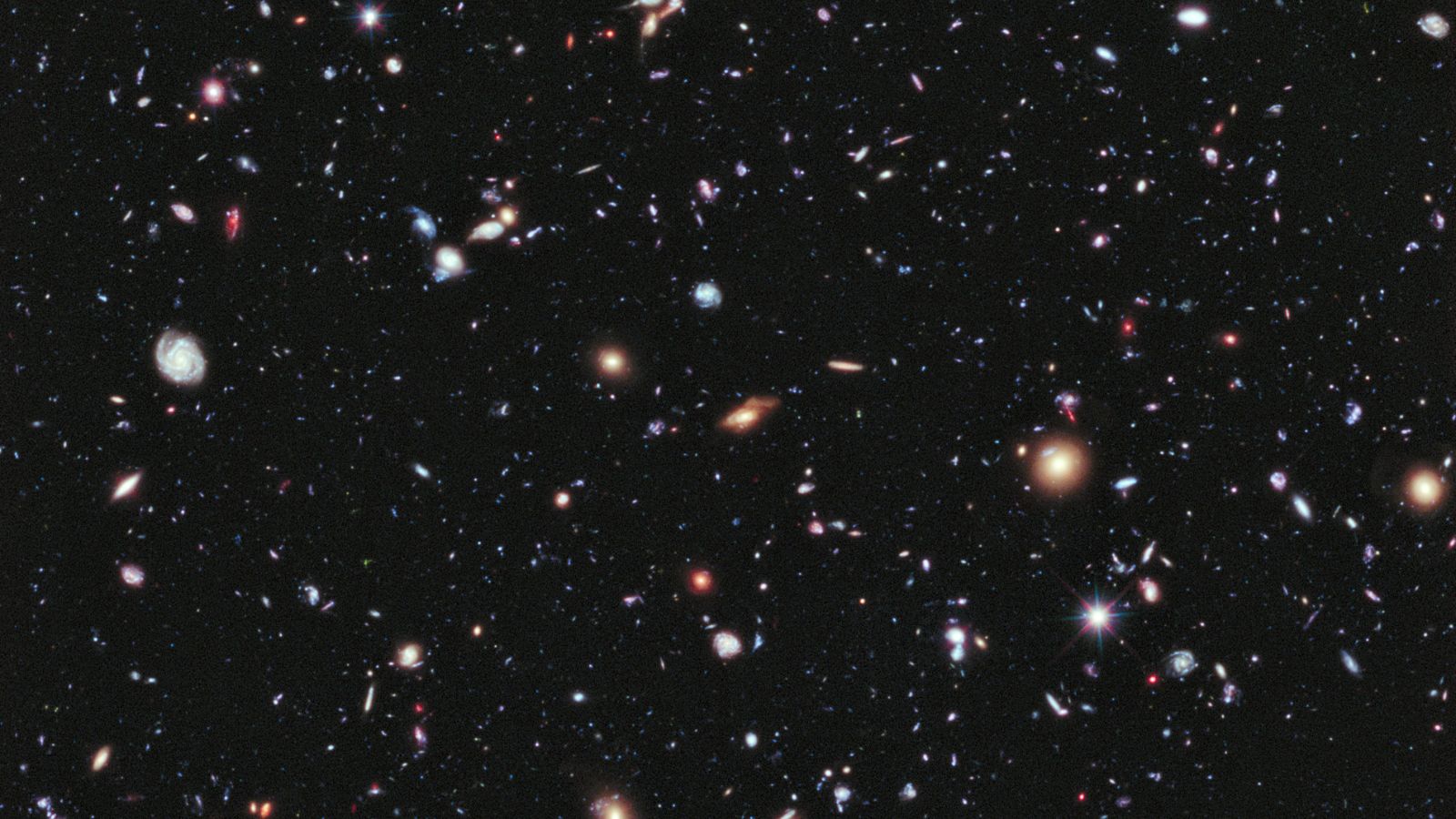
- Cover image: NASA / ESA / G. Illingworth, Hubble eXtreme Deep Field. Public domain.