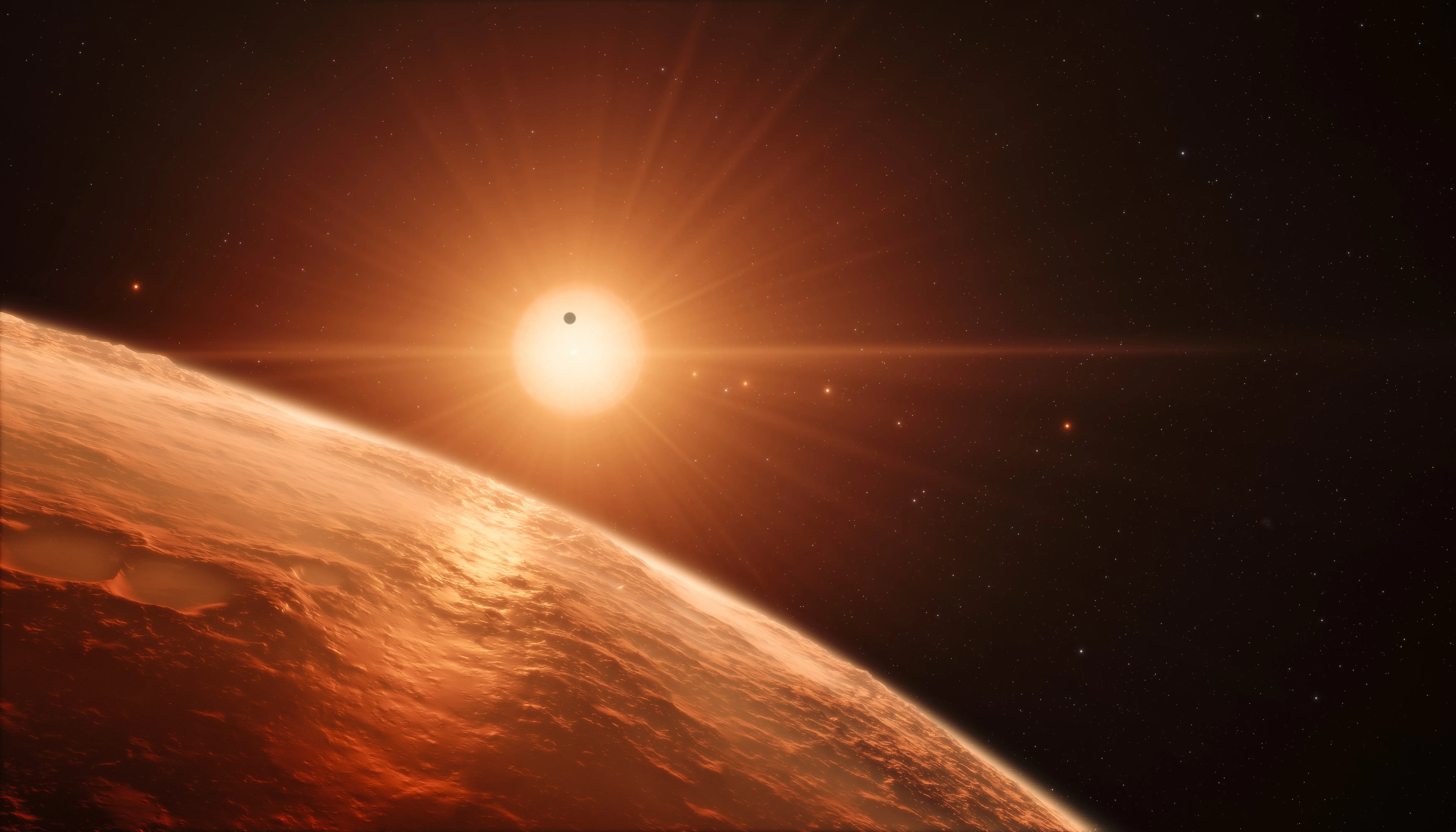
The Star Astronomers Almost Missed
TRAPPIST-1 is, in stellar terms, almost nothing. It is an ultracool red dwarf star roughly the size of Jupiter, not the mass of Jupiter, the diameter of Jupiter, with a surface temperature of just 2,500 Kelvin. By comparison, our Sun is 1,400 times more luminous. TRAPPIST-1 is so faint that despite being only 40 light-years away, it cannot be seen with the naked eye. It cannot be seen with most amateur telescopes either. It was catalogued by the Two Micron All Sky Survey in 1999 as just another red dwarf, one of dozens of millions in the catalog, and ignored for fifteen years.
The interesting thing about red dwarfs is that they make up most of the stars in the galaxy, roughly 75 percent of all main-sequence stars. They also have extraordinarily long lifetimes. While our Sun has a total main-sequence lifespan of approximately 10 billion years, a small red dwarf like TRAPPIST-1 can stay stable for trillions of years, far longer than the current age of the universe. If life is going to have time to evolve anywhere, red dwarfs offer the most patience.
In 2015 and 2016, the TRAPPIST telescope (Transiting Planets and Planetesimals Small Telescope), a pair of small instruments operated jointly by the University of Liège in Belgium, with stations in Chile and Morocco, was conducting a transit-photometry survey of nearby small stars. The technique watches for tiny periodic dips in a star's brightness as a planet passes in front of it. TRAPPIST-1 produced an astonishing pattern: not one, not two, but multiple dips at different periods. By February 2017, the team had confirmed seven planets, all approximately Earth-sized, all packed into orbits closer to TRAPPIST-1 than Mercury is to the Sun.
The system was an immediate sensation. Three of the seven planets, TRAPPIST-1d, e, and f, sit within the star's habitable zone, the range of distances where the equilibrium temperature would allow liquid water on the surface. Whether liquid water actually exists on any of them depends on whether they have atmospheres capable of supporting it. That question, in 2017, was unanswerable.
The Telescope That Could Finally Look
The James Webb Space Telescope, launched in December 2021 and operating since mid-2022, has the sensitivity required to detect the faint signatures of exoplanet atmospheres. Its primary tool for this is transmission spectroscopy. When a planet transits its star, passing in front of the stellar disk as seen from Earth, a small fraction of the starlight passes through the planet's atmosphere on its way to us. Different molecules in the atmosphere absorb different wavelengths of light. By measuring the spectrum of the starlight during the transit and comparing it to the spectrum when the planet is not transiting, astronomers can identify which molecules are present in the atmosphere.
The TRAPPIST-1 system is one of the best targets in the sky for this technique, for a slightly counterintuitive reason: the star is dim. A planet transiting a dim small star blocks proportionally more of the starlight than the same planet transiting a bright big star would. The signal-to-noise ratio for atmospheric measurements is therefore better for TRAPPIST-1 than for almost any other known habitable-zone system. The DREAMS team, Deep Reconnaissance of Exoplanet Atmospheres by Multi-instrument Spectroscopy, an international collaboration led by Olivia Lim at the University of Montreal, has used its guaranteed JWST time to systematically observe the TRAPPIST-1 planets one by one.
What They Found, Planet by Planet
The first results came in 2023 and have been refined since. TRAPPIST-1b, the innermost planet at 1.7 million kilometers from the star, has no detectable atmosphere. JWST's MIRI instrument measured its dayside thermal emission and found temperatures consistent with a bare rocky surface: roughly 230 degrees Celsius on the dayside, far colder than would be the case if the planet had a thick CO₂ atmosphere to redistribute heat. The result, published in Nature in 2023, ruled out any substantial atmosphere on TRAPPIST-1b.
TRAPPIST-1c, the next planet outward, produced a similar story. JWST measured its dayside temperature in 2024 and found, again, that the planet appears to be a bare rocky body. Either it never had an atmosphere or it lost what it had to the intense stellar wind from TRAPPIST-1 during the star's early, more violent phase. The temperatures observed are not survivable for life as we know it.
TRAPPIST-1d, the first planet in the conventional habitable zone, has been harder to characterize. JWST observations have so far shown only an upper limit on atmospheric thickness, the data are consistent with no atmosphere, or with a thin atmosphere whose specific composition cannot yet be determined. Modeling suggests that TRAPPIST-1d might be one of several possibilities: a bare rock like 1b and 1c; a thin-atmosphere world with potentially habitable conditions only in a narrow band near the planet's day-night terminator; or, most interesting, a water world with a substantial subsurface or atmospheric water inventory. The data do not yet distinguish among these.
TRAPPIST-1e is the system's most-studied planet and the one with the most ambiguous results. It sits squarely in the middle of the habitable zone, with an equilibrium temperature that would allow liquid water on the surface if it has an atmosphere comparable to Earth's. JWST's most recent measurements, published in 2025 and refined in early 2026, indicate that TRAPPIST-1e has an atmosphere of some kind, but its composition is contested. The data favor an atmosphere dominated by a heavier-than-hydrogen gas like nitrogen, possibly with methane and carbon dioxide as trace components. One reading of the data favors a thick methane-rich atmosphere producing a strong greenhouse effect, which would warm the planet enough to potentially have a liquid-water ocean despite its weak host star. Another reading favors a thinner atmosphere with limited water, in which case any habitable conditions would be confined to a narrow band of terminator regions perpetually in twilight. Both interpretations are consistent with the current data; deeper observations are needed to distinguish them.
TRAPPIST-1f, 1g, and 1h sit further from the star. They probably have substantial water inventories. TRAPPIST-1f, at 5.8 million kilometers, may be a "steam world", a planet with so much water in vapor form that the surface pressure and temperature exceed habitability thresholds. TRAPPIST-1h, the outermost planet, is probably an ice world with a frozen surface but a possible subsurface liquid ocean similar to Europa or Enceladus in our own solar system. None of these has been observed in atmospheric detail yet by JWST; the priority has been the inner, more-easily-observed planets.
The TRAPPIST-1 inner planets are bare rocks. The outer planets are too cold. The middle ones might be habitable, but JWST can't yet say for sure. The most interesting question in modern astronomy, is there life on TRAPPIST-1e?, has not been answered, but it has been narrowed.
The Star Is the Problem
Even if TRAPPIST-1e or another habitable-zone planet does have a livable atmosphere today, there is a serious question about whether it could have survived to develop life. The reason is the host star itself.
TRAPPIST-1 is a red dwarf, and red dwarfs are violently active when young. During their first few hundred million years, they produce frequent and intense stellar flares, sudden brightenings that can release up to a thousand times more energy than the largest flares produced by our Sun. The Carrington Event of 1859, the largest geomagnetic storm in human history, would by all available evidence have been a typical or even sub-typical flare for early TRAPPIST-1.
The bombardment of stellar flares and accompanying coronal mass ejections during a red dwarf's youth strips atmospheres from any nearby planets. Hydrogen atmospheres, in particular, the kind a young planet would initially have, are blown away within tens to hundreds of millions of years. Whether a planet can retain a secondary atmosphere (the kind that develops later, from volcanic outgassing) depends on whether the planet has a strong enough magnetic field to deflect the stellar wind and whether the volcanism can keep up with the loss rate.
For the TRAPPIST-1 inner planets, the evidence suggests the atmospheres did not survive. JWST measurements of 1b and 1c are consistent with that picture. For TRAPPIST-1e and beyond, the question is whether the more distant orbits provided enough protection from the early flare era, and whether enough volcanic activity has continued to maintain a secondary atmosphere over the planet's lifetime. JWST observations of TRAPPIST-1e suggest the answer for at least that planet is yes, but the composition of the surviving atmosphere is contested.
What We Are Actually Learning
The TRAPPIST-1 system has, in a way, become the test case for a broader question: how often do red-dwarf planets retain atmospheres long enough to develop life? The answer matters because red dwarfs are the most common stars in the galaxy. If habitable-zone planets around red dwarfs reliably lose their atmospheres to early flares, then the most numerous class of potentially habitable worlds in the galaxy is in fact uninhabitable. The Drake equation gets revised downward.
If, however, some red-dwarf planets, TRAPPIST-1e being the leading candidate, can retain atmospheres through the early flare era, then the universe is plausibly populated with a large number of habitable worlds, mostly orbiting red dwarfs, mostly tidally locked, mostly with day-night terminator habitability rather than full-surface habitability, but habitable nonetheless. The answer will reshape the search for life in the galaxy.
JWST's TRAPPIST-1 program is ongoing. The DREAMS team has accumulated dozens of transits of each planet so far and continues to refine the spectroscopy. The Habitable Worlds Observatory, NASA's flagship space telescope currently in design for a 2041 launch, will be capable of directly imaging TRAPPIST-1-class planets and definitively determining their atmospheric compositions and surface conditions. Until then, JWST is the only tool that can probe the system at all.
So the current status is: seven Earth-sized planets, three in the habitable zone, one (1e) with a likely atmosphere whose composition is being actively debated, several others with no atmosphere or atmospheres too thin to identify, and a star whose early violence has likely shaped the inhabited prospects of all of them. We do not yet know whether anything is alive on TRAPPIST-1e. We know that the question is testable, and that the next decade of observations should answer it.
The closest plausibly-habitable planet outside our solar system orbits a star you cannot see with your eyes, 40 light-years away. The James Webb Space Telescope is the first instrument capable of finding out whether anyone is home. The answer is not in yet, but for the first time in human history, the answer is no longer impossible to obtain.
Frequently Asked Questions
What is the TRAPPIST-1 system?
TRAPPIST-1 is an ultracool red dwarf star approximately 40 light-years from Earth, in the constellation Aquarius. It is orbited by seven confirmed rocky planets, all approximately Earth-sized. Three of the planets, TRAPPIST-1d, 1e, and 1f, sit within the star's habitable zone, where surface temperatures might allow liquid water given an appropriate atmosphere. The system was discovered by the TRAPPIST telescope (operated jointly from Chile and Morocco) and confirmed by NASA's Spitzer Space Telescope, with the full seven-planet count established in February 2017.
Are TRAPPIST-1 planets habitable?
Unknown. JWST has shown that the innermost planets (1b and 1c) have no significant atmospheres and are not habitable. The outer planets (1f, 1g, 1h) are probably too cold for surface liquid water, though subsurface oceans like Europa's are possible. The middle three (1d, 1e, 1f) sit in the conventional habitable zone, but their habitability depends on atmospheric composition, which is still being determined. TRAPPIST-1e in particular shows evidence of having an atmosphere of some kind, with composition still under debate.
What did JWST find on TRAPPIST-1e?
Observations through 2026 show that TRAPPIST-1e likely has an atmosphere, but its specific composition is contested. The data favor a heavier-than-hydrogen atmosphere (probably nitrogen-dominated, possibly with methane and carbon dioxide), but it is not yet clear whether the atmosphere is thick enough to support a liquid-water ocean or thin enough that habitability would be confined to a narrow terminator zone. Two interpretations of the current data are roughly equally consistent. More observations are needed.
Why does the host star matter so much?
Red dwarfs like TRAPPIST-1 are extraordinarily active when young. They produce frequent intense stellar flares for hundreds of millions of years after formation, which can strip atmospheres from any orbiting planets. The Carrington Event of 1859, the largest geomagnetic storm in recorded human history, would have been a typical flare for early TRAPPIST-1. Whether a planet in the TRAPPIST-1 system can retain an atmosphere depends on whether it has a strong magnetic field to deflect the stellar wind and whether ongoing volcanic activity can replenish atmosphere as fast as the star strips it. For the inner planets, the evidence suggests this does not happen. For TRAPPIST-1e, it may.
How would we know if there's life on TRAPPIST-1e?
The strongest evidence would be a 'biosignature', a combination of atmospheric gases that cannot easily be produced by abiotic processes. The clearest example is the simultaneous presence of oxygen and methane in significant quantities; these two gases react quickly together and should not coexist unless they are being continuously produced by some active source, like biology. JWST's current TRAPPIST-1e measurements are not yet precise enough to detect simultaneous oxygen and methane at the levels Earth shows. The Habitable Worlds Observatory, scheduled for 2041, will be capable of directly imaging the planet and definitively characterizing its atmosphere.
What does the TRAPPIST-1 search tell us about life in the galaxy?
If red-dwarf planets reliably lose their atmospheres to early stellar flares (the picture suggested by TRAPPIST-1b and 1c), then the majority of potentially-habitable worlds in the galaxy, those around the most common type of star, are probably uninhabitable, and the Drake equation's estimate of communicating civilizations is correspondingly lower. If some red-dwarf planets retain atmospheres (the picture suggested tentatively by TRAPPIST-1e), then habitable worlds may be much more common than we thought, just with very different surface conditions than Earth. The TRAPPIST-1 results are a key test case for which of these pictures is closer to reality.
Continue Exploring
- Two Planets Caught in the Act of Being BornAround a young Sun-like star called WISPIT 2, astronomers have directly imaged a gas giant glowing inside a dark gap in...
- The Habitable World Next Door That Its Star May Have SterilizedProxima Centauri b orbits the closest star to the Sun, inside the zone where liquid water could exist. The problem is...
- Every Living Thing on Earth Descended From One Cell. We Now Know Roughly Where It Lived.Three billion years ago, perhaps four, a single cell at the bottom of an ocean was the ancestor of every plant, animal...
- The World That Breathes SulfurThirty-five light-years away, the super-Earth L 98-59 d has no solid ground. A permanent ocean of magma feeds a sky...
- The Planet That Webb Actually PhotographedAround a bright star in Cygnus, the James Webb Space Telescope blocked the glare of the star itself and captured the...
Sources
- Gillon, M. et al. "Seven temperate terrestrial planets around the nearby ultracool dwarf star TRAPPIST-1." Nature, 542, 456 (2017).
- Greene, T. P. et al. "Thermal emission from the Earth-sized exoplanet TRAPPIST-1b using JWST." Nature, 618, 39 (2023).
- Zieba, S. et al. "No thick carbon dioxide atmosphere on the rocky exoplanet TRAPPIST-1c." Nature, 620, 746 (2023).
- Lim, O. et al. (DREAMS Collaboration). "TRAPPIST-1e atmospheric reconnaissance with JWST: Implications for habitability." The Astrophysical Journal Letters, 985, L42 (2025).
- Wheatley, P. J. et al. "Strong XUV irradiation of the Earth-sized exoplanets orbiting the ultracool dwarf TRAPPIST-1." MNRAS Letters, 465, L74 (2017).
- Turbet, M. et al. "A review of possible planetary atmospheres in the TRAPPIST-1 system." Space Science Reviews, 216, 100 (2020).
- France, K. et al. "The ultraviolet environment of habitable-zone planets around M dwarfs." The Astrophysical Journal, 820, 89 (2016).
- NASA Habitable Worlds Observatory mission concept. science.nasa.gov
- Cover image: NASA / JPL-Caltech artist's concept of the TRAPPIST-1 planetary system. Public domain.