The Detection That Changed What Was Possible
The ATLAS network, short for Asteroid Terrestrial-impact Last Alert System, is a sky survey designed primarily to spot near-Earth asteroids. It consists of four wide-field telescopes located in South Africa, Chile, and Hawaii (two stations). Together they scan the entire night sky every 48 hours, photographing each region four times during that period. The rapid revisit cadence is what lets ATLAS catch fast-moving asteroid candidates before they slip out of view.
On the night of April 10, 2024, the system was running its routine scan. At 03:21 UTC on April 11, ATLAS detected something unexpected: a single point of light in the spiral galaxy NGC 3621 that had brightened dramatically over the previous 5.8 hours. The automated alert system fired. Within minutes, the discovery had been pushed to the worldwide network of transient-event monitors. The new object was given the designation SN 2024ggi.
NGC 3621 is approximately 23.8 million light-years away in the southern constellation Hydra. It is a face-on spiral galaxy, the kind that appears in textbooks as a clean example of disk-galaxy structure. SN 2024ggi was a Type II supernova, the death of a massive star. From its position at the edge of one of the galaxy's spiral arms, it had begun blasting its outer layers into space at thousands of kilometers per second.
The key feature of the detection was the timing. SN 2024ggi was caught within hours of the actual shock-breakout, the moment when the supernova's outward-moving blast wave reaches the surface of the dying star and erupts into space. This phase is the one moment in a supernova's life where the geometry of the explosion is preserved in its purest form, before subsequent collisions with the surrounding gas and dust distort everything. The window lasts only a few hours.
The Sleepless Night in Beijing
Yi Yang, an astronomer at Tsinghua University in Beijing, was awake when the ATLAS alert came through. Yang and his collaborators had been preparing for years to study a supernova in this exact window, they had a long-standing target-of-opportunity proposal with the European Southern Observatory's Very Large Telescope in Chile, and they had a list of which instruments they needed if a suitable transient appeared.
The instrument they wanted was called FORS2, a spectropolarimeter mounted on one of the VLT's 8.2-meter Unit Telescopes. Spectropolarimetry measures the polarization of light at different wavelengths, that is, the orientation of the light's electromagnetic oscillation as a function of color. For an ordinary star, light is essentially unpolarized; the photons are emitted in all orientations equally. For a supernova, however, the polarization carries direct information about the geometry of the explosion. A perfectly spherical explosion scatters light uniformly and produces no net polarization. An elongated explosion, say, one shaped like a football, polarizes the light in a characteristic pattern that depends on the elongation axis. By measuring the polarization carefully, astronomers can reconstruct the three-dimensional shape of an explosion they cannot otherwise resolve.
The catch was that they had to act immediately. The shock-breakout phase lasts hours. Once it ends and the supernova's ejecta start colliding with circumstellar gas, the original geometry gets smeared out and the measurement becomes impossible. Yang and his team worked through the night drafting an emergency proposal to the ESO. By the time the next observing slot on the VLT became available, they needed to be at the front of the queue.
The ESO approved the proposal within hours. The VLT pointed at NGC 3621. FORS2 began collecting spectropolarimetry data. The data flowed in. Yang and his team had bet that they could measure the shape of a stellar explosion in real time, before any other technique could see it. They had bet correctly.
A supernova's geometric signature survives for a few hours. By dawn in Beijing, the window had closed. By the time Yang's team had the data, they were the only people on Earth who had ever measured what the inside of an exploding star looks like.
How Massive Stars Die
To understand why the shape of SN 2024ggi matters, you need a sketch of what is happening inside an exploding star.
A massive star, say, ten to twenty times the mass of the Sun, spends most of its life fusing lighter elements into heavier ones in its core. Hydrogen becomes helium; helium becomes carbon; carbon becomes neon, then oxygen, then silicon, then iron. Each step releases less energy than the one before. When the core reaches iron, the chain stops. Iron is the most tightly bound nucleus, and further fusion would absorb energy rather than release it. The star, no longer producing the outward pressure that has been holding it up against gravity, suddenly collapses.
The collapse is violent. The outer layers of the iron core fall inward at roughly a quarter of the speed of light. They slam into the neutron-degenerate material of the inner core, which is essentially incompressible at this point, and they rebound. The rebound creates an outward-moving shock wave that begins to propagate through the remaining layers of the star.
Here is where the central mystery begins. The shock wave, by itself, does not have enough energy to push through the entire outer envelope of the star and produce the supernova explosion we observe. Within milliseconds of the rebound, the shock should stall out, choked by the inertia of the overlying matter. Something else must revive it. For nearly fifty years, two leading hypotheses have competed to explain what.
The first is neutrino heating. The collapse of the iron core produces an enormous flux of neutrinos. Most of them stream out of the star unimpeded, but a small fraction deposit their energy into the matter above the proto-neutron star, heating it and driving turbulent convection. If enough energy is deposited fast enough, the shock can be reignited. In this picture, the explosion is asymmetric and turbulent, the neutrino heating is not uniform, and the resulting expansion is patchy and irregular.
The second is magnetorotational. If the collapsing core is rotating fast enough and has strong enough magnetic fields, the rotation can wind the magnetic field lines into a tightly coiled structure that channels material into two opposing jets along the rotational axis. These jets punch through the envelope of the star and produce a much more axially symmetric explosion, elongated along the rotation axis, with a roughly bipolar shape.
The two predictions are testably different. A neutrino-driven explosion is shaped irregularly. A jet-driven explosion is elongated along one axis. The shape of SN 2024ggi, measured during the shock-breakout window, distinguishes between them.
What Yang's Team Found
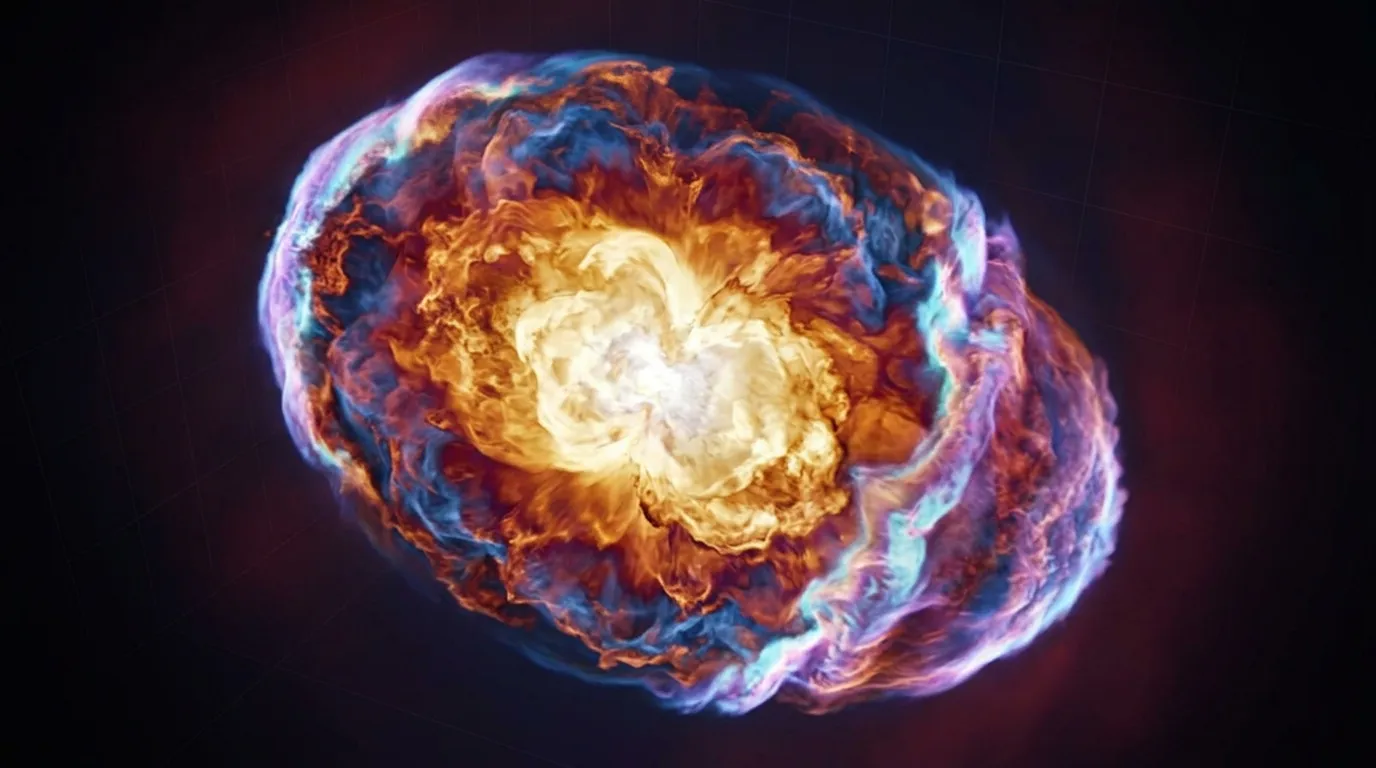
The FORS2 data, processed and published in 2025, showed an unambiguous result. SN 2024ggi was axially symmetric. Its explosion was prolate, football-shaped, with a clear preferred axis. The polarization measurement excluded a randomly turbulent geometry; the supernova had an organized direction.
This is the geometry predicted by the magnetorotational model. The jet model wins, at first glance.
But the story is more complicated. Detailed three-dimensional simulations published in 2023 and 2024 by groups at Caltech and elsewhere have shown that magnetohydrodynamic instabilities, small perturbations in the spinning core, can cause the polar jets to wobble. If they wobble too fast, they get destabilized; they cannot punch a clean channel through the star, and the explosion fails. If they wobble at the right rate, they deposit their energy not in narrow jets but in a roughly axially symmetric pattern. This produces an explosion that looks like a jet-driven explosion from the outside (axially symmetric and prolate) but is actually a hybrid process where the magnetic field is doing the work but the geometry is determined by something more subtle.
Neutrinos may still play a role too. The current best models suggest that neutrino heating contributes to the energy budget even in magnetorotational explosions; it provides the baseline thermal pressure that the magnetic-field-driven jets then organize. The two mechanisms are not strictly competing but probably collaborating, with the magnetic field setting the geometry and the neutrinos providing some of the energy.
So the picture from SN 2024ggi is: the explosion was clearly organized along a preferred axis; neutrino heating alone cannot easily produce this; magnetic fields probably play a structural role; and the next supernova that gets caught in real-time will sharpen this further.
What Comes Next
The success of the SN 2024ggi observation has rewritten the priority list at every major observatory. ATLAS-like rapid-cadence surveys are being expanded, the Vera C. Rubin Observatory began full operations in 2025, and its survey speed is much higher than ATLAS's. The number of supernovae caught within hours of breakout is expected to increase by an order of magnitude over the next decade.
For each one caught, the question that drove Yang's team will be asked: jet-shaped or turbulent? Magnetic or neutrino? With enough cases, statistical patterns will emerge. Some massive stars may die by neutrino heating; others by magnetic jets; others by hybrid mechanisms; some may fail to explode at all and quietly collapse into black holes. The 1980s textbook story of "stars explode at the end of their lives" is becoming a textbook story of "stars die by several different mechanisms, depending on their mass, rotation, and magnetic field, and we are only now learning how to tell which is which."
SN 2024ggi was the first time we measured what an exploding star actually looks like in the first hours of its death. The next decade is going to give us hundreds more.
Frequently Asked Questions
What is SN 2024ggi?
SN 2024ggi is a Type II supernova, the death of a massive star, that was detected on April 11, 2024 in the spiral galaxy NGC 3621, approximately 23.8 million light-years from Earth. It is significant because it was caught by the ATLAS survey within hours of its shock breakout, the brief phase of the explosion when its three-dimensional geometry is preserved before it gets distorted by subsequent interactions with surrounding material. A team led by Yi Yang at Tsinghua University then used the Very Large Telescope's FORS2 spectropolarimeter to measure that geometry in unprecedented detail.
How can the shape of a supernova be measured?
Through spectropolarimetry. Light from a perfectly spherical explosion is unpolarized. Light from an elongated explosion is polarized in a pattern that depends on the elongation axis. By measuring the polarization of the supernova's light at multiple wavelengths, astronomers can reconstruct its three-dimensional shape without resolving the supernova spatially, the polarization itself encodes the geometry. The technique was applied to SN 2024ggi using the VLT's FORS2 instrument.
What did the SN 2024ggi observations reveal?
The supernova was axially symmetric and prolate, football-shaped, with a clear preferred axis. This is the geometry predicted by the magnetorotational model of supernova explosions, in which magnetic fields and rotation organize the blast along a rotational axis. It is harder to produce with the alternative neutrino-heating model, which tends to produce more turbulent, irregular explosions. The result favors a role for magnetic fields in driving the explosion, although recent simulations suggest the picture is hybrid: magnetic fields organize the geometry while neutrino heating contributes energy.
Why was the timing so critical?
The shape of a supernova explosion is preserved in its purest form only during the first few hours after shock breakout. After that, the expanding ejecta collide with the surrounding stellar wind and interstellar gas, which scrambles the original geometry. SN 2024ggi was detected within hours of the breakout. Yang's team had to draft and submit an emergency proposal to the European Southern Observatory, get telescope time on the VLT, and begin observations within that narrow window. They succeeded, but only just.
How do massive stars die?
Stars more than approximately 8 times the mass of the Sun end their lives in core-collapse supernovae. The core fuses elements progressively heavier until it reaches iron, at which point fusion stops releasing energy. The core collapses under its own gravity, rebounds against an incompressible neutron-degenerate inner core, and produces an outward shock wave. The shock wave by itself does not have enough energy to fully eject the outer envelope of the star, so something must revive it. The two leading candidates are neutrino heating and magnetorotational (jet-driven) explosions. SN 2024ggi's geometry supports a substantial role for the latter.
Will more supernovae be caught this way?
Yes, increasingly. The Vera C. Rubin Observatory began full operations in 2025 with a survey speed substantially higher than ATLAS. NASA's SPHEREx mission, also operational, contributes complementary infrared transient detection. The Zwicky Transient Facility is in continuous operation. The combined network of sky surveys is expected to catch supernovae within hours of breakout at a rate of dozens to hundreds per year over the next decade. Each one is a chance to test the shape of the explosion, and over enough cases, statistical patterns of how different stars die should emerge.
Continue Exploring
- The Lighthouses at the End of a Star's LifeIn 1967 a young researcher found a signal so regular it was half-jokingly labeled Little Green Men. It was a city-sized...
- The Star We Saw Before It DiedFor the first time, JWST identified the exact star that would become a supernova: a red supergiant hidden inside a...
- The Star That Vanished Without an ExplosionSome massive stars do not end in a supernova. They flicker, fade, and quietly fall into the black hole they have just...
- What the Sun Will Become When It DiesIn about five billion years the Sun will swell, shed its outer layers, and leave behind an Earth-sized ember of carbon...
- The Closest Star About to Explode Has a Hidden CompanionBetelgeuse is 650 light-years away, one thousand times the diameter of the Sun, and visibly twinkling above your head...
Sources
- Yang, Y. et al. "Spectropolarimetry of SN 2024ggi: a directly observed prolate Type II supernova." The Astrophysical Journal Letters, 985, L7 (2025).
- Smartt, S. J. et al. "ATLAS detection of SN 2024ggi shortly after shock breakout." Transient Name Server AstroNote, 2024-101 (2024).
- Müller, B. "The status of multi-dimensional core-collapse supernova models." Publications of the Astronomical Society of Australia, 33, e048 (2016).
- Burrows, A. et al. "The role of neutrinos, rotation, and magnetic fields in supernova explosions." The Astrophysical Journal, 880, 50 (2019).
- Mösta, P. et al. "Magnetorotational core-collapse supernovae in three dimensions." Nature, 528, 376 (2015).
- Vera C. Rubin Observatory science specifications. lsst.org
- ATLAS survey overview, Tonry et al. Publications of the Astronomical Society of the Pacific, 130, 064505 (2018).
- ESO press release on SN 2024ggi observations, 2025. eso.org
- Cover image: ESO / VLT, SN 2024ggi in NGC 3621. Public domain.