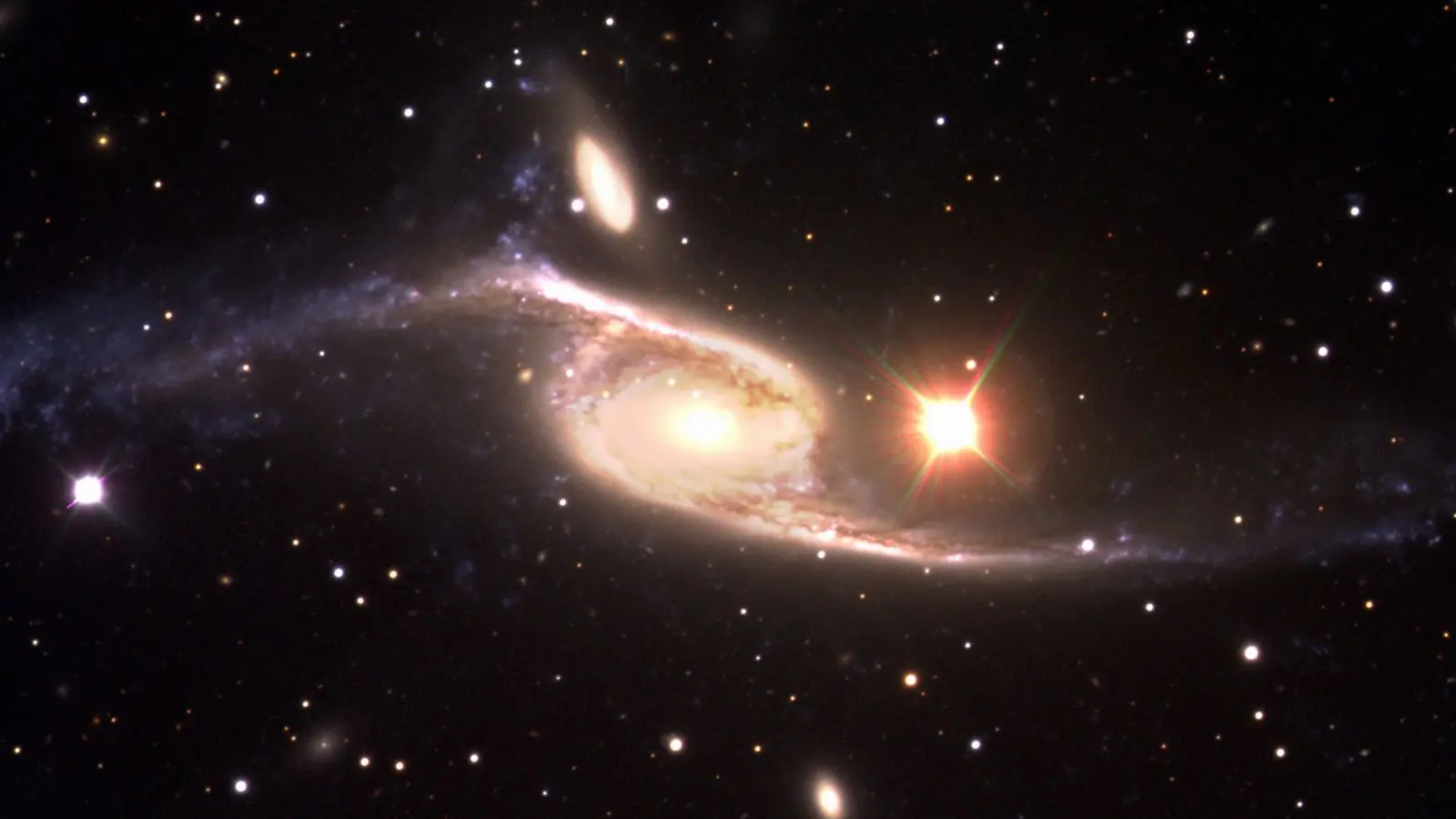
A Galaxy Built by a Collision in Slow Motion
NGC 6872 sits roughly 212 million light-years away in the southern constellation Pavo. Catalogued by John Herschel in 1835, it appeared in early surveys as a faint elongated smudge, interesting enough to be recorded, but unremarkable. Photographic plates over the following century did not change that impression. The galaxy looked unusually long, but it was distant, and detailed measurement of its scale was not possible with the instruments of the time.
The story changed when NASA's Galaxy Evolution Explorer (GALEX), an ultraviolet space telescope, observed NGC 6872 in 2013. The ultraviolet image revealed something the visible-light surveys had missed: the spiral arms extend much further than the optical glow suggests. In ultraviolet light, where young hot stars dominate, the arms reach more than 260,000 light-years from the galactic center on either side, giving a total span of approximately 522,000 light-years.
This was a record. The Milky Way, our own galaxy, measures roughly 100,000 light-years from edge to edge. NGC 6872 is more than five times larger. It is, on current measurements, the largest spiral galaxy ever observed.
Why It Got That Big
Galaxies do not just grow. A spiral galaxy's diameter is set by the rotational dynamics of its disk and the gravitational pull of its halo of dark matter. To stretch a galaxy to half a million light-years requires either an unusual initial condition or an external force pulling outward against the galaxy's own gravity. NGC 6872 is the second case.
Approximately 130 million years ago, a relatively recent event in galactic terms, a smaller spiral galaxy called IC 4970 passed close to NGC 6872. The two are still gravitationally bound, and the smaller galaxy continues to drift past the larger one on a slow elliptical orbit. The gravitational pull from IC 4970, integrated over those millions of years, has dragged the outer arms of NGC 6872 outward.
The result is what astronomers call a tidal interaction. It is the same physical mechanism that produces the tides on Earth, but acting on a galactic scale. The near side of NGC 6872 is pulled toward IC 4970, the far side trails behind, and the spiral arms stretch into long thin streamers. Detailed simulations by Cathy Horellou and Bärbel Koribalski in 2007 reproduced the observed shape of NGC 6872 by modeling exactly this kind of slow flyby encounter.
NGC 6872 is the largest spiral galaxy not because it formed that way, but because a smaller galaxy has been quietly stretching it for 130 million years.
A Galaxy Being Born From the Stretched Arms
The ultraviolet GALEX data showed something else unexpected. At the very end of one of the elongated arms, far from the center of NGC 6872, the ultraviolet emission brightens again. This is the signature of intense new star formation, gas compressed by the tidal stretching has collapsed into new stars, which burn hot and bright in ultraviolet.
The bright region at the tail tip is, in effect, a stellar nursery 200,000 light-years from its parent galaxy. If the tidal stretching continues, this region may eventually accumulate enough mass and gravitational coherence to become a self-contained system, what astronomers call a tidal dwarf galaxy. A new small galaxy, in other words, would be born from the disrupted arm of the old one.
Tidal dwarf galaxies are not hypothetical. Several have been confirmed elsewhere in nearby galactic interactions. They are typically less massive than ordinary dwarf galaxies and have lower fractions of dark matter, because they form from the visible disk material of their parent rather than from the primordial dark-matter-dominated structures of the early universe. NGC 6872's tail represents one of the more accessible examples currently being studied of this process in action.
What This Tells Us About the Milky Way's Future
NGC 6872 is not unique because of its tidal interaction. Galaxies interact constantly. The Milky Way is currently consuming the Sagittarius Dwarf Spheroidal galaxy, whose stars trail behind in long stellar streams that astronomers have mapped over the past two decades. In about four billion years, the Milky Way will collide with the Andromeda Galaxy in a much more dramatic encounter, one whose end state will be a single merged elliptical galaxy.
What makes NGC 6872 valuable as a laboratory is the timing. The interaction is happening on a timescale where we can see the structure clearly without the violence having yet erased the spiral. We can measure the arms before they fully merge or dissipate, and we can watch the tidal dwarf form in its early stages. This is rare. Most galactic interactions we observe are either at their start (no visible distortion yet) or at their late stage (the spiral is destroyed and the merger has produced a fuzzy elliptical).
NGC 6872 catches the process at its photogenic middle. The arms are stretched but still recognizable as arms. The companion is still distinct from the parent. The tidal dwarf is forming but has not yet separated. Astronomers can study each phase of the interaction on a single object, the way an entomologist might study insect metamorphosis on a single specimen captured at the right moment.
What we see in NGC 6872 is, on a much faster scale and with a smaller partner, a glimpse of what will happen to the Milky Way and Andromeda four billion years from now.
The Limits of "Largest"
One caveat. The 522,000-light-year span of NGC 6872 makes it the largest spiral galaxy, but not the largest galaxy. The most massive galaxies in the universe are elliptical, not spiral. IC 1101, a giant elliptical at the center of the Abell 2029 galaxy cluster, has been variously measured at between 600,000 and 6 million light-years across depending on how its outer halo is defined. Even taking the lower end of that range, IC 1101 is comparable to or larger than NGC 6872.
The two records are different in kind. Giant ellipticals get their size by aggregating smaller galaxies over billions of years, accumulating stars into a featureless ball. NGC 6872 got its size by having its existing structure stretched. Both are extremes, but they are extremes of different processes. The honest superlative is: NGC 6872 is the largest known galaxy that still looks like a spiral.
What Comes Next
The future of NGC 6872 is roughly predictable from the current simulations. Over the next 200 to 400 million years, IC 4970 will continue its orbit and may eventually merge with the larger galaxy, similar to a smaller star drifting into a more massive companion. The stretched arms will gradually relax, redistributing their stars back into a more compact distribution. The tidal dwarf at the tip of one arm may either separate cleanly and become its own galaxy, or fall back into the main disk and lose its independent identity.
None of this will be visible to anyone watching from Earth. Galactic interactions evolve on timescales that dwarf any human civilization. The light we see from NGC 6872 today left the galaxy 212 million years ago, when dinosaurs walked the Earth. The light from the eventual merger of the system will not reach a possible observer for a comparable time after the event. NGC 6872 is, in a sense, a glacier we are watching from a great distance, moving steadily, recording its history in its shape, and changing on timescales beyond any reasonable observation.
The biggest spiral galaxy in the universe is not the product of unusual formation. It is the product of patience, 130 million years of a smaller galaxy doing one thing, slowly.
Frequently Asked Questions
How big is NGC 6872 exactly?
NGC 6872's spiral arms span approximately 522,000 light-years from tip to tip, as measured in ultraviolet by NASA's Galaxy Evolution Explorer (GALEX) and reported by Eufrasio et al. in 2013. For comparison, the Milky Way is roughly 100,000 light-years across. NGC 6872 is therefore more than five times larger by diameter. It is the largest spiral galaxy currently known.
Why is it so much bigger than other spirals?
NGC 6872 is being gravitationally stretched by a smaller companion galaxy, IC 4970, which has been on a close encounter trajectory for approximately 130 million years. The tidal force from IC 4970 has pulled the outer arms of NGC 6872 outward over that period, producing the extreme span we see today. Simulations by Cathy Horellou and Bärbel Koribalski in 2007 reproduced the observed shape using exactly this kind of slow flyby encounter.
Is a new galaxy being born from NGC 6872?
Possibly. The GALEX ultraviolet data revealed an unexpected bright region at the tip of one of NGC 6872's stretched arms, a stellar nursery roughly 200,000 light-years from the galactic center, where compressed gas is forming new stars. If this region continues to accrete mass and gravitational coherence, it may evolve into a tidal dwarf galaxy, a small independent galaxy formed from disrupted disk material of its parent. Several such tidal dwarfs have been confirmed elsewhere; NGC 6872's tail represents one in the early stages of formation.
Is NGC 6872 the largest galaxy in the universe?
Largest spiral, yes. Largest galaxy overall, no. Giant elliptical galaxies like IC 1101 at the center of the Abell 2029 cluster have been measured at hundreds of thousands of light-years to several million light-years across, depending on how their diffuse outer halos are defined. Elliptical galaxies grow by aggregating smaller galaxies over billions of years, while NGC 6872 grew by tidal stretching of a pre-existing structure. The two records reflect different processes.
Does NGC 6872 have a supermassive black hole?
Yes. Like most large galaxies, NGC 6872 hosts a supermassive black hole at its center, with mass estimated in the range of 108, 109 solar masses based on X-ray observations. The black hole is not unusually active. The tidal interaction with IC 4970 has not (so far) triggered the kind of central gas inflow that would convert it into a strong active galactic nucleus, although such inflows are common in late-stage galaxy mergers.
What will happen to NGC 6872 in the future?
Over the next 200 to 400 million years, IC 4970 is expected to continue its elliptical orbit around NGC 6872 and may eventually merge with the larger galaxy. The stretched spiral arms will gradually relax, redistributing stars back into a more compact disk-and-halo configuration. The tidal dwarf candidate at the tail tip may separate and become its own small galaxy, or fall back into the parent. The system will not be observed in its final state on any human timescale, the light from current events reaches Earth 212 million years after they occur.
Continue Exploring
- Hubble's Look Inside the Largest Planet Nursery Ever FoundA young star 1,000 light-years away is wrapped in a disk so vast it could swallow forty solar systems. When Hubble...
- The Third Object From Another Star System Survived Its Closest Pass to Our SunIt was discovered in July 2025. In October it vanished behind the Sun. When it came out the other side, it had survived...
Sources
- Eufrasio, R. T. et al. "NGC 6872: an unusual spiral galaxy?" The Astrophysical Journal, 765, 29 (2013).
- Horellou, C. & Koribalski, B. "Stars and gas in the very large interacting galaxy NGC 6872." Astronomy & Astrophysics, 464, 155 (2007).
- Mihos, J. C. et al. "Galaxy interactions and the structure of NGC 6872." The Astrophysical Journal, 425, L13 (1994).
- NASA GALEX mission overview. nasa.gov/galex
- Duc, P.-A. & Renaud, F. "Tidal debris from high-velocity galaxy collisions: Tidal dwarf galaxies and stellar streams." Lecture Notes in Physics, 861, 327 (2013).
- NASA / ESA Hubble Heritage release on NGC 6872, 2013. hubblesite.org
- Cover image: NASA / ESA / Hubble + GALEX composite of NGC 6872 and IC 4970. Public domain.