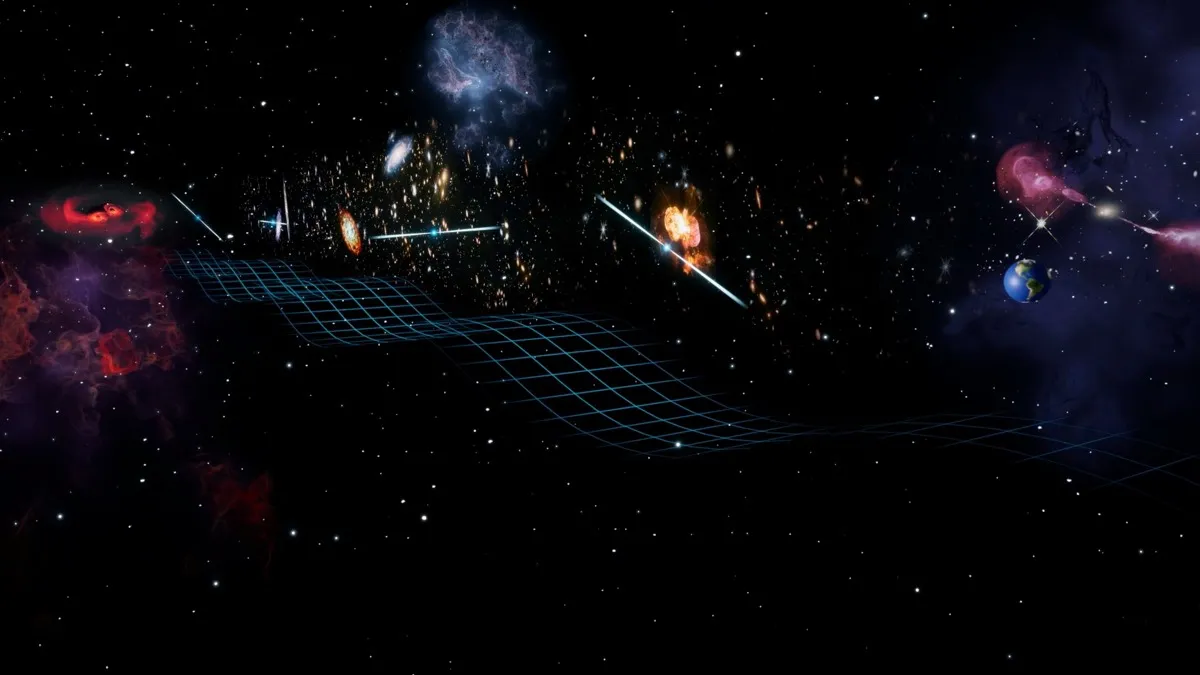
Albert Einstein predicted gravitational waves in 1916. He also said we would never detect them, the effect was too small. In 2015, LIGO proved him wrong about the detection, recording a signal from two black holes merging 1.6 billion light-years away. But LIGO can only see one band of the gravitational wave spectrum: the high-frequency end, where stellar-mass objects spiral together over fractions of a second.
The rest of the spectrum, the long, slow waves produced by supermassive black holes orbiting each other across the centers of merging galaxies, or by phenomena from the first instants after the Big Bang itself, was beyond any instrument we could build on Earth. The wavelengths were tens of light-years long. You cannot build a tunnel that big.
So the NANOGrav collaboration did something else. They turned the galaxy into a detector.
The frequency problem
Gravitational waves come in frequencies, just like sound waves and light waves. LIGO is sensitive in the range of tens to thousands of Hertz, the band produced when stellar-mass black holes or neutron stars are seconds away from collision, spiraling in at a hundred orbits per second. The technique works because LIGO can measure changes in distance smaller than one ten-thousandth the width of a proton along its four-kilometer arms.
But there are gravitational wave sources that operate at much lower frequencies. When two supermassive black holes, each millions to billions of times the mass of the Sun, orbit each other after their host galaxies merge, the orbital period can be years or decades. The gravitational waves they produce have wavelengths of light-years.
Detecting such waves requires measuring tiny changes in distance over baselines comparable to the wavelength. For a nanohertz signal, that baseline must be on the order of light-years. There is no engineering solution to building that on Earth.
The pulsar trick
The NANOGrav collaboration, the North American Nanohertz Observatory for Gravitational Waves, turned a long-standing astronomical curiosity into a detector. Pulsars are rapidly rotating neutron stars that emit beams of radio waves from their magnetic poles. As the star rotates, the beams sweep across space like the light of a lighthouse. When a beam crosses Earth, we register a pulse.
Millisecond pulsars, pulsars that rotate hundreds of times per second, are among the most stable clocks in the universe. Their pulse arrival times are so regular that they rival atomic clocks for precision. Some of them, observed over decades, drift by less than a microsecond per year.
Each pulsar is a clock thousands of light-years away. Compare two of them carefully, and you have a gravitational wave detector galaxies wide.
If a gravitational wave passes through the galaxy, it stretches and squeezes space in alternating directions. A pulsar on one side of the sky will have its pulses arrive slightly delayed, while a pulsar on the perpendicular side will have its pulses arrive slightly early. The pattern of timing residuals, the difference between when the pulses are expected and when they actually arrive, across many pulsars reveals the gravitational wave.
NANOGrav assembled a pulsar timing array of 68 millisecond pulsars distributed across the sky and observed each of them with the Green Bank Telescope, the Arecibo Observatory (until its collapse in 2020), and the Very Large Array for over fifteen years.
The Hellings-Downs curve
The signature that distinguishes a gravitational wave background from random noise is mathematical. In 1983, the physicists Ron Hellings and George Downs derived the expected correlation between timing residuals of pulsar pairs as a function of their angular separation on the sky. For a stochastic gravitational wave background, a combined hum from many sources, the correlation should follow a specific quadrupolar curve.
Pulsars close together on the sky should show strongly correlated timing residuals, both pulled or pushed by the same passing wave. Pulsars separated by 90 degrees should show anticorrelation. Pulsars 180 degrees apart should again correlate. The pattern is the unmistakable signature of a gravitational wave, distinct from any other source of timing noise.
On June 28, 2023, after fifteen years of accumulated observations, NANOGrav announced that the Hellings-Downs curve had emerged from the data. Three independent international collaborations, the European Pulsar Timing Array, the Parkes Pulsar Timing Array in Australia, and the Chinese Pulsar Timing Array using FAST, announced consistent detections within days of each other.
What the signal is
The detected gravitational wave background has a frequency in the nanohertz range, about one cycle per year to one cycle per decade. The dominant source is almost certainly the cosmic population of supermassive black hole binaries.
Every massive galaxy has a supermassive black hole at its center. When two galaxies merge, and the Milky Way's history is full of such mergers, and Andromeda is on track to merge with the Milky Way in roughly 4.5 billion years, the two central black holes eventually find each other and begin orbiting. The final stages of that orbital decay, before the black holes merge into a single object, can take hundreds of millions of years. Throughout that time, the binary emits gravitational waves in the nanohertz band.
The collective signal from every supermassive black hole binary in the observable universe, billions of them, at every stage of inspiral, produces the background NANOGrav detected. It is the gravitational wave equivalent of the cosmic microwave background, except instead of light from one moment 380,000 years after the Big Bang, it is the continuous hum of structure formation across the entire history of the universe.
The window before the CMB
What makes the gravitational wave background even more interesting than the supermassive black hole signal is what else might be hiding in it.
The cosmic microwave background, the earliest light in the universe, comes from 380,000 years after the Big Bang. Before that point, the universe was a plasma so dense that photons could not travel freely. Light from the first 380,000 years is hopelessly scattered and lost to direct observation.
Gravitational waves pass through plasma untouched. They are the only signal we will ever have from the first instant of time.
Gravitational waves are not affected by plasma. They travel through everything. A gravitational wave produced in the first second after the Big Bang would reach us today, redshifted by the expansion of the universe into the nanohertz band, exactly the frequency NANOGrav can detect. The current NANOGrav signal is dominated by supermassive black hole binaries, but buried within it may be primordial gravitational waves from cosmic inflation, the phase transitions of the early universe, or hypothetical cosmic strings.
Disentangling those signals from the black hole background is the next challenge. It requires longer baselines, more pulsars, and better timing precision.
What comes next
NANOGrav's announcement was a 3-sigma evidence claim, strong, but below the 5-sigma threshold for a formal discovery. The international pulsar timing array collaboration is now combining datasets across all four regional consortia (NANOGrav, EPTA, PPTA, CPTA), which will roughly double the effective baseline and push the significance well past 5-sigma within the next few years.
New facilities will accelerate the process further. The Square Kilometre Array (SKA), under construction in South Africa and Australia, will improve pulsar timing precision by a factor of ten when its first phase comes online in the late 2020s. China's FAST telescope is already adding pulsars to the timing array at a rate of dozens per year.
By the early 2030s, pulsar timing arrays should be able to resolve individual supermassive black hole binaries, pointing at specific galaxies where the inspirals are happening in real time. Combined with electromagnetic follow-up, that would let us watch the slow choreography of galaxy mergers across the universe.
We are bobbing up and down in the ripples of every galaxy merger in the history of the universe.
Frequently Asked Questions
What is NANOGrav?
NANOGrav is the North American Nanohertz Observatory for Gravitational Waves, a collaboration of over 100 researchers using radio telescopes to time millisecond pulsars and detect very low frequency gravitational waves. NANOGrav is one of four regional Pulsar Timing Array collaborations worldwide, alongside the European Pulsar Timing Array, the Parkes Pulsar Timing Array, and the Chinese Pulsar Timing Array.
How does a pulsar timing array work?
Millisecond pulsars are rapidly rotating neutron stars that emit radio pulses with clock-like regularity. By precisely timing these pulses over many years and comparing pulsars across the sky, astronomers can detect tiny correlated changes in pulse arrival times caused by gravitational waves stretching and squeezing the space between Earth and the pulsars. The pattern of correlations across pulsar pairs reveals the gravitational wave background.
What sources produce the gravitational wave background?
The dominant source is almost certainly the collective hum of supermassive black hole binaries, pairs of black holes at the centers of merged galaxies, slowly spiraling toward eventual coalescence. Each binary emits gravitational waves with periods of years to decades, and billions of such systems exist across the observable universe. Additional contributions may come from cosmic inflation, early-universe phase transitions, and hypothetical cosmic strings.
How is NANOGrav different from LIGO?
LIGO detects high-frequency gravitational waves (tens to thousands of Hertz) from stellar-mass black hole and neutron star mergers, using laser interferometry along 4-kilometer arms. NANOGrav detects nanohertz-frequency waves (periods of years to decades) from supermassive black hole binaries, using millisecond pulsars across the galaxy as a galaxy-sized detector. The two techniques are complementary, covering different parts of the gravitational wave spectrum.
How significant is the NANOGrav detection?
The June 2023 announcement reported evidence at the 3-sigma level, a probability of about 1 in 1,000 that the signal arose by chance. This is "strong evidence" but below the 5-sigma threshold (1 in 3.5 million) required for a confirmed discovery in physics. Combining data across all four international pulsar timing arrays is expected to push the significance well past 5-sigma within the next few years.
Can pulsar timing arrays detect signals from the Big Bang?
In principle, yes. Gravitational waves produced in the first instant after the Big Bang travel through the plasma that blocks electromagnetic radiation from that era. Redshifted by the expansion of the universe over 13.8 billion years, primordial gravitational waves should reach Earth in the nanohertz band, exactly the range pulsar timing arrays can detect. Disentangling such a primordial signal from the dominant supermassive black hole background is a major goal of the next decade.
Continue Exploring
- The Ghost Particles Passing Through YouRight now, trillions of them are streaming through your body every second, and almost none will touch a single atom....
- The Fastest Particles in the UniverseEvery second, particles from deep space slam into the atmosphere at nearly the speed of light. The most extreme carry...
- The Collision That Might Never HappenFor decades, astronomers told a confident story: in about five billion years, the Milky Way and Andromeda would crash...
Sources
- Agazie et al. / NANOGrav (2023). "The NANOGrav 15 yr Data Set: Evidence for a Gravitational-Wave Background." link.
- Hellings & Downs (1983). "Upper limits on the isotropic gravitational radiation background from pulsar timing analysis." link.
- EPTA Collaboration (2023). "The second data release from the European Pulsar Timing Array." link.
- Xu et al. / CPTA (2023). "Searching for the nano-Hertz stochastic gravitational wave background with the Chinese Pulsar Timing Array Data Release I." link.
- Burke-Spolaor et al. (2019). "The astrophysics of nanohertz gravitational waves." link.