The basic fact is extraordinary. Every living organism on Earth, every bacterium, every fungus, every flowering plant, every elephant, shares a common ancestor. Not because some divine designer planted it, but because that ancestor existed: a single cell, or a coherent population of cells, from which every subsequent organism descended. Charles Darwin called it the "one primordial form into which life was first breathed." Today we call it LUCA, the Last Universal Common Ancestor.
LUCA was not the first life on Earth. Earlier lineages may have existed and gone extinct. LUCA was the last common ancestor, the one whose descendants made it. And in 2024, a Nature Ecology paper dated LUCA's existence to roughly 4.2 billion years ago, narrowing the window between the formation of liquid oceans on Earth (about 4.4 billion years ago) and the earliest microfossil evidence (about 3.5 billion years ago).
This is not a long window. Life appears to have emerged on Earth almost as soon as it could have.
What life is
NASA's working definition is "a self-sustaining chemical system capable of Darwinian evolution." Even this brief sentence has been argued over. Critics point out that life is not strictly self-sustaining; it requires an environment to exchange matter and energy with. The reformulated definition emphasizes that life is a dynamic relationship between an organism and its environment, drawing in free energy, transforming it, and exporting waste.
This framing is important because it resolves what looks at first like a paradox. The second law of thermodynamics says entropy must increase over time. A living cell, however, is a marvel of organized complexity, proteins folded into precise shapes, DNA encoding billions of bits of information, membranes selectively permitting and excluding specific molecules. How does life, which appears to defy entropy, exist in a universe whose fundamental law is increasing disorder?
Erwin Schrödinger asked exactly this in his 1944 book What is Life?. His answer was that life does not violate the second law; it pays for its local order by exporting more disorder to its environment. The total entropy of life-plus-environment always increases. Living systems are, in a sense, entropy pumps, converting concentrated free energy (sunlight, chemical gradients) into heat and waste, with a residual fraction used to maintain local order.
The physicist Jeremy England at MIT has argued that this thermodynamic framing is actually a positive driver for life. Given enough free energy and enough time, the universe tends to produce systems that are efficient at dissipating energy. Living systems are among the most efficient dissipators we know. Pound for pound, the human body produces about six thousand times more power, at rest, than the Sun.
The three building blocks
Every living organism uses the same three families of molecules to build itself.
The first is fatty acids, long, oily molecules that form the membranes around every cell. Fatty acids are the simplest part of the recipe, and remarkably, they self-assemble. Drop fatty acids into water, and they spontaneously arrange into bilayer membranes called liposomes, hollow spheres that can encapsulate other molecules and even divide. The principle is just chemistry: the water-loving heads face outward, the water-hating tails face inward, and the system minimizes its free energy by forming a sealed bubble.
The second is amino acids, the building blocks of proteins. Twenty different amino acids are used by all known life to build the enzymes, structural proteins, and signaling molecules that make a cell function. Amino acids form readily in the kind of conditions believed to have existed on the early Earth. Stanley Miller and Harold Urey demonstrated this in 1953 with their famous "spark in a flask" experiment, and amino acids have since been found in meteorites, in asteroid samples like Bennu, and in interstellar molecular clouds.
The third is nucleotides, the building blocks of RNA and DNA. Nucleotides are more chemically demanding than amino acids, and their abiotic synthesis on the early Earth is more contested. But they also self-assemble, in some conditions, into short RNA strands.
Drop the right molecules into water, give them an energy source, and they begin doing things that look uncomfortably like the early steps of life.
The chemistry that became biology
What turns a random soup of amino acids, fatty acids, and nucleotides into a living cell? The answer involves several intermediate steps that are themselves chemical, not biological.
The first is selection. Some chemical reactions produce molecules that catalyze themselves, they speed up their own formation. These autocatalytic reactions are exponentially favored once they start. When multiple autocatalytic reactions loop into each other, the network becomes an "autocatalytic set", a self-sustaining metabolism that exists without any of the enzymes biology eventually develops. Autocatalytic sets have been demonstrated in laboratory chemistry.
The second is encapsulation. The fatty acid membranes that self-assemble in water concentrate other molecules inside their interiors. A protocell, a liposome containing some autocatalytic chemistry, has all of the ingredients of a primitive cell except the genetic code. Protocells can be made in laboratories and have been shown to divide spontaneously when stressed.
The third is the genetic code itself. RNA, the precursor to DNA in many models, can both encode information (like DNA) and catalyze reactions (like proteins). The "RNA world" hypothesis proposes that the earliest forms of life used RNA for both functions, with DNA and proteins evolving later. Short RNA strands inside protocells could have encoded short peptide sequences that stabilized the membrane or accelerated useful reactions, producing the first hereditary information.
Where LUCA lived
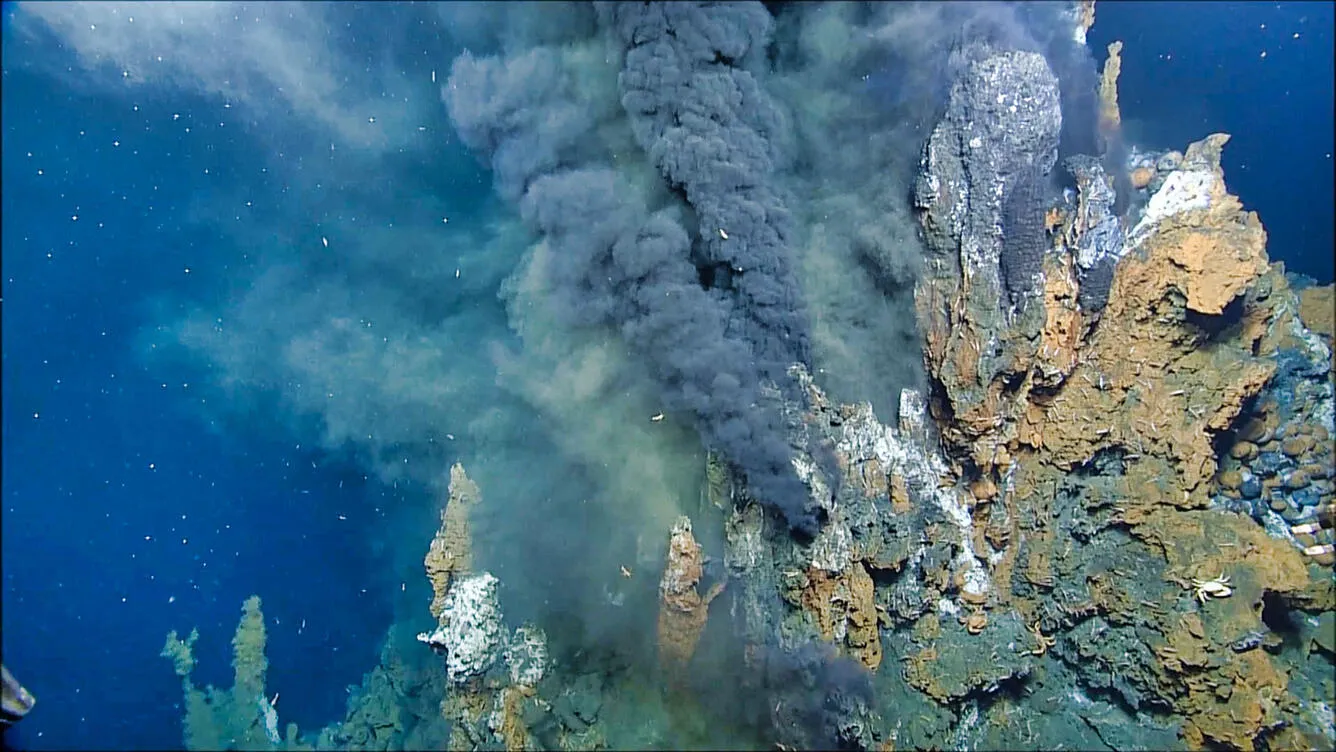
The leading candidate for LUCA's habitat is a deep-sea hydrothermal vent system on the early Earth. Specifically, the alkaline hydrothermal vents, not the volcanic "black smoker" vents most familiar from documentaries, but the cooler, longer-lived, mineral-precipitating "white smoker" systems exemplified today by the Lost City Hydrothermal Field in the mid-Atlantic.
These vents are interesting for several reasons. They produce a sustained chemical disequilibrium, the hot, alkaline, hydrogen-rich vent fluid pours into cold, acidic, electron-poor seawater, creating a natural battery with a voltage of about half a volt. They produce porous mineral chimneys with networks of microscopic pores that concentrate organic molecules. And they sustain themselves on Earth's internal heat, not solar energy, meaning the same kind of system would work on a world with no sunlight at all.
The 2024 paper by Edmund Moody and colleagues at the University of Bristol applied molecular clock analysis to the genomes of 700 modern organisms, both bacteria and archaea, and reconstructed the inferred genome of LUCA. The picture that emerged was of a cell that lived on chemiosmotic energy gradients exactly like those produced at alkaline hydrothermal vents, fixed carbon by reducing CO₂ with hydrogen (the Wood-Ljungdahl pathway, still used by some modern microbes), and produced methane as a waste product.
LUCA was a methanogen.
How fast it happened
Earth formed roughly 4.54 billion years ago. The Moon-forming impact, which left the Earth's surface a molten magma ocean, happened about 4.5 billion years ago. Liquid oceans appear to have existed by 4.4 billion years ago, possibly even before, in transient pulses during cooling intervals.
The earliest definitive microfossils, physical evidence of microbial cells preserved in rock, date to about 3.5 billion years ago in Western Australia. Chemical signatures of life, including isotopic ratios in graphite inclusions that can only be produced by biology, push the date back to about 3.7-4.0 billion years ago in Greenland.
LUCA's existence at approximately 4.2 billion years ago means life emerged on Earth essentially as soon as it could have, within a window of perhaps 100-200 million years after the appearance of stable liquid oceans. On geological timescales, this is fast.
The implication is uncomfortable but also exciting. If life on Earth emerged so quickly under the conditions that prevailed here, then either Earth happened to be exceptionally favorable for life's emergence, or life is the kind of process that gets going wherever and whenever the conditions allow it. The second possibility is what motivates the search for life on Europa, Enceladus, and the more than 5,800 known exoplanets.
Why it can't happen now
One of the strange features of the early-Earth scenario is that the same chemistry that produced life billions of years ago would not work today. The key difference is oxygen.
Today's atmosphere is 21 percent oxygen. The early Earth's atmosphere had essentially none, the so-called "Great Oxidation Event" that produced today's oxygen-rich conditions did not happen until about 2.4 billion years ago, the result of photosynthesizing cyanobacteria gradually saturating the planet's iron sinks.
Hydrogen and methane, which were abundant in the early ocean and atmosphere, react explosively with oxygen. The chemistry that LUCA used, combining hydrogen with CO₂ to produce methane, would, today, just produce rocket fuel. The reducing chemistry on which life originally bootstrapped itself is incompatible with the oxidizing chemistry that life today depends on.
This is part of why we think life cannot easily re-emerge on Earth. The conditions that allowed it the first time have been chemically transformed by the very life that emerged in them.
The first cell that survived to have descendants did so at the bottom of an ocean that no longer exists, on a planet that has chemically transformed itself out of the conditions that produced it.
Frequently Asked Questions
What is LUCA?
LUCA, the Last Universal Common Ancestor, is the most recent organism from which all currently living things on Earth descend. It was not the first form of life, but it was the last common ancestor of every modern bacterium, archaeon, plant, animal, and fungus. A 2024 Nature Ecology paper estimates LUCA lived approximately 4.2 billion years ago, was a methanogen (producing methane as a waste product), and lived in chemiosmotic environments resembling deep-sea alkaline hydrothermal vents.
How can we know what LUCA was like if no fossils exist?
The genomes of modern organisms preserve information about their ancestry. By comparing the genes shared between distantly related lineages, bacteria and archaea, researchers can reconstruct the genes that LUCA must have had. Edmund Moody and colleagues' 2024 paper used this technique with 700 modern genomes to reconstruct an inferred LUCA genome consisting of roughly 2,600 genes, including the pathways for carbon fixation, ATP synthesis, and methane production.
Where did LUCA live?
The leading candidate is a deep-sea alkaline hydrothermal vent system. These environments produce a sustained chemical disequilibrium between hydrogen-rich, alkaline vent fluid and electron-poor, acidic seawater, the natural energy gradient LUCA's reconstructed metabolism would have exploited. The Lost City Hydrothermal Field in the mid-Atlantic is the closest modern analog.
Why couldn't life emerge on Earth today?
The chemistry that produced life on the early Earth required a reducing atmosphere and ocean, rich in hydrogen, methane, and CO₂, with essentially no free oxygen. Today's atmosphere is 21 percent oxygen, the result of photosynthesizing cyanobacteria that gradually saturated Earth's chemical sinks beginning around 2.4 billion years ago. The reducing chemistry that LUCA used would, in modern oxidizing conditions, simply produce explosive reactions rather than self-sustaining chemistry.
Does the LUCA timeline mean life is common in the universe?
It is suggestive but not conclusive. If life emerged on Earth almost as soon as conditions allowed, within 100-200 million years of stable oceans forming, then either Earth happened to be exceptionally favorable, or the process of life's emergence is rapid wherever conditions allow it. The second possibility motivates the search for life on Europa, Enceladus, and exoplanets with conditions resembling early Earth.
What is the "RNA world" hypothesis?
The RNA world hypothesis proposes that the earliest forms of life used RNA as both the carrier of genetic information and the catalyst for chemical reactions, before the modern split between DNA (information storage) and proteins (catalysis) evolved. The evidence is that RNA is uniquely able to perform both functions, and that some catalytically active RNA molecules called ribozymes still exist in modern cells, where they perform essential housekeeping reactions.
Continue Exploring
- The Planet That Almost Had a Sign of LifeIn 2025, a team announced a gas in a distant world's air that, on Earth, is made almost only by living things. Then the...
- How to Spot a Civilization From Light-Years AwayAn advanced civilization might betray itself not with a message but with its machinery: the waste heat of a star...
- The Equation That Tries to Count Alien CivilizationsIn 1961, a young astronomer wrote seven terms on a blackboard to organize a single impossible question: how many...
- The First Exoplanet Whose Surface We Have Actually SeenFor the first time, the James Webb Space Telescope has read the bare rock of a world 48.5 light-years away. LHS 3844 b...
Sources
- Moody et al. (2024). "The nature of the last universal common ancestor and its impact on the early Earth system." link.
- Schrödinger (1944). "What is Life? The Physical Aspect of the Living Cell." link.
- England (2013). "Statistical physics of self-replication." link.
- Martin & Russell (2007). "On the origin of biochemistry at an alkaline hydrothermal vent." link.
- Powner et al. (2009). "Synthesis of activated pyrimidine ribonucleotides in prebiotically plausible conditions." link.