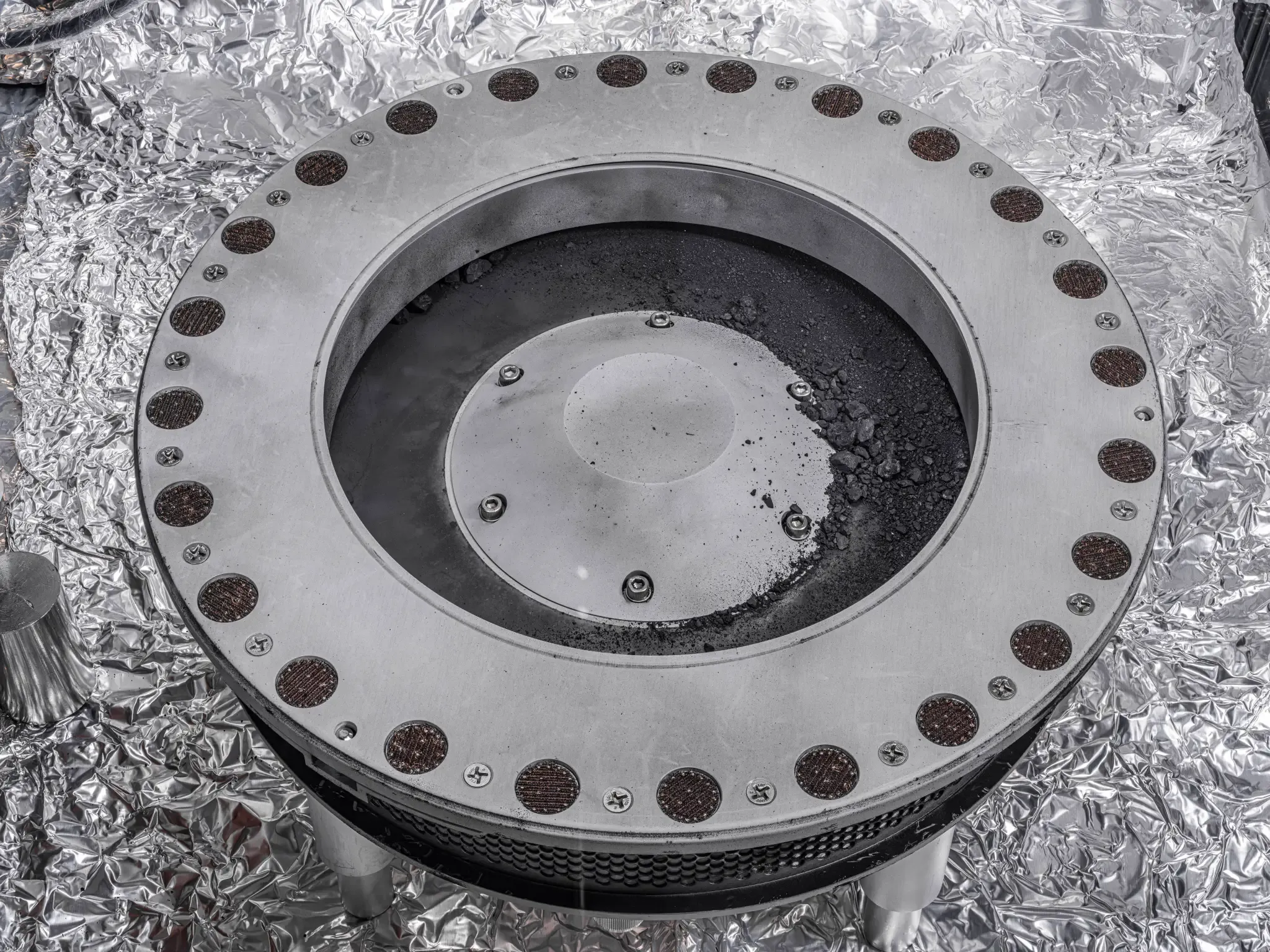
In September 2023, a charred capsule fell out of the sky over the Utah desert. Inside it was 121.6 grams of asteroid, dust, pebbles, and rock fragments collected from the surface of 101955 Bennu, a 500-meter carbonaceous body in orbit between Mars and the Earth. NASA's OSIRIS-REx had spent seven years getting there and back. The sample was the first ever returned from an asteroid by NASA, and it contained more material than the mission had hoped for.
By 2025, the chemical analysis was beginning to surface. The Bennu sample contained fifteen of the twenty amino acids that build proteins in every organism on Earth. It contained all five of the nucleobases that encode information in DNA and RNA. It contained ribose, the sugar in RNA. And it contained glucose, the energy currency of life, never before identified in an extraterrestrial sample.
The prebiotic toolkit, intact, in a rock that has been sitting in space for 4.5 billion years.
Why Bennu
The choice of Bennu was not accidental. NASA needed a near-Earth asteroid, close enough to reach without an impossibly long mission timeline, and it needed one that was carbonaceous. Carbonaceous asteroids belong to the C-type and B-type spectral classes, which are dark, primitive, and rich in carbon compounds. They are thought to have preserved the chemistry of the early solar system better than any other small bodies, because they never experienced enough heat to drive off their volatiles.
Bennu fit all the criteria. It is a B-type carbonaceous asteroid, 492 meters across, with an orbit that brings it close to Earth's. It is also, possibly, a fragment of a much larger parent body that broke apart 1-2 billion years ago, meaning the sample would contain material from deep inside that ancient asteroid, not just its weathered surface.
The mission
OSIRIS-REx, the Origins, Spectral Interpretation, Resource Identification, and Security, Regolith Explorer, launched from Cape Canaveral on September 8, 2016. It arrived at Bennu in December 2018 and spent 505 days in orbit, mapping the surface in unprecedented detail.
What the mapping showed was a problem. Pre-launch radar imaging had suggested Bennu's surface would be relatively smooth, covered in fine regolith similar to the lunar mare. It was not. Bennu was a rubble pile of boulders, some sixty meters across, some the size of a horse. The original landing zone, 25 meters in diameter, free of obstacles, did not exist anywhere on the asteroid.
OSIRIS-REx sank half a meter into the surface before its thrusters arrested the fall. Bennu was foam.
Four smaller landing sites were selected. The chosen one, named Nightingale, was in a small crater that appeared geologically young, exposed material that might be more representative of the deep interior than the radiation-weathered surface. On October 20, 2020, OSIRIS-REx descended for what was supposed to be a brief touch-and-go.
It did not stop at "touch." The spacecraft's TAGSAM arm pushed half a meter into the asteroid before the thrusters could halt the descent. The surface, held together only by Bennu's almost-nonexistent gravity, was effectively foam. When the nitrogen gas burst fired to collect the sample, it displaced over six tons of loose material. The expected 60 grams turned out to be over a kilogram, so much that a rock got stuck in the closing flap of the sampler head, allowing some of the haul to escape into space.
The return
The capsule reentered Earth's atmosphere on September 24, 2023, at 43,000 kilometers per hour, enduring 32 g-forces and surface temperatures of 2,700 degrees Celsius. Inside, the sample was protected by an advanced phenolic-impregnated carbon ablator heat shield that kept the interior below 75 degrees Celsius.
When NASA opened the outer canister at the Johnson Space Center in Houston, they found 70 grams of dark gray rocks and dust outside the inner sample container. Material had escaped from the over-stuffed sampler head during transit. That alone exceeded the mission's 60-gram target.
Opening the main canister took three and a half months. Two of the 35 fasteners holding the inner container shut had become contaminated with Bennu dust, stripping the threads and preventing standard tools from removing them. Engineers had to design, fabricate, and test new custom screwdrivers made from non-magnetic surgical stainless steel, and the new tools had to be cleared into the pristine nitrogen-purged glovebox before use. When the canister finally opened, another 51 grams of pristine, uncontaminated material was inside. Combined total: 121.6 grams. More than twice what the mission had aimed for.
The chemistry
Mass spectrometry, electron microscopy, and X-ray spectroscopy on the sample began almost immediately. The results came in waves.
First, the amino acids. Fifteen of the twenty amino acids that build proteins in living cells were detected, including glycine, alanine, glutamic acid, and aspartic acid. These molecules were already known to form abiotically in space, they have been found in meteorites for decades, but Bennu's sample, free from terrestrial contamination, confirmed their presence in pristine asteroidal material.
Second, the nucleobases. All five of the bases that encode genetic information in DNA and RNA, adenine, guanine, cytosine, thymine, and uracil, were present. The presence of all five in a single extraterrestrial sample had never been demonstrated before.
Third, the sugars. A team led by Yoshihiro Furukawa at Tohoku University detected ribose, the sugar backbone of RNA, and, for the first time in any space rock, glucose. The presence of ribose, but the relative absence of deoxyribose (the sugar in DNA), supports a long-standing hypothesis that the first life used RNA before evolving DNA.
The building blocks were already in the rock. Life did not have to invent them. It only had to assemble them.
Fourth, the phosphates. Water-soluble phosphates were identified in Bennu's regolith, an essential component of DNA, RNA, and the energy currency ATP. Phosphates in space rocks are relatively common, but water-soluble ones suggest the parent body of Bennu once had liquid water flowing through it.
Fifth, the "space gum." A team at NASA's Ames Research Center identified a polymer that has never been observed in any other extraterrestrial material, a layered, nitrogen-and-oxygen-rich compound chemically resembling polyurethane, deposited in thin layers on ice and mineral grains inside the sample. Its composition is more random than terrestrial plastics, suggesting it formed through cosmic-ray-driven chemistry over hundreds of millions of years.
Water in the past
Beyond the organics, the mineralogy told a story. Bennu's sample is dominated by hydrated clay minerals, serpentines and smectites, that form only in the presence of liquid water. The serpentines in particular are chemically and structurally similar to the rocks found at mid-ocean hydrothermal vents on Earth.
The sample also contained pyrrhotite, an iron sulfide mineral common around hydrothermal vents, and water-soluble phosphates that would have dissolved long ago if Bennu had been dry for its entire history. The picture that emerges is a parent body, Bennu's ancestor before the impact that produced it, that was once at least ten kilometers across, contained liquid water, and had active aqueous geochemistry. It may have shared important characteristics with primitive Earth or with the icy moons of the outer solar system, Enceladus and Europa.
Six times the supernova dust
Embedded within the Bennu sample are presolar grains, microscopic crystals that formed in the atmospheres of dying stars before the Sun existed. Different presolar grains can be traced to different types of stellar source: small and medium-mass stars produce one isotopic signature, supernovae produce another.
Initial analysis by the NASA Johnson Space Center showed that Bennu contained six times more supernova dust than any other astromaterial ever studied, including meteorites, lunar samples, and the previous asteroid sample-return material from JAXA's Hayabusa missions. The solar system, the sample suggests, was enriched by an unusual concentration of supernova ejecta before it formed, in addition to the steadier contribution from smaller stellar sources.
What it means and what it doesn't
The presence of amino acids, nucleobases, and sugars in Bennu does not mean life ever existed on it. Bennu is a 500-meter asteroid with no atmosphere, no liquid water, and surface temperatures ranging from minus 73 to plus 116 degrees Celsius. It is not, and has never been, habitable.
What the sample does mean is that the chemical preconditions for life, the so-called prebiotic toolkit, are abundant in the solar system and were already present when Earth formed. Whether life on Earth used materials delivered by asteroids and comets, or assembled its own from materials available locally, the inventory shown by Bennu is consistent with the picture that the early solar system was awash in organic chemistry.
Carl Sagan once compared the emergence of life to a musical composition, the organic compounds, on their own, are not the music. They are the notes. Bennu's sample shows that the notes were present everywhere.
The chemistry of life was already in the rocks before the rocks became a planet.
Frequently Asked Questions
What is OSIRIS-REx?
OSIRIS-REx (Origins, Spectral Interpretation, Resource Identification, and Security, Regolith Explorer) was a NASA mission that traveled to asteroid 101955 Bennu, collected a sample from its surface, and returned that sample to Earth. The mission launched in September 2016 and the sample capsule landed in Utah in September 2023. The spacecraft has since been renamed OSIRIS-APEX and is heading to asteroid Apophis for a 2029 encounter.
How much material did OSIRIS-REx return?
The mission's target was 60 grams. The actual sample mass was 121.6 grams, more than twice the goal. The sampler head over-collected during the touch-and-go, with material packed so densely that a rock blocked the closing flap and some material was lost in transit. The remaining sample is divided into pristine and bonus categories, with at least 70% reserved for future analysis by next-generation instruments.
What life-relevant compounds were found in the Bennu sample?
Fifteen of the 20 amino acids used in terrestrial proteins, all five DNA and RNA nucleobases (adenine, guanine, cytosine, thymine, uracil), the sugars ribose and glucose, water-soluble phosphates, and a previously unknown polymer informally called "space gum" with a composition resembling polyurethane. These represent the major chemical building blocks of biology, although their presence does not imply life ever existed on Bennu.
Did Bennu ever have liquid water?
Bennu itself, at 492 meters across, is too small to have hosted liquid water. But its mineralogy, hydrated clays, serpentines, pyrrhotite, water-soluble phosphates, indicates that Bennu's parent body, the larger asteroid Bennu broke off from 1-2 billion years ago, did experience aqueous geochemistry. That parent body was estimated to be at least 10 kilometers across and may have shared characteristics with primitive Earth or icy outer-solar-system moons.
Why is the Bennu sample more scientifically valuable than meteorites we find on Earth?
Meteorites that reach Earth's surface have passed through the atmosphere at high speed, heating to temperatures that destroy delicate organic molecules and chemically altering the surface. Once on the ground, they are exposed to terrestrial water, oxygen, and microorganisms that contaminate the sample. The Bennu material, sealed in a nitrogen-purged glovebox from collection to analysis, preserves chemistry that is impossible to recover from any terrestrial meteorite find.
What happens next with OSIRIS-REx?
The spacecraft, renamed OSIRIS-APEX (Origins, Spectral Interpretation, Resource Identification, and Security, Apophis Explorer), is on its way to the asteroid Apophis. Apophis will pass within 50,000 kilometers of Earth in April 2029. OSIRIS-APEX will rendezvous with Apophis in June 2029 and spend 18 months mapping the asteroid and documenting any changes caused by the close Earth encounter. It will repeat the touch-and-go maneuver from Bennu to stir up surface regolith for spectroscopic analysis.
Continue Exploring
- The Planet That Almost Had a Sign of LifeIn 2025, a team announced a gas in a distant world's air that, on Earth, is made almost only by living things. Then the...
- How to Spot a Civilization From Light-Years AwayAn advanced civilization might betray itself not with a message but with its machinery: the waste heat of a star...
- Every Living Thing on Earth Descended From One Cell. We Now Know Roughly Where It Lived.Three billion years ago, perhaps four, a single cell at the bottom of an ocean was the ancestor of every plant, animal...
- The Equation That Tries to Count Alien CivilizationsIn 1961, a young astronomer wrote seven terms on a blackboard to organize a single impossible question: how many...
Sources
- Lauretta et al. (2024). "Asteroid (101955) Bennu in the laboratory: properties of the sample collected by OSIRIS-REx." link.
- Glavin et al. (2025). "Abundant amino acids and nucleobases in the asteroid Bennu sample." link.
- Furukawa et al. (2025). "Detection of ribose and glucose in the OSIRIS-REx Bennu sample." link.
- Russell et al. (2024). "Hydrated minerals and aqueous alteration in asteroid Bennu." link.
- NASA OSIRIS-REx mission overview. "Origins, Spectral Interpretation, Resource Identification, and Security, Regolith Explorer." link.