The Problem the Apollo Samples Solved
Before the Apollo missions of 1969 to 1972, there were three serious theories for how the Moon formed. It might have formed alongside Earth from the same disk of dust and gas, in which case it should have a composition similar to Earth's. It might have formed elsewhere in the solar system and been captured by Earth's gravity, in which case it should have a composition similar to other captured objects, say, the asteroids. Or it might have been spun off from Earth itself early in our planet's history, when Earth was spinning so fast that material flung from its equator coalesced into a satellite.
Each theory had problems. The accretion theory could not explain why the Moon has so little iron, Earth has a large iron core, but the Moon barely has one at all. The capture theory could not explain the Moon's orbit, which is too circular and too close to Earth's equatorial plane for a captured body. The spin-off theory required Earth to have been rotating so fast that it would have been unstable, and produced too small a Moon by the relevant simulations.
The Apollo samples ruled out all three. Lunar rocks brought back to Earth turned out to be isotopically nearly identical to Earth's mantle, the proportion of oxygen-17 to oxygen-16, for example, was the same on the Moon as on Earth, while it differed measurably for Mars samples and most meteorites. The Moon and Earth were made of the same material. At the same time, the Moon had a profound deficit of iron relative to Earth and a much lower density. The Moon was Earth-like in composition but not in proportion.
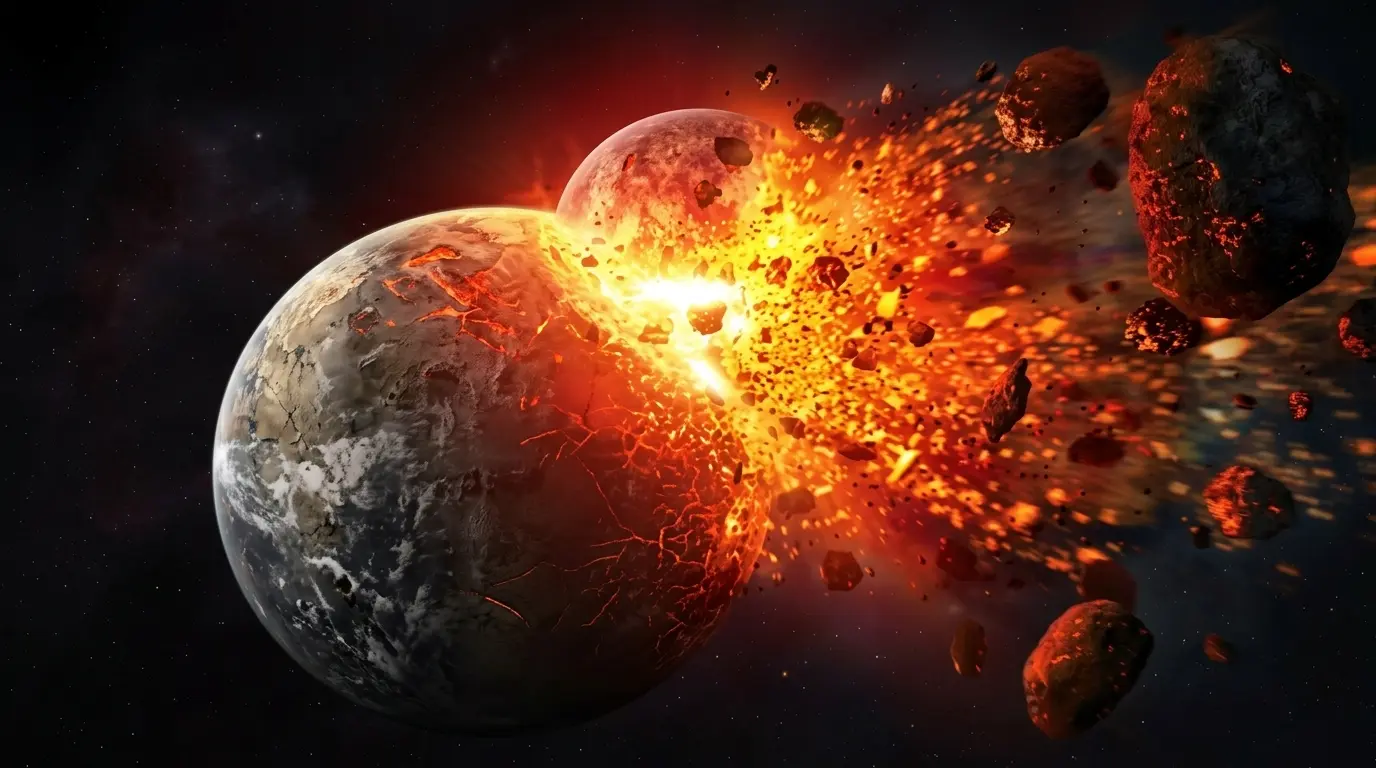
In 1975, William Hartmann and Donald Davis at the Planetary Science Institute, and independently Alastair Cameron and William Ward at Harvard, proposed a fourth theory that resolved the contradiction. A Mars-sized body collided with the proto-Earth. The collision was off-center, fast, and catastrophic. Most of the iron from the impactor's core sank into Earth's molten interior, joining Earth's growing iron core. Most of the rocky mantle material from both bodies, Earth and the impactor, was vaporized and flung into orbit, where it condensed and coalesced into the Moon. The Moon ended up made of Earth-mantle material with very little iron. Earth ended up with a slightly enlarged core and a partially re-melted mantle.
The impactor was given a name: Theia, after the Greek titan who was the mother of Selene, goddess of the Moon. The Theia hypothesis is now the standard model of lunar formation.
What Actually Happened During the Collision
The collision occurred approximately 4.5 billion years ago, within about 100 million years of the formation of the solar system. The proto-Earth was already nearly its current size, having accreted from smaller bodies over the preceding tens of millions of years. Theia was approximately the size of present-day Mars, about half Earth's diameter and roughly 10 percent of Earth's mass. It had its own iron core and its own rocky mantle.
Theia struck the proto-Earth at an angle, not head-on. The impact velocity was approximately 4 kilometers per second, slow by interstellar standards but enormous on planetary scales. The energy released was sufficient to vaporize a significant fraction of both bodies. Modern simulations, including the most detailed work by Robin Canup at the Southwest Research Institute and her collaborators in the 2000s, suggest that the collision raised the temperature of the colliding region to several thousand kelvins. Surface temperatures of the proto-Earth immediately post-impact may have reached 8,000 to 10,000 kelvins, hotter than the surface of the Sun.
The debris cloud formed within hours. Vaporized rock condensed back into droplets, then into pebbles, then into accreted bodies. The Moon's main body assembled from this debris in a process lasting perhaps a few thousand years to a few million years, extraordinarily fast on geological timescales. The new Moon was initially much closer to Earth than it is today, perhaps as close as 20,000 to 30,000 kilometers (versus the current 384,000 km). It has been receding slowly ever since.
The Moon formed in the time it would take a human to walk to the nearest village. The Earth has since spent 4.5 billion years moving its companion farther away.
How We Know the Theory Is Right
The Theia hypothesis is not just consistent with the Apollo data, it makes specific predictions that have since been tested.
First, the angular momentum of the Earth-Moon system today is consistent with the energy budget required for the giant impact, when the recession of the Moon and the slowing of Earth's rotation are accounted for. The system is, in this sense, a closed-book record of an enormous collision in the deep past. The current rotation rate and the Moon's orbital distance are exactly what the impact would have predicted, run forward 4.5 billion years through the known tidal physics.
Second, the isotopic similarity between Earth and the Moon turned out to be even more precise than the original 1970s data showed. Modern measurements of the ratio of tungsten-182 (a radiogenic isotope that traces core differentiation) to non-radiogenic tungsten in lunar rocks, published by Touboul et al. in 2007 and refined since, show that the Moon's rocks fit on the same isotopic line as Earth's mantle. This pinned the Moon's origin to Earth itself, with the Theia contribution mostly mixed into Earth's mantle. It also resolved a long-standing puzzle: the Theia material is hard to distinguish from the proto-Earth material because the two were dynamically very similar at the time of impact.
Third, recent computational refinements, including the high-energy "high-spin Earth" model by Matija Ćuk and Sarah Stewart published in Science in 2012, have shown that the standard giant-impact scenario can reproduce the Earth-Moon system more accurately than previously possible. The hypothesis has been stress-tested against the data several times in the last two decades and has held up.
The Moon Made Earth Habitable
Here is the part of the story that is most often overlooked. The giant impact did not just produce the Moon. It also reshaped Earth in three ways that turned out to be decisive for the development of complex life.
First, the collision tilted Earth's axis. Before the impact, the proto-Earth had been spinning with its axis nearly perpendicular to the plane of its orbit, like a top spinning upright. The off-center collision with Theia knocked Earth's axis sideways, leaving it tilted at approximately 23.5 degrees. That tilt is the cause of seasons. Without it, Earth would have no winters, no summers, and no temperate latitudes, equatorial regions would be permanently hot, polar regions permanently cold, and most of the planet's surface would be too uniform to drive the climatic cycling that supports diverse ecosystems.
Second, the collision dramatically slowed Earth's rotation. The proto-Earth had been spinning much faster, with a day that may have been only a few hours long. The angular momentum redistribution after the impact slowed the rotation. The Moon's subsequent tidal influence has continued to slow Earth's rotation gradually over geological time, lengthening the day from a few hours to the current 24. Without this slowdown, Earth would have ferocious winds and storms, the rotation rate would not have allowed the development of stable mid-latitude weather systems that life depends on.
Third, the Moon stabilizes Earth's axial tilt. Computer simulations published by Jacques Laskar at the Bureau des Longitudes in 1993 and confirmed since show that, in the absence of the Moon, Earth's axial tilt would wander chaotically over geological timescales, sometimes as little as zero degrees, sometimes as much as 60 degrees or more. Such large excursions would cause climate catastrophes on multimillion-year timescales: ice ages of unprecedented severity, equatorial deserts of unprecedented heat, and rapid switches between the two. The Moon's gravitational pull damps this chaos. Earth's tilt has stayed within a narrow range of 22 to 24 degrees for the past several hundred million years because the Moon prevents it from wandering.
The compound effect is that Earth has had stable seasons, stable weather, and a stable climate for the entire history of complex life. Mars, which has no large moon, has a tilt that varies between roughly 10 and 60 degrees on million-year timescales, and its climate has been correspondingly unstable. Venus, also moonless, rotates so slowly that one day is longer than a year. Earth is the only rocky planet in the solar system that has had a stable axial regime for billions of years, and the reason is the Moon.
The same collision that nearly destroyed Earth is the reason Earth is the only rocky planet in the solar system that has had a stable climate for billions of years.
What This Means for Exoplanets
The Theia hypothesis carries an uncomfortable implication for the search for life elsewhere in the universe. If giant-impact moon formation is rare, and it appears to be, since none of the other rocky planets in our own solar system have anything like Earth's Moon, then the kind of stable climate that complex life apparently needed to evolve may also be rare. Mars and Venus have small or no moons. Mercury has none. Of the rocky planets, Earth is the only one with a large stabilizing companion.
This is one of the candidates for what Robin Hanson and others have called the "Great Filter", a step in the chain from chemistry to civilization that almost never happens. It may be that habitable rocky planets are common enough, but habitable rocky planets with large stabilizing moons are rare. If that is the right answer, then the silence we observe from the rest of the galaxy is not a mystery. It is a consequence of the specific catastrophic luck that produced our particular pair of worlds.
The Moon is not a decoration on Earth's sky. It is a piece of the early planet, blasted off and held in orbit, and the reason there is anyone on Earth to look at it.
Frequently Asked Questions
What is the Theia hypothesis?
The Theia hypothesis is the standard scientific theory of how Earth's Moon formed. Approximately 4.5 billion years ago, within 100 million years of the formation of the solar system, a Mars-sized body (named Theia) collided with the proto-Earth at an angle and a velocity of roughly 4 km/s. The collision vaporized most of both bodies; the debris condensed into orbit and accreted into the Moon over a period of thousands to millions of years. The theory was independently proposed in 1975 by William Hartmann and Donald Davis at the Planetary Science Institute and by Alastair Cameron and William Ward at Harvard.
How do we know the Moon came from this collision?
Several lines of evidence converge on the giant-impact theory. Apollo lunar samples are isotopically nearly identical to Earth's mantle (matching oxygen, titanium, tungsten ratios), establishing that the Moon's material came from Earth-like rock, not from elsewhere in the solar system. The Moon has a much smaller iron core than Earth, indicating that it formed from outer mantle material, not from a body that retained its own core. The current angular momentum of the Earth-Moon system, when run backward through known tidal physics, matches the energy budget of an off-center giant impact. Modern simulations by Robin Canup and others reproduce the Earth-Moon system from the impact scenario.
How did the impact make Earth habitable?
The collision tilted Earth's axis to approximately 23.5 degrees, producing seasons; without seasons, Earth would have stable but extreme temperature zones that would be hostile to complex life. The collision and the subsequent presence of the Moon slowed Earth's rotation from a few hours per day to the current 24 hours, allowing stable mid-latitude weather systems to develop. Finally, the Moon's gravitational pull stabilizes Earth's axial tilt; without the Moon, Jacques Laskar's 1993 simulations show that Earth's tilt would wander chaotically between roughly 0 and 60 degrees over geological time, causing catastrophic climate swings. The Moon is the reason Earth has had a stable climate for billions of years.
Was Earth molten after the impact?
Yes. Modeling by Robin Canup and others suggests that surface temperatures of the proto-Earth immediately after impact reached 8,000 to 10,000 kelvins, hotter than the surface of the Sun. The entire outer layer of Earth was molten. This 'magma ocean' state lasted for tens of millions of years before Earth cooled enough for a solid crust to form. The earliest known evidence of liquid water on Earth's surface dates to about 4.4 billion years ago, consistent with cooling beginning shortly after the giant impact.
How close was the Moon to Earth originally?
Estimates from giant-impact simulations and from tidal-recession backward extrapolation place the Moon initially at roughly 20,000 to 30,000 kilometers from Earth, compared with the current 384,000 km. From Earth's surface, the newly formed Moon would have appeared 10 to 15 times larger in the sky than it does today. Tidal forces have been pushing the Moon away from Earth at an average rate of about 3.8 centimeters per year ever since. Within a few hundred million years it had receded to roughly its modern distance; the recession continues today, slowing Earth's rotation by about 2 milliseconds per century.
Could a similar impact happen to Earth today?
No body of comparable size currently exists on a trajectory that could collide with Earth. The inner solar system has been swept clean of Mars-sized objects over its 4.5 billion-year history; any that existed have either merged with the inner planets or been ejected. Smaller impacts (asteroids of kilometer-class) remain possible and are the focus of NASA's planetary defense program (DART, NEO Surveyor). A giant impact of the Theia class would require a perturbation of the outer-solar-system population on a scale unprecedented since the early solar system; it is not on any current list of credible existential threats.
Continue Exploring
- Saturn Kept Changing Its Day, and the Planet Was Never the CulpritFor four decades, every spacecraft that visited Saturn seemed to clock a different length of day, an impossibility for...
- The Day a Refrigerator-Sized Spacecraft Punched an Asteroid Into a New OrbitOn September 26, 2022, a 610-kilogram spacecraft slammed into a 160-meter asteroid at 22,000 kilometers per hour. The...
- What Actually Happened to NASA's Return to the MoonArtemis was announced in 2017 with a goal of landing on the Moon by 2024. In 2026 the first crewed mission has finally...
Sources
- Hartmann, W. K. & Davis, D. R. "Satellite-sized planetesimals and lunar origin." Icarus, 24, 504 (1975).
- Cameron, A. G. W. & Ward, W. R. "The origin of the Moon." Lunar Science Conference Abstracts, 7, 120 (1976).
- Canup, R. M. & Asphaug, E. "Origin of the Moon in a giant impact near the end of the Earth's formation." Nature, 412, 708 (2001).
- Ćuk, M. & Stewart, S. T. "Making the Moon from a fast-spinning Earth: A giant impact followed by resonant despinning." Science, 338, 1047 (2012).
- Touboul, M. et al. "Late formation and prolonged differentiation of the Moon inferred from W isotopes in lunar metals." Nature, 450, 1206 (2007).
- Laskar, J. & Robutel, P. "The chaotic obliquity of the planets." Nature, 361, 608 (1993).
- Canup, R. M. "Forming a Moon with an Earth-like composition via a giant impact." Science, 338, 1052 (2012).
- NASA Apollo Lunar Sample Compendium. lpi.usra.edu/lunar/samples
- Cover image: NASA / JPL-Caltech artist's impression of the giant impact. Public domain.