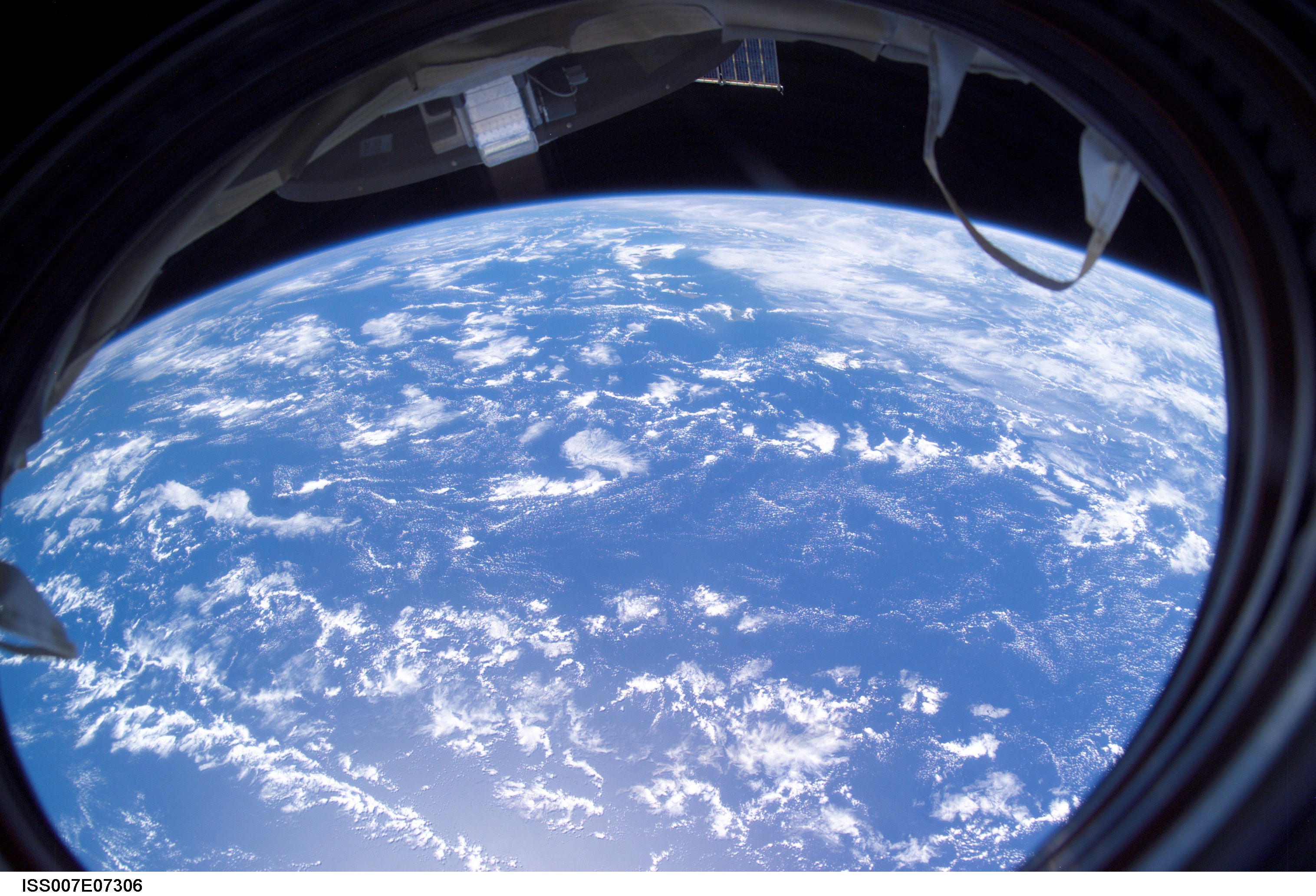
The Oxygen We Take for Granted
Earth's atmosphere is 21 percent oxygen. It has not always been that way, and it will not always be that way.
For the first two billion years of Earth's history, the atmosphere contained essentially no free oxygen. The planet was dominated by methane, carbon dioxide, and nitrogen, and the life that existed was entirely microbial and anaerobic, organisms that not only survived without oxygen, but for which oxygen was toxic.
Oxygen began building up in the atmosphere approximately 2.45 billion years ago, during what is known as the Great Oxidation Event. The cause was cyanobacteria, microscopic organisms that had evolved a new trick: photosynthesis. They absorbed sunlight and carbon dioxide, and exhaled oxygen as a byproduct. For hundreds of millions of years, that oxygen was absorbed by iron and other reactive minerals on the seafloor and land surface. Eventually, the sinks filled. Oxygen began to accumulate. The atmosphere transformed.
Oxygen levels stayed relatively low for most of the planet's history, only rising to near modern levels following the evolution of land plants around 400 million years ago. Complex life, everything from fish to fungi to human beings, exists because of that accumulation. The ozone layer that shields the surface from ultraviolet radiation is made of oxygen. The aerobic metabolism that powers animal cells requires oxygen. Remove it, and the biosphere as we know it collapses.
A study published in March 2021 calculated precisely how long we have before that happens.
The Model and the Number
Kazumi Ozaki of the University of Tokyo and Chris Reinhard of Georgia Tech modeled Earth's climatic, biological, and geological systems as part of a NASA program called NExSS, the Nexus for Exoplanet System Science, designed to explore and assess the habitability of worlds beyond our own.
Their approach was unusually rigorous. Rather than running a single simulation, they used a stochastic method, running the model thousands of times with slightly varied parameters to capture the full range of possible outcomes. The result was not a single prediction but a probability distribution with genuine statistical weight.
The mean future lifespan of Earth's atmosphere, with oxygen levels above 1% of the present atmospheric level, is 1.08 ± 0.14 billion years.
That is the number. Not a rough estimate, a precise figure with a margin of error, derived from biogeochemistry, climate modeling, and the known physics of stellar evolution. Published in peer review. Confirmed by two independent scenarios modeled in the same study.
"We find that the Earth's oxygenated atmosphere will not be a permanent feature."
The Mechanism: A Star That Won't Stop Growing
The culprit is not pollution, not asteroid impact, not any catastrophe in the conventional sense. It is the ordinary, inevitable aging of the Sun.
Stars like the Sun grow gradually brighter as they age. Over billions of years, the Sun's luminosity increases as hydrogen in its core is converted to helium, altering the internal pressure and temperature balance. This increased solar energy accelerates the weathering of silicate rocks such as basalt and granite. When these rocks weather, the greenhouse gas carbon dioxide is drawn out of the atmosphere and locked into carbonate minerals through chemical reactions.
This is where the chain reaction begins. As carbon dioxide levels fall, photosynthesis becomes less efficient. Plants, and before them, cyanobacteria, require CO₂ to produce oxygen. Carbon dioxide levels will continue to drop until photosynthesizing organisms can no longer survive, effectively shutting off Earth's oxygen supply.
The oxygen in the atmosphere is not a stored reservoir, it is continuously produced. Stop the production, and what remains is gradually consumed by oxidation reactions in rocks and oceans. The atmosphere deoxygenates.
The Collapse Will Be Fast
Here is the detail that makes the finding genuinely unsettling: the transition will not be gradual. It will not give life time to adapt.
Although the deoxygenation is approximately 1 billion years away, once the depletion begins, it will occur in roughly 10,000 years. The drop will be extreme, oxygen levels falling to about one-millionth of what exists in today's atmosphere.
Ten thousand years is an eyeblink in geological time. It is fast enough that aerobic life, life that depends on oxygen, would have no evolutionary pathway to adapt. Organisms cannot evolve entirely new metabolic systems in that timeframe. The biosphere would not transition. It would collapse.
The deoxygenation event will coincide with a simultaneous rise in methane, levels approximately 10,000 times higher than in today's atmosphere. The ozone layer, composed of oxygen, will vanish. Ultraviolet radiation will penetrate to the surface without filtration, extinguishing both terrestrial and aquatic life.
What survives? The same organisms that thrived before the Great Oxidation Event. The anaerobic and primitive bacteria currently inhabiting low-oxygen niches, deep sediments, hydrothermal vents, oxygen-depleted ocean zones, will inherit the planet. The clock, in a sense, runs backward.
"A world where many of the anaerobic and primitive bacteria are currently hiding in the shadows will, again, take over, just as in the beginning. Complex life forms will go extinct except for tiny colonies of cells."
Why This Matters Beyond Earth
The study was funded in part by a NASA program specifically designed to understand the habitability of exoplanets. That context is not incidental, it reframes the entire finding.
The authors estimate that the total habitable lifetime of Earth, before it loses its surface water entirely, is around 7.2 billion years. But an oxygen-rich atmosphere may only be present for around 20 to 30 percent of that time.
This has profound implications for the search for extraterrestrial life. When astronomers scan exoplanet atmospheres for oxygen as a biosignature, a chemical sign of life, they are implicitly assuming that oxygen is a stable, long-term indicator. The Earth study suggests it is not.
Imagine scanning the heavens for signs of life by looking for oxygen and ozone in the atmospheres of other planets. If those instruments passed over Earth 2 billion years from now, or 2 billion years ago, the result would be a false negative, a living planet dismissed as lifeless, simply because it was observed in the wrong phase of its oxygen cycle.
Some exoplanets already dismissed as barren may simply be in a pre- or post-oxygen phase. Some planets currently being searched may harbor complex life that produces no detectable oxygen at all.
The Perspective That Changes Everything
A billion years is a number that resists comprehension. Homo sapiens have existed for roughly 300,000 years. Recorded human history spans about 5,000. The dinosaurs lasted 165 million years. A billion is six times longer than that.
The oxygen crisis is not a problem to solve. It is not a threat to prepare for. It is a feature of a finite universe, a reminder that even the most fundamental conditions for life on Earth, the invisible blanket of gas that makes every breath possible, are not permanent.
The oxygen in the atmosphere today is the product of 2.5 billion years of biological work by organisms that had no idea they were transforming the world. Cyanobacteria did not intend to create the conditions for complex life. They were simply doing what their chemistry demanded. And yet, through billions of years of unintentional labor, they built the atmosphere that made everything else possible.
That work will sustain complex life for another billion years. And then, with geological inevitability, it will end, not with a bang, but with a slow dimming of the photosynthetic engines that have kept the planet breathing since before animals existed.
The Sun will keep shining. The rocks will keep weathering. The CO₂ will keep dropping. And one day, in the deep future, the last oxygen-breathing organism on Earth will exhale for the last time, unaware, as we are now, of the billion-year story that made that breath possible.
Oxygen took 2.5 billion years to arrive. It will spend 1.08 billion more years on its way out. In the full history of this planet, its presence is the exception, not the rule.
Frequently Asked Questions
When will Earth run out of oxygen?
According to a 2021 study published in Nature Geoscience, Earth's atmosphere will maintain oxygen levels above 1% of current levels for approximately 1.08 billion more years. After that, a rapid deoxygenation is expected to occur over roughly 10,000 years, returning the atmosphere to conditions similar to early Earth before the Great Oxidation Event.
What causes Earth's future deoxygenation?
The primary driver is the gradual brightening of the Sun as it ages. Increased solar energy accelerates the weathering of silicate rocks, which draws carbon dioxide out of the atmosphere. With less CO₂, photosynthesis declines, oxygen production drops, and the atmosphere deoxygenates. The process is driven by stellar physics, not human activity.
How fast will the oxygen disappear?
Once deoxygenation begins, it will occur very rapidly in geological terms, approximately 10,000 years. This is too fast for aerobic life to adapt through evolution. Oxygen levels are expected to fall to roughly one-millionth of current atmospheric levels.
What happens to life when oxygen disappears?
Complex aerobic life, animals, plants, fungi, will go extinct. The ozone layer, which is composed of oxygen, will vanish, exposing the surface to intense ultraviolet radiation. Anaerobic microorganisms, which do not require oxygen, are expected to survive and eventually dominate the planet as they did before the Great Oxidation Event.
Who conducted this research?
The study was led by Kazumi Ozaki of the University of Tokyo and Chris Reinhard of Georgia Tech. It was conducted as part of NASA's NExSS program and published in Nature Geoscience on March 1, 2021.
What does this mean for the search for alien life?
The finding suggests that oxygen is not a permanent biosignature even on living planets. Earth itself will lack atmospheric oxygen for most of its total habitable lifetime. This means astronomers searching for life by detecting oxygen may miss planets that harbor life in a pre- or post-oxygen phase of their atmospheric evolution.
Continue Exploring
- The Worst Day in Earth's History Lasted Two Million Years252 million years ago, an event the paleontologists now call simply The Great Dying erased 96 percent of all marine...
- How Far Back in Earth's History Could a Human Community Actually Survive?Take a hundred modern humans, give them stone-age tools, and drop them into a random point in Earth's 4.6 billion-year...
- If You Stood on a World in the Pleiades, This Is What You'd SeeMessier 45 is the most photographed open cluster in the sky and one of the closest. No planet has ever been confirmed...
- Venus Was Earth's Twin for a Billion Years. Then Something Broke.Venus formed alongside Earth, from the same cloud of dust, at essentially the same moment. Same size. Same mass....
Sources
- Ozaki, K. & Reinhard, C.T. "The future lifespan of Earth's oxygenated atmosphere." Nature Geoscience, March 2021. nature.com
- NASA NExSS Program, Nexus for Exoplanet System Science. nasa.gov
- The Conversation: "A billion years from now, a lack of oxygen will wipe out life on Earth." theconversation.com
- EarthSky: "Earth's oxygen will be gone in 1 billion years." earthsky.org
- Cover image: Earth from the International Space Station, NASA. Public domain.