Imagine, for a second, that humans had evolved without the ability to see light. For thousands of years, we would fumble through a world we could touch, hear, taste, and smell, but not see. Then someone built a machine that could perceive light for us. Overnight, we would discover the Sun. The Moon. The galaxy. The deep field of every galaxy beyond it.
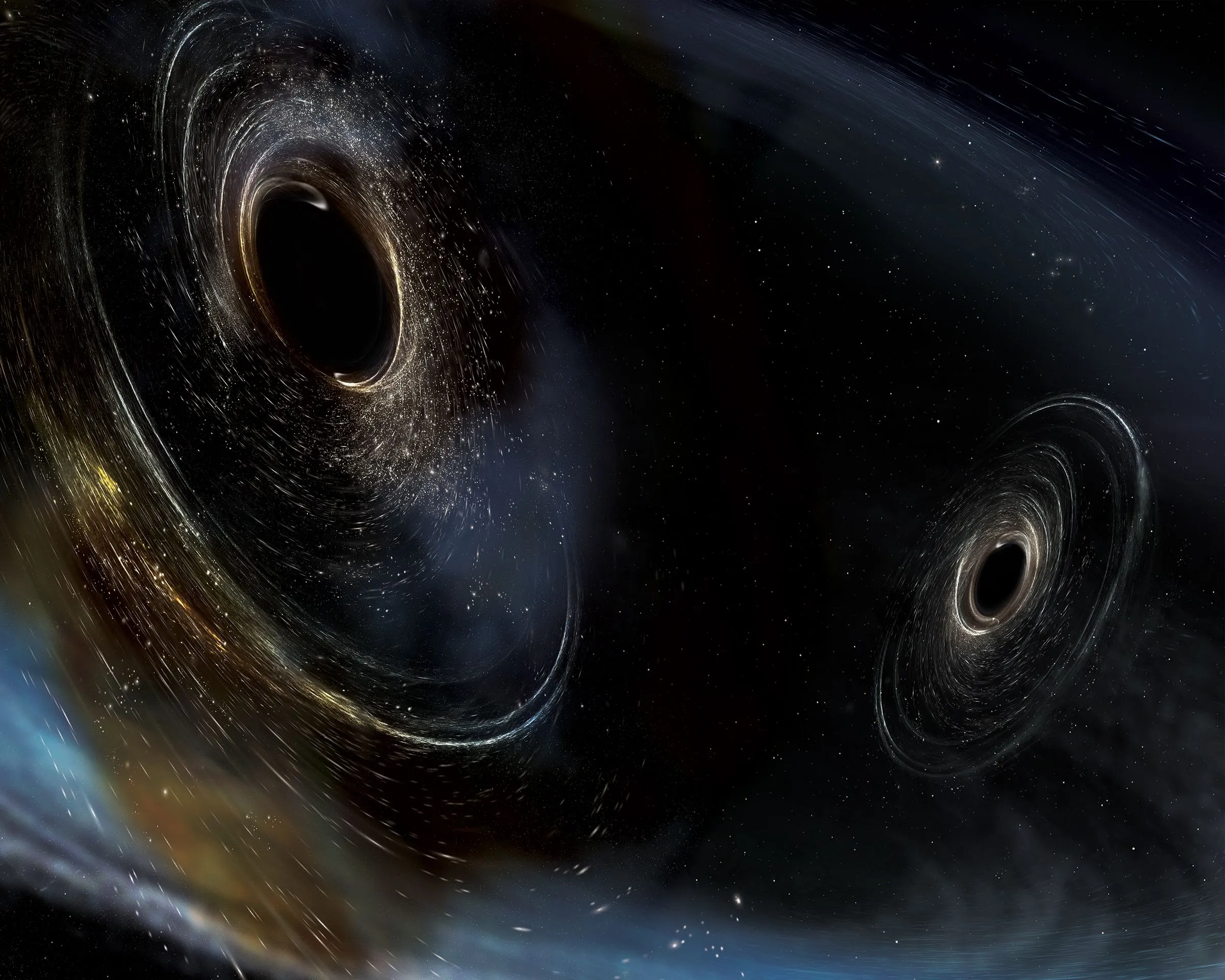
That is what happened in physics on September 14, 2015. At 09:50:45 UTC, the twin LIGO detectors, one in Hanford, Washington, the other in Livingston, Louisiana, recorded a signal that lasted exactly 0.2 seconds. It was the first time in history we had detected a gravitational wave directly. It was the first time we had seen, in any sense, the merger of two black holes. And it had been a billion years in the making.
The signal was named GW150914. Its source was 1.3 billion light-years away.
What Einstein predicted
In 1915, Einstein published his theory of general relativity. Mass curves spacetime; the curvature is what we experience as gravity. The equations also had a less-discussed consequence. When mass accelerates, it sends out ripples in spacetime itself, distortions that travel outward at the speed of light, alternately stretching and compressing distances as they pass.
These ripples were called gravitational waves. Einstein calculated their amplitude and found it absurdly small. Detecting one would require measuring changes in distance smaller than the diameter of a proton, over kilometers. He concluded the effect would never be observed.
The conclusion stood for a century. Indirect evidence accumulated: in 1974, Russell Hulse and Joseph Taylor discovered a binary pulsar whose orbit was decaying exactly as general relativity predicted it should if gravitational waves were carrying away energy. That earned them the 1993 Nobel Prize. But the direct detection, actually catching a wave as it passed through Earth, required machines that did not yet exist.
How LIGO works
The Laser Interferometer Gravitational-Wave Observatory is, fundamentally, two arms of a very precise ruler. Each arm is 4 kilometers long, evacuated to a trillionth of atmospheric pressure, and aligned perpendicular to the other. At one end of each arm is a 40-kilogram fused-silica mirror, suspended by silica fibers as thin as a human hair. A laser beam at the corner of the L-shape is split, sent down both arms, bounced 280 times between the end mirrors and a recycling mirror near the entrance, and recombined.
If the two arms are exactly the same length, the recombined beams cancel each other out and no light reaches the photodetector. If a gravitational wave passes through Earth, it stretches one arm and squeezes the other. The arms are momentarily different lengths. The cancellation fails. Light reaches the detector.
The arms changed length by less than one ten-thousandth the width of a proton. LIGO measured it.
The precision required is staggering. To detect the GW150914 signal, LIGO measured a change in arm length of approximately 10⁻¹⁸ meters, one ten-thousandth the width of a single proton. The challenge is not just the small size of the signal but distinguishing it from everything else that can move a mirror: ground vibrations, thermal fluctuations, quantum noise in the laser, even the gravitational pull of trucks driving past the detector.
Every one of those noise sources is suppressed by a stack of engineering. The mirrors are isolated on seismic platforms. The lasers operate at 750 kilowatts of circulating power. The light is "squeezed" using quantum optics to reduce the inherent quantum uncertainty in photon arrival times. The detectors at Hanford and Livingston are 3,000 kilometers apart and need to record the same signal within a few milliseconds, fast enough that any noise affecting only one site can be vetoed.
The detection
On September 14, 2015, LIGO had just completed a major upgrade, Advanced LIGO, and was four days into its first observing run. At 09:50:45 UTC, both detectors recorded a chirp: a signal that swept upward in frequency from 35 Hz to 250 Hz over the course of 0.2 seconds.
That chirp pattern is the unmistakable signature of two compact massive objects spiraling into each other. As they orbit closer, the frequency of the gravitational waves rises. The amplitude rises with it. When the two objects finally merge, the signal cuts off abruptly, replaced by a brief "ringdown" as the merged object settles into its final shape.
The waveform from GW150914 matched the predicted template for a merger of two black holes of 29 and 36 solar masses, at a luminosity distance of 410 megaparsecs, about 1.3 billion light-years. The peak gravitational-wave luminosity was approximately 3.6 × 10⁴⁹ watts. For comparison: the total electromagnetic luminosity of all the stars in the observable universe is about 5 × 10⁴⁸ watts. For 20 milliseconds, GW150914 outshone the entire universe by a factor of fifty.
What we learned from one signal
The 0.2-second waveform was packed with information. It told us:
Black holes of 30 solar masses exist. Before GW150914, only stellar-mass black holes around 5-15 solar masses were known. The existence of 29- and 36-solar-mass black holes implied that some pathway in stellar evolution can produce more massive black holes than had been observed, eventually traced to low-metallicity star formation in the early universe.
Two such black holes can find each other and merge within the age of the universe. Whether through dynamic interactions in dense star clusters or through evolution as a primordial binary, the formation channel had to be efficient enough to produce mergers at a rate detectable on LIGO timescales.
General relativity is correct to extraordinary precision, even in the strong-field regime near merging black holes. The waveform matched numerical relativity simulations to within instrumental error.
And gravitational waves travel at the speed of light. The signal arrived simultaneously at Hanford and Livingston, with the 6.9-millisecond difference exactly matching the light travel time between the two detectors.
The avalanche after
The second detection, GW151226, arrived three months later. It was another binary black hole merger, this one of 14- and 8-solar-mass objects, 1.4 billion light-years away. Then GW170104. Then GW170814, observed simultaneously by LIGO and the newly operational Virgo detector in Italy, which provided a third triangulation point and pinned the source down to a small patch of sky.
The first three observing runs catalogued more than eighty mergers. Black holes, it turned out, are everywhere.
And on August 17, 2017, GW170817 changed everything again. This signal was different, longer, lower in mass, and accompanied two seconds later by a short gamma-ray burst detected by the Fermi space telescope. Seventy ground-based observatories scrambled to follow up. They found, in the galaxy NGC 4993, a kilonova, the optical and infrared afterglow of two neutron stars colliding. It was the first multi-messenger detection of a single astrophysical event by both gravitational waves and electromagnetic radiation, and it confirmed that neutron star mergers are a major source of heavy elements like gold and platinum in the universe.
The 2017 Nobel Prize
Three scientists shared the 2017 Nobel Prize in Physics for the LIGO detection. Rainer Weiss of MIT invented the interferometer-based detector concept in the early 1970s. Kip Thorne of Caltech provided the theoretical foundation for waveform predictions and pushed for the project's funding. Barry Barish, also of Caltech, led the LIGO Laboratory from 1994 to 2005, transforming it from a research project into the operational observatory that made the detection.
What's coming
LIGO is currently in its fifth observing run, with detection sensitivity roughly four times better than during GW150914. Several upgrades are planned for the late 2020s: LIGO Voyager, with heavier mirrors and improved squeezed light, will push sensitivity by another factor of four.
India is building a third LIGO detector, LIGO-India, which will provide better triangulation and reduce the sky-localization area for new detections. KAGRA, an underground cryogenic detector in Japan, is online and joining the international network.
The most ambitious project is LISA, the Laser Interferometer Space Antenna, a constellation of three spacecraft 2.5 million kilometers apart, scheduled for launch in 2037. LISA will detect gravitational waves at frequencies far lower than LIGO can reach, including signals from supermassive black hole binaries and possibly even cosmic strings.
Ten years after GW150914, gravitational wave astronomy has gone from impossible to routine. The universe is now visible in two completely different kinds of light. We are still learning to see.
One hundred years after Einstein said we would never detect them, we built two ears and listened.
Frequently Asked Questions
What is LIGO?
LIGO is the Laser Interferometer Gravitational-Wave Observatory, a pair of large-scale laser interferometers in Hanford, Washington and Livingston, Louisiana, designed to detect gravitational waves. Each detector has two perpendicular 4-kilometer arms, and tiny differences in the time light takes to traverse the two arms reveal the passage of a gravitational wave. LIGO is operated by Caltech and MIT and funded by the U.S. National Science Foundation.
What was GW150914?
GW150914 was the first directly detected gravitational wave signal, recorded on September 14, 2015. The signal originated from the merger of two black holes, of 29 and 36 solar masses, at a distance of approximately 1.3 billion light-years. The merger lasted about 0.2 seconds, during which the peak gravitational-wave luminosity briefly exceeded the combined electromagnetic luminosity of all the stars in the observable universe.
How small a signal can LIGO detect?
LIGO can measure changes in arm length of approximately 10⁻¹⁸ meters, about one ten-thousandth the width of a single proton. To put this in perspective, the equivalent precision applied to the distance between the Sun and the nearest star, Proxima Centauri, would be measuring a difference the width of a human hair. Achieving this precision requires extensive vibration isolation, ultra-pure mirrors, ultra-high vacuum, and quantum-optical noise reduction.
How are gravitational waves different from light?
Light is an oscillation in the electromagnetic field, fluctuations of electric and magnetic fields that propagate through space. Gravitational waves are oscillations in the geometry of spacetime itself, alternating stretches and compressions of distance. Both travel at the speed of light, but gravitational waves are not absorbed or scattered by matter the way light is. They pass through everything, which is why they give us a view of phenomena like black hole mergers and the early universe that light cannot reach.
What is LISA?
LISA, the Laser Interferometer Space Antenna, is a planned space-based gravitational wave observatory consisting of three spacecraft arranged in an equilateral triangle 2.5 million kilometers on a side. Each spacecraft will exchange laser beams with the other two, creating a Michelson interferometer with arms vastly longer than any Earth-based detector. LISA is led by the European Space Agency with NASA participation, and is scheduled for launch in 2037. It will detect gravitational waves at frequencies LIGO cannot reach.
Have we detected gravitational waves from anything besides black holes?
Yes. GW170817, detected on August 17, 2017, was the merger of two neutron stars, accompanied by a short gamma-ray burst and optical afterglow observed across the electromagnetic spectrum. This was the first "multi-messenger" detection of a single astrophysical event by both gravitational and electromagnetic radiation, and it confirmed that neutron star mergers are a major source of heavy elements like gold and platinum in the universe. LIGO's third observing run also detected several neutron-star-black-hole mergers.
Continue Exploring
- The Collision That Came In SidewaysTheory assumed colliding compact objects settle into near-perfect circles before merging. Then astronomers reanalyzed a...
- When a Black Hole Shreds a StarWander too close to a supermassive black hole and gravity becomes a weapon. The star is stretched into a stream of gas...
- The Supernova That Chirped Like a Black Hole MergerA billion light-years away, one of the brightest explosions in the universe pulsed with a rhythm that kept speeding up....
- The Star That Vanished Without an ExplosionSome massive stars do not end in a supernova. They flicker, fade, and quietly fall into the black hole they have just...
- The Brightest Object in the Universe Was Hiding as a StarJ0529-4351 outshines five hundred trillion Suns, yet for forty years our telescopes filed it away as an ordinary point...
Sources
- Abbott et al. / LIGO (2016). "Observation of Gravitational Waves from a Binary Black Hole Merger." link.
- Abbott et al. / LIGO-Virgo (2017). "GW170817: Observation of Gravitational Waves from a Binary Neutron Star Inspiral." link.
- Hulse & Taylor (1975). "Discovery of a pulsar in a binary system." link.
- LIGO Scientific Collaboration. "LIGO Open Science Center, detected events." link.
- Amaro-Seoane et al. (2017). "Laser Interferometer Space Antenna (LISA) mission concept." link.