There is one number that ties together almost every calculation in cosmology. It is the Hubble constant, the rate at which the universe is expanding right now. It determines the age of the universe, the distance to remote galaxies, the size of the observable cosmos, the temperature of the cosmic microwave background, and the predicted abundance of hydrogen, helium, and lithium produced in the first minutes after the Big Bang.
For most of the past century, the Hubble constant was uncertain. As measurement techniques improved through the 1990s and 2000s, the uncertainty shrank, and astronomers expected the two main methods of measurement, one using nearby Type Ia supernovae and Cepheid variable stars, the other using the cosmic microwave background, to converge on a single value.
They have not converged. The two methods now disagree by about 10 percent. The gap has held steady, and in some recent measurements grown larger, despite a decade of efforts to find systematic errors. The discrepancy has its own name now, the Hubble Tension. And it has crossed into the regime where it is no longer easily explained as a measurement problem.
The two methods
The first measurement is what astronomers call the "late universe" method. It uses the cosmic distance ladder, a chain of overlapping techniques that links nearby objects to distant ones. The bottom rung is direct parallax measurements of nearby stars. The next rung uses Cepheid variable stars in our galaxy and the Magellanic Clouds, whose intrinsic brightness can be inferred from their pulsation period. The next rung uses Type Ia supernovae, whose intrinsic brightness is calibrated against Cepheids in galaxies that host both. At the top of the ladder, Type Ia supernovae can be observed in galaxies billions of light-years away, and their redshift combined with their distance gives a direct measurement of the current expansion rate.
The most recent value from this technique, refined by Adam Riess and collaborators using Hubble Space Telescope observations, is approximately 73.5 kilometers per second per megaparsec. Independent measurements using megamaser galaxies, J-band luminosity standards, and Mira variables all agree, falling within the range 72-77.
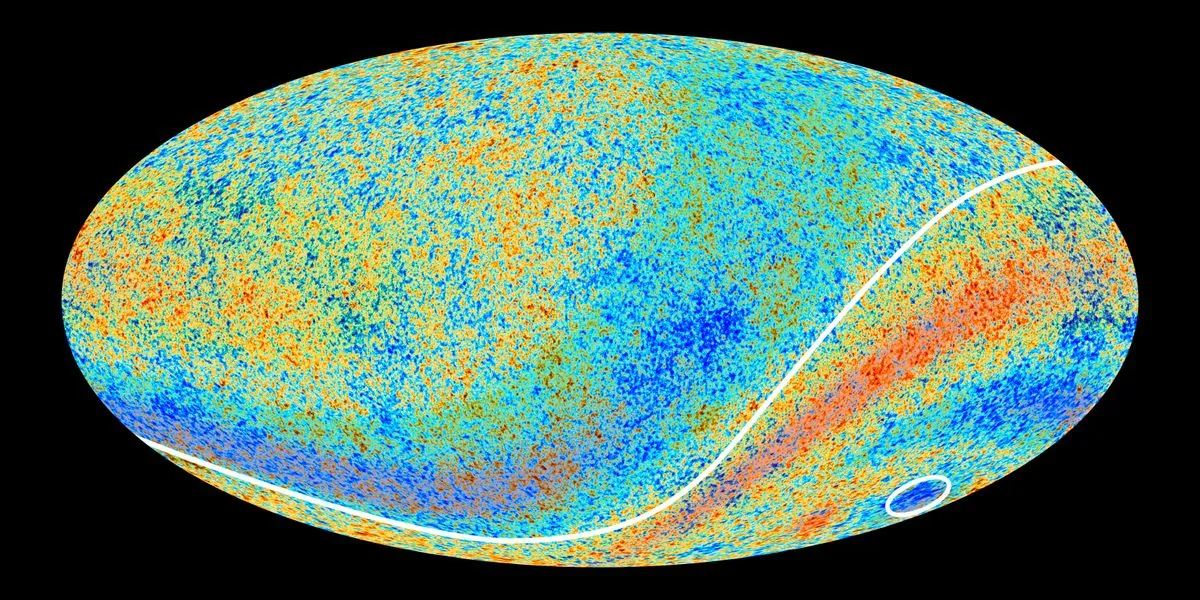
The second measurement is the "early universe" method. It uses the cosmic microwave background, the radiation left over from when the universe became transparent, 380,000 years after the Big Bang. The Planck satellite, operating from 2009 to 2013, measured the CMB temperature fluctuations to such precision that it could fit the full Lambda-CDM cosmological model to them. Given that fit, the model predicts what the universe should look like today, including the expansion rate.
Planck's predicted value is 67.4 kilometers per second per megaparsec.
73.5 and 67.4. Both measurements have error bars of less than one percent. The gap between them is 6 percent. They cannot both be right.
The significance grows
When the tension first appeared in the early 2010s, both teams assumed it would resolve. Some systematic error in one of the techniques, an unaccounted-for bias in Cepheid calibration, an unmodeled foreground in the CMB analysis, would be identified, and the values would converge.
The opposite has happened. As more data has accumulated and the error bars have shrunk, the gap has remained. The current statistical significance of the disagreement is approximately 5 sigma, which in physics is the threshold for declaring a discovery.
The 2020 measurement from the Megamaser Cosmology Project, which uses water masers around supermassive black holes to obtain geometric distances completely independent of the Cepheid-supernova ladder, returned a Hubble constant of 73.9 km/s/Mpc, squarely on the late-universe side.
In late 2024, a team led by Daniel Scolnic at Duke University used DESI data and the Coma galaxy cluster to anchor Type Ia supernovae and got 76.5 km/s/Mpc. In 2025, a team at the Inter-University Centre for Astronomy and Astrophysics in India used Mira variable stars in our galaxy as anchors for Mira variables in distant galaxies, a method completely independent of Cepheids, and got 73.0 km/s/Mpc.
All of these independent late-universe techniques converge on roughly 73 km/s/Mpc. None of them are consistent with 67.4.
What it could mean
The cosmological community is now split between three broad responses to the tension.
The first is that some systematic error has not been found yet. The Cepheid calibration, the supernova standardization, the CMB foreground modeling, the assumed model of cosmic dust, any of these could have hidden problems. This is the most conservative possibility, and dedicated programs to find such errors have been running for years. They have not succeeded.
The second is that the Lambda-CDM model is incomplete. The most popular variant of this idea is "early dark energy", a transient form of dark energy that was active in the first 100,000 years after the Big Bang and then decayed away. Its effect would be to shift the predicted late-universe expansion rate upward, bringing the CMB prediction closer to the local measurement. Other proposals invoke modifications to neutrino physics, additional relativistic particles in the early universe, or a different equation of state for dark energy. None of these proposals are excluded by the data, but none are uniquely required either.
The third response, proposed in a 2025 paper by Balázs Endre Szigeti and colleagues at the Wigner Research Centre, is that the universe is rotating. Not the galaxies in it, all of which we know rotate, but the entire cosmos as a whole. A rotation period of approximately 500 billion years would be too slow to detect directly but fast enough to systematically affect how distances are measured across cosmic time. The hypothesis is preliminary, but the initial calculation shows that it could in principle reconcile both Hubble values.
What is at stake
The Hubble Tension is not a minor measurement disagreement. If it is real, if our standard model of cosmology is genuinely missing something, then the standard model needs to change. And the standard model underlies almost every quantitative statement we make about the universe.
The age of the universe depends on the Hubble constant. The current value is 13.8 billion years, but if the local measurement is correct, the universe could be closer to 12.5 billion years old. That is a substantial revision.
The amount of matter in the universe depends on the Hubble constant. The fraction of dark matter, the fraction of baryons, the fraction of dark energy, all of these are derived from the model and depend on which Hubble value is used.
The predicted growth of large-scale structure depends on the Hubble constant. The age and distance of every distant object, every quasar, every gamma-ray burst, every measurement we use to constrain models of inflation and the early universe, depends on which value we use.
If the Hubble Tension is real, our model of how the universe formed is missing a piece. We do not know which piece.
What will resolve it
Three observational programs in the late 2020s should be decisive.
The James Webb Space Telescope is observing Cepheid variables in nearby galaxies at infrared wavelengths, where dust extinction is much less of a concern than for Hubble's optical observations. JWST data is consistent with the Hubble value of 73 km/s/Mpc, strengthening the late-universe measurement and weakening the case that the Cepheid calibration is responsible for the tension.
The Vera C. Rubin Observatory, which began science operations in 2025, will catalog millions of new Type Ia supernovae and significantly reduce the statistical error on the late-universe measurement. By the early 2030s, the Hubble constant from this technique should be known to better than 0.5 percent.
The Simons Observatory and CMB-S4, ground-based next-generation cosmic microwave background experiments coming online in the late 2020s, will measure the CMB polarization to unprecedented precision, providing an independent constraint on the early-universe value.
By the early 2030s, the Hubble Tension will either resolve, through the identification of a systematic error in one of the techniques, or it will be definitively confirmed. If it is confirmed, the standard model of cosmology is broken, and we will need to find what is broken.
The universe is expanding. The question of how fast may break the model we used to ask it.
Frequently Asked Questions
What is the Hubble constant?
The Hubble constant (H₀) is the rate at which the universe is expanding right now, expressed in kilometers per second per megaparsec. It quantifies how fast distant galaxies are receding as a function of their distance from us. The Hubble constant is fundamental to cosmology because it determines the age of the universe, the size of the observable cosmos, and most other cosmological parameters.
What is the Hubble Tension?
The Hubble Tension is the persistent disagreement between two methods of measuring the Hubble constant. The "late universe" method, using nearby supernovae and Cepheid variables, gives approximately 73.5 km/s/Mpc. The "early universe" method, using the cosmic microwave background as observed by the Planck satellite, gives 67.4 km/s/Mpc. The current statistical significance of the disagreement is approximately 5 sigma, the threshold for declaring a discovery in physics.
Could one of the measurements be wrong?
Both teams have searched extensively for systematic errors that could explain the discrepancy. Independent late-universe measurements, using megamasers, J-band luminosity, Mira variables, and Type Ia supernovae anchored differently, all return values near 73 km/s/Mpc. James Webb Space Telescope observations have ruled out Cepheid dust extinction as a major source of the local measurement's error. The CMB measurement is similarly well-constrained. It is increasingly difficult to attribute the disagreement to measurement error alone.
What might the Hubble Tension mean for cosmology?
If the tension is real, the standard Lambda-CDM model of cosmology is incomplete. Popular proposed extensions include "early dark energy" (a transient dark energy phase in the first 100,000 years after the Big Bang), modified neutrino physics, additional relativistic particles in the early universe, or a non-trivial equation of state for dark energy. None of these proposals are uniquely required by the data, but the standard model alone cannot accommodate both Hubble values.
How is the Hubble constant related to the age of the universe?
The Hubble constant sets the time scale of cosmic expansion. A higher Hubble constant implies a younger universe; a lower Hubble constant implies an older one. With the Planck value of 67.4 km/s/Mpc, the universe is approximately 13.8 billion years old. With the local measurement of 73.5 km/s/Mpc, the inferred age is closer to 12.5 billion years. The difference is substantial enough that the ages of the oldest globular clusters and the oldest stars become uncomfortably close to the age of the universe itself, raising additional theoretical concerns.
When will the Hubble Tension be resolved?
Three observational programs in the late 2020s and early 2030s are expected to be decisive. The Vera C. Rubin Observatory will catalog millions of new Type Ia supernovae, reducing the statistical error on the late-universe measurement to under 0.5 percent. The James Webb Space Telescope is providing independent Cepheid calibrations free of dust contamination. Next-generation CMB experiments, Simons Observatory, CMB-S4, will measure the early-universe value to unprecedented precision. By the early 2030s, the tension will either resolve or be definitively confirmed.
Continue Exploring
- The Thing Pulling Us Across the UniverseThe Milky Way is falling toward a gravitational anomaly we cannot easily see, hidden behind the dust of our own galaxy....
- The Quiet Suspect Behind the Universe's First Giant Black HolesSupermassive black holes appeared too early and grew too fast for standard physics to comfortably explain. A 2026 study...
Sources
- Riess et al. (2022). "A Comprehensive Measurement of the Local Value of the Hubble Constant." link.
- Planck Collaboration (2020). "Planck 2018 results. VI. Cosmological parameters." link.
- Pesce et al. (2020). "The Megamaser Cosmology Project. XIII. Combined Hubble Constant Constraints." link.
- Scolnic et al. (2024). "The Hubble Constant from DESI and Coma Cluster Anchored Supernovae." link.
- Szigeti et al. (2025). "Cosmic rotation as a resolution of the Hubble tension." link.