The asteroid that killed the dinosaurs was probably 10 to 15 kilometers across. The asteroid that exploded over Chelyabinsk in 2013, injuring 1,500 people, was about 20 meters. The threshold between routine atmospheric meteor and civilizational ending event is shockingly thin. For most of human history, we had no defense against either end of the spectrum, only luck, and the empty distances of space.
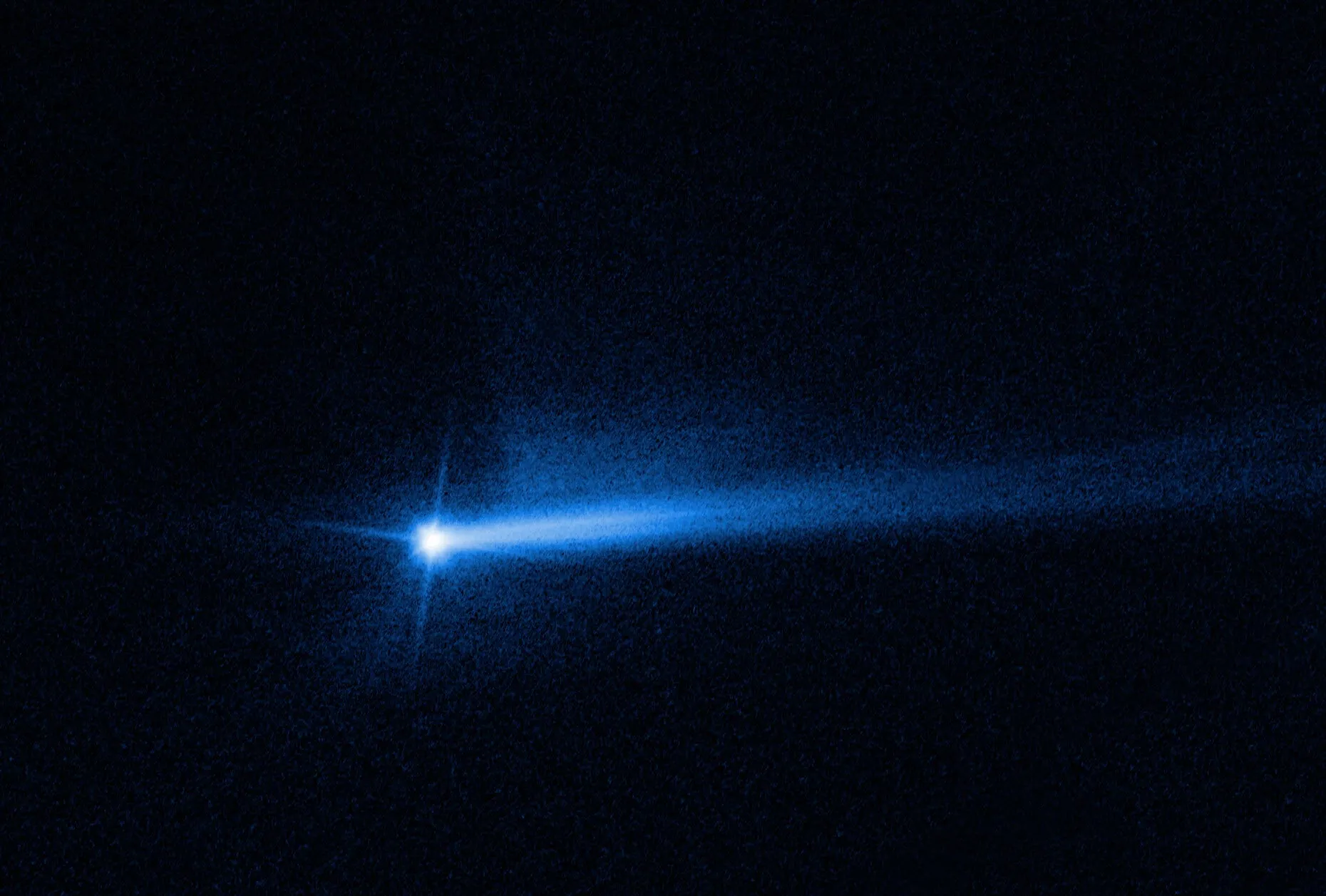
On September 26, 2022, at 23:14 UTC, the Double Asteroid Redirection Test, a 610-kilogram NASA spacecraft moving at 22,000 kilometers per hour, collided with the asteroid Dimorphos. It was the first time in history that humanity had deliberately altered the trajectory of a celestial body.
The mission's success criterion was a 73-second change in Dimorphos's orbital period. The actual change was 32 minutes, twenty-five times the benchmark. Planetary defense is no longer hypothetical.
Why Dimorphos
Dimorphos is the smaller of a binary asteroid pair. It orbits the larger asteroid Didymos at a distance of about one kilometer, completing each loop in just under 12 hours. Didymos is 780 meters across; Dimorphos is 160 meters. The system, discovered in 1996, was selected for the DART mission because it offered a clean experimental setup: the orbital period of Dimorphos around Didymos can be measured precisely from Earth by watching the brightness of the system dip as Dimorphos passes in front of and behind its larger neighbor. Any change in the period after impact would be measurable to within seconds.
Critically, the orbital geometry of Didymos itself never brings the system close enough to Earth to pose a threat. Even with a major orbital perturbation, Didymos was guaranteed to remain a safe target. DART could test the technique without risking the unintended consequence of nudging an asteroid toward us instead of away.
Dimorphos was also small enough, 160 meters, to be the kind of object planetary defense actually needs to address. Asteroids larger than a kilometer are rare and well-catalogued; we know where essentially all of them are. The dangerous unknowns are the smaller objects in the 100-to-300-meter range, which can devastate a region but are too numerous and too dim to track exhaustively. A successful nudge of a 160-meter target would prove the technique on the relevant size scale.
The spacecraft
DART was small. The bus measured about the size of a refrigerator and weighed 610 kilograms, minuscule compared to Dimorphos's estimated 5 billion kilograms. The only payload was an imager called DRACO (Didymos Reconnaissance and Asteroid Camera for Optical Navigation), used both for terminal guidance and for documenting the final approach.
The spacecraft carried no explosives. The entire impact-mitigation strategy rested on kinetic energy, the simple physics of momentum transfer. A 610-kilogram object moving at 22,000 kilometers per hour carries about 11 gigajoules of kinetic energy, equivalent to roughly 2.5 tons of TNT.
The mission's success depended on autonomous decision-making in the final hour. Light-speed delays made remote control impossible.
The terminal phase relied on SMART Nav, a vision-based autonomous guidance system that locked onto Dimorphos in the final hour, distinguishing it from its larger neighbor Didymos and aiming the spacecraft for impact. Light-speed lag at impact distance was nearly a minute round-trip; real-time remote piloting from Earth was impossible.
Accompanying DART was a small Italian CubeSat called LICIACube, built by the Italian Space Agency. It separated from DART 15 days before impact and used its own autonomous navigation to fly past Dimorphos two minutes and 45 seconds after the collision, photographing the aftermath with two cameras named LUKE and LEIA.
The impact
DART launched on November 23, 2021, on a SpaceX Falcon 9. The cruise to the Didymos system took 10 months. By September 26, 2022, the spacecraft was on final approach.
The DRACO camera streamed images back to Earth at one per second during the final hour. The early frames showed Didymos and Dimorphos as a single bright dot. By 90 seconds out, both bodies were visible. By 24,000 kilometers, Dimorphos resolved into a distinct shape. The last fully transmitted image, two seconds before impact, was taken at a distance of 12 kilometers, a resolution of three centimeters per pixel. The final, partially transmitted image was interrupted mid-downlink by the spacecraft's destruction.
What those images revealed was a surprise. Dimorphos was not the solid rock most planetary scientists had expected. It was a rubble pile, a loose aggregation of boulders held together by mutual gravity. Some of the boulders were the size of buildings. The surface had no clear bedrock, no flat plains, only a chaotic landscape of irregular rocks.
This mattered. A rubble pile responds to impact very differently than a solid body. Most of the kinetic energy goes not into pushing the asteroid but into rearranging and ejecting its loose material, and that ejecta itself produces additional thrust.
The factor of 25
Measuring the result took weeks. Ground-based telescopes, including the Southern Astrophysical Research Telescope in Chile, tracked the brightness of the Didymos-Dimorphos pair night after night, looking for the slight changes in eclipse timing that would indicate a shift in Dimorphos's orbital period.
Before impact, Dimorphos orbited Didymos once every 11 hours and 55 minutes. After impact, the period was 11 hours and 23 minutes. The change: 32 minutes shorter.
This was 25 times the mission's success criterion. The reason was the rubble pile. When DART impacted, the kinetic energy ejected over six tons of material into space, material that itself carried momentum away from the asteroid in the direction opposite the impact. The total momentum change was the spacecraft's contribution plus the recoil from all that ejecta. The factor by which the ejecta amplified the impulse, called the "beta factor", was about 3.6. A perfectly inelastic collision would have a beta of 1. Dimorphos got 3.6.
The shape of Dimorphos also changed. Pre-impact, it was an oblate spheroid, a slightly squashed sphere. Post-impact, after losing a substantial fraction of its mass and rearranging the rest, it became a triaxial ellipsoid, elongated like a watermelon. A 150-meter crater was excavated by the impact itself, but the larger reshaping came from the rubble pile responding to the loss of so much surface material at once.
The asteroid's rubble-pile nature multiplied the impact's effect by a factor of 3.6. The technique worked better than predicted.
Hera follows up
The DART team measured the impact's effect from Earth, but to fully understand what happened to Dimorphos, a follow-up mission was needed. The European Space Agency launched Hera on October 7, 2024. Hera is scheduled to arrive at the Didymos system in December 2026, almost four years after the impact.
Hera carries a sophisticated suite of instruments: high-resolution cameras, a spectrometer, an altimeter, and two CubeSats that will be deployed on close-approach orbits. Its job is to image the impact crater in detail, measure the precise mass of Dimorphos after the impact (using the gravitational tug on its CubeSats), and determine the asteroid's internal structure through radar tomography.
The internal structure measurement is the key one. We know the impact moved Dimorphos. We know the ejecta amplified the effect. What we still do not know is how a rubble pile transmits stress and momentum internally, whether the energy distributes through the loose interior, whether internal voids absorb impact, whether parts of the asteroid behave like a fluid under shock loading.
What planetary defense looks like now
DART proved the kinetic impactor concept on a 160-meter target. Scaling up to larger asteroids requires more momentum, but the physics is the same, the impactor just needs to be larger, or there need to be multiple impactors. For a one-kilometer asteroid, current concepts suggest a fleet of three to five DART-sized impactors could produce a sufficient deflection if launched five to ten years before predicted impact.
The bigger constraint is detection. To deflect an asteroid, you need to know it is coming. NASA's NEO Surveyor space telescope, scheduled for launch in 2028, will scan for near-Earth objects in the infrared, including the dangerous population of dark, hard-to-spot asteroids that approach from the direction of the Sun and are invisible to ground-based optical surveys. The current near-Earth object catalog includes about 90 percent of asteroids larger than one kilometer and a much smaller fraction of objects in the 100-to-300-meter range. NEO Surveyor's stated goal is to find 90 percent of objects above 140 meters within ten years.
With detection and deflection both in hand, we are, for the first time, no longer entirely at the mercy of orbital mechanics.
The asteroid that killed the dinosaurs had no defense waiting for it. We do.
Frequently Asked Questions
What is DART?
DART is NASA's Double Asteroid Redirection Test, the first mission to test planetary defense by kinetic impact. A 610-kilogram spacecraft was deliberately crashed into the asteroid Dimorphos on September 26, 2022, at a speed of 22,000 km/h. The goal was to demonstrate that the trajectory of an asteroid could be deliberately altered by ramming it with a spacecraft.
How much did DART change Dimorphos's orbit?
Dimorphos's orbital period around its larger companion Didymos was shortened by 32 minutes, from 11 hours 55 minutes to 11 hours 23 minutes. NASA's pre-mission success criterion was a change of at least 73 seconds. The actual result exceeded that benchmark by a factor of 25.
Why did the impact work so well?
Dimorphos turned out to be a rubble pile, a loose aggregation of boulders held together by gravity, not a solid rock. The impact ejected over six tons of surface material into space, and that ejecta itself carried momentum away from the asteroid in the direction opposite to the impact. This amplified the spacecraft's direct momentum transfer by a factor of approximately 3.6 (the "beta factor"). A perfectly inelastic collision would have a beta factor of 1.
Was Dimorphos a threat to Earth?
No. The Didymos-Dimorphos system was deliberately chosen because its orbit never brings it close enough to Earth to pose a danger, regardless of any deflection. The mission could test the technique without risking the unintended consequence of nudging an asteroid toward Earth.
What is the Hera mission?
Hera is a European Space Agency follow-up mission that launched on October 7, 2024, and is scheduled to arrive at Dimorphos in December 2026. It will image the impact crater, measure Dimorphos's precise post-impact mass, and use radar tomography to investigate the internal structure of the rubble pile. This data is essential for refining models of how kinetic impactors interact with asteroids of different compositions.
Could DART's technique deflect a city-killer asteroid?
Yes, with sufficient warning time. Current concepts suggest that a fleet of three to five DART-sized impactors, launched five to ten years before predicted impact, could deflect a one-kilometer asteroid sufficiently to miss Earth. The bigger limitation is detection, we need to find the dangerous asteroid first. NASA's NEO Surveyor space telescope, scheduled for launch in 2028, will scan for near-Earth objects in the infrared and substantially improve the detection of dark, hard-to-spot asteroids.
Continue Exploring
- The Day We Left the Solar BubbleThe Sun blows a vast bubble in the gas between the stars, and everything we call home lives inside it. In 2012 a...
- Three Missions That Make 2026 Europe's Year in SpaceA planet hunter with 26 eyes, a spacecraft photographing Earth's invisible shield, and a probe finally reaching...
- The Spacecraft Built to Decide If an Alien Ocean Is HabitableEuropa Clipper, the largest spacecraft NASA has ever sent to another world, is racing toward a Jupiter moon that may...
- NASA Is Sending a Nuclear Drone to Fly Across Another MoonDragonfly, a car-sized rotorcraft powered by plutonium, will spend years flying between the dunes and craters of...
Sources
- Daly et al. (2023). "Successful kinetic impact into an asteroid for planetary defence." link.
- Cheng et al. (2023). "Momentum transfer from the DART mission kinetic impact on asteroid Dimorphos." link.
- Thomas et al. (2023). "Orbital period change of Dimorphos due to the DART kinetic impact." link.
- ESA Hera Mission Overview. "Hera, ESA's planetary defence mission." link.
- NASA Planetary Defense Coordination Office. "DART Mission Results." link.