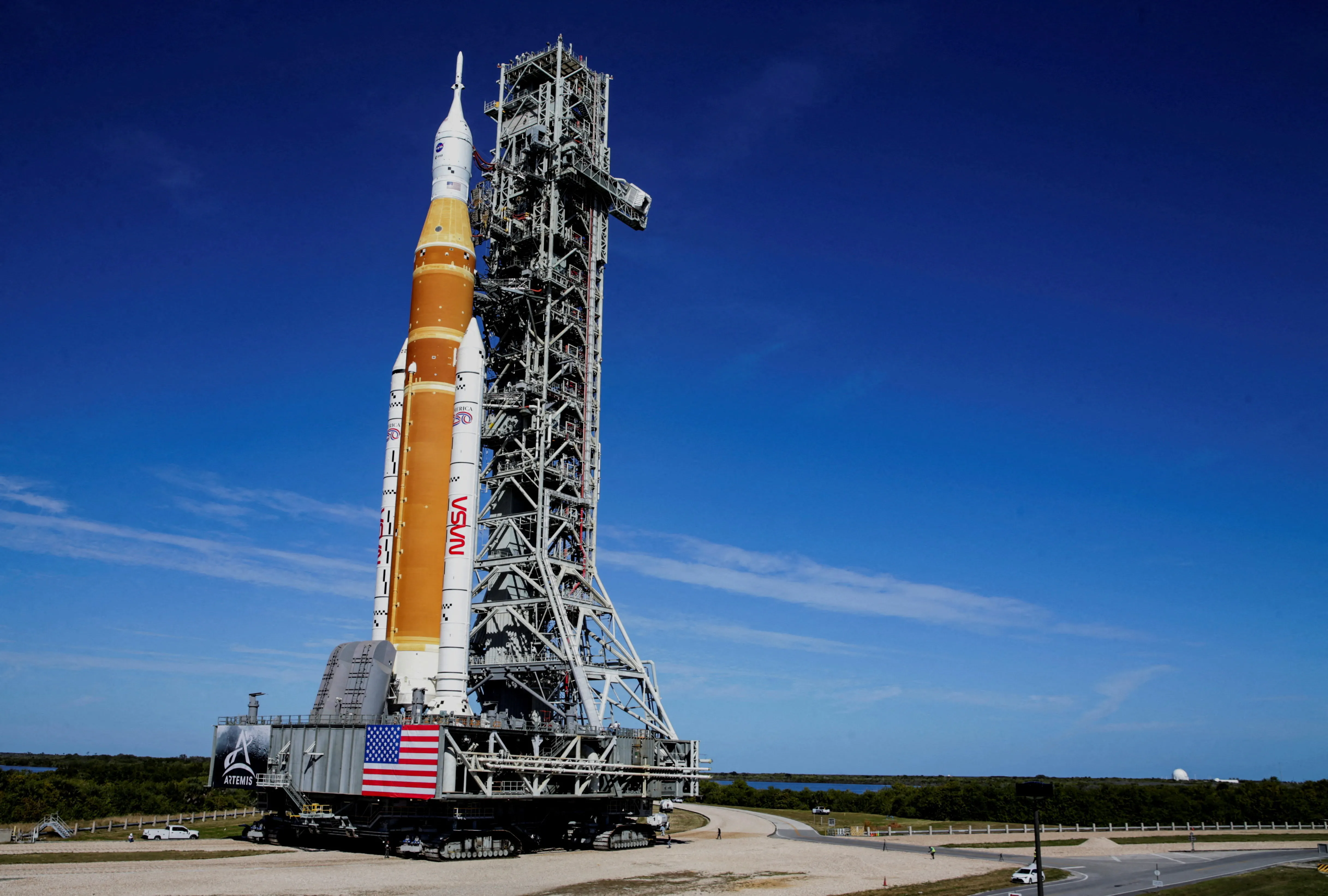
The Program That Was Supposed to Be Easy
The Apollo program took eight years from announcement to landing. President John F. Kennedy committed the United States to landing astronauts on the Moon in May 1961. Apollo 11 set down in the Sea of Tranquility in July 1969. Between those two dates, NASA designed the Saturn V rocket from scratch, built the Apollo capsule, the Lunar Module, the launch facilities, the global tracking network, and the procedures and training that turned a Cold War political commitment into a technical reality.
Artemis was announced in 2017, near the start of the first Trump administration, with a stated goal of returning humans to the lunar surface by 2024. The framing was that Apollo had been hard but it had been done; the technology now existed; the new program could repeat the feat faster than Apollo had originally accomplished it. Nine years have passed. The first crewed Artemis mission, Artemis II, finally launched on April 1, 2026, and it did not go to the lunar surface. It looped around the Moon and came back, demonstrating that the rocket and the capsule could keep a crew alive in deep space for ten days. That is the entirety of its mission.
The original Artemis III, planned as the actual lunar landing, has been redefined. It will not land on the Moon. It will instead, in 2027, conduct a 30-day docking and systems-integration test in low Earth orbit with SpaceX's Starship lander. The actual return to the Moon's surface has been pushed to Artemis IV in 2028. The program is, in 2026, approximately four years behind its 2017 schedule and substantially restructured from what was originally announced.
The Hydrogen Problem
The technical reason for many of the delays is simple, even if its consequences have been complicated. The Space Launch System, the rocket that carries the Orion capsule, uses cryogenic liquid hydrogen as one of its propellants, with liquid oxygen as the oxidizer. Hydrogen is the smallest molecule in the universe. At cryogenic temperatures, around minus 252 degrees Celsius, it is extraordinarily difficult to contain. Any seal in the propellant system that is even slightly imperfect will leak.
The Artemis II preparation campaign in early 2026 was repeatedly delayed by hydrogen leaks. The first wet-dress rehearsal in late January detected a leak in a liquid hydrogen line; seals had to be replaced. A second rehearsal in mid-February completed the propellant loading but discovered a helium-flow problem in the upper stage after the test. Helium is essential for purging propellant lines and maintaining tank pressure; the issue traced to a valve in a region of the rocket that is not accessible while the vehicle is on the pad. NASA was forced to roll the entire stack back to the Vehicle Assembly Building for repairs.
These were not abstract failures. They were small mechanical problems in a vehicle that had not flown since the uncrewed Artemis I mission in November 2022, almost four years earlier. The current NASA administrator, Jared Isaacman, has been blunt about the underlying issue: launching a vehicle as complex as SLS only once every three years leads to skill atrophy in the workforce. Knowledge is lost between flights. Procedures get forgotten. The fix, in his stated view, is to fly more often, but flying more often requires solving the very integration problems that make flying so rare.
The Heat Shield That Almost Failed
The bigger technical concern from Artemis I was discovered only after the mission ended. The Orion capsule's heat shield, the layer of ablative material that protects the crew compartment during atmospheric reentry, had performed differently than expected. The material, called Avcoat, had charred and eroded in more than 100 distinct patches during reentry. None of the damage was severe enough to threaten the uncrewed capsule, but inspectors realized that with a crew aboard, the safety margin would have been uncomfortably thin.
The investigation traced the problem to gas trapped inside the Avcoat layer during reentry. Normally, ablative gases escape outward through the charred surface. The Artemis I capsule had used a "skip" reentry profile, a flight path that dips into the atmosphere, bounces back briefly into space, and then reenters. The repeated thermal cycling during the skip caused the gases to accumulate in the Avcoat, building up pressure that eventually cracked the shield.
The fix, announced in late 2024, was not to redesign the heat shield but to change the reentry profile. Artemis II will perform a direct, non-skipping reentry. This produces higher g-loads on the crew, uncomfortable but not dangerous, and avoids the conditions that caused the Avcoat to fail on Artemis I. It is a workaround, not a redesign. Future capsules may incorporate a more permeable heat-shield material that allows ablation gases to escape more freely, but this would require a new manufacturing campaign and is not on Artemis II.
The Artemis I heat shield came back charred in over 100 places. The fix was not to replace the shield but to change how the crew comes home, accepting harder g-loads to avoid the failure mode that almost happened on the uncrewed test flight.
Why Artemis III Is No Longer a Landing
The original plan for Artemis III was straightforward in principle and complex in practice. The Orion capsule would carry a crew of four to lunar orbit, where it would rendezvous and dock with a separately launched SpaceX Starship Human Landing System. Two of the four astronauts would transfer to Starship and ride it down to the lunar south pole. They would conduct a week of surface operations, then ride Starship back up to dock again with Orion, and the full crew would return to Earth.
The "separately launched Starship" part was the problem. SpaceX's Starship requires fueling in low Earth orbit to have enough propellant for the trip to the Moon. The amount of propellant required is substantial, enough that not one but more than ten separate refueling launches of additional Starship "tankers" are required to fill up the Starship that will actually land on the Moon. Each tanker launch is itself a new technology demonstration. Cryogenic propellant transfer in microgravity has never been done at scale. The combined risk of doing this fueling sequence, then sending Starship to lunar orbit, then docking with Orion, then landing on the Moon, then taking off again, all without having tested the integrated system, was deemed unacceptable by an independent safety panel reviewing the program in 2025.
The restructured plan, announced in February 2026, defers the actual lunar landing to Artemis IV. Artemis III, now scheduled for 2027, will conduct the rendezvous and docking between Orion and Starship in low Earth orbit, close to home, with abort options available, and as a clean dress rehearsal for the lunar mission. Critics have called this an admission that the original Artemis III plan was always too ambitious to fit the original timeline. Defenders argue that it is the right call for crew safety, and that a successful Artemis III rehearsal makes the actual Artemis IV landing substantially more likely to succeed.
The Centaur Decision
A separate decision announced in early 2026 will reshape the SLS rocket itself. The original plan was to upgrade SLS from its current "Block 1" configuration to a more powerful "Block 1B" with a new upper stage called the Exploration Upper Stage (EUS). EUS development has been chronically delayed and over budget, common for NASA-managed propulsion systems, but particularly painful in a program where every additional year of delay is politically expensive.
Isaacman cancelled EUS in February 2026. In its place, NASA will adopt the Centaur V, an upper stage already in production by United Launch Alliance and currently used on the Vulcan rocket. Centaur V is less powerful than EUS would have been but is mature, available, and significantly cheaper. The trade-off is that some Artemis mission profiles will have to be reconfigured around Centaur V's reduced performance, most notably, payload mass to lunar orbit decreases by roughly 10 percent.
The Centaur V selection is a substantial strategic shift. It moves Artemis away from custom NASA-managed propulsion and toward off-the-shelf commercial hardware. It is also an implicit admission that the original Block 1B plan was not going to be ready on the timeline the program needed. Whether this turns out to be the right call depends on whether Centaur V can be integrated quickly enough to enable Artemis IV in 2028.
The Chinese Pressure
Threaded through all the technical decisions is a geopolitical pressure that has reshaped the program's urgency. The China National Space Administration has announced its own crewed lunar landing program with a target date of 2030. In 2024, the Chang'e-6 mission successfully returned samples from the far side of the Moon, a technical achievement no other country has matched. China's lunar program has been steadily executing on its announced milestones, while the United States program has been steadily slipping.
The strategic concern within NASA, articulated publicly by Administrator Isaacman in 2026, is what is called "lunar resource lock-in", the possibility that China could establish a sustained presence at the lunar south pole, claim the water-ice deposits in the permanently shadowed craters as a national resource, and effectively close that region to American access. The water ice at the south pole is essential to any long-term lunar program: it can be electrolyzed into hydrogen and oxygen for rocket fuel, used as drinking water for crews, and used for radiation shielding. Whoever controls the south pole controls the practical base for further exploration of the solar system from a lunar staging point.
This concern has accelerated NASA's stated timeline pressure even as the program has been slowing in practice. The result is a peculiar moment: Artemis is simultaneously being told to move faster (to beat China to the south pole) and being restructured to move slower (to ensure the missions actually succeed when they fly). The two pressures are not easily reconcilable. The Artemis IV landing target of 2028 reflects an attempt to thread the needle.
What This Actually Looks Like in Late 2026
The current status, as of mid-May 2026, is: Artemis II has launched successfully on April 1, 2026 with a crew of four, Reid Wiseman, Victor Glover, Christina Koch, and Jeremy Hansen, and is in the middle of its ten-day lunar flyby mission. The capsule is functioning as designed; the crew has reported no issues. Splashdown is scheduled for April 11. The Avcoat heat-shield workaround will be tested under crewed conditions for the first time during reentry.
If Artemis II splashes down successfully, the program continues. Artemis III is on the schedule for 2027 as a LEO test; Artemis IV is on the schedule for 2028 as the actual landing. The Centaur V upper stage is in integration testing. The new spacesuits, the Axiom Extravehicular Mobility Unit, developed in partnership with Axiom Space and reportedly with input from Prada, are scheduled for first crewed wear on Artemis III. The full sequence of events that ends with American astronauts standing on the lunar south pole is now, at the earliest, eighteen months away.
If China lands its own crew before that, which their announced schedule suggests is possible, the geopolitical loss will be substantial. If America lands first, the program will have demonstrated that the more cautious, integration-first approach was the right one. Either way, what was announced in 2017 as "Apollo, but faster" has become something more textured: a slow, methodical, repeatedly-restructured campaign to establish a sustained American presence on the Moon, in competition with another superpower, with technical setbacks at every step and the original timeline long since abandoned.
Artemis was promised in 2017 as a four-year sprint to the Moon. In 2026 it has become an eight-year program with a different rocket, a different mission architecture, a different timeline, and a competitor that may get there first. The substance is the same: get back. The execution is what is being learned, the hard way.
Frequently Asked Questions
Did Artemis II actually launch?
Yes. NASA's Artemis II mission launched successfully on April 1, 2026 from Kennedy Space Center's Pad 39B, carrying a crew of four, Reid Wiseman, Victor Glover, Christina Koch, and Jeremy Hansen. The mission is a ten-day crewed lunar flyby; it does not land on the lunar surface. Splashdown is scheduled for April 11. It is the first crewed flight beyond low Earth orbit since Apollo 17 in December 1972.
Why doesn't Artemis II land on the Moon?
Artemis II was never designed to land. It is a systems verification flight, checking that the Space Launch System rocket, the Orion capsule, and the deep-space life-support systems all function correctly with a crew aboard before any landing is attempted. The crew loops around the Moon at a distance of approximately 7,400 kilometers from the lunar surface and returns to Earth. The actual lunar landing was originally planned for Artemis III, but has been deferred to Artemis IV in 2028.
Why was Artemis III restructured?
An independent safety review in 2025 identified an unacceptable accumulation of first-time risk in the original Artemis III plan. The mission required: the first crewed Orion-Starship docking in lunar orbit, the first cryogenic propellant transfer at scale in low Earth orbit (requiring 10+ separate Starship tanker launches), the first use of new Axiom spacesuits in vacuum, and the first crewed lunar landing in over 50 years, all in a single mission. The restructured plan, announced February 2026, has Artemis III conduct only the Orion-Starship docking, in low Earth orbit, as a 30-day systems-integration test.
What happened to the heat shield problem?
The Orion capsule's Avcoat heat shield charred and eroded in more than 100 patches during the Artemis I reentry in 2022. The investigation found that the 'skip' reentry profile, which dips the capsule into the atmosphere, bounces it briefly back to space, and then completes reentry, caused ablation gases to accumulate inside the shield rather than escape, eventually cracking it. NASA's solution is not to redesign the shield but to change Artemis II's reentry to a direct (non-skipping) profile. This produces higher g-loads on the crew but avoids the gas-accumulation failure mode. Future capsules may use a more permeable heat-shield material.
Why did NASA cancel the Exploration Upper Stage?
The Exploration Upper Stage (EUS) was the planned next-generation upper stage for SLS Block 1B. It was chronically over budget and behind schedule. In February 2026, NASA Administrator Jared Isaacman cancelled EUS and selected the Centaur V upper stage from United Launch Alliance as its replacement. Centaur V is less powerful than EUS would have been (Artemis payload to lunar orbit drops by roughly 10 percent), but it is in active production for ULA's Vulcan rocket and can be integrated with SLS without years of additional development. The decision reflects a broader strategic shift from custom NASA hardware to off-the-shelf commercial components.
Is China actually going to beat the United States to the Moon?
Uncertain. China has announced a crewed lunar landing target of 2030, four years after the United States' announced Artemis IV target of 2028. China's space program has historically executed on its announced milestones more reliably than the United States' has, Chang'e-6 returned samples from the lunar far side in 2024 on schedule, while Artemis has been delayed repeatedly. The most pressing American concern is not the order of first landing but control of the lunar south pole, where water ice deposits make sustained operations possible. If China establishes a base there first, it could effectively lock the United States out of the most strategically important region of the Moon.
Continue Exploring
- The Mission to Grab a Piece of a Martian MoonMars has two small, mysterious moons, and no one is sure where they came from. In late 2026 a Japanese spacecraft is...
- Three Missions That Make 2026 Europe's Year in SpaceA planet hunter with 26 eyes, a spacecraft photographing Earth's invisible shield, and a probe finally reaching...
- The Spacecraft Built to Decide If an Alien Ocean Is HabitableEuropa Clipper, the largest spacecraft NASA has ever sent to another world, is racing toward a Jupiter moon that may...
- NASA Is Sending a Nuclear Drone to Fly Across Another MoonDragonfly, a car-sized rotorcraft powered by plutonium, will spend years flying between the dunes and craters of...
- The Day a Refrigerator-Sized Spacecraft Punched an Asteroid Into a New OrbitOn September 26, 2022, a 610-kilogram spacecraft slammed into a 160-meter asteroid at 22,000 kilometers per hour. The...
Sources
- NASA. "Artemis II Mission Overview." nasa.gov/artemis-ii
- NASA Office of Inspector General. "NASA's Management of the Artemis Missions." Report IG-22-003 (2022).
- Berger, E. "NASA quietly admits Artemis III won't land on the Moon." Ars Technica, February 2026.
- Foust, J. "NASA selects Centaur V for SLS Block 1B replacement." SpaceNews, February 2026.
- NASA Aerospace Safety Advisory Panel. "Annual Report 2025." NASA HQ (2025).
- Smith, M. "China's Chang'e-6 returns first samples from the lunar far side." Nature Astronomy, 8, 1180 (2024).
- Cernan, E. & Davis, D. The Last Man on the Moon. St. Martin's Press (1999), historical reference on Apollo 17.
- Cover image: NASA / KSC, Artemis II SLS on Pad 39B. Public domain.