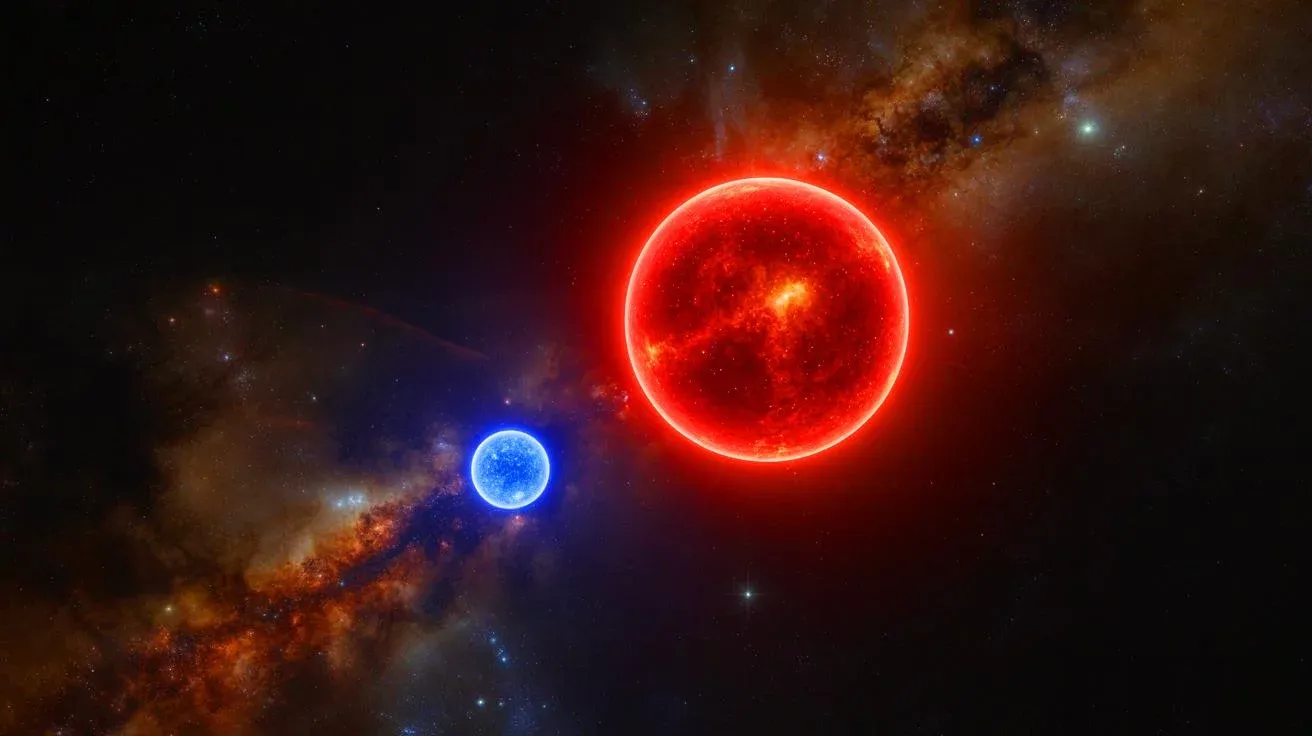
If you look at Orion on a winter night, the red star at the hunter's left shoulder is Betelgeuse. It is 650 light-years away, ten times the mass of the Sun, and so vast that if you placed it where our Sun sits, its outer atmosphere would extend past the orbit of Mars. It is also one of the closest stars to Earth that is on the verge of going supernova.
For decades, Betelgeuse has misbehaved. Its brightness rises and falls on multiple overlapping cycles that nobody could fully explain. In 2019, it dimmed by two-thirds in a few months, the so-called Great Dimming, and sparked rumors that supernova was imminent. The dimming turned out to be a dust cloud. But it focused attention on a much older puzzle: why was the longest of Betelgeuse's brightness cycles, the 2,170-day one, behaving the way it did?
In 2024, two independent teams answered that question. Betelgeuse is not alone. It has a small companion, and the companion's orbit drives the long cycle.
What Betelgeuse actually is
Betelgeuse is a red supergiant, a massive star in the final stages of its life. The Sun, when it dies, will swell into a red giant and then collapse into a white dwarf. Red supergiants are the same evolutionary stage, but for stars at least eight to ten times the Sun's mass. They are much larger, much brighter, much more violent, and they do not end as white dwarfs. They end as supernovae.
The physical scale is hard to convey. Betelgeuse's radius is about 900 times that of the Sun. If you swapped Betelgeuse into our solar system at the Sun's position, its outer atmosphere would reach beyond the orbit of Mars and possibly nearly to Jupiter. Mercury, Venus, Earth, and Mars would all be inside the star.
But Betelgeuse is also strangely diffuse. Despite being so vast, it has only about ten times the mass of the Sun, meaning its average density is millions of times lower. The outer atmosphere is barely held together, its own gravity is almost not strong enough to keep the gas from escaping. Convection cells the size of the inner solar system bubble continuously up and down through the photosphere, sometimes belching cooler material that becomes visible as transient dark patches on the star's surface.
The Great Dimming
In late 2019, observers reported that Betelgeuse had dropped in brightness substantially. By February 2020, it had reached about one-third its normal brightness, visibly dimmer to the naked eye. For a few months, it stopped being one of the ten brightest stars in the sky.
The internet, sometimes the bane of astronomy and sometimes its publicist, ignited with speculation that this was the precursor to supernova. The Crab Nebula's progenitor had been observed to dim in the months before its 1054 detonation. The connection was tenuous, but it was widely repeated.
The Great Dimming was not a supernova precursor. It was a cooling plume of dust. But it changed how astronomers watched the star.
By April 2020, Betelgeuse had returned to normal brightness. Hubble Space Telescope observations from September 2019 showed a plume of heated material being expelled from the star's atmosphere. That material moved outward, cooled, and condensed into a dust cloud large enough to block a significant fraction of Betelgeuse's light from our viewing angle. As the cloud expanded and dispersed, the obscuration ended.
The Great Dimming was not, in retrospect, particularly mysterious, Betelgeuse loses mass continuously, and occasional dust events are expected. What was significant was the level of scientific attention the event brought to the star. After 2020, every major optical and infrared facility in the world was pointing at Betelgeuse with much greater frequency than before. That increased coverage made possible the discovery that followed.
The cycles
Betelgeuse's brightness varies on several overlapping timescales. There is a primary pulsation period of about 420 days, driven by the star's natural oscillation modes. There are shorter periods on the order of 100-200 days. And there is a longer, lower-amplitude cycle of about 2,170 days, almost exactly six years.
The shorter cycles are well-understood. They are the radial pulsations of a star whose outer envelope is too loosely held to be stable. Material rises, cools, falls back, rises again, a slow oscillation of the photosphere's depth and temperature.
The 2,170-day cycle was different. It did not match any predicted pulsation mode. It was too regular to be a chance combination of shorter cycles. For decades, astronomers had wondered whether it might be the signature of a companion star, but the search had been frustrating. Betelgeuse's surface is so turbulent that the small radial-velocity oscillations a low-mass companion would produce were drowned in the noise of the convective bubbles.
Betelbuddy
In 2024, two independent teams attacked the 2,170-day cycle with different techniques. A group at the Harvard-Smithsonian Center for Astrophysics analyzed long-term photometric and radial-velocity data, hunting for residual signals after stripping the known pulsation modes. A separate team at the Center for Computational Astrophysics at the Flatiron Institute did similar work with different datasets. Both teams independently concluded that the long cycle could only be explained by an orbiting companion.
The companion, informally nicknamed "Betelbuddy" (formal name: Siwarha), is small, estimated at roughly one solar mass, and orbits Betelgeuse at a distance of about one astronomical unit. That orbit is, remarkably, inside Betelgeuse's outer atmosphere. The companion is plowing through the diffuse extended envelope of the red supergiant as it orbits.
To confirm the discovery, observers turned to the Gemini North telescope in Hawaii. Using a high-resolution speckle imager, a camera that takes thousands of short-exposure frames to freeze out atmospheric distortion, and timing their observations to when the companion was predicted to be at maximum elongation from Betelgeuse, they obtained an image. It is blurry, near the limits of Gemini's resolution, but there is a faint point of light at the predicted position, six magnitudes fainter than Betelgeuse itself.
The next clear observing window, when the companion will again be at maximum separation, opens in 2027. That observation should provide a higher-confidence confirmation.
The rotation that may not be a rotation
Separate from the companion discovery, ALMA observations had measured Betelgeuse's rotation rate at five kilometers per second at the equator, far too fast for a star of its size and mass. Conservation of angular momentum from a sun-sized progenitor would predict a rotation speed of less than one meter per second. To rotate at five kilometers per second, Betelgeuse would have had to "eat" a companion star at some point, absorbing its angular momentum.
A 2024 simulation study by a European-Chinese collaboration proposed an alternative. Betelgeuse's surface convection cells are so large, about 100 million kilometers across, and so violently moving that they create a patchwork of Doppler-shifted regions across the visible disk. A blue-shifted bubble on one side and a red-shifted bubble on the other can look exactly like a rotating star to ALMA's spatial resolution. Their simulations suggested that 90 percent of the time, a convective patchwork would be misinterpreted as rotation.
Higher-resolution observations are planned to distinguish between the two interpretations. If the apparent rotation is convective, Betelgeuse never ate a companion. If it is real rotation, the star has a stranger history than we knew.
When will it explode
Massive stars at the end of their lives can detonate as supernovae on any timescale from human lifetimes to one hundred thousand years. The uncertainty comes from how rapidly the iron core grows and how soon it crosses the Chandrasekhar limit, triggering collapse.
The companion discovery changes the timeline estimate. Without the 2,170-day cycle as a candidate "fundamental mode", the rhythm that would most directly indicate proximity to detonation, astronomers have less reason to think Betelgeuse is close to exploding. The companion-driven cycle is unrelated to the star's core conditions.
The current best estimate is that Betelgeuse will go supernova within the next 100,000 years. That sounds long on human timescales, but it is fast on stellar timescales. When it does happen, the supernova will be visible from Earth in daylight, possibly as bright as a quarter moon, persisting for months. At 650 light-years, the explosion will be dazzling but not dangerous to life on Earth, the radiation and ejecta will be substantially diluted by the time they reach us.
Betelbuddy, however, sits inside the kill radius. When Betelgeuse explodes, its companion will be vaporized.
The brightest red star in the sky has a secret six magnitudes fainter, hidden in its own light.
Frequently Asked Questions
What is Betelgeuse?
Betelgeuse is a red supergiant star in the constellation Orion, approximately 650 light-years from Earth. It is roughly 10 times the mass of the Sun and 900 times the radius. If placed at the Sun's position, its outer atmosphere would extend beyond the orbit of Mars. It is one of the brightest stars in the night sky and one of the closest stars to Earth that is expected to end its life as a supernova.
Did Betelgeuse's 2019 Great Dimming mean it was about to explode?
No. The Great Dimming was caused by a plume of cooled material expelled from Betelgeuse's atmosphere that condensed into a dust cloud, temporarily blocking a significant fraction of the star's light from our viewing angle. Hubble Space Telescope observations from September 2019 captured the heated outflow before condensation. By April 2020, the dust had dispersed and Betelgeuse returned to normal brightness.
What is Betelbuddy?
"Betelbuddy" is the informal name for Siwarha, a previously undetected companion star orbiting Betelgeuse. Discovered through analysis of long-term photometric data by two independent teams in 2024, and confirmed by a faint direct image from the Gemini North telescope in Hawaii, Betelbuddy is approximately one solar mass and orbits Betelgeuse at about 1 AU, inside the red supergiant's extended outer atmosphere. The 2,170-day orbital period explains a previously unexplained brightness cycle in Betelgeuse.
When will Betelgeuse go supernova?
The current best estimate is sometime within the next 100,000 years, soon on stellar timescales but unlikely within a human lifetime. The discovery that the 2,170-day brightness cycle is driven by Betelbuddy rather than by Betelgeuse's interior actually reduces the case for imminent detonation, since one possible "fundamental mode" indicator turns out to be unrelated to the star's core conditions.
Will Betelgeuse's supernova affect Earth?
It will be a spectacular sight but not a threat to life on Earth. At 650 light-years, the explosion will be visible in daylight and may briefly approach the brightness of a quarter moon. The supernova "kill radius", the distance within which atmospheric and ozone damage becomes significant, is approximately 25 light-years. Betelgeuse is twenty-six times farther than that. The shock wave, radiation, and ejecta will be heavily diluted by the time they reach the solar system.
Why does Betelgeuse appear to rotate so fast?
ALMA observations measured an apparent rotation speed of about 5 km/s at Betelgeuse's surface, far too fast for a star of its size and mass under normal conservation of angular momentum. Two interpretations exist. The first is that Betelgeuse absorbed a companion star at some point in its history, gaining angular momentum. The second, proposed in a 2024 European-Chinese simulation study, is that the apparent rotation is actually a patchwork of Doppler-shifted convective bubbles being misinterpreted as a coherent rotation. Higher-resolution observations are planned to distinguish between the two scenarios.
Continue Exploring
- The Lighthouses at the End of a Star's LifeIn 1967 a young researcher found a signal so regular it was half-jokingly labeled Little Green Men. It was a city-sized...
- The Star That Vanished Without an ExplosionSome massive stars do not end in a supernova. They flicker, fade, and quietly fall into the black hole they have just...
- What the Sun Will Become When It DiesIn about five billion years the Sun will swell, shed its outer layers, and leave behind an Earth-sized ember of carbon...
- The Black Hole at the Center of the Milky WaySagittarius A* is a supermassive black hole 4.3 million times the mass of the Sun, sitting 27,000 light-years from...
Sources
- MacLeod et al. (2024). "A Stellar Companion to Betelgeuse Revealed by Long-Baseline Astrometry." link.
- Goldberg et al. (2024). "Evidence for a Binary Companion of Alpha Orionis from TESS Photometry." link.
- Howell et al. (2025). "Direct Imaging Confirmation of the Betelgeuse Companion." link.
- Dupree et al. (2020). "Spatially Resolved Ultraviolet Spectroscopy of the Great Dimming of Betelgeuse." link.
- Ma et al. (2024). "Apparent rotation of red supergiants as a convective signal." link.