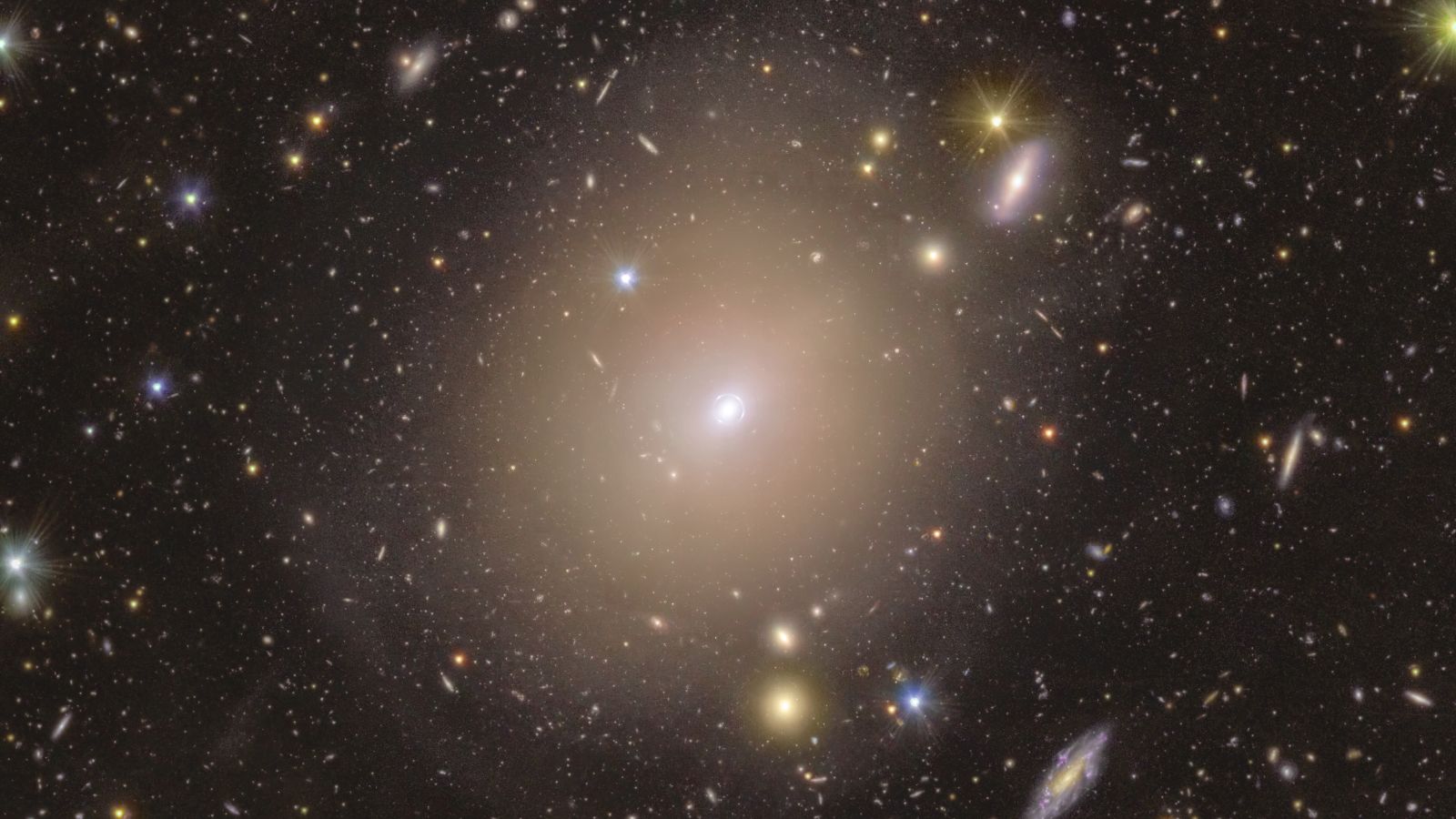
The Galaxy Nobody Was Looking At
In September 2023, the European Space Agency's Euclid satellite returned an early performance-verification image of NGC 6505, a faint elliptical galaxy roughly 590 million light-years from Earth. NGC 6505 is unremarkable. It is in the catalog of galaxies first compiled in the nineteenth century. Astronomers had imaged it many times. They had nothing in particular to look for in it.
The image went, like everything Euclid produces, into a pipeline. Inside the pipeline, a convolutional neural network trained on simulated gravitational lenses scanned the frame for ring-like distortions. It flagged NGC 6505. The flag triggered a follow-up at higher resolution. Inside the follow-up image was an almost perfect Einstein ring, a circle of distorted light from a galaxy roughly four billion light-years behind NGC 6505, bent into a halo by NGC 6505's gravity.
An Einstein ring of that quality, that close, around a known galaxy that nobody had thought to look at, is the kind of object astronomers would describe as a generational discovery. Bruno Altieri at ESA, the Euclid scientist who confirmed the find, has said the ring is the most spectacular he has seen in a quarter-century of work on gravitational lensing. The detection was published in Astronomy & Astrophysics in February 2025.
The point of the story is not the ring. The point is that no human looked at NGC 6505 and noticed anything unusual. The pipeline did. The pipeline was a neural network. And the discovery was, at the moment of detection, an act of pattern recognition by software.
The Data Problem That Forced the Hand
Astronomy used to be, by the standards of modern data science, a small field. The Hubble Space Telescope, after thirty-five years of operation, has produced about 200 terabytes of data. That is roughly the volume the Vera Rubin Observatory in Chile expects to produce per week of routine operation, beginning with its full survey in late 2025. The Square Kilometre Array, scheduled to come online in stages over the next decade, will, when complete, generate raw data at a rate of around 700 petabytes per second.
Those numbers are no longer compatible with classical analysis. Even if every working astronomer on Earth spent every working hour staring at survey images, the surveys would outproduce the staring by orders of magnitude. The choice was not whether to use machine learning. The choice was whether to lose the data.
By 2023, more than eight percent of all papers published in the major astronomy journals contained the phrase "machine learning" or "neural network" in the abstract. By 2024 it was over twelve percent. By the time of writing, early 2026, the field has crossed a quieter line: there are now major astronomy results that could not, in principle, have been produced without machine learning, because the underlying data volume cannot be processed any other way.
The choice was not whether astronomy would use machine learning. The choice was whether astronomy would lose the data.
Gravitational Waves, Cleaned by a Network
The Laser Interferometer Gravitational-Wave Observatory, LIGO, is, in some respects, the purest case of an instrument fundamentally limited by noise. Its detectors are kilometer-scale interferometers tuned to register changes in arm length smaller than a thousandth the diameter of a proton. Everything in the universe that vibrates, earthquakes, ocean waves on distant coastlines, traffic on highways tens of kilometers away, even the thermal motion of the mirrors themselves, is, at LIGO's sensitivity, indistinguishable from a gravitational-wave signal until it has been carefully removed.
The traditional approach to extracting signals from LIGO's data was to compare incoming streams against banks of templates: precomputed waveforms calculated from general relativity for every plausible combination of black-hole and neutron-star masses. The matched-filter method, as it is called, has worked since the first detection in September 2015. It is also computationally enormous and, for certain types of signal, eccentric orbits, exotic compact objects, signals overlapping in time, fundamentally limited.
In 2024, a group at the California Institute of Technology led by Rana Adhikari published a paper in The Astrophysical Journal introducing a system the team named Urania. Urania is a deep neural network trained on synthetic gravitational waveforms and fed live LIGO data in parallel with the standard template-matching pipeline. In the team's tests on archival data from LIGO's third observing run, Urania recovered every confirmed event the standard pipeline had recovered, plus several candidate detections, overlapping signals, low-mass mergers, and short-duration bursts, that template matching had missed.
The point is not that Urania has replaced template matching at LIGO. It has not. It runs alongside the standard pipeline as a triage layer. The point is that gravitational-wave astronomy is now, in operational practice, a hybrid discipline: classical inference where it is fast enough, neural inference where it is not, and a human astronomer at the end of the chain reviewing whatever survives.
Galaxy Classification at Survey Scale
The Subaru Hyper Suprime-Cam survey, operated jointly by the National Astronomical Observatory of Japan and Princeton, has imaged more than eighty million galaxies in five photometric bands across roughly fourteen hundred square degrees of sky. Each galaxy in the catalog is a candidate for morphological classification: spiral, elliptical, irregular, lenticular, or one of the many subtypes that have proliferated since Edwin Hubble's original tuning-fork diagram in 1926.
Classifying eighty million galaxies by eye is not a project. It is several human lifetimes of full-time work. The Galaxy Zoo project, which began in 2007, attempted exactly that, handing the work to volunteers on the internet, and managed to classify on the order of a million galaxies before the queue grew faster than the volunteers could process it.
By 2018, neural-network classifiers trained on the Galaxy Zoo labels were matching expert agreement on standard test sets. By 2022, they were producing the morphology catalogs for surveys like Hyper Suprime-Cam and the Dark Energy Survey directly, with humans serving as auditors rather than primary classifiers. The role of the volunteer in projects like Galaxy Zoo has shifted: they are no longer classifying everything. They are reviewing the network's hardest cases, the ones the network itself flags as ambiguous, and the disagreements get fed back into the next round of training.
The Solar Surface, Read by Software
The Daniel K. Inouye Solar Telescope on Maui, which began operations in 2020, produces images of the Sun's surface at resolutions that resolve features the size of small cities. Each frame contains thousands of granules, the convective cells that mottle the photosphere, and each granule has its own life cycle, magnetic structure, and connection to the larger flow of plasma beneath the visible surface.
To track the relevant features in real time, Inouye's data pipeline uses a stack of segmentation networks adapted from medical imaging. The networks were originally trained to find tumors in MRI scans. Retrained on solar imagery, they identify magnetic flux tubes, classify granule lifecycles, and flag flare-precursor configurations that would, until recently, have required a postdoctoral solar physicist staring at a single image for an afternoon.
The transfer is not coincidental. A solar granule and a tumor margin and a galaxy and a coastline all have, at the level of the pixel grid, similar mathematical structure: regions of relatively uniform texture separated by sharp gradients. A network that learns to find the gradients in one domain can be persuaded, with comparatively little additional training, to find them in another. This is why machine learning has propagated through astronomy with unusual speed: most of the methods were already invented for other industries.
What the Machines Cannot Yet Do
The capabilities described above are real and operational. They are also, in important respects, narrow. A network that flags Einstein rings does not understand gravity. A network that catches gravitational waves does not understand general relativity. A galaxy classifier does not understand stellar populations. The networks operate by association: they have seen many examples of a thing, and they reliably recognize new instances of that thing.
The interesting failures are at the edges of the training distribution. A 2023 review in Nature Astronomy documented multiple cases where lensing-finder networks confidently flagged objects that, on follow-up, turned out to be camera artifacts, satellite trails, or merging foreground galaxies, not lenses at all. The networks had learned to recognize the surface signature of a ring without understanding the physics that produces one. When the surface signature appeared for a non-physical reason, the network did not know it was wrong.
This is a known limitation of supervised learning, and it is not unique to astronomy. The mitigation is human review. Every major survey that uses neural classifiers also runs a layer of expert auditing on the high-confidence flags. The auditing is itself a research discipline now: the question of how to design audit protocols that catch the specific failure modes of specific networks is published in journals separate from the original astronomy.
The networks operate by association. They have seen many examples of a thing, and they reliably recognize new instances. They do not, in any meaningful sense, understand what the thing is.
What This Changes
The most immediate change is that the rate-limiting step in observational astronomy has moved. For most of the field's history, the limit was photons: how many you could collect, how cleanly you could record them, and how patiently you could compare them against models. The limit, now, is increasingly the cost of running inference over the photons after they have been recorded.
That has practical consequences. Survey planning is increasingly driven by what classifiers can be trained on, not just what telescopes can see. Funding for compute infrastructure is now a real component of major project budgets. Graduate-student training in observational astronomy has, over the past decade, quietly added a substantial machine-learning component that did not exist a generation ago.
The deeper change is in what counts as a discovery. NGC 6505's Einstein ring exists because some gravity bent some light, and that gravitational arrangement existed billions of years before Euclid was launched. But the discovery, the moment when human knowledge gained the existence of that ring, did not happen when a person looked at the image. It happened when a neural network registered an elevated probability that the image contained a lensed object, and that probability crossed a threshold that triggered a follow-up. Scientists wrote the paper, but software flagged the find.
That is, narrowly, a change in pipeline architecture. More broadly, it is a change in the place humans occupy in the production of astronomical knowledge. The work that used to make a postdoc's career, patient, repetitive, attentive looking at data until something unusual registered, is now, in many corners of the field, performed by inference engines running unattended on data centers in the Chilean Andes and the high desert of New Mexico. What is left for the human is the question of whether to believe what came out.
The Einstein ring around NGC 6505 was always going to be discovered. The question that the discovery actually answers is not "what is in the data", it is who, or what, was first to see it.
Frequently Asked Questions
What is the Euclid AI Einstein ring discovery?
ESA's Euclid satellite imaged the elliptical galaxy NGC 6505 during early operations in September 2023. A convolutional neural network in Euclid's pipeline, trained on simulated gravitational lenses, flagged a ring-like distortion in the image before any human inspected it. Follow-up confirmed an almost perfect Einstein ring around NGC 6505, with a background galaxy roughly four billion light-years away as the source. The discovery was published in Astronomy & Astrophysics in February 2025.
How much astronomy data needs machine learning to be processed?
By the mid-2020s the figure crossed a threshold where most large modern surveys cannot, in principle, be analyzed without machine learning. Vera Rubin Observatory will produce roughly 20 terabytes of imaging per night. The Square Kilometre Array, when fully operational, will generate raw data at hundreds of petabytes per second. These rates exceed the throughput of any classical visual or template-based analysis pipeline.
What is Urania at LIGO?
Urania is a deep neural network developed at Caltech and described in a 2024 Astrophysical Journal paper led by Rana Adhikari. It runs alongside the standard matched-filter pipeline at the Laser Interferometer Gravitational-Wave Observatory and recovers gravitational-wave signals, including overlapping events and certain low-mass mergers, that the template-based pipeline tends to miss. It does not replace the classical pipeline; it operates as a parallel triage layer.
Can AI make discoveries on its own in astronomy?
Not in any meaningful sense yet. Modern astronomy AI is overwhelmingly supervised: it learns to recognize objects from labeled training data and reliably finds new instances of those objects, but it does not propose new physics or generate hypotheses. Every confirmed AI-flagged discovery, Einstein rings, gravitational-wave candidates, transients, is followed by human review and modeling before it enters the literature.
What are the main risks of AI in astronomy?
The dominant risk is confident misclassification at the edges of the training distribution. Neural networks have flagged camera artifacts, satellite trails, and unusual merging galaxies as gravitational lenses; have promoted noisy detector glitches as gravitational-wave candidates; and have reproduced training-set biases (preferring certain galaxy morphologies because the labeled examples were biased that way). The mitigation is layered human auditing, which is itself now a published research discipline.
Will AI replace astronomers?
On current evidence, no. The work the networks do, pattern recognition over enormous data volumes, is work that astronomers cannot do at the relevant scale anyway, and would not have done if the alternative were leaving the data unanalyzed. Where AI has changed the field is in what astronomers spend their time on: less labeling and inspection, more model design, audit-protocol design, and follow-up planning. The role has shifted, not vanished.
Continue Exploring
- We Have Only Visited Uranus Once, and Almost Everything We Learned That Day Was WrongVoyager 2 flew past Uranus in 1986 during a freak solar event. A 2024 reanalysis shows that what we have believed about...
- The Sun Just Hit Its Peak, and the 1859 Storm That Could Repeat TomorrowOn September 1, 1859, telegraph operators around the world were knocked out of their chairs by sparks from their...
- The Largest Spiral Galaxy We've Ever Found, and the Smaller Galaxy That's Quietly Tearing It ApartNGC 6872 is roughly 522,000 light-years across, more than five times the diameter of the Milky Way. The reason it is...
Sources
- Acevedo Barroso, J. A. et al. "Euclid: Early Release Observations, A complete Einstein ring in NGC 6505." Astronomy & Astrophysics, 686, A258 (2025). aanda.org
- ESA. "Euclid discovers a stunning Einstein ring." Press release, 10 February 2025. esa.int
- Adhikari, R. X. et al. "Searching for gravitational waves with deep learning: Urania." The Astrophysical Journal, 967, 41 (2024).
- Abbott, B. P. et al. (LIGO & Virgo Collaborations). "Observation of Gravitational Waves from a Binary Black Hole Merger." Physical Review Letters, 116, 061102 (2016).
- Walmsley, M. et al. "Galaxy Zoo DECaLS: Detailed visual morphology measurements from volunteers and deep learning." MNRAS, 509, 3966 (2022).
- Smith, M. J. & Geach, J. E. "Astronomia ex machina: a history, primer, and outlook on neural networks in astronomy." Royal Society Open Science, 10, 221454 (2023).
- Huertas-Company, M. & Lanusse, F. "The DAWES review: deep learning for astrophysics." Publications of the Astronomical Society of Australia, 40, e001 (2023).
- National Solar Observatory. Daniel K. Inouye Solar Telescope first-light data products. nso.edu
- Cover image: ESA / Euclid Consortium / NASA, image processing by J.-C. Cuillandre (CEA Paris-Saclay), G. Anselmi · Public domain.