The Day the Sky Powered the Telegraph
At about 11:18 on the morning of September 1, 1859, the British astronomer Richard Carrington was making his daily sketch of sunspots from his private observatory in Redhill, south of London. Carrington had been documenting the Sun's surface for years; he was a serious observer with a small but excellent telescope, and his sunspot drawings remain a primary record of nineteenth-century solar activity.
What he saw that morning he had never seen before. Two patches of intensely bright light flared up at the edge of a large sunspot group, brightened for about five minutes, and faded. Carrington recorded the event in detail and submitted his observations to the Royal Astronomical Society. He suspected the flare was real, not an instrumental artifact or a wandering cloud, but he had no way of knowing what, if anything, it would cause.
It caused, beginning roughly seventeen hours later, the largest geomagnetic storm in recorded human history. The northern lights, normally confined to high latitudes, were photographed in Cuba, in Hawaii, and in Colombia. Newspapers in Boston printed by the light of the aurora alone. In Sumatra, Australia, sailors recorded reading their compasses by the glow.
The damage was telegraphic. The global telegraph network, the only widely deployed electrical infrastructure of the time, was, on that day, an enormous antenna for the geomagnetic disturbance. Telegraph operators in Boston were knocked off their chairs by sparks from the equipment. In Pittsburgh, a storm of arcs ignited a roll of paper tape. In Washington, an operator on the line to Philadelphia disconnected his battery and continued sending messages, successfully, using only the current induced in the wire by the storm itself. The event ran from about September 1 through September 3. It is now called the Carrington Event.
What Actually Happened on the Sun
The mechanism is now well understood, although it took most of the twentieth century to assemble. Carrington's flare was a coronal mass ejection, a colossal cloud of magnetized plasma launched from the Sun's outer atmosphere by a sudden reconfiguration of the Sun's magnetic field above an active region. The ejection traveled toward Earth at roughly seven million kilometers per hour, three to four times faster than typical coronal mass ejections. It reached Earth's magnetosphere in about seventeen and a half hours, instead of the usual three to four days.
When the magnetized plasma struck Earth's magnetic field, it compressed the magnetosphere on the dayside, draped its own field around the planet, and, because the embedded magnetic field happened to point southward, opposing Earth's, connected to Earth's field along long reconnection lines. The reconnection drove a vast current through Earth's upper atmosphere. The aurora was the visible signature of that current heating and exciting the air. The induced ground currents, the part that mattered for the telegraph, were the consequence of the same time-varying magnetic field inducing electromotive force in any long conductor on Earth's surface.
The storm's strength is measured by the disturbance storm-time index, Dst, which captures the depression of Earth's surface magnetic field at the equator during a storm. Modern reconstructions of the Carrington Event from auroral records and remaining magnetograms put its peak Dst at somewhere between, 850 and, 1,750 nanotesla. The strongest storm of the modern instrumental era, the March 1989 storm that collapsed the entire Hydro-Québec power grid in ninety seconds, leaving six million people without electricity for nine hours, had a peak Dst of, 589.
In 1859 the global telegraph was a curiosity. In 2026 every long conductor on Earth, every power line, every pipeline, every undersea cable, is a target the same physics will use the same way.
The 2012 Near-Miss
On July 23, 2012, the Sun produced a coronal mass ejection that NASA's STEREO-A spacecraft, then orbiting the Sun ahead of Earth, caught from in front. The ejection's speed was estimated at about 2,500 kilometers per second, comparable to the Carrington event. Its embedded magnetic field was strongly southward. STEREO-A measured the storm in flight; the data were studied for years afterward by Daniel Baker at the University of Colorado, whose 2013 paper in Space Weather concluded that, had the ejection been aimed at Earth, the resulting geomagnetic storm would have matched or exceeded the Carrington Event.
It was not aimed at Earth. The ejection passed through the part of Earth's orbit where Earth had been roughly nine days earlier. STEREO-A was in the path; it was, fortuitously, an instrument designed to survive what it received.
The 2012 event is the closest thing modern space-weather science has to a controlled experiment for what a Carrington-class storm would now do. Pete Riley of Predictive Science Inc., in a 2012 paper in Space Weather, used the historical record of solar storms to estimate the probability of a Carrington-class event hitting Earth in any given decade. The number he reported was twelve percent. That number has been refined and contested over the years; the current consensus is that the probability is non-negligible, somewhere between four and twelve percent per decade, and that the cumulative risk over a working human lifetime is high enough to take seriously.
What a Carrington-Class Storm Would Do Now
The headline number, the one the United States National Academy of Sciences put forward in its 2008 study and the European Union's HORIZON 2020 work refined in 2017, is between one and two trillion U.S. dollars in direct economic damage in the first year, and a recovery period of between four and ten years. The damage is concentrated in three areas.
The first is the high-voltage power grid. Power transformers, particularly the very large ones at high-latitude substations, are vulnerable to the geomagnetically induced currents the storm produces in long transmission lines. The Hydro-Québec failure in 1989 occurred because induced currents drove the system's protective relays into a cascade. A Carrington-class storm would do the same thing to many more grids simultaneously. Replacing a single high-voltage transformer takes months, sometimes years; there are no spare units kept on hand at most utilities. NOAA's Space Weather Prediction Center has modeled the 1989 event being replayed at modern grid scale and concluded that the failures would be widespread and not localized to one country.
The second is satellite infrastructure. Modern civilization runs on a small number of GPS satellites in medium Earth orbit, communications satellites in geostationary orbit, and a rapidly growing population of low-Earth-orbit constellations. A storm of Carrington magnitude would degrade GPS positioning for days, knock multiple geostationary satellites permanently offline through electrostatic discharge events, and, through atmospheric drag effects in the heated upper atmosphere, shorten the orbital lifetime of low-Earth-orbit satellites. SpaceX's loss of forty newly launched Starlink satellites in February 2022 to a comparatively minor storm illustrated the principle.
The third is everything that depends on the first two, which is, increasingly, everything. Pipelines, undersea cables, water treatment, hospital equipment, financial settlement, food distribution. The 2008 NAS report concluded that a Carrington-class event today would, in the United States alone, leave somewhere between twenty and forty million people without reliable electricity for periods measured in months.
The Sun Right Now
Solar activity rises and falls on an eleven-year cycle. The cycle is counted from the cycle 1 of 1755; the cycle currently underway is cycle 25, which began in late 2019. NOAA and NASA's joint Solar Cycle 25 Prediction Panel originally forecast a moderate cycle, peaking in late 2024 or early 2025 with a maximum sunspot number around 115. The cycle has substantially overshot the prediction. Sunspot numbers crossed 200 in mid-2024, and the smoothed maximum is now expected to fall sometime in late 2024 or early 2025, with elevated activity continuing through 2026.
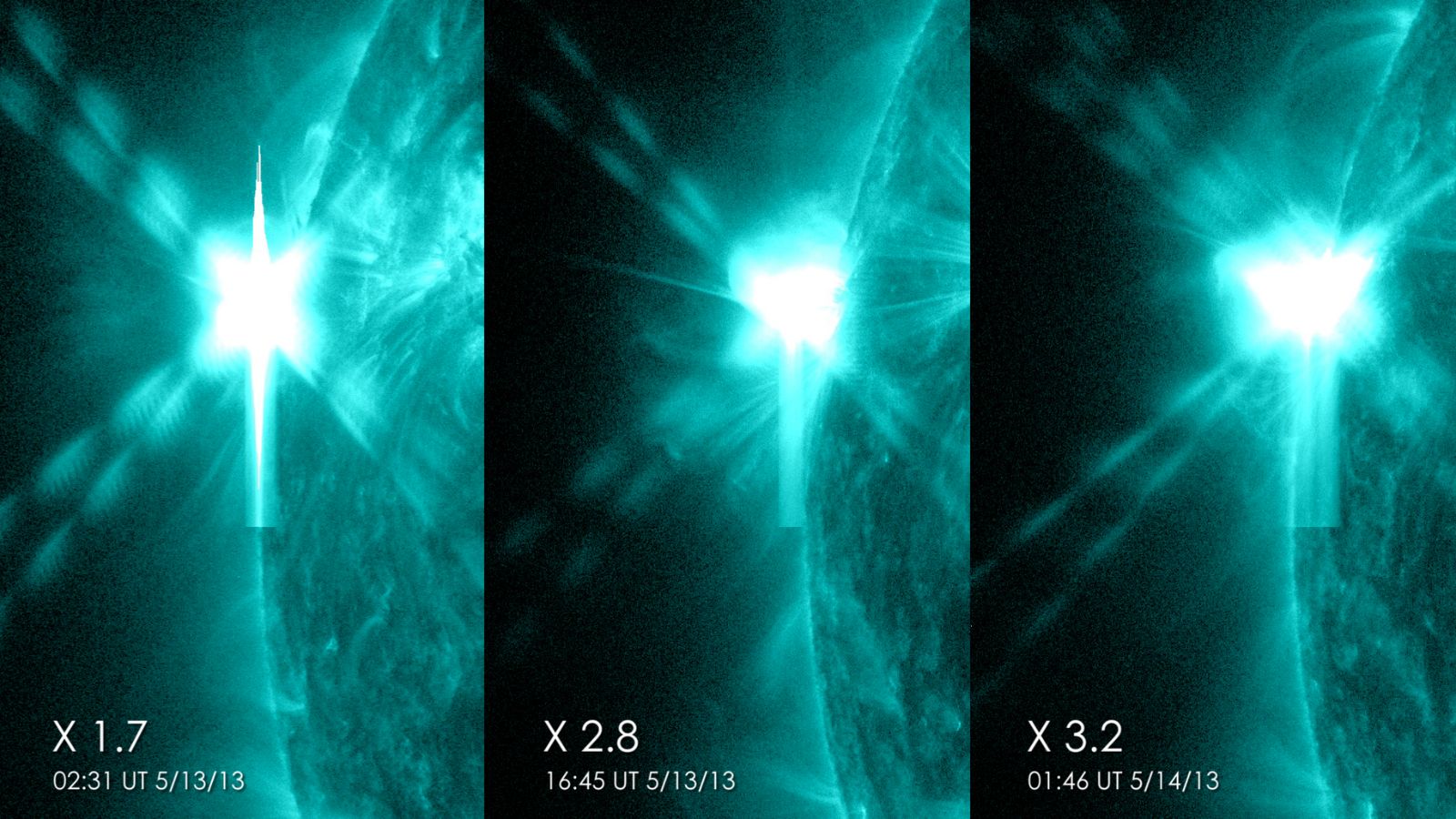
The peak of a cycle is the time when X-class flares, the most energetic class on the standard scale, and the largest coronal mass ejections cluster. In 2024 the Sun produced more X-class flares than in any year since detailed records began. Several large coronal mass ejections in May 2024 produced auroras visible from latitudes as low as Mexico, Florida, and the Mediterranean, the most extensive auroral display since 2003. None of those May 2024 storms were Carrington-class. But they happened, and the cycle is not over.
What the New Probes Are Telling Us
The current cycle is the first to be observed by two flagship missions designed specifically for it. NASA's Parker Solar Probe, launched in 2018, has now flown closer to the Sun than any human-built object, within about 6.2 million kilometers of the surface, well inside the corona itself. The European Space Agency's Solar Orbiter, launched in 2020, observes the Sun from highly inclined orbits that allow it, for the first time, to image the solar poles directly. Together, the two missions have substantially improved the data on the magnetic conditions that precede the largest eruptions.
What they have not yet produced is the holy grail of solar physics: a flare that can be reliably predicted before it happens. Coronal mass ejections are still observed in flight, not in advance. The lead time between a Carrington-class CME being detected leaving the Sun and its arrival at Earth is, in the worst case, on the order of fifteen hours, fast enough to disable equipment, but barely enough time to switch off vulnerable transformers and ground-based equipment manually.
In April 2025, an international working group on space-weather preparedness issued a report concluding that the United States and the European Union are still operating with response times that assume two to three days of warning, the figure for typical CMEs, not extreme ones. The same report estimated that, even with full implementation of all currently proposed mitigation measures, the residual damage from a Carrington-class event would still exceed half a trillion dollars.
The 1859 storm is not a museum piece. It is a probability density. The Sun, at its peak, is loaded.
Frequently Asked Questions
What was the Carrington Event?
The Carrington Event was a geomagnetic storm that struck Earth on September 1 to 2, 1859. It was caused by a coronal mass ejection from the Sun, observed in flight by Richard Carrington as a brilliant flare on a sunspot group. The resulting storm produced auroras visible at tropical latitudes, started fires in telegraph offices, and caused enough induced ground current that some telegraphs continued operating with their batteries disconnected. It is the most powerful geomagnetic storm ever recorded.
How likely is another Carrington-class event?
Estimates from the 2012 paper by Pete Riley in Space Weather put the probability at roughly 12% per decade. More recent and more conservative estimates lower the figure to between four and twelve percent per decade, but agree that the cumulative risk over a working lifetime is non-negligible. The 2012 near-miss, when a Carrington-magnitude coronal mass ejection passed through Earth's orbit nine days after Earth had been there, is the most dramatic recent illustration.
What is the Sun doing right now?
The Sun is in Solar Cycle 25, which began in 2019 and reached its sunspot maximum in 2024 to 2025. The cycle has been substantially more active than originally forecast, producing more X-class flares in 2024 than in any year since detailed records began. The May 2024 storms produced auroras visible from Mexico, Florida, and the Mediterranean, the most extensive auroral display since 2003. Elevated activity is expected to continue through 2026.
What would happen if a Carrington Event hit Earth today?
The U.S. National Academy of Sciences and follow-up E.U. studies have estimated direct economic damage between one and two trillion dollars and recovery periods between four and ten years. The most acute damage would be to high-voltage power-grid transformers, satellite infrastructure (GPS, geostationary communications, and low-Earth-orbit constellations), and any service that depends on either. Estimates suggest twenty to forty million people in the United States could lose reliable electricity for months.
How much warning would we have?
For a typical coronal mass ejection, the warning is two to four days, the travel time of the ejection from the Sun to Earth. For a Carrington-class CME, which moves three to four times faster, the warning could be as short as fifteen to seventeen hours. Most national grid-protection plans currently assume the longer warning time, not the shorter one. Closing this gap is one of the priorities highlighted by the 2025 international space-weather preparedness report.
Can we predict solar flares before they happen?
Not yet, in the sense of predicting a specific eruption hours or days in advance. Parker Solar Probe and Solar Orbiter have substantially improved the data on the magnetic conditions that precede large eruptions, and machine-learning systems now flag flare-precursor configurations on the solar surface. But the field has not yet produced a system that turns that into reliable advance warning of specific eruptions. The current operational regime is to detect coronal mass ejections in flight after they leave the Sun, then forecast their arrival at Earth.
Continue Exploring
- The Dust That May Solve the Sun's Hottest MysteryThe Sun's outer atmosphere is hundreds of times hotter than its surface, and nobody is sure why. Parker Solar Probe...
- We Have Only Visited Uranus Once, and Almost Everything We Learned That Day Was WrongVoyager 2 flew past Uranus in 1986 during a freak solar event. A 2024 reanalysis shows that what we have believed about...
- We Live Inside the Wreckage of Exploded StarsA thousand light-years across, the Local Bubble is a cavity blown into the galaxy by a string of ancient supernovae....
- The Strangest Dwarf Planet in the Solar System Is Shaped Like an Egg, Has Two Moons, and Spins Every 3.9 HoursPluto is round. Eris is round. Haumea is shaped like an egg because it spins so fast that gravity cannot keep up. It is...
Sources
- Carrington, R. C. "Description of a Singular Appearance seen in the Sun on September 1, 1859." Monthly Notices of the Royal Astronomical Society, 20, 13 (1859).
- Tsurutani, B. T. et al. "The extreme magnetic storm of 1 to 2 September 1859." Journal of Geophysical Research, 108(A7), 1268 (2003).
- Riley, P. "On the probability of occurrence of extreme space weather events." Space Weather, 10, S02012 (2012).
- Baker, D. N. et al. "A major solar eruptive event in July 2012: Defining extreme space weather scenarios." Space Weather, 11, 585 to 591 (2013).
- National Research Council. Severe Space Weather Events: Understanding Societal and Economic Impacts. National Academies Press, 2008.
- NASA. "Solar Cycle 25 Prediction Panel Report." NOAA Space Weather Prediction Center, updated 2024. swpc.noaa.gov
- ESA Solar Orbiter mission overview. esa.int
- NASA Parker Solar Probe mission overview. nasa.gov
- Cover image: NASA Solar Dynamics Observatory, X-class flare in extreme ultraviolet · Public domain.