The Largest Extinction We Have Ever Found
The boundary in the rocks is sharp. At the end of the Permian period, around 252 million years ago, sedimentary layers contain a rich and diverse fauna, trilobites, brachiopods, large reef-building organisms, complex terrestrial ecosystems with synapsid predators ancestral to mammals, and a global biosphere that had spent 300 million years building itself up. In the very next layer, almost everything is gone. Reefs are absent. The marine fossil record collapses to a handful of opportunistic species, clams, snails, and burrowing worms that could tolerate very low oxygen. On land, the dominant predators and herbivores are wiped out. What survives is a small, stress-tolerant subset.
The most rigorous estimates, based on the global marine fossil record, suggest that approximately 96 percent of marine species disappeared in this transition, along with roughly 70 percent of terrestrial vertebrate species. This is the largest extinction event in Earth's history. The end-Cretaceous extinction that killed the dinosaurs 66 million years ago killed roughly 75 percent of species, bad, but not as bad. The Permian-Triassic extinction is in a different category.
It is also, despite its severity, the least well-known of the major extinctions in popular awareness. The dinosaur extinction has the asteroid, the iridium layer, the impressive crater under the Yucatan Peninsula. The Permian-Triassic extinction has none of those things. It was caused by something less dramatic but ultimately more devastating: the planet's own interior turning against the biosphere on its surface.
The Siberian Traps
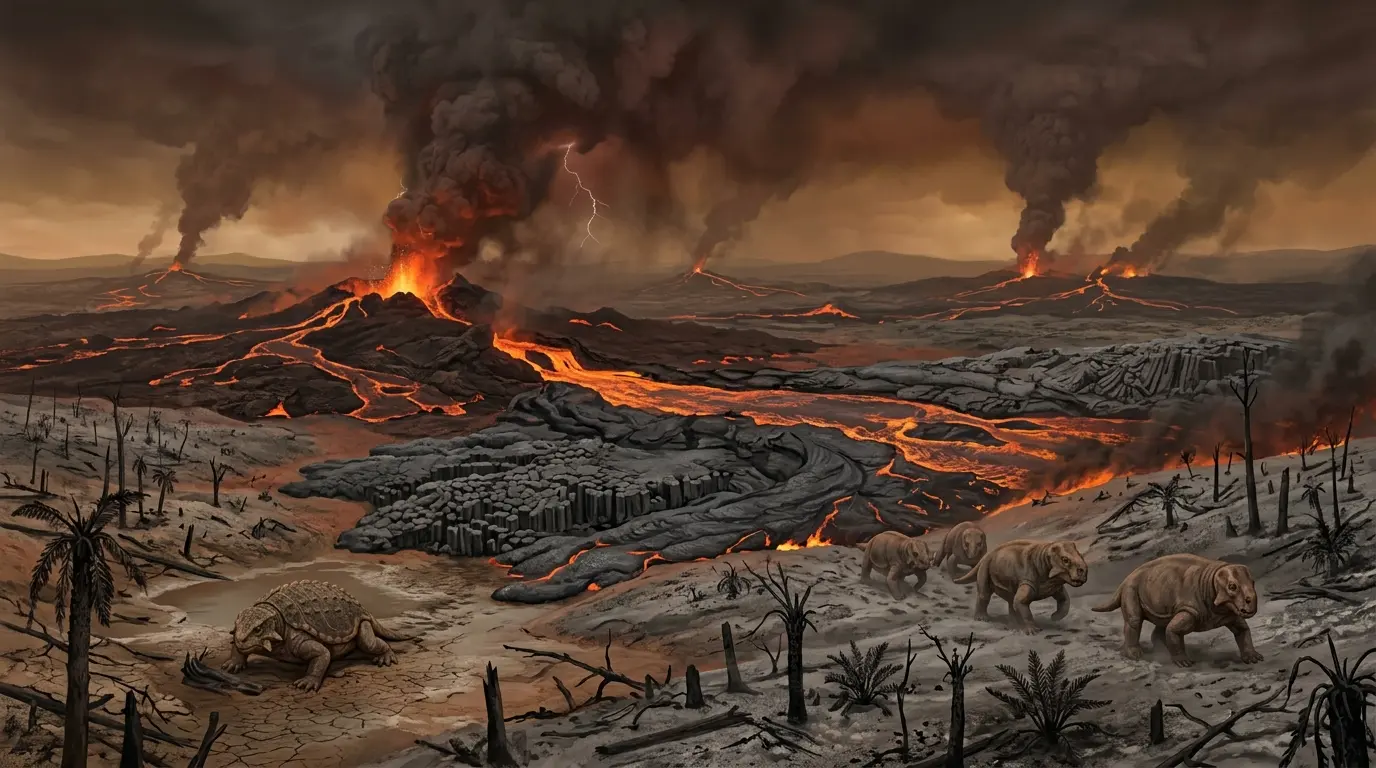
In what is now central Siberia, beneath the modern Russian taiga, lies a region of basalt rock several million square kilometers in area. Most of it is buried, but exposed sections reach hundreds of meters thick, and in some areas the original lava flows can be traced for tens of kilometers. This is the Siberian Traps, the eroded remnant of one of the largest flood-basalt eruptions in Earth's history.
"Flood basalt" is a misleading term because it suggests something violent and brief. The reality is different. Flood-basalt eruptions are slow-motion catastrophes: vast fissures in the crust that vent enormous quantities of low-viscosity basaltic magma over geological timescales. The Siberian Traps eruption began approximately 252 million years ago and continued, in pulses, for between several hundred thousand years and two million years depending on which dating methods are used. The volume of erupted material is estimated at three to four million cubic kilometers, enough to cover the entire continental United States to a depth of half a kilometer.
The dating is now precise enough to be highly suggestive. Work by Seth Burgess and Samuel Bowring at MIT, published in Science in 2014 and refined since, used uranium-lead radiometric dating of zircon crystals in Siberian Trap deposits to place the main eruption pulses within just a few hundred thousand years of the extinction horizon in the global fossil record. The correlation is too tight to be coincidence. The Siberian Traps are the cause, and the timing rules out most alternative explanations.
How Volcanism Killed Almost Everything
The Siberian Traps did not kill the biosphere by burying it under lava. The lava was a regional phenomenon; most of the world was nowhere near it. The kill mechanism was atmospheric.
Flood-basalt eruptions release enormous quantities of carbon dioxide and sulfur dioxide into the atmosphere. The CO₂ comes from the magma itself; the SO₂ comes from sulfur compounds in the magma and from the rocks the magma intrudes through on its way up. The Siberian Traps were particularly dangerous because the magma rose through extensive deposits of coal, organic-rich shales, and evaporites, sedimentary rocks that, when heated, release additional CO₂, methane, and toxic compounds. Recent modeling by Benjamin Black and colleagues at the University of California, Berkeley estimates that the total CO₂ release was on the order of tens of thousands of gigatonnes, comparable to the total carbon currently stored in all fossil fuels remaining in Earth's crust.
The result was rapid warming. Sea surface temperatures rose by approximately 8 to 10 degrees Celsius within a few tens of thousands of years of the main eruption pulse. Equatorial oceans became uninhabitable for most species; recent isotope work by Yadong Sun and colleagues, published in Science in 2012, found that tropical sea surface temperatures during the worst of the extinction may have reached 40 °C, a thermal regime in which most fish cannot survive, let alone reproduce.
Warm water holds less dissolved oxygen than cold water. As oceans warmed, dissolved oxygen levels fell, and large regions of the global ocean became anoxic, entirely without dissolved oxygen. The fossil record from the Permian-Triassic boundary shows characteristic signatures of widespread ocean anoxia: black sulfur-rich shales formed in anoxic deep waters, a near-disappearance of bioturbation (animals burrowing in sediments), and isotopic signatures of sulfate-reducing bacteria that thrive in anoxic conditions.
Simultaneously, CO₂ dissolving into seawater formed carbonic acid, acidifying the oceans. Calcium carbonate, which marine organisms use to build shells and reefs, becomes harder to deposit in acidic water and eventually dissolves outright. Reefs collapsed. Calcareous organisms (clams, brachiopods, corals, ammonoids) lost the ability to maintain their skeletons. The marine record shows the geological signature of widespread shell dissolution, known as a "carbonate gap", in the immediate aftermath of the eruption.
The Permian-Triassic ocean was hot, oxygen-starved, and acidic. It is the closest analog Earth's history has to what fully-developed climate change could do, and 96 percent of marine species could not survive it.
The Land Was Not Spared
Terrestrial ecosystems collapsed in parallel. The Permian land biosphere included a diverse set of synapsids, mammal-like reptiles that had been the dominant large land vertebrates for tens of millions of years. The therapsids, an advanced synapsid group, included animals with features that would not appear in later mammals for another 100 million years: differentiated teeth, partially erect posture, possibly fur and warm-bloodedness. They were on the verge of becoming what we now think of as mammals.
Almost all of them died. Of the dozens of therapsid lineages present at the end of the Permian, only a handful survived into the Triassic. The survivors were small, stress-tolerant burrowers, animals that could shelter underground, eat opportunistically, and tolerate the rapidly changing climate. The dominant lineage from this bottleneck, the cynodonts, would eventually evolve into mammals, but not for another 50 million years. The pause matters because of what filled the vacancy in the meantime: archosaurs, the lineage that includes crocodiles and birds, and the dinosaurs.
The Triassic that emerged from the Great Dying was a different world. The dominant large land animals were not synapsids but archosaurs. By the end of the Triassic, the first dinosaurs had appeared. By the middle Jurassic, they were the dominant terrestrial vertebrates and would remain so for another 130 million years. The mammal-ancestor lineage that had been on the cusp of dominating the Permian was relegated to the small-and-burrowing role it would occupy until the K-Pg extinction reset the board 186 million years later.
Without the Permian-Triassic extinction, mammals, and eventually humans, would likely have evolved earlier and dominated longer, with dinosaurs perhaps never emerging at all. The Great Dying did not just kill species; it redirected the evolutionary path of land life on Earth.
The Slow Recovery
The biosphere did not bounce back. The fossil record of the Early Triassic, the 5 to 10 million years immediately after the extinction, shows a depauperate world: low biodiversity, simple ecosystems, repeated episodes of additional environmental stress that kept knocking down recoveries before they could establish themselves. Reefs took approximately 8 to 10 million years to return as complex ecosystems. Diversity at the species level took roughly 30 million years to recover to pre-extinction levels.
This is much slower than the recovery from later extinctions. The end-Cretaceous extinction was followed by a relatively rapid rebound, with mammalian diversity restored within roughly 5 million years. The Permian-Triassic was different, and the difference matters because it reveals something about the nature of the catastrophe. A short-duration impact event (like the asteroid 66 million years ago) damages the biosphere severely but leaves a habitable planet on the other side. A long-duration atmospheric catastrophe (like the Siberian Traps eruption) keeps damaging the biosphere for hundreds of thousands of years after the worst is over, because the atmospheric chemistry takes that long to stabilize. Even after the eruption stopped, the elevated CO₂, warmed oceans, and acidified seas persisted, and continued to suppress recovery.
What This Has to Do With Us
The Permian-Triassic extinction is paleontology, but it is not just paleontology. The kill mechanism was rapid release of carbon into the atmosphere over a geologically short timescale. The total CO₂ release, divided by the duration, gives a rate of CO₂ injection comparable to, in some estimates, somewhat below, the current rate of human CO₂ emissions. The ocean acidification, the warming, the loss of dissolved oxygen, and the disappearance of calcareous organisms are all observed in modern oceans, at smaller scale, in response to current emissions.
This is not a prediction. Modern emissions, if they continue at current rates, would not produce a Great Dying, the absolute amount of carbon involved in human emissions is smaller, and the duration is shorter. But the Permian-Triassic boundary is the closest analog Earth's geological history has to a rapid CO₂ injection event, and the response of the marine biosphere to it is a record of what such events can do. The most rigorous current assessment is that we are pushing the climate system in the same direction as the Siberian Traps did, toward a warmer, more acidic, less oxygenated ocean, but on a smaller scale.
The worst day in Earth's history lasted two million years and killed 96 percent of marine species. The cause was carbon dioxide. The planet did it to itself.
Frequently Asked Questions
What was the Permian-Triassic extinction?
The Permian-Triassic extinction (also called the End-Permian extinction or 'The Great Dying') occurred approximately 252 million years ago and is the largest mass extinction event in Earth's history. Approximately 96 percent of marine species and roughly 70 percent of terrestrial vertebrate species disappeared. The extinction marks the boundary between the Permian and Triassic periods and the Paleozoic and Mesozoic eras.
What caused the Great Dying?
The Siberian Traps, a massive flood-basalt eruption in what is now central Siberia that lasted between several hundred thousand years and two million years. The eruption released tens of thousands of gigatonnes of CO₂ into the atmosphere, partly from the magma itself and partly from carbon-rich rocks (coal, organic shales) that the magma intruded through. The resulting CO₂ caused rapid warming, ocean acidification, and widespread ocean anoxia, all of which contributed to the extinction. Precise uranium-lead dating by Seth Burgess and colleagues (2014) places the main eruption pulses within a few hundred thousand years of the extinction horizon.
How did volcanism kill marine species?
Three interconnected mechanisms. First, atmospheric CO₂ from the eruption caused global warming of approximately 8 to 10 °C, with tropical sea surface temperatures reaching 40 °C, beyond the thermal tolerance of most marine species. Second, warm water holds less dissolved oxygen, so large regions of the global ocean became anoxic, killing most marine animals. Third, CO₂ dissolving into seawater formed carbonic acid, acidifying the oceans and dissolving the calcium carbonate skeletons of corals, clams, brachiopods, and other reef-builders. The fossil record shows a characteristic 'carbonate gap' across the Permian-Triassic boundary as a result.
How long did the extinction take?
The main extinction pulse occurred within approximately 60,000 years, geologically rapid, but vastly longer than the immediate K-Pg extinction at the end of the Cretaceous. The triggering volcanic activity continued for hundreds of thousands of years to two million years, and the biosphere did not fully recover for 10 to 30 million years afterward. Reefs took approximately 8 to 10 million years to return; species diversity took 30 million years to reach pre-extinction levels.
How does this relate to modern climate change?
The Permian-Triassic extinction is the closest analog Earth's geological history has to a rapid atmospheric CO₂ injection event. The kill mechanisms, warming, ocean acidification, dissolved-oxygen loss, are observed today, at smaller scale, in response to human CO₂ emissions. Modern emissions are not on track to produce a Great Dying (the absolute carbon involved is smaller and the duration is shorter), but they are pushing the climate system in the same direction. The Permian-Triassic boundary serves as a calibration point for understanding how rapidly biospheres can degrade when atmospheric chemistry changes quickly.
What animals survived the extinction?
On land, only a handful of synapsid (mammal-ancestor) lineages survived, mainly small, burrowing, stress-tolerant cynodonts. In the oceans, opportunistic species that could tolerate low oxygen survived: small clams, snails, and burrowing worms. The reef ecosystems were destroyed entirely. The dominant pre-extinction groups, trilobites (final extinction), large brachiopods, complex reef-builders, large therapsid predators, all disappeared. The Triassic that emerged was dominated by different lineages: archosaurs (the group that would eventually produce dinosaurs and birds) rather than synapsids; bivalve mollusks rather than brachiopods. The extinction redirected the evolutionary trajectory of life on land.
Sources
- Burgess, S. D., Bowring, S. A. & Shen, S.-Z. "High-precision timeline for Earth's most severe extinction." Proceedings of the National Academy of Sciences, 111, 3316 (2014).
- Sun, Y. et al. "Lethally hot temperatures during the Early Triassic greenhouse." Science, 338, 366 (2012).
- Black, B. A. et al. "Magnitude and consequences of volatile release from the Siberian Traps." Earth and Planetary Science Letters, 317 to 318, 363 (2012).
- Erwin, D. H. Extinction: How Life on Earth Nearly Ended 250 Million Years Ago. Princeton University Press, 2006.
- Payne, J. L. & Clapham, M. E. "End-Permian mass extinction in the oceans: An ancient analog for the twenty-first century?" Annual Review of Earth and Planetary Sciences, 40, 89 (2012).
- Shen, S.-Z. et al. "Calibrating the end-Permian mass extinction." Science, 334, 1367 (2011).
- Bond, D. P. G. & Wignall, P. B. "Large igneous provinces and mass extinctions: An update." Geological Society of America Special Paper, 505, 29 (2014).
- Cover image: U.S. Geological Survey, Siberian Traps modern aerial. Public domain.