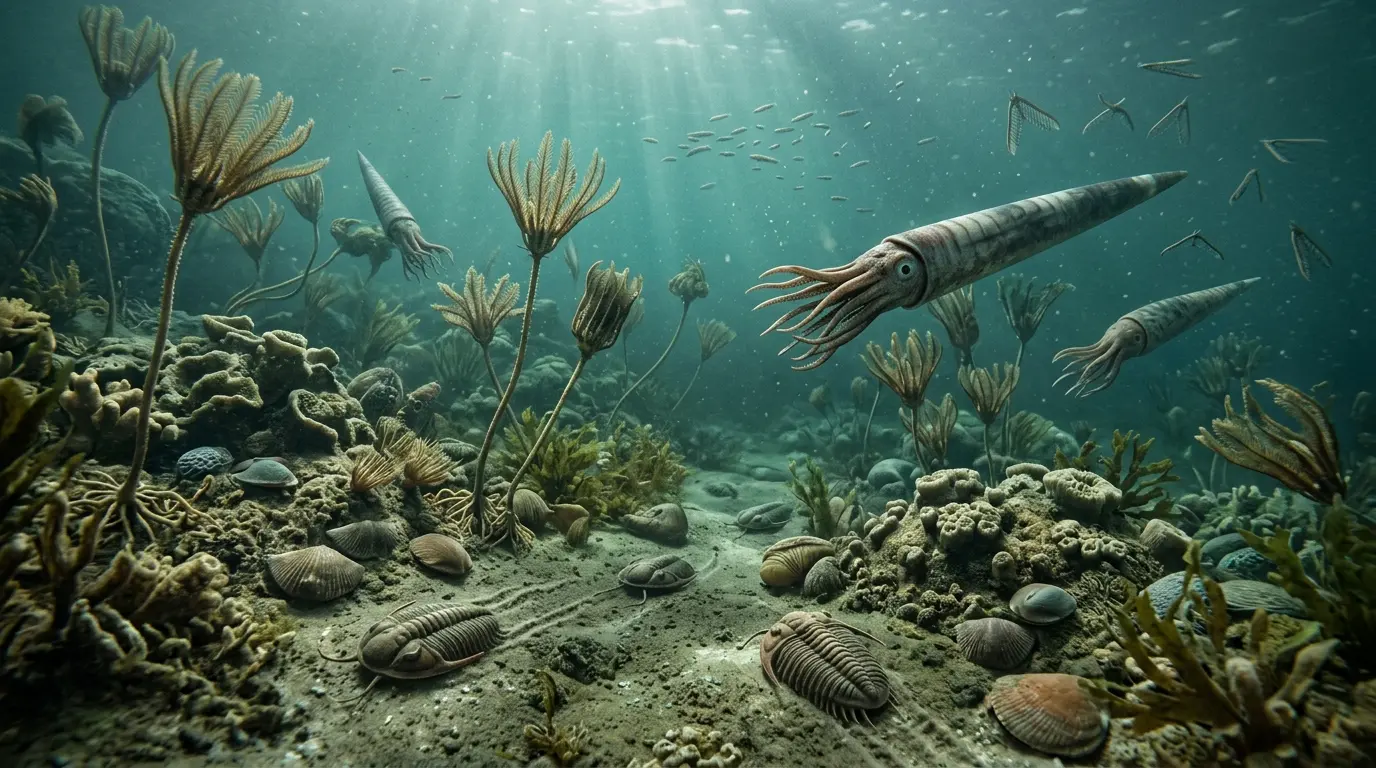
The Question Most People Get Wrong
The intuitive answer is "anywhere far enough back to avoid recent pollution, but recent enough that humans existed." Both halves of that intuition are misleading. Humans, as a species, have only existed for about 300,000 years, a fraction of a percent of Earth's history. So a more interesting version of the question is hypothetical: if you could send a small modern community back in time with their knowledge, their bodies, and what they could carry, what is the earliest period in which they could survive?
The question forces us to consider what humans actually need. Not just food and water, those are negotiable. The hard constraint is the atmosphere. Humans evolved in an atmosphere of approximately 21 percent oxygen, 78 percent nitrogen, and trace amounts of carbon dioxide. Substantial deviations from those values are fatal. And for most of Earth's history, the atmosphere was substantially different.
The Easy Era: The Past 65 Million Years
The Cenozoic Era, which began with the asteroid that ended the dinosaurs about 66 million years ago, is unambiguously survivable. Atmospheric oxygen has been close to its modern value throughout. Carbon dioxide levels have fluctuated but stayed within ranges that humans tolerate, typically 280 to 400 parts per million, occasionally higher during warmer epochs. Temperatures have varied from the warm early Eocene to the cold Pleistocene ice ages, but always within the range that human populations have demonstrably handled. Modern humans walked into ice age Europe and survived.
The Cenozoic is also the era of mammals. Many of the animals are recognizable, early primates, ancestral horses, ancestral whales, ancestral dogs. A community dropped into the middle Eocene would face an alien but recognizable ecosystem. They could hunt, gather, and make fire. They would be fine.
The Risky Era: The Mesozoic
Go back further, into the era of the dinosaurs (252 to 66 million years ago), and the picture changes. Atmospheric oxygen during the Mesozoic ranged from approximately 12 to 25 percent depending on the period. The lower end of that range, Late Triassic and Early Jurassic, would be just at the edge of human tolerance, comparable to standing at the elevation of base camp on Mount Everest. People can survive there but cannot do much heavy work.
Carbon dioxide levels were elevated, often 4 to 6 times modern levels, but not yet toxic. The Mesozoic atmosphere would feel warm, humid, and slightly thin. The bigger problem was ecological. The Mesozoic dinosaurs were not all the giants of popular imagination, most were smaller than a modern wolf, but they were ubiquitous predators, and a community of humans without firearms would be an unusual target rather than an obvious one. The risks were higher than in the Cenozoic but probably manageable for a coherent group with tools, fire, and the wisdom to stay away from anything bigger than a horse.
A wrinkle: the first 1 to 2 million years after the K-Pg extinction event 66 million years ago would have been deeply dangerous. The asteroid impact filled the atmosphere with sulfate aerosols, blocked sunlight, killed most plants, and collapsed the food chain. Survival in this window would have been a matter of subsisting on detritus, fungi, and whatever small animals had survived. Avoid the immediate post-impact era; otherwise the Mesozoic is, with care, doable.
The Hard Limit: The Paleozoic
Push further back, into the Paleozoic (538 to 252 million years ago), and the constraint shifts from predators to chemistry. The Paleozoic atmosphere had wildly varying composition. During parts of the Carboniferous (around 300 million years ago), oxygen reached approximately 35 percent, higher than modern levels, supporting dragonflies the size of seagulls and millipedes two meters long. That is breathable.
But carbon dioxide tells a darker story. During the early Paleozoic, atmospheric CO₂ was approximately 10 to 20 times modern levels, possibly as high as 4,000 to 8,000 parts per million, depending on the period and reconstruction method (the GEOCARB models by Robert Berner provide the standard estimate). At those concentrations, CO₂ is not just an inconvenience; it is toxic.
Humans begin to experience symptoms of CO₂ toxicity at around 5,000 ppm, fatigue, headaches, difficulty concentrating, accelerated heart rate. At 30,000 ppm and above (3 percent of atmosphere), CO₂ becomes acutely dangerous: rapid breathing, confusion, loss of motor coordination. At 100,000 ppm (10 percent), it is fatal within minutes. The Cambrian, Ordovician, and Silurian periods, in some reconstructions, had atmospheric CO₂ in the 3,000 to 8,000 ppm range. Survival there would have been marginal at best, and physical activity would have been impossible.
By the late Carboniferous and Permian (roughly 330 to 252 million years ago), atmospheric oxygen had risen and CO₂ had fallen as vast forests of land plants drew down the carbon. The Permian, in particular, had atmospheric composition not far from modern values. This is the earliest period in which a human community could survive without protective equipment, lethargy from CO₂, or asphyxia from low oxygen. The standard estimate places the floor at approximately 298 million years ago, the start of the Permian.
For roughly 4 billion of Earth's 4.6 billion years, the air itself would kill you. The window of survivable atmosphere is only the last 6.5 percent of the planet's history.
The Impossible Era: The Precambrian
Before the Cambrian (around 538 million years ago), atmospheric oxygen was lower still. For most of the Precambrian, that is, for most of Earth's history, atmospheric oxygen was below 1 percent. There were no large animals, no plants, no fungi. The land was bare rock. The oceans were full of microbial life, but the surface conditions resemble those of modern Mars more than those of modern Earth.
Any human dropped onto Precambrian Earth would suffocate within minutes. The atmosphere is not survivable. There is also nothing to eat, no plants, no animals, only microbial mats in the water. Liquid water exists, but at variable temperatures (Earth had multiple "Snowball Earth" episodes during which the entire planet froze) and without the ecosystems that humans depend on for food.
This is the great asymmetry of Earth's history. The planet is 4.6 billion years old. Microbial life has existed for at least 3.7 billion years. But the conditions that support complex animals, including humans, have existed for only the last 538 million years, and the conditions that humans can specifically tolerate have existed for only the last 298 million years. The vast majority of Earth's history is, from a human perspective, an alien planet.
What This Tells Us About Exoplanets
The same atmospheric chemistry that makes most of Earth's past inhospitable to humans tells us something about exoplanets. The "habitable zone" of a star, the region where a planet's surface temperature would allow liquid water, is a necessary but not sufficient condition for the kind of life that needs oxygen. A planet in the habitable zone may have atmospheric chemistry like Earth's Precambrian: liquid water on the surface, microbial life, but nothing that breathes.
The transition to a high-oxygen atmosphere requires biology. On Earth, it took photosynthetic microbes more than a billion years to produce enough oxygen to begin accumulating in the atmosphere. The "Great Oxygenation Event" around 2.4 billion years ago raised oxygen from below 0.001 percent to perhaps 1 percent, still far below modern levels. It took another 2 billion years to reach the conditions humans can breathe.
If exoplanets follow this trajectory, then a planet biologically active for "only" a billion years will not yet have the kind of atmosphere we would recognize as habitable. The biosphere has to spend a very long time terraforming the planet from the inside before it can support visitors. We are the result of that 4.5 billion-year process having been completed exactly once, here.
Earth has been here for 4.6 billion years. The atmosphere humans can breathe has existed for the last 298 million. We live in a thin sliver of habitable time on a planet that, for most of its history, would have killed us.
Frequently Asked Questions
What is the earliest period a human community could survive on Earth?
Approximately the early Permian, about 298 million years ago. By that point, vast Carboniferous forests had drawn atmospheric CO₂ down from the toxic levels of the early Paleozoic (often 3,000 to 8,000 ppm) to values close to modern (200 to 500 ppm). Oxygen levels had also stabilized at around 21 to 30 percent. Before this transition, atmospheric chemistry would have been either suffocating (Precambrian, very low oxygen) or acutely toxic (early Paleozoic, very high CO₂). The Permian is the earliest era humans could enter without protective equipment.
Could humans survive among the dinosaurs?
Mostly yes. Atmospheric conditions during most of the Mesozoic (252 to 66 million years ago) were within human tolerance: oxygen 12 to 25 percent, CO₂ elevated but not yet toxic. The risk was ecological rather than chemical, large predatory dinosaurs were dangerous, but most dinosaur species were smaller than a modern wolf. A coherent community with stone tools and fire could plausibly have established itself. The exception is the first 1 to 2 million years immediately after the K-Pg asteroid impact 66 million years ago, when the global food web collapsed.
How much CO₂ does it take to be toxic to humans?
Humans begin to experience symptoms (headaches, fatigue, concentration difficulty) at around 5,000 ppm. Acute symptoms (rapid breathing, confusion, motor coordination loss) appear at around 30,000 ppm (3 percent of atmosphere). Concentrations above 100,000 ppm (10 percent) are fatal within minutes. Modern atmospheric CO₂ is approximately 420 ppm, well below any toxicity threshold. Early Paleozoic CO₂ in the 3,000 to 8,000 ppm range would have made significant physical activity nearly impossible for humans, even before reaching acutely dangerous levels.
What was the atmosphere like during the Precambrian?
Atmospheric oxygen was below 1 percent for most of the Precambrian. Before the Great Oxygenation Event (about 2.4 billion years ago), oxygen was below 0.001 percent, essentially zero in human terms. After the GOE, oxygen rose to approximately 1 percent and stayed there until the late Neoproterozoic, around 600 to 800 million years ago, when it began rising rapidly toward modern levels. For most of Earth's history, the atmosphere was unbreathable. Any human dropped onto Precambrian Earth would suffocate within minutes.
How long has Earth had a 'modern' atmosphere?
The current oxygen level of 21 percent has been roughly stable for the past 300 million years, with significant variations during the Carboniferous (oxygen reaching 35 percent) and during the Permian-Triassic extinction (briefly dropping below 15 percent). CO₂ has varied much more, from the low Quaternary levels (around 280 ppm in pre-industrial atmosphere) to peaks above 1,000 ppm during warmer epochs of the Mesozoic and Cenozoic. The 'modern' atmosphere humans evolved in, with low CO₂ and ~21% oxygen, has existed in detail only for the past few million years.
What does this say about life on exoplanets?
The conditions humans can tolerate took 4.5 billion years of biological terraforming to develop on Earth. Photosynthetic microbes produced the oxygen over more than two billion years; vast forests drew down the CO₂ during the Carboniferous. A planet biologically active for only a billion years may have life but not the kind of atmosphere humans can breathe, it may resemble Earth's Precambrian rather than modern Earth. The 'habitable zone' of a star is a necessary but not sufficient condition for a planet to be habitable by complex, oxygen-breathing life.
Continue Exploring
- The Worst Day in Earth's History Lasted Two Million Years252 million years ago, an event the paleontologists now call simply The Great Dying erased 96 percent of all marine...
Sources
- Berner, R. A. "GEOCARBSULF: A combined model for Phanerozoic atmospheric O₂ and CO₂." Geochimica et Cosmochimica Acta, 70, 5653 (2006).
- Royer, D. L. "CO₂-forced climate thresholds during the Phanerozoic." Geochimica et Cosmochimica Acta, 70, 5665 (2006).
- Lyons, T. W., Reinhard, C. T. & Planavsky, N. J. "The rise of oxygen in Earth's early ocean and atmosphere." Nature, 506, 307 (2014).
- Holland, H. D. "The oxygenation of the atmosphere and oceans." Philosophical Transactions of the Royal Society B, 361, 903 (2006).
- Robinson, J. M. "Phanerozoic atmospheric reconstructions: A terrestrial perspective." Palaeogeography, Palaeoclimatology, Palaeoecology, 75, 223 (1989).
- Pierrehumbert, R. T. Principles of Planetary Climate, Cambridge University Press (2010), Ch. 8 on atmospheric history.
- Cover image: Smithsonian Institution reconstruction of a Carboniferous swamp forest. Public domain.