The Object That Did Not Look Right
In late 2003, a team led by Mike Brown at Caltech was running a Kuiper Belt survey on the Samuel Oschin Telescope at Palomar Observatory. The survey was the same one that had already produced Sedna and would later produce Eris and Makemake, the discoveries that ultimately forced the International Astronomical Union to demote Pluto from planet to dwarf planet in 2006. The Brown team's standard procedure was to detect candidate objects in survey images, then track them on subsequent nights to confirm orbits.
One candidate detected on December 28, 2004 stood out. The object was bright, bright enough that the team initially worried they had made an arithmetic error. Brightness in the Kuiper Belt usually indicates either size or surface reflectivity. Either was interesting. But the more puzzling feature emerged on later nights: the object's brightness changed by nearly a factor of two on a roughly four-hour cycle. Most Kuiper Belt objects do not change brightness on those timescales. The brightness variation could mean the object had a moon eclipsing it, or it could mean the object was elongated, with a long axis and a short axis presenting different cross-sections to Earth as it rotated.
The Brown team ran the analysis, ruled out an eclipsing binary, and concluded the object was rotating end-over-end every 3.9 hours. At a roughly 1,600-kilometer mean diameter, this was the fastest rotation of any large body anywhere in the solar system. They internally nicknamed it Santa, because it was discovered just after Christmas.
The Discovery Dispute
What happened next is one of the most uncomfortable episodes in modern observational astronomy. In July 2005, Brown's team submitted an abstract to a planetary science conference describing their object. Several days later, before the abstract was publicly released, a Spanish team led by José Luis Ortiz at the Instituto de Astrofísica de Andalucía in Granada announced via the Minor Planet Center that they had discovered the same object in archival imagery from 2003.
Brown initially congratulated the Spanish team. Then his collaborators noticed that the IP address from which Ortiz had accessed the Caltech telescope-observation logs immediately before announcing the discovery matched Ortiz's own institute. The Caltech logs were online, accessible to anyone who knew the URL, and contained pointing coordinates that would have allowed someone to identify exactly where the candidate object was. Brown alleged that Ortiz had used the logs to retroactively "find" the object in archival data and announce it.
The International Astronomical Union eventually credited the Spanish team with the announcement but assigned the right to name the object, which under IAU procedure is the more meaningful credit, to the Caltech team. Brown chose Haumea, the Hawaiian goddess of childbirth and fertility, and named the moons after Haumea's children. The Ortiz team disputed the IAU's reasoning publicly for years. The dispute is settled in a formal sense, but it has never been resolved in the way scientific priority disputes occasionally are: with both parties signing off on a shared narrative.
The Egg Shape
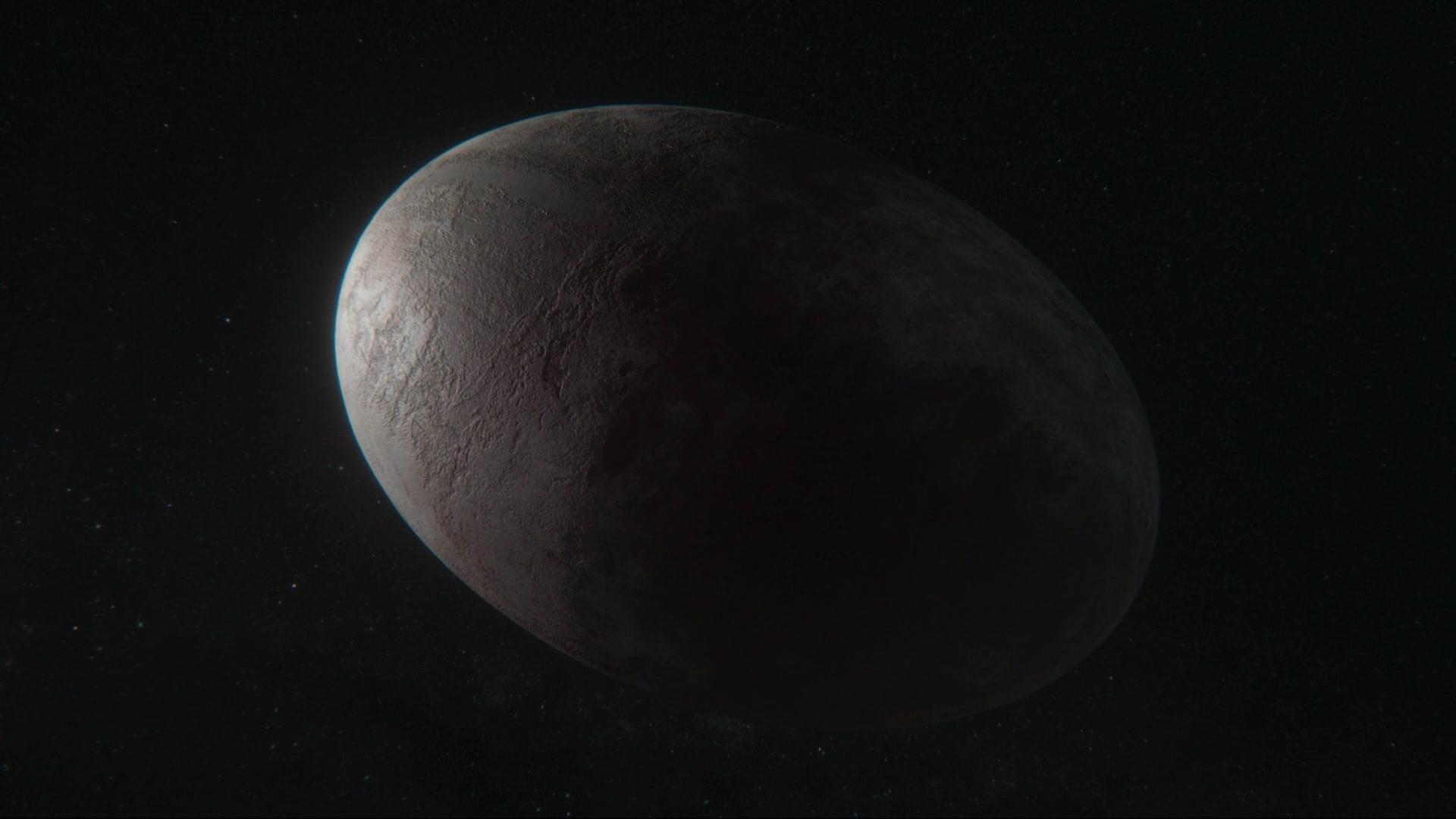
The brightness variations that the Brown team had spotted were not artifacts. Haumea is genuinely shaped like an egg, formally, a triaxial ellipsoid with three different principal axis lengths. Subsequent stellar occultation measurements published by Ortiz, Lockwood, and others have refined the dimensions to approximately 2,322 × 1,704 × 1,138 kilometers along the three axes.
For an object of Haumea's mass, gravity should pull the body into a sphere over geological time, like every other large object in the solar system. Haumea's shape is not a violation of physics. It is a consequence of rotation. Spinning a large object fast enough to produce significant centrifugal force at its equator distorts it into an oblate spheroid, then into an elongated triaxial ellipsoid as the spin gets faster. The shape Haumea has is exactly the shape a fluid body of its mass and density would take if it were rotating at its current period.
This makes Haumea a textbook example of hydrostatic equilibrium for a rapidly rotating body. It is also the smallest known object in the solar system to take this shape. Smaller asteroids do not have enough self-gravity to relax into a fluid-equilibrium shape on any reasonable timescale. Haumea does, its gravity is strong enough to deform the rock and ice as if they were fluid, but its rotation is fast enough to overcome sphericity.
The Spin That Should Have Torn It Apart
Haumea rotates every 3 hours and 54 minutes. This is the fastest rotation period of any object larger than 100 kilometers in the solar system. For comparison, Earth rotates every 24 hours; the asteroid Bennu rotates every 4.3 hours despite being only 500 meters across; Saturn, the fastest-rotating large planet, completes one rotation in about 10.7 hours. Haumea, at 1,632 kilometers in mean diameter, beats all of them.
The spin is fast enough that Haumea is approaching the rotational breakup limit, the rate at which centrifugal force at the equator would exceed surface gravity, and material at the equator would begin to fly off. The breakup limit depends on density; current best estimates put Haumea's bulk density at around 2.6 grams per cubic centimeter, denser than water ice and consistent with a rock-and-ice composition. Spin one notch faster and the equator would lose material outward.
The leading explanation for this extreme spin is an ancient catastrophic impact. At some point in the early solar system, Haumea collided with a comparably sized body. The collision spun the surviving body up to its current rotation rate, ejected ice from its surface, and produced the satellites and ring system that orbit it today. Whatever the impact was, the angular momentum it deposited has been preserved for billions of years.
Haumea is rotating so fast that gravity is barely winning. One more impact in the right direction and the equator would shed material into space.
The Two Moons
Hi'iaka and Namaka, named for Haumea's daughters in Hawaiian myth, were discovered in 2005 by Brown's team using adaptive-optics imaging at the Keck Observatory. Hi'iaka is the larger and brighter of the two, about 320 kilometers across, and orbits at roughly 50,000 kilometers from Haumea on a nearly circular orbit with a 49-day period. Namaka is smaller, closer in, and follows a more elliptical orbit inclined at roughly 13 degrees relative to Hi'iaka's.
The mutual inclination and eccentricity of the moons' orbits are unusual. Tidal forces between Haumea and its moons, integrated over billions of years, should have damped both into nearly circular co-planar orbits. The fact that they have not means either that the system is younger than tidal evolution timescales, or that something has been actively perturbing the orbits. The leading hypothesis is interactions with the rest of Haumea's collisional family, the descendants of the same ancient impact.
The Ring Nobody Expected
In 2017, Ortiz's team, yes, the same Ortiz, used a stellar occultation to measure Haumea's size with unprecedented precision. The technique works by timing how long a background star's light is blocked when an object passes in front of it from the perspective of multiple ground stations. From the timings, the team can reconstruct the object's silhouette to kilometer precision.
The 2017 occultation produced the expected silhouette of a triaxial ellipsoid. It also produced something completely unexpected: brief, symmetric dips in the star's brightness on either side of Haumea's main body. The team interpreted the dips as a ring approximately 70 kilometers wide, located at about 2,287 kilometers from Haumea's center of mass, well outside the Roche limit for ice but inside the orbits of both moons.
The ring was published in Nature in October 2017 as the first ring system ever discovered around a trans-Neptunian object. Since then, two other minor planets, Chariklo (a Centaur) and Chiron (a similar Centaur), have also been confirmed to host rings, but Haumea remains the only known ringed object in the Kuiper Belt proper. The ring's origin is presumed to be the same collisional event that produced the moons and the high spin: debris from the impact, captured into orbit, has been gradually rearranged by gravitational resonances into the narrow band we see now.
The Family
Haumea is not alone in its orbital region. A roughly comparable group of about a dozen smaller Kuiper Belt objects, including 2002 TX300, 2003 OP32, and others, share Haumea's orbital characteristics and surface composition (water ice, no methane). The group is collectively called the Haumea family and is the only known collisional family in the Kuiper Belt.
Brown, Barkume, and others have argued, on the basis of the family's orbital and spectral coherence, that all of its members are fragments of a single body that broke up after Haumea's ancestor was struck by a smaller object roughly 4 billion years ago. The original Haumea would have been larger; the impact ejected ice from the surface, sent fragments into space, and left behind the spinning remnant we now call Haumea. The ice ejected at that moment is still detectable as the bright water-ice surfaces of the family members.
This makes Haumea the only known dwarf planet that is both the survivor of a major impact and the progenitor of a family of children. Pluto is bigger, Eris is more massive, but Haumea is the most genealogically interesting object in the outer solar system.
Pluto and Eris are simple objects with complicated atmospheres. Haumea is a complicated object with no atmosphere at all, and the most violent past of any dwarf planet we have catalogued.
Frequently Asked Questions
What is Haumea?
Haumea is a dwarf planet in the Kuiper Belt, beyond Neptune. It has a mean diameter of approximately 1,632 kilometers, two moons (Hi'iaka and Namaka), a narrow ring discovered in 2017, and the fastest rotation period of any large body in the solar system at 3.9 hours. Its rotation is so rapid that it is shaped like an egg rather than a sphere.
Why is Haumea egg-shaped?
Haumea's rotation period of 3 hours 54 minutes is fast enough that centrifugal force at its equator significantly counteracts its self-gravity. The shape it takes is the shape a fluid body of its mass, density, and rotation rate would assume in hydrostatic equilibrium, a triaxial ellipsoid measuring roughly 2,322 × 1,704 × 1,138 kilometers along its three principal axes. It is the smallest known body in the solar system that has relaxed into hydrostatic equilibrium under rotation.
Who discovered Haumea?
The discovery is contested. A team led by Mike Brown at Caltech detected Haumea in survey data on December 28, 2004, and announced internal results in mid-2005. A Spanish team led by José Luis Ortiz at the Instituto de Astrofísica de Andalucía publicly announced an independent identification a few days later, after, Brown alleged, accessing Caltech's online observation logs. The International Astronomical Union credited the Spanish team with the formal announcement but gave the Caltech team naming rights. The dispute has never been fully resolved in public.
What is the Haumea ring?
Haumea's ring is a narrow band of debris approximately 70 kilometers wide, located about 2,287 kilometers from Haumea's center of mass. It was discovered through a 2017 stellar occultation observed from multiple ground stations and published in Nature. It is the first ring system ever found around a trans-Neptunian object and is presumed to be debris from the same ancient impact that produced Haumea's moons and rapid spin.
How did Haumea start spinning so fast?
The leading explanation is a catastrophic collision in the early solar system. Haumea's ancestor was struck by a comparably sized body roughly 4 billion years ago. The collision ejected ice from the surface, scattered fragments to form what is now the Haumea collisional family, and spun the surviving remnant up to its current rotation rate. Angular momentum from the impact has been preserved for billions of years.
Has any spacecraft visited Haumea?
No. Haumea has only been observed from Earth and Earth-orbiting telescopes. There are no missions in active development to visit it. Haumea is approximately 50 astronomical units from the Sun, even further than Pluto, which makes a flyby mission a multi-decade undertaking. Most of what we know about its shape, density, and ring system comes from stellar occultations and high-resolution adaptive-optics imaging from the Keck Observatory.
Continue Exploring
- The Collision That Made the Moon, and the Habitable Planet Underneath ItAbout 4.5 billion years ago, an object roughly the size of Mars struck the proto-Earth. The collision was the most...
Sources
- Brown, M. E. et al. "Satellites of the largest Kuiper Belt objects." The Astrophysical Journal Letters, 632, L45 (2005).
- Ortiz, J. L. et al. "The size, shape, density and ring of the dwarf planet Haumea from a stellar occultation." Nature, 550, 219 to 223 (2017).
- Lockwood, A. C. et al. "A photometric search for active Main Belt asteroids." Earth, Moon, and Planets, 111, 127 (2014).
- Ragozzine, D. & Brown, M. E. "Candidate members and age estimate of the family of Kuiper Belt object 2003 EL61." The Astronomical Journal, 134, 2160 (2007).
- Lacerda, P. & Jewitt, D. "Densities of solar system objects from their rotational lightcurves." The Astronomical Journal, 133, 1393 (2007).
- Brown, M. E. et al. "A collisional family of icy objects in the Kuiper Belt." Nature, 446, 294 (2007).
- Santos-Sanz, P. et al. "'TNOs are Cool': A survey of the trans-Neptunian region. IV. Size/albedo characterization of 15 scattered disk and detached objects observed with Herschel-PACS." Astronomy & Astrophysics, 541, A92 (2012).
- International Astronomical Union. Minor Planet Circular MPC 60173, naming announcement (2008).
- Cover image: Artist's impression by IAA-CSIC / UHU via ESA. Public domain.