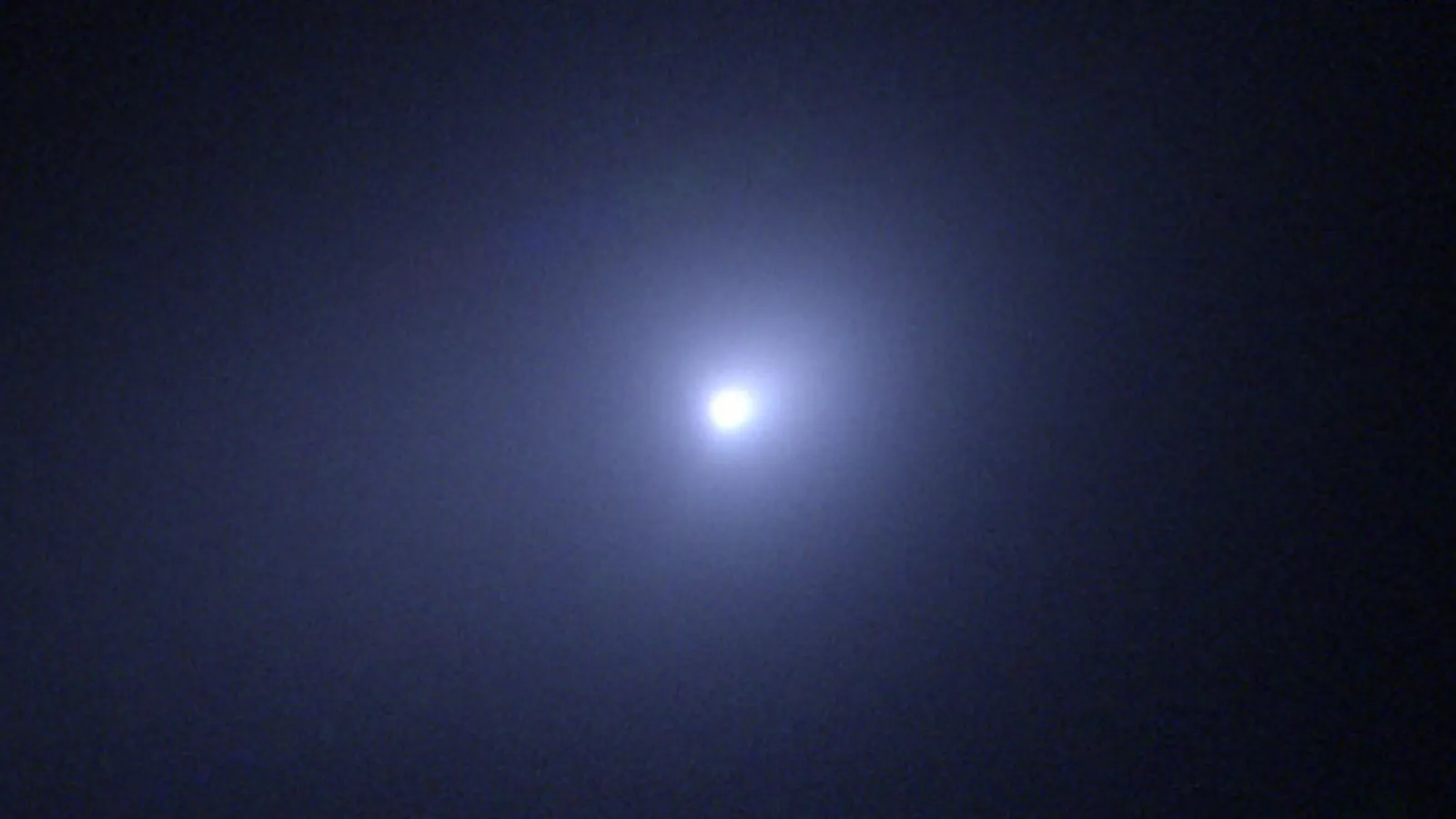
Two interstellar objects had passed through the solar system before this one. 1I/'Oumuamua, discovered in 2017, was a strange, elongated thing that left more questions than answers. 2I/Borisov, in 2019, was unambiguously a comet, a fragment of someone else's protoplanetary disk, sublimating predictably as it approached the Sun. The third, designated 3I/ATLAS, was detected on July 1, 2025, moving at 68 kilometers per second along a trajectory no body bound to our Sun could ever travel.
By October, it had dived behind the Sun, beyond the reach of every telescope on Earth. When it emerged in November, the chemistry was wrong. The carbon dioxide content was sixty times what a normal comet carries. It glowed blue when it should have glowed red. And a radio detection from South Africa settled, finally, what kind of object we were looking at.
What an interstellar object is
Every comet and asteroid in our solar system formed in the same disk of gas and dust that produced the Sun and planets. They share an inheritance, a common chemistry, common isotope ratios, predictable behavior. They orbit the Sun in elliptical paths, returning year after year or millennium after millennium.
An interstellar object is different. Its trajectory is hyperbolic, the kind of path an object follows when it is moving fast enough to escape the Sun's gravity entirely. It is passing through, not orbiting. And it formed around some other star, in some other protoplanetary disk, ages ago. The galaxy is full of such wanderers, ejected from their home systems by gravitational interactions with planets and other stars. Estimates suggest there should be roughly one in every cubic astronomical unit of interstellar space.
We had never seen one until 'Oumuamua passed through in 2017. That changed everything about how astronomers think about the population of small bodies in the galaxy.
The discovery
3I/ATLAS was found by the Asteroid Terrestrial-impact Last Alert System, ATLAS, on July 1, 2025. The orbit, computed from its first few weeks of motion, was clearly hyperbolic. Its incoming trajectory traced back to a region near the constellation Lyra, though the actual stellar origin is unknown and may be impossible to determine.
Initial photometry put its diameter at no more than 2.8 kilometers, a modest nucleus, comparable to many bound comets. What was unusual was its activity level. Even at three astronomical units from the Sun, three times the Earth-Sun distance, where temperatures are still well below freezing, it was already outgassing aggressively.
A comet this far out should not be venting water at forty kilograms per second. 3I/ATLAS was.
NASA's Swift observatory detected hydroxyl radicals, the broken pieces of water molecules, pouring off the comet at the equivalent rate of an industrial fire hose. That suggested 3I/ATLAS was not merely sublimating ice from its surface but actively ejecting icy grains into its coma, where they melted independently and amplified the apparent water loss.
Behind the Sun
In October 2025, 3I/ATLAS's apparent path took it behind the Sun from Earth's perspective. Ground-based telescopes were blinded for weeks during the most active phase of the object's journey. But three solar observatories, STEREO-A, SOHO, and the recently launched GOES-19, kept watch. All three use coronagraphs, which physically block out the Sun's disk to study the corona.
A team led by Qicheng Zhang at the Lowell Observatory and Karl Battams at the U.S. Naval Research Laboratory aggregated the coronagraph data. The brightness curve was extraordinary. Before October, 3I/ATLAS had been brightening at a rate proportional to its distance from the Sun raised to the minus 3.8 power, a normal rate for an active comet. Inside two astronomical units, that scaling went vertical. The new slope was r to the minus 7.5. The comet was shedding mass at a rate that defied every standard model.
And the color changed. For months, 3I/ATLAS had appeared red, the color of a dusty, organic-rich surface, similar to 'Oumuamua. Then, briefly, it shifted to green as cyanogen and diatomic carbon emission lines became visible. Through the filters of the LASCO and CCOR-1 coronagraphs, it appeared blue relative to the Sun.
The blue color is the spectroscopic signature of fluorescing carbon monoxide and amide radicals, gases boiling out of deep, freshly exposed ice. As 3I/ATLAS approached the Sun, the radiation had penetrated its dusty outer crust and reached the volatile inner material. The real comet, hidden under a coating of red space dust for billions of years, was finally showing itself.
The Mars flyby
Three months before perihelion, in early October, 3I/ATLAS passed within 0.19 astronomical units of Mars, about 28 million kilometers. Every Mars-orbiting and Mars-surface mission turned toward it. NASA's Mars Reconnaissance Orbiter targeted it with HiRISE, the camera powerful enough to see a coffee table on the Martian surface. The European Space Agency's Mars Express and ExoMars orbiters joined. MAVEN's ultraviolet spectrograph imaged the comet's hydrogen envelope, which extended far beyond the visible coma. And the Perseverance rover, sitting in Jezero Crater, aimed Mastcam-Z at the sky and caught 3I/ATLAS as a faint smudge drifting across the stars.
The HiRISE images, released six weeks late due to a U.S. government shutdown, were a disappointment to those hoping for a resolved view of the nucleus. The dust coma was 1,500 kilometers across, more than enough to hide a 2.8-kilometer object completely. But this was the first time in history that an interstellar object had been imaged from another world.
The alien spaceship hypothesis, and its end
Two features of 3I/ATLAS attracted attention from outside mainstream astronomy. The first was a "sunward jet", a bright streak of material extending from the comet toward the Sun, rather than away from it as a normal tail does. The second was an apparent non-gravitational acceleration, with the comet's trajectory deviating slightly from the path pure gravity would predict.
Harvard astrophysicist Avi Loeb published a series of articles arguing that these features were difficult to explain naturally and might be consistent with artificial propulsion. The argument was that the outgassing required to produce the observed acceleration would, by some calculations, be enough to disintegrate the nucleus, which it had not done.
Standard cometary science offered straightforward natural explanations for both features. Sunward jets are common in active comets, occurring when a weak point on the sun-facing hemisphere allows sublimating gases to vent toward the Sun before being swept back by the solar wind. The same feature has been observed on Comets Halley, NEOWISE, and 67P/Churyumov-Gerasimenko. The non-gravitational acceleration is the rocket effect of any active comet, and a dynamical analysis by Goldy Ahuja and Shashikiran Ganesh showed it matched the measured mass-loss rate exactly.
The MeerKAT detection sealed the debate. 3I/ATLAS is venting water vapor. It is a comet.
The decisive evidence came from the MeerKAT radio telescope array in South Africa. MeerKAT detected absorption lines at 1665 and 1667 MHz, the radio signature of hydroxyl. This was the first radio detection of any interstellar object, and it confirmed unambiguously that 3I/ATLAS is venting water. A dry, rocky probe would produce no such signal.
The cooked comet
One of the assumptions astronomers had brought to 3I/ATLAS was that it would be pristine, a time capsule from another star system, preserved by the cold and emptiness of interstellar space. A November 2025 paper by Romain Maggiolo at the Royal Belgian Institute for Space Aeronomy argued the opposite. The object was not pristine at all. It was cooked.
The James Webb Space Telescope and SPHEREx had measured an extreme abundance of carbon dioxide in the coma. The ratio of CO₂ to water in a normal solar system comet is about 0.12. In 3I/ATLAS, it is 7.6, nearly sixty times higher.
Maggiolo's mechanism is galactic cosmic rays. For the billions of years 3I/ATLAS spent drifting between the stars, it was bombarded by high-energy particles from supernovae and active galactic nuclei. These particles penetrated meters into the ice and chemically transformed it, converting carbon monoxide and water into carbon dioxide and complex organic solids. The result is a fifteen-to-twenty-meter-deep "processed crust" of radiation-damaged material, a chemical sunburn accumulated over eons.
What we are watching now, as 3I/ATLAS emerges from perihelion, is that crust peeling off.
Where it is going
As of this writing, 3I/ATLAS is making its closest approach to Earth and is once again observable from amateur telescopes. On March 16, 2026, it will pass approximately 0.35 astronomical units from Jupiter, well inside Jupiter's Hill Sphere. If the Juno spacecraft is still operational at that point, it may capture a final close-up view of the visitor before it leaves the solar system entirely.
After that, 3I/ATLAS will accelerate away from the Sun and disappear into interstellar space, probably forever. The trajectory does not allow for return.
The Vera Rubin Observatory, which began full operations in 2025, is expected to detect dozens of interstellar objects per year. The category that contained only 'Oumuamua and Borisov for nearly a decade is about to become a regular field of study. 3I/ATLAS is the first interstellar object we have studied across the entire electromagnetic spectrum, from radio to ultraviolet. It will not be the last.
The interstellar object that arrived this year was a chemical sunburn, peeling under a sun that was never its own.
Frequently Asked Questions
What is 3I/ATLAS?
3I/ATLAS is the third confirmed interstellar object to pass through our solar system, discovered on July 1, 2025, by the Asteroid Terrestrial-impact Last Alert System. Its hyperbolic trajectory shows it is not gravitationally bound to the Sun and originated in another star system. The "3I" designation marks it as the third interstellar object after 1I/'Oumuamua and 2I/Borisov.
Could 3I/ATLAS be artificial?
No. While some commentators raised the possibility based on a sunward jet and non-gravitational acceleration, both features are well-explained by standard cometary physics. The decisive evidence came from the MeerKAT radio telescope in South Africa, which detected hydroxyl absorption at 1665 and 1667 MHz, the unambiguous signature of water vapor. A dry artificial object would produce no such signal.
Why does 3I/ATLAS have so much carbon dioxide?
The CO₂-to-water ratio in 3I/ATLAS is approximately 7.6, nearly 60 times higher than typical solar system comets. A November 2025 paper by Romain Maggiolo proposed that galactic cosmic rays, accumulated over billions of years in interstellar space, chemically transformed the comet's outer 15-20 meters of ice. CO and H₂O were converted into CO₂ and complex organic compounds, creating a "cooked" crust that is now sublimating.
How big is 3I/ATLAS?
Hubble Space Telescope observations suggest the nucleus is no more than 2.8 kilometers across, making it a modest-sized comet by solar system standards. Its coma, however, can extend 1,500 kilometers or more, which is why even high-resolution imaging from the Mars Reconnaissance Orbiter could not resolve the underlying nucleus during its October 2025 flyby of Mars.
When can I see 3I/ATLAS?
3I/ATLAS is making its closest approach to Earth around the publication of this article (May 2026), at which point it is observable from moderately equipped amateur telescopes. On March 16, 2026, it passed within 0.35 AU of Jupiter. After that, it will accelerate away from the inner solar system and become progressively fainter as it leaves on a one-way trajectory back into interstellar space.
Where did 3I/ATLAS come from?
The incoming trajectory traces back to a region near the constellation Lyra, but the actual star system of origin cannot be determined. Interstellar objects are thought to be ejected from their home systems by gravitational interactions with planets and other stars, and they can drift through the galaxy for billions of years before passing through another star system. The Vera Rubin Observatory is expected to detect dozens of interstellar objects per year, beginning a new era in their study.
Continue Exploring
- The Comet That Was Almost GreatIt was billed as the great comet of 2026, a naked-eye visitor from the deep. It delivered a modest glow instead, and in...
- The Third Zone of the Solar SystemBeyond Neptune lies a broad ring of icy worlds that no one confirmed until 1992. It reset the definition of a planet...
- The Death Star Moon Was Hiding an Ocean. Nobody Saw It Coming.Mimas is 400 kilometers across, dominated by a crater so large the impact nearly broke it apart, and looks exactly like...
- The Frozen Shell at the Edge of the Sun's ReachFar beyond Pluto and the Kuiper Belt, the solar system may end in a vast spherical cloud of icy bodies reaching nearly...
Sources
- Jewitt et al. (2025). "Initial Characterization of Interstellar Comet 3I/ATLAS." link.
- Zhang & Battams (2025). "Solar coronagraph observations of 3I/ATLAS at perihelion." link.
- Maggiolo et al. (2025). "Galactic cosmic-ray processing of interstellar object surfaces." link.
- MeerKAT Collaboration (2025). "First radio detection of hydroxyl in an interstellar object." link.
- Ahuja & Ganesh (2025). "Dynamical modeling of 3I/ATLAS non-gravitational accelerations." link.