As you read this sentence, about a hundred trillion neutrinos are passing through your body every second, and not one of them will leave a mark. They stream out of the Sun, through the vacuum of space, through the Earth, and through you, almost never bumping into anything. You could line up a wall of solid lead a light-year thick and a typical neutrino would sail straight through it. They are the closest thing physics has to a ghost: real, abundant, and very nearly untouchable.
Neutrinos are among the most common particles in the universe, and among the least understood. Learning to catch even a handful of them has required some of the most extraordinary experiments ever built, buried deep underground and filled with thousands of tons of material. The payoff has been immense: neutrinos let us peer inside the Sun, witness the death of a star, and probe some of the deepest questions in physics.
A particle invented to save physics
The neutrino began as an act of desperation. In 1930, physicists studying a form of radioactive decay found that energy seemed to be vanishing, as if some had leaked out of the accounts. Rather than abandon the sacred principle that energy is conserved, the physicist Wolfgang Pauli proposed that an invisible, undetected particle was carrying the missing energy away, a particle so faint it might never be seen. He apologized for suggesting something undetectable. It took until 1956 for Clyde Cowan and Frederick Reines to finally catch one, confirming that Pauli's ghost was real.
The reason it took so long is the same reason neutrinos are so useful. They interact only through the weak nuclear force, one of nature's feeblest, so they almost never touch ordinary matter. That makes them maddeningly hard to detect, but it also means they escape from places nothing else can, carrying information out of the hearts of stars and the cores of explosions.
Pauli proposed a particle he thought no one would ever detect, and apologized for it. Twenty-six years later, someone caught one.
Seeing inside the Sun
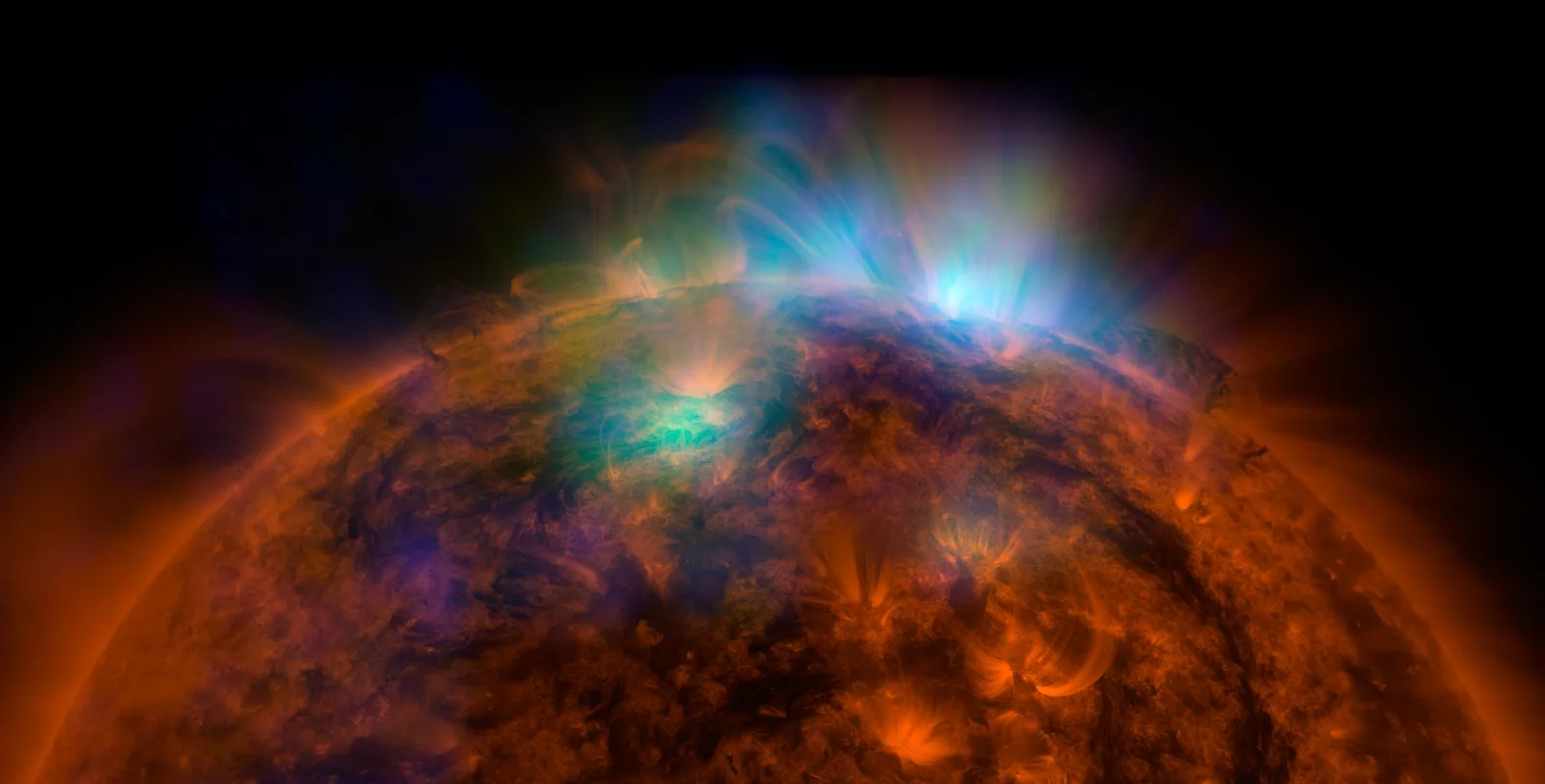
The Sun shines because it fuses hydrogen into helium in its core, and that fusion produces a flood of neutrinos. Light from the core takes many thousands of years to fight its way out to the surface, but neutrinos leave almost instantly, streaming directly to us. Detect them, and you are looking straight into the nuclear furnace at the center of the Sun, in real time.
When physicists first counted solar neutrinos, they found only about a third as many as the Sun should produce. This solar neutrino problem puzzled scientists for decades. The resolution was profound: neutrinos come in three types, or flavors, and they can transform from one into another as they travel, a behavior called oscillation. The detectors had been blind to two of the three flavors. The missing neutrinos had not vanished; they had changed disguise. This discovery, honored with the 2015 Nobel Prize, also revealed that neutrinos have a tiny but nonzero mass, contradicting the original theory and pointing toward physics beyond the standard model.
Messengers from a dying star
Neutrinos also delivered one of the most dramatic observations in the history of astronomy. When a massive star collapses and explodes as a supernova, the vast majority of the energy released, far more than the light, is carried off by an immense burst of neutrinos. Because they escape the collapsing core immediately while the light takes hours to emerge, the neutrinos arrive first.
In 1987, a supernova erupted in a nearby galaxy, and hours before its light reached telescopes, detectors on Earth registered a brief pulse of neutrinos, just a couple dozen particles, from the dying star. It was the first time neutrinos had been detected from beyond the solar system, and it confirmed in a single stroke the basic theory of how massive stars die. A handful of ghost particles had announced the death of a star before its light even arrived.
A window still opening
Today, enormous detectors continue the work, some buried in mines, others frozen into a cubic kilometer of Antarctic ice, watching for the rare flashes that betray a passing neutrino. They have begun to catch high-energy neutrinos from far beyond our galaxy, from the violent surroundings of distant black holes, opening a new way to observe the universe that uses neither light nor gravitational waves but these faint, ghostly particles.
Neutrinos remain at the frontier of physics. Their tiny masses, the way they oscillate, and the question of whether they might explain why the universe is made of matter rather than antimatter are among the most active topics in the field. It is a strange kind of importance for a particle that barely interacts with anything. The ghost that Pauli was almost embarrassed to propose has turned out to be a key to the Sun, to exploding stars, and perhaps to why there is anything here at all.
They pass through us, through the Earth, through stars, almost untouched. And in the rare instant one is caught, it carries word from places no light can escape.
Frequently Asked Questions
What is a neutrino?
A neutrino is a tiny, nearly massless subatomic particle that interacts with matter only through the weak nuclear force, so it almost never touches anything. Neutrinos are among the most abundant particles in the universe, streaming out of the Sun and other sources by the trillions.
Why are neutrinos so hard to detect?
Neutrinos interact only through the weak force, one of nature's feeblest, so they pass through ordinary matter almost without stopping. A typical neutrino could cross a light-year of solid lead unimpeded. Detecting them requires huge detectors and enormous patience to catch the rare interaction.
How do neutrinos let us see inside the Sun?
The Sun's core produces neutrinos through nuclear fusion, and they escape almost instantly, unlike light, which takes thousands of years to leave the core. Detecting solar neutrinos is effectively looking directly into the Sun's nuclear furnace as it burns.
What was the solar neutrino problem?
Early experiments detected only about a third of the solar neutrinos the Sun should produce. The resolution was that neutrinos come in three flavors and can change from one to another as they travel, a process called oscillation. The detectors had been blind to two flavors.
Why do neutrinos matter to astronomy?
Because they escape places light cannot, neutrinos carry information from the cores of stars and explosions. In 1987 they were detected from a supernova hours before its light arrived, and modern detectors now catch high-energy neutrinos from beyond our galaxy, opening a new way to observe the universe.