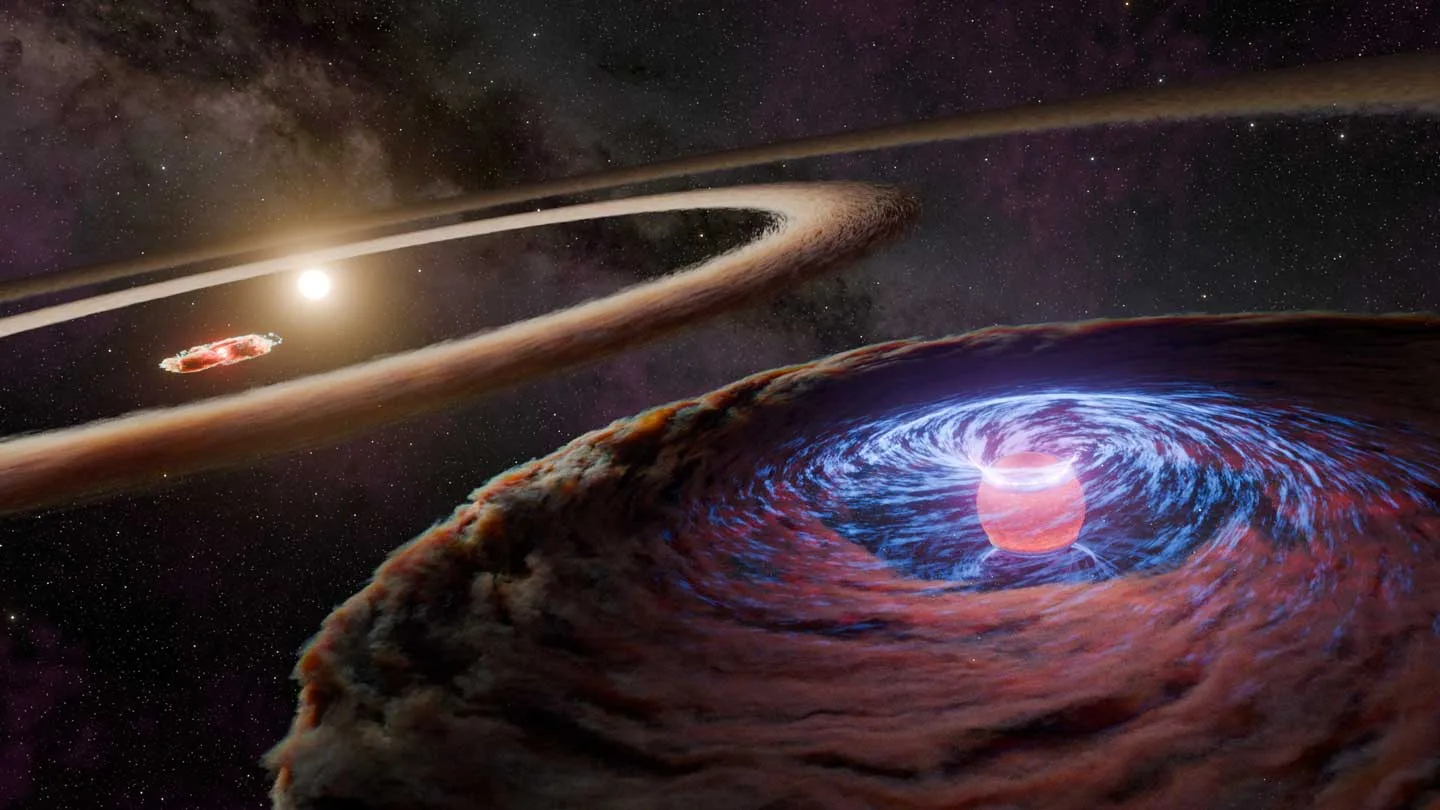
Almost every planet ever found arrived already finished. We catch them as silhouettes crossing a star, or as faint reflected points beside one, long after the violence of their making has cooled. The act of formation itself, the slow gathering of a world out of gas and dust, has stayed almost entirely hidden from us. It happens in a few million years, an eyeblink in cosmic time, and it happens inside thick, dusty disks that swallow the very light we would need to watch. Until recently, the gaps that planets carve in those disks were the only evidence we had, dark rings of emptiness with nothing visible inside them.
Around a young Sun-like star catalogued as WISPIT 2, that has changed. Astronomers have now directly photographed a gas giant glowing inside one of those dark gaps, still feeding on the disk that birthed it, and then confirmed a second forming world orbiting closer in. It is one of the cleanest examples ever recorded of planets being born, and the star at the center of it looks unsettlingly like our own.
A star young enough to still be building
WISPIT 2, also listed in star catalogs as TYC 5709-354-1, sits about 437 light-years from Earth in the southern sky. It is a solar analog: a star of roughly 1.08 solar masses, almost exactly the mass of the Sun. The crucial difference is its age. WISPIT 2 is only about 5.1 million years old. The Sun is roughly 4.6 billion. In human terms, if the Sun were a person in late middle age, WISPIT 2 would be a few hours old.
That youth is the entire reason this system matters. A star of one solar mass takes only a few million years to finish assembling its planets before the leftover disk of gas and dust dissipates and the construction site closes for good. To witness planet formation, astronomers must find a star caught in that narrow window, and such stars are rare. WISPIT 2 is one of them, and it is close enough and bright enough to study in detail.
The system was identified through a survey named Wide Separation Planets In Time, abbreviated WISPIT, which searches young stars for companions on wide orbits. What the survey found around WISPIT 2 was not a single planet but a structure: a sprawling disk of dust and gas, extending to roughly 380 astronomical units from the star, organized into four concentric bright rings separated by dark gaps. One astronomical unit is the Earth-Sun distance, so this disk reaches outward nearly ten times farther than Neptune orbits the Sun.
To see planets in the fleeting time of their youth, astronomers have to find young disk systems, which are rare, because that is the one time that they really are brighter and so detectable.
Those rings are not decoration. In the leading theory of planet formation, a growing planet sweeps its orbit clear of material, opening a dark gap and piling the leftover dust into bright rings on either side. The gravity of the planet acts like a snowplow, shepherding gas and dust into ever sharper bands and scouring the lane it travels through. For decades, astronomers had seen ringed disks like this and inferred that planets must be carving them. What they had almost never managed to do was see the planet itself sitting in the dark.
The Atacama Large Millimeter Array, the great radio observatory in the Chilean desert, had revealed dozens of such ringed disks over the past decade. Each one looked like a target painted in dust, concentric circles split by shadows. Each one seemed to whisper that planets were at work. But a whisper is not proof, and the disks guarded their secrets closely. WISPIT 2 stood out because its rings were unusually broad and well separated, leaving wide dark lanes where a planet, if one existed, would have room to shine without drowning in the surrounding glow of dust.
The planet that jumped out of the gap
The first direct image of a WISPIT 2 planet came from the European Southern Observatory's Very Large Telescope in Chile, using the SPHERE instrument and its IRDIS camera. SPHERE is built for exactly this task: it blocks the overwhelming glare of the central star so that faint objects right beside it can emerge. In those images, reported by Richelle van Capelleveen and colleagues in The Astrophysical Journal Letters in 2025, a point of light appeared inside one of the disk's dark gaps, lodged between the two brightest dust rings.
That object is WISPIT 2b. It orbits at a semimajor axis of about 57 astronomical units, more than fifty times the Earth-Sun distance and well beyond where Neptune sits in our own system. Its estimated mass is about 4.9 times that of Jupiter, making it a substantial gas giant. And it is young, the same 5 million years as its star, which means it is still glowing with the leftover heat of its own formation rather than merely reflecting starlight. That self-luminous glow is what made it detectable at all.
But the most striking confirmation came from a different telescope and a different kind of light.
Catching a planet in the act of feeding
A separate team, led by Laird Close at the University of Arizona, observed WISPIT 2 with an instrument called MagAO-X mounted on the Magellan Clay Telescope. MagAO-X is an extreme adaptive optics system, a technology that bends a deformable mirror thousands of times per second to cancel the blurring of Earth's atmosphere. What it looked for was not infrared heat but a specific color of red light: hydrogen-alpha.
Hydrogen-alpha is emitted when hydrogen gas falls onto a growing object and heats to a glowing plasma. A planet still gathering mass from its disk is doing exactly that, pulling in hydrogen and lighting up at this wavelength as the gas crashes down. Detecting hydrogen-alpha from a point inside a disk gap is therefore close to a smoking gun: it does not just show a planet, it shows a planet in the act of being fed.
On April 13 and April 16, 2025, MagAO-X found that signal. The detection on the second night reached a statistical significance of 12.5 sigma, a level so high that the chance of it being noise is effectively zero. The source sat at a separation of about 309 milliarcseconds, roughly 54 astronomical units when corrected for the disk's tilt, squarely in the dark gap between the two brightest rings. The team even measured how fast the planet is gathering material, estimating an accretion rate of around two trillionths of a solar mass per year, a slow but steady infall of gas.
Dozens of theory papers have been written about these observed disk gaps being caused by protoplanets, but no one had ever found a definitive one until now.
The reaction in the observing room was immediate. Close described how, once the adaptive optics locked on, the planet appeared without ambiguity. After combining a couple of hours of images, he said, it simply popped out of the gap that theory had long predicted should hold a planet but had never been shown to.
Then there were two
A single forming planet would already have been a landmark. What turned WISPIT 2 into something more was the confirmation of a second one.
Follow-up work led by Chloe Lawlor at the University of Galway, with van Capelleveen again among the contributors, combined direct imaging from the VLT's SPHERE with spectroscopic data from the GRAVITY+ instrument on the Very Large Telescope Interferometer. Reported in The Astronomical Journal in March 2026, this study confirmed a second forming gas giant, WISPIT 2c, orbiting roughly four times closer to the star than WISPIT 2b and estimated to be about twice as massive. Both are gas giants, broadly Jupiter-like in nature, caught at the same early moment.
Two confirmed planets forming in the same disk is a distinction almost nothing else in the sky can claim. Before WISPIT 2, exactly one system was known to host two directly observed planets still in formation: PDS 70, imaged in 2018 and 2019, which remains the textbook case. WISPIT 2 is the second, and its disk is larger and more sharply ringed, with cleaner gaps that make the planet-carving process easier to read. As one of the researchers put it, the system amounts to a laboratory in which the assembly of an entire planetary system can be watched as it unfolds.
Why a Sun-like star changes the stakes
Both PDS 70 and WISPIT 2 give us forming planets to study, but they are not equally relevant to our own origins. What makes WISPIT 2 particularly compelling is the star itself. At 1.08 solar masses it is a genuine analog of the Sun, which means the disk swirling around it is a reasonable stand-in for the disk that once surrounded our own star four and a half billion years ago.
Our solar system began the same way: a flattened disk of gas and dust around a young Sun, out of which Jupiter, Saturn, and the rest condensed. Jupiter and Saturn very likely cleared their own ring-shaped gaps in that primordial disk, gaps no human ever saw because they closed billions of years before anyone existed to look. WISPIT 2 lets astronomers watch a comparable process around a comparable star, in real time. One researcher offered a vivid comparison: this is roughly what our own Jupiter and Saturn would have looked like when they were thousands of times younger than they are today.
There are limits to the analogy. WISPIT 2b orbits far beyond where Jupiter sits, and a planet of nearly five Jupiter masses on a 57-unit orbit is not a precise copy of anything in our system. But the broad physics, a Sun-mass star, a dusty disk, gas giants opening gaps and feeding on their surroundings, is the same physics that built the worlds we live among. The value is not that WISPIT 2 mirrors us exactly. It is that it lets us check, against direct observation, the theory we have used to explain our own beginnings.
What the dark gaps were hiding
For years, the dark gaps in protoplanetary disks were a source of quiet tension in astronomy. The rings were everywhere once instruments like ALMA began mapping young disks in detail, and the most natural explanation was always planets. Yet the planets themselves stayed invisible, too faint to pull out of the glare and the dust. Some researchers wondered whether other processes, pressure bumps, ice lines, instabilities in the gas, might be carving the gaps instead, with no planet required at all.
WISPIT 2 does not settle every case, but it settles this one decisively. A planet sits in the gap. It glows in hydrogen-alpha because it is actively feeding. A second planet does the same closer in. The gaps in this disk are carved by planets, exactly as the theory said, and now there is an image to prove it. The decades of inference have, at least here, become direct sight.
The system will be studied for years. Continued monitoring can trace the planets along their orbits, refine their masses, and watch how their accretion changes over time. ALMA observations are already resolving the disk's structure down to a couple of astronomical units, fine enough to see how the rings and gaps respond to the worlds embedded in them. Each measurement tightens the link between the planets we can now see and the disk architecture they are shaping.
There is also the question of what else might be hiding. A four-ringed disk could be sculpted by more than two planets, and the cleanest way to test that is to keep looking for additional points of light in the remaining gaps, or for the telltale hydrogen-alpha glow of another world still feeding. Each forming planet that turns up adds a data point to a question astronomers have asked since they first understood where worlds come from: how orderly, or how chaotic, is the process that builds a planetary system? WISPIT 2, with its tidy rings and its two confirmed giants, leans toward order. Whether that holds as the picture sharpens is exactly the kind of thing this system was made to reveal.
For decades the dark gaps in young disks were a question we could only answer by inference. Around WISPIT 2, the answer finally glows back at us: a planet in the gap, feeding on the disk that made it, and a second one taking shape nearby. The act of creation, hidden through all of human history, has been photographed at last.
Frequently Asked Questions
What is WISPIT 2?
WISPIT 2, also catalogued as TYC 5709-354-1, is a young Sun-like star about 437 light-years from Earth. It has roughly 1.08 times the Sun's mass and is only about 5.1 million years old. It is surrounded by a large, multi-ringed disk of gas and dust in which at least two planets are forming.
How many planets have been found forming around WISPIT 2?
Two. WISPIT 2b was directly imaged in a dark gap of the disk and detected in hydrogen-alpha light, confirming it is actively gathering gas. A second planet, WISPIT 2c, was later confirmed orbiting about four times closer to the star and is estimated to be roughly twice as massive. Both are gas giants.
How were the planets actually detected?
WISPIT 2b was imaged with the VLT's SPHERE instrument in the infrared and, separately, detected in hydrogen-alpha light by the MagAO-X system on the Magellan Telescope at a significance of 12.5 sigma. The hydrogen-alpha signal comes from gas falling onto the planet, evidence it is still feeding. WISPIT 2c was confirmed using SPHERE together with the GRAVITY+ instrument on the VLT Interferometer.
Why is catching planet formation so rare?
Planet formation around a Sun-like star is finished within a few million years, a brief window compared with a star's billions-of-years lifetime. It also happens inside thick, dusty disks that hide the forming planets. A star has to be young enough to still be building and close enough to study, a combination that is uncommon. WISPIT 2 meets both conditions.
How does WISPIT 2 compare to PDS 70?
PDS 70, imaged in 2018 and 2019, was the first system with two directly observed forming planets. WISPIT 2 is the second. Its disk is larger and more clearly structured into bright rings and dark gaps, and its host star is a closer analog of the Sun, which makes it especially useful for understanding how a system like our own may have formed.
Does WISPIT 2 tell us anything about our own solar system?
Indirectly, yes. Because WISPIT 2 is nearly the same mass as the Sun, its disk resembles the one that once surrounded our young Sun. Jupiter and Saturn likely carved gaps in that early disk much as WISPIT 2b and 2c are doing now. Watching this system lets astronomers test, against direct images, the theory used to explain how our own planets formed.
Continue Exploring
- The Planet That Almost Had a Sign of LifeIn 2025, a team announced a gas in a distant world's air that, on Earth, is made almost only by living things. Then the...
- The Planet That Webb Actually PhotographedAround a bright star in Cygnus, the James Webb Space Telescope blocked the glare of the star itself and captured the...
Sources
- van Capelleveen et al. (2025). "WISPIT: A Gap-clearing Planet in a Multi-ringed Disk around the Young Solar-type Star WISPIT 2." link.
- Close et al. (2025). "WISPIT: Discovery of a Gap Halpha Protoplanet WISPIT 2b with MagAO-X." link.
- Lawlor et al. (2026). "Direct Spectroscopic Confirmation of the Young Embedded Protoplanet WISPIT 2c." link.
- University of Arizona News (2025). "A growing baby planet photographed for the first time in a ring of darkness." link.
- Leiden University (2026). "Two planets-in-formation discovered around young star WISPIT 2." link.
- NASA Science (2025). "Discovery Alert: Baby Planet Photographed in a Ring around a Star for the First Time." link.