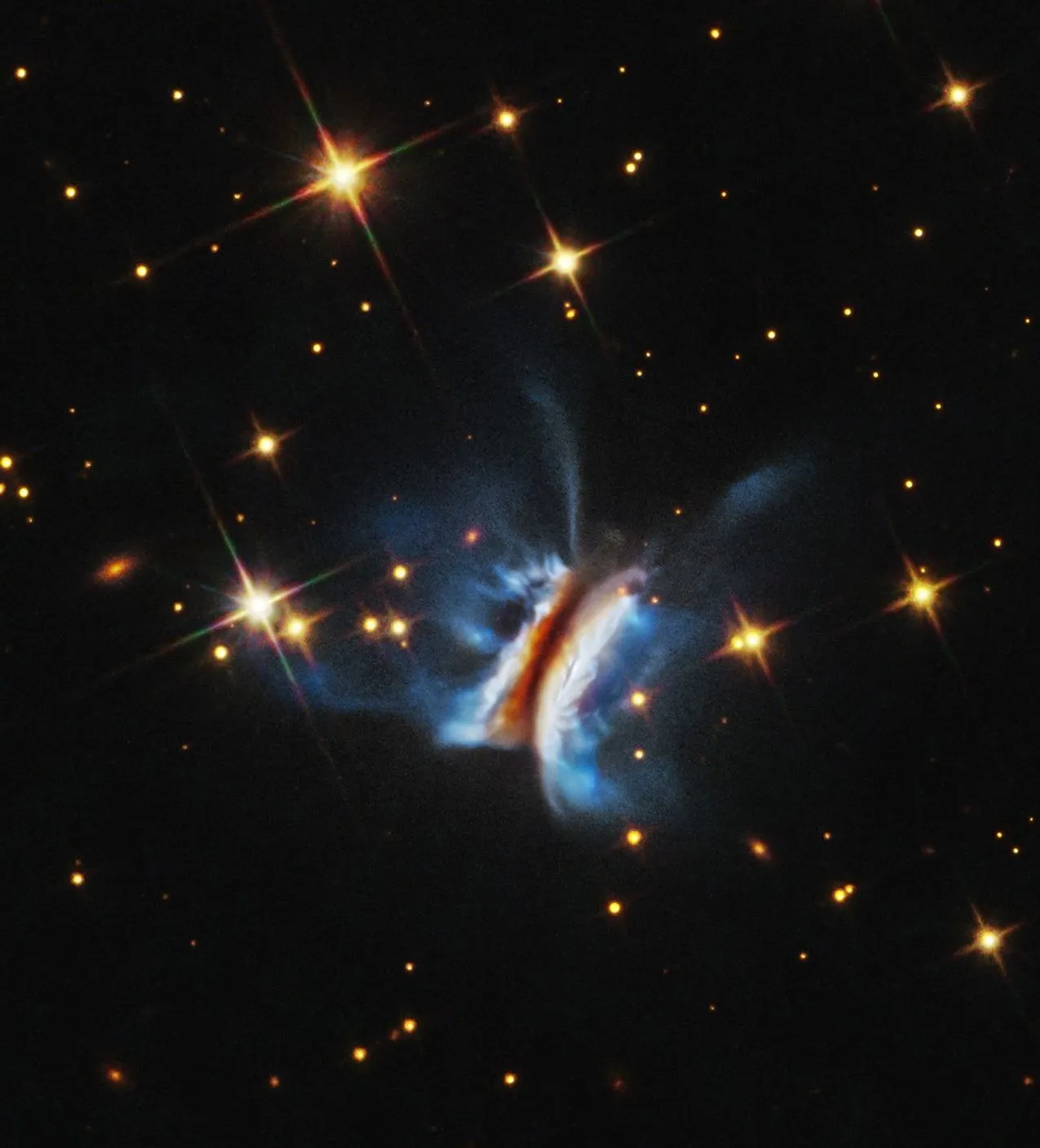
In the constellation Cepheus, about 1,000 light-years from Earth, a star is being born inside a structure so large that our entire planetary system would fit inside it forty times over. We cannot see the star itself. It is buried behind a wall of dust turned edge-on to our line of sight, a dark lane splitting two glowing slabs of light. Astronomers nicknamed the object Dracula's Chivito, partly for the fang-like filaments protruding from its edges, partly for a Transylvanian joke that got out of hand. For two years it was simply the largest planet-forming disk anyone had ever found. Then the Hubble Space Telescope looked closely, and the disk stopped behaving the way planet nurseries are supposed to behave.
A sandwich the size of a solar system
The formal name is IRAS 23077+6707, a catalog entry from an infrared survey flown in the 1980s. It went largely ignored until 2016, when the Pan-STARRS telescope in Hawaii caught it during a search for distant active galaxies. What looked at first like a faint smudge resolved into something unmistakable: a bright object cleaved in two by a black band, with two thin filaments curling off the top edges like wings, or fangs.
The shape is a giveaway. When a young star is wrapped in a flattened disk of gas and dust, and that disk happens to lie edge-on from our vantage point, the dense midplane blocks the starlight directly behind it. What reaches us instead is light scattered off the disk's upper and lower surfaces, two luminous lobes separated by a dark central lane. Astronomers have a name for this silhouette. They call it the hamburger geometry, after a famous example known as Gomez's Hamburger. The Cepheus object earned a regional variation: the chivito, a towering sandwich that is Uruguay's national dish, suggested by co-author Ana Mosquera, while lead author Ciprian Berghea supplied the Dracula half in honor of the Romanian region where he grew up.
The naming was whimsical. The measurements were not. In the 2024 discovery paper, published in The Astrophysical Journal Letters, Berghea and colleagues reported that the scattered-light structure spans roughly 11 to 14 arcseconds on the sky. That is enormous for a protoplanetary disk. Follow-up observations with the Submillimeter Array in Hawaii confirmed the object was no optical illusion: the array detected thermal emission from cold dust at millimeter wavelengths and mapped carbon monoxide gas swirling in the orderly, organized pattern of Keplerian rotation, the same gravitational waltz that governs the planets around our own Sun.
For two years it was simply the largest planet-forming disk anyone had ever found. Then Hubble looked closely.
How big is the largest disk we know
Translating an angular size into a physical one requires knowing the distance, and here the system guards its secret. IRAS 23077+6707 has no firmly measured distance. If it belongs to the Cepheus star-forming region, as its position on the sky suggests, it sits somewhere between roughly 180 and 800 parsecs away, between about 590 and 2,600 light-years. The Hubble team adopted a working value near 300 parsecs, just under 1,000 light-years, for its calculations.
At that distance, the numbers become staggering. The disk's scattered light extends to a radius of about 4,200 astronomical units, where one astronomical unit is the Earth-Sun distance. Radiative-transfer modeling in the discovery paper, which simulates how light bounces through dust, settled on a disk radius near 1,650 astronomical units for the densest part of the structure. Either way, the object dwarfs the typical protoplanetary disk, which usually spans a few hundred astronomical units at most. NASA's summary put it in plainer terms: the disk reaches nearly 400 billion miles across, roughly forty times the diameter of our solar system out to the icy edge of the Kuiper Belt.
The discovery modeling pointed to a central star with an effective temperature around 8,000 kelvin, hotter and more massive than the Sun, surrounded by a disk holding about 0.2 solar masses of material at an inclination of 82 degrees, just shy of perfectly edge-on. The Hubble analysis later estimated the disk's mass at somewhere between 10 and 30 times the mass of Jupiter, more than enough raw material to build a sprawling planetary system. That is the headline that traveled: the largest planet nursery yet found, with the ingredients for worlds we cannot yet see.
What a protoplanetary disk actually is
To understand why the new images matter, it helps to know what a disk like this represents. Stars form inside cold, dense clouds of molecular gas. When a clump within such a cloud grows heavy enough, it collapses under its own gravity. Because the original cloud was rotating, however slightly, the infalling material cannot fall straight to the center. Conservation of angular momentum spins it up, the way a figure skater accelerates by pulling in her arms. The collapsing cloud flattens into a rotating disk, with a growing protostar at the hub and a broad platter of leftover gas and dust circling it.
That platter is the protoplanetary disk, and it is where planets are made. Over millions of years, microscopic dust grains in the disk collide and stick, building pebbles, then boulders, then planetesimals, then, in the most successful cases, planets. Our own solar system condensed out of such a disk about 4.6 billion years ago. Every world you have ever heard of, every moon, every comet, was assembled from the same kind of swirling debris. Studying a disk like IRAS 23077+6707 is, in a real sense, watching our own origin story play out around a different star.
The standard picture of this process is reassuringly calm. In the textbook version, a mature disk is smooth and settled. Dust grains, heavier than gas, gradually sink toward the midplane, concentrating into a thin sheet where planet formation proceeds. The disk's surface should taper gently. Models built on this assumption have guided decades of work. They are why the new Hubble images came as a shock.
The standard picture of planet formation is reassuringly calm. The new images are not.
The view that broke the calm
In February 2025, Hubble trained its Wide Field Camera 3 on IRAS 23077+6707 and imaged it across six broadband filters spanning wavelengths from 0.4 to 1.6 micrometers, from visible blue light through the near-infrared. The resolution reached better than a tenth of an arcsecond, the sharpest visible-light look anyone had taken of this system. The results were published in The Astrophysical Journal by Kristina Monsch, Joshua Bennett Lovell, Karl Stapelfeldt, Sean Andrews, and their collaborators, and announced by NASA and the Space Telescope Science Institute in December 2025.
Where earlier images showed a clean sandwich, Hubble revealed a tangle. Wispy filaments of material rise well above the disk's flat midplane, visible in every filter, far higher than astronomers expected to see in a system of this kind. The disk's outer atmosphere, the thin upper layers of gas and dust, appears stirred up and structured rather than smooth and settled.
"The level of detail we're seeing is rare in protoplanetary disk imaging," Monsch said in the NASA announcement, "and these new Hubble images show that planet nurseries can be much more active and chaotic than we expected." The word chaotic is not hyperbole here. It describes a genuine tension between what the disk looks like and what models of a quiet, settled disk predict.
The lopsided disk
The strangest feature is the asymmetry. The discovery images had already hinted at it, but Hubble made it unmistakable. Extended filaments reach roughly 10 arcseconds outward from the northern edges of both glowing lobes. On the southern side, there is nothing comparable. One half of the disk trails long streamers into space; the other half ends in a sharp, clean edge.
This is odd. Gravity is symmetric, and a disk in steady Keplerian rotation should look broadly the same on both sides. A lopsided disk implies that something is acting on it from outside the simple star-plus-disk system, or that the disk is caught in a moment of genuine imbalance. "We were stunned to see how asymmetric this disk is," said Lovell, a co-investigator at the Center for Astrophysics. "Hubble has given us a front row seat to the chaotic processes that are shaping disks."
The research paper offers three candidate explanations for the wispy, lopsided structure, and they are not mutually exclusive. The first is infall: the star may still be drawing in fresh gas and dust from its birth cloud, and a stream of new material striking the disk from one direction could pile up filaments on one side. The second is dynamical stirring, the gravitational churn of bodies already embedded in the disk, perhaps young planets, perhaps a hidden companion star, kicking material out of the plane. The third, and most dramatic, is gravitational instability: a disk this massive may be heavy enough that its own gravity makes it clump and fragment, generating spiral arms and turbulence rather than settling into smooth rings.
One half of the disk trails long streamers into space. The other half ends in a sharp, clean edge.
Why the chaos matters
For planet formation, the difference between a calm disk and a turbulent one is not cosmetic. The textbook scenario, in which dust quietly settles to the midplane and assembles into planets, depends on stillness. Turbulence works against it, lofting grains back up and keeping them from concentrating. Yet turbulence can also help, by stirring material into dense clumps that collapse directly into planetesimals, skipping the slow pebble-by-pebble grind. Which effect wins shapes what kind of planetary system, if any, a disk produces.
IRAS 23077+6707 is an unusually clean laboratory for these questions precisely because it is so large and so close to edge-on. Most disks are too small or too tilted to reveal their vertical structure. This one, seen nearly side-on at high resolution, lets astronomers measure how far material rises above the midplane and how the dust is distributed from top to bottom. The Hubble team's radiative-transfer simulations could not yet decide whether the disk's dust has settled into a thin layer or remains lofted throughout, a question that bears directly on how ready the disk is to make planets. Resolving it will require the mid-infrared eyes of the James Webb Space Telescope, which can probe deeper into the dusty interior than Hubble's visible light can reach.
There is also a humbling lesson in the central star's invisibility. The very geometry that makes this disk so informative, its edge-on orientation, also hides the engine at its heart. Astronomers cannot yet say with certainty whether a single hot, massive star or a tight pair of stars sits behind that dark lane. The disk reveals everything except the thing at its center, a reminder that even our best telescopes work by inference as much as by direct sight.
We cannot see the star at the heart of Dracula's Chivito. But in the chaos swirling around it, lopsided, restless, far larger than anything we predicted, we are watching the raw machinery of world-building, caught in an act it has performed countless times across the galaxy, and once, long ago, around our own Sun.
Frequently Asked Questions
What is Dracula's Chivito?
Dracula's Chivito is the nickname for IRAS 23077+6707, a young star in the constellation Cepheus surrounded by the largest protoplanetary disk yet discovered. Seen edge-on, the disk resembles a sandwich, the chivito, with two filaments protruding like fangs, the Dracula.
How big is the disk?
Its scattered light spans about 14 arcseconds on the sky, which translates to a radius of roughly 4,200 astronomical units if the system lies about 1,000 light-years away. NASA describes it as nearly 400 billion miles across, about forty times the size of our solar system out to the Kuiper Belt.
Why is the disk considered chaotic?
Hubble's detailed images show wispy filaments rising far above the disk's flat midplane and long streamers extending from only the northern side. A settled, mature disk should look smooth and symmetric, so this turbulence and lopsidedness surprised astronomers and suggests active, dynamic processes are at work.
What could cause the disk's asymmetry?
The research paper lists three possibilities: fresh gas and dust still falling onto one side of the disk, gravitational stirring by embedded bodies or a companion star, and gravitational instability in a disk massive enough to clump under its own weight. These explanations may all play a role.
Can we see the star at the center?
No. The disk is turned nearly edge-on, so its dense central lane blocks the star directly behind it. Astronomers see only light scattered off the disk's surfaces. They cannot yet confirm whether the hidden source is a single hot star or a pair of stars.
What telescope took the images?
The most detailed visible-light images came from the Hubble Space Telescope's Wide Field Camera 3, using six filters from 0.4 to 1.6 micrometers. Earlier observations used the Pan-STARRS survey telescope and the Submillimeter Array, both in Hawaii.
Continue Exploring
- The Star That Flickers Like Nothing Else in the SkyFor four years, a telescope watched one ordinary-looking star lose up to a fifth of its light in jagged, unpredictable...
- The Stars That Almost WereBrown dwarfs are too heavy to be planets and too light to ignite as stars. They are the objects the galaxy started...
Sources
- Monsch et al. (2025). "Hubble Reveals Complex Multi-scale Structure in the Edge-on Protoplanetary Disk IRAS 23077+6707, The Astrophysical Journal." link.
- Berghea et al. (2024). "Dracula's Chivito: Discovery of a Large Edge-on Protoplanetary Disk with Pan-STARRS, The Astrophysical Journal Letters 967, L3." link.
- Monsch et al. (2024). "High-resolution Pan-STARRS and SMA observations of IRAS 23077+6707: A giant edge-on protoplanetary disk." link.
- NASA / STScI (2025). "NASA's Hubble Reveals Largest Found Chaotic Birthplace of Planets." link.
- Center for Astrophysics (2025). "NASA's Hubble Reveals Largest Found Chaotic Birthplace of Planets." link.
- AAS Nova (2024). "A Vampire's Sandwich Filled with Gas and Dust." link.