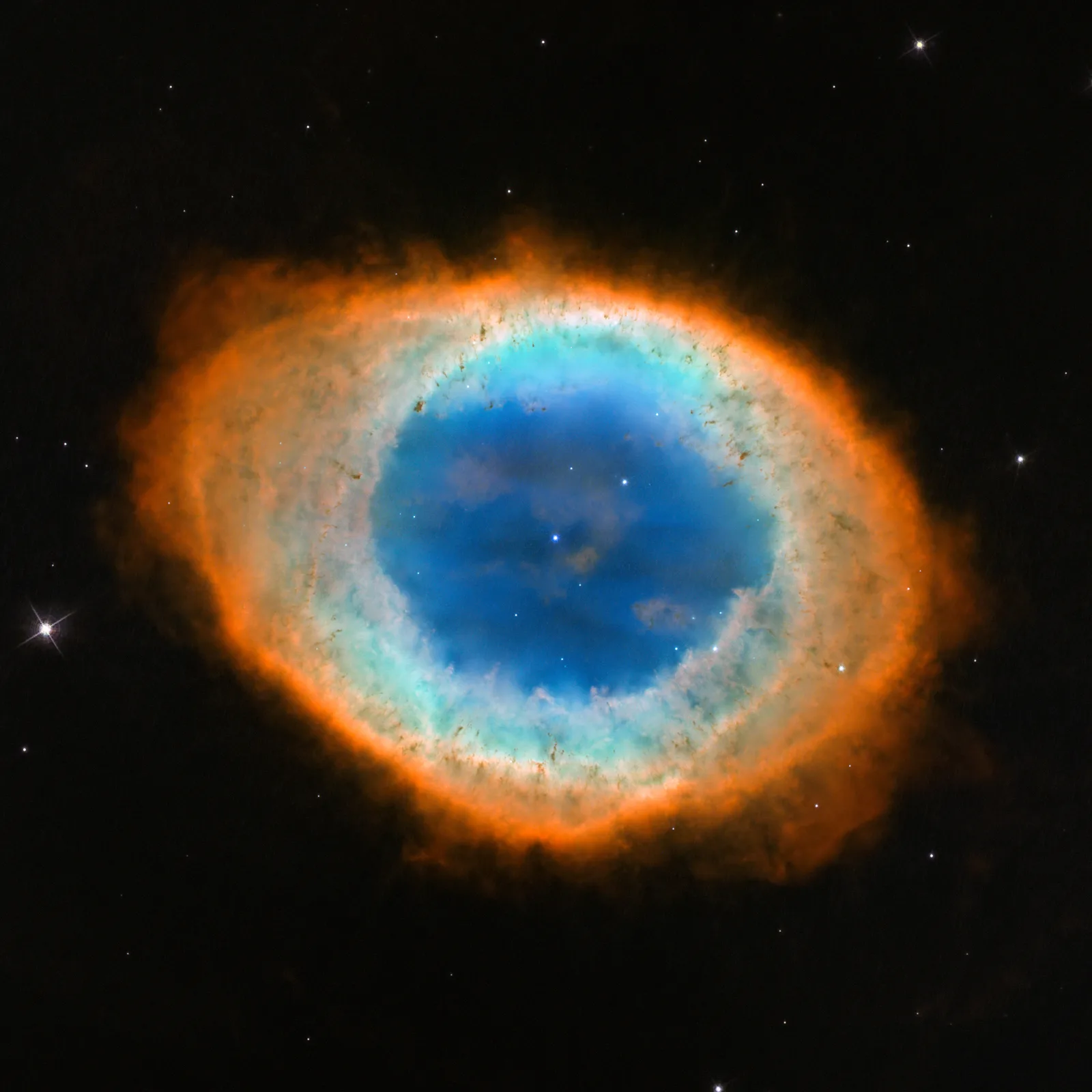
Roughly five billion years from now, the Sun will run out of the hydrogen at its core that has kept it burning for ten billion years. What follows is not an explosion. It is a long, luminous undoing. The Sun will swell into a red giant large enough to swallow Mercury and Venus, possibly Earth. Then it will exhale its outer layers into space as a glowing shell, and what remains at the center will be something strange and dense and quietly eternal: a sphere of carbon and oxygen no larger than Earth, holding nearly half the mass the Sun has now.
That object is a white dwarf. It is the most common ending for a star, the fate awaiting more than ninety percent of the stars in the galaxy, the Sun included. And thanks to a flood of precise measurements from the European Space Agency's Gaia mission, astronomers now know something about these embers that earlier generations could only predict: as they cool over billions of years, they crystallize from the inside out, turning into the largest diamonds in the universe.
The last days of an ordinary star
The Sun is a main-sequence star, which means it spends its life fusing hydrogen into helium in a core squeezed to fifteen million degrees. That fusion is a balancing act. The outward pressure of radiation pushes against the inward crush of gravity, and as long as the fuel lasts, the two stay in equilibrium. The Sun has held this balance for about 4.6 billion years and has roughly five billion left.
When the central hydrogen runs out, the balance breaks. The core, now mostly inert helium, contracts and heats. Hydrogen fusion migrates outward into a shell surrounding the core, and the extra energy inflates the star's outer envelope to enormous size. The Sun becomes a red giant, ballooning to perhaps a hundred times its current radius. Mercury and Venus will almost certainly be engulfed. Earth's fate is less certain, balanced between being swallowed and being scorched bare, but either way the planet's surface will not survive.
Inside the swollen giant, the helium core eventually grows hot and dense enough to ignite in a sudden event called the helium flash, fusing helium into carbon and oxygen. This phase is brief by stellar standards, a few hundred million years of increasingly unstable burning, punctuated by thermal pulses that send shudders through the star. The Sun is not massive enough to push fusion any further. To ignite carbon, a stellar core needs to reach temperatures and pressures the Sun will never achieve. Carbon and oxygen are, for a star this size, the end of the line. They accumulate inertly in the center while the burning shells above them slowly consume what is left.
This is the fork in the road that decides every star's fate, and it is set almost entirely by mass. Stars more than about eight times heavier than the Sun keep fusing past carbon, building heavier elements in shells like the layers of an onion until they reach iron, at which point fusion stops paying its energy bill and the core collapses catastrophically into a neutron star or black hole. The Sun is far below that threshold. Its ending is gentler, slower, and far more common across the galaxy.
The Sun will not die in fire. It will die by exhaling, shedding the loose outer ninety percent of itself into the dark and leaving only its compressed heart behind.
A breath becomes a nebula
What happens next is one of the most beautiful events in the life of a star, and one of the most misleadingly named. As the dying Sun's fusion sputters, pulses of energy and stellar winds push its bloated outer layers off entirely. Over tens of thousands of years the star loses something like forty percent of its mass, casting the gas outward in expanding shells. Ultraviolet light from the exposed hot core sets that gas glowing in greens and reds and blues.
This luminous shell is a planetary nebula. The name is a historical accident: eighteenth-century observers peering through small telescopes thought the round, fuzzy glows resembled the disks of planets like Uranus. There are no planets involved. A planetary nebula is the visible ghost of a Sun-like star in the act of dying, and it lasts only briefly, ten or twenty thousand years, before the gas disperses into the interstellar medium where it may someday seed new stars and new worlds.
At the center, fully revealed once the shroud blows away, sits the leftover core. It no longer fuses anything. It produces no new heat. It is a white dwarf, and from this moment on its entire future is a slow surrender of the warmth it was born with. The gas it ejected, enriched with carbon and oxygen forged in its final fusion, drifts outward to mingle with the interstellar medium. Some of it may one day collapse into new stars and planets. The atoms in your body that are heavier than helium were minted this way, in stars that lived and died before the Sun was born. The Sun, in turn, will pay the same gift forward when its time comes.
The pressure that holds up a dead star
A white dwarf should not be able to exist. With no fusion to push back against gravity, an object that dense ought to keep collapsing. The Sun's leftover core, around half a solar mass, will be packed into a sphere the size of Earth, at densities approaching a million times that of water. A teaspoon of white dwarf material would weigh several tons. What stops the collapse is not heat or radiation. It is a rule of quantum mechanics.
Electrons obey the Pauli exclusion principle, which forbids any two of them from occupying the same quantum state. As gravity tries to compress the core, it forces electrons closer and closer together, but they cannot all crowd into the lowest energy states. They are pushed into higher and higher momenta, and the resulting outward push is called electron degeneracy pressure. It does not depend on temperature. Even as the star cools toward absolute zero over the eons, this pressure remains, propping up the dead star indefinitely.
Degeneracy pressure produces one of the strangest properties in astrophysics. For a white dwarf, more mass means a smaller size. Pile on more matter and gravity wins more ground, squeezing the star down rather than puffing it up. This inverse relationship between mass and radius is the signature of a degenerate object, and it leads directly to a hard ceiling.
For a white dwarf, gaining weight means shrinking. Push past a certain mass and there is no size small enough to survive, and the star collapses.
The limit a teenager calculated at sea
In 1930, a nineteen-year-old named Subrahmanyan Chandrasekhar boarded a ship from India to England to begin graduate study. On the voyage he worked out what happens when you combine electron degeneracy with Einstein's special relativity. The answer, which he published in 1931 in a two-page paper in the Astrophysical Journal titled "The Maximum Mass of Ideal White Dwarfs," was that degeneracy pressure has a breaking point.
As a white dwarf grows more massive and more compressed, its electrons are forced to move faster, approaching the speed of light. Relativity caps how much pressure those electrons can supply. Above a certain mass, gravity overwhelms degeneracy pressure entirely and nothing can stop the collapse. That threshold is the Chandrasekhar limit, equal to about 1.4 times the mass of the Sun. A white dwarf cannot exist above it. Cross the line, and the core collapses into a neutron star or detonates as a supernova.
Chandrasekhar's result was so unsettling that the eminent astronomer Arthur Eddington publicly ridiculed it for years, insisting that nature must have some way to avoid such an absurd outcome. The young theorist was right, and Eddington was wrong. The work eventually earned Chandrasekhar a share of the 1983 Nobel Prize in Physics, more than half a century after he scribbled it out on a ship. The Sun, at roughly half a solar mass once it sheds its envelope, sits comfortably below the limit. It will become a white dwarf and stay one, with mass to spare.
The limit matters for more than bookkeeping. White dwarfs that do reach it, usually by stealing matter from a companion star, can detonate as type Ia supernovae, the standardized explosions that astronomers use as cosmic mile markers to measure the expansion of the universe. The same quantum threshold that guarantees the Sun a quiet ending also, in other systems, produces some of the brightest explosions in the cosmos.
The nearest example, hiding in plain sight
We do not have to wait five billion years to study a white dwarf. The closest one is bound to the brightest star in the night sky. Sirius, the dog star, is actually two stars: a brilliant main-sequence star, Sirius A, and a faint, dense companion called Sirius B, eight and a half light-years away.
Sirius B announced itself before anyone saw it. In 1844 the astronomer Friedrich Bessel noticed that Sirius A wobbled across the sky as though tugged by an invisible mass. In 1862 the telescope maker Alvan Graham Clark, testing a new eighteen-inch refractor, finally spotted the faint companion. It turned out to be a furnace of a star compressed into almost nothing. Sirius B holds about 1.02 times the mass of the Sun inside a radius of roughly 5,600 kilometers, smaller than Earth, at a surface temperature near 25,000 kelvin. It is, in effect, a preview of our own Sun's distant future, and like the Sun's future remnant it is made of a carbon and oxygen interior wrapped in a thin shell of lighter elements.
Sirius B is more massive than the average white dwarf, which tends to weigh around half to six tenths of a solar mass, the value the Sun's own remnant should land near. But it makes the abstract concrete. The future of the Sun is not a theory. It is shining, dimly, just past the brightest point in our sky.
The slow turn to crystal
For decades, theorists predicted that white dwarfs do not simply fade smoothly into the dark. As the carbon-oxygen interior cools, it should undergo a phase transition, the ions arranging themselves into an ordered lattice, the same kind of change that turns liquid water into ice. The star would crystallize from the center outward. The carbon and oxygen nuclei, locking into a body-centered cubic structure, would form what amounts to a colossal crystal. Given the chemistry, more than one writer has called it a cosmic diamond.
Crystallization should leave a detectable fingerprint. Freezing releases latent heat, the same energy that water gives up as it turns to ice. In a white dwarf, that released heat slows the cooling, causing the star to linger at certain temperatures longer than it otherwise would. Many stars should pile up at the temperatures where crystallization is underway.
In 2019, a team led by Pier-Emmanuel Tremblay published the observational proof in Nature. Using precise brightness and distance measurements from ESA's Gaia satellite for white dwarfs within 100 parsecs, about 326 light-years, of the Sun, they found exactly the predicted pile-up: an excess of stars stalled at the temperatures where the core releases its latent heat. The crystallization delays the cooling by around a billion years. The theory was no longer just a model. The diamonds were real, and the galaxy is full of them.
An earlier hint had come from a single star. In 2004, asteroseismologists led by Antonio Kanaan used the rhythmic pulsations of a massive white dwarf called BPM 37093, nicknamed Lucy after the Beatles song, to estimate that a large fraction of its mass had already crystallized. Gaia turned that single case study into a population-wide confirmation.
The long dark afterward
A white dwarf has no fuel and no engine. From the moment its envelope blows away, it does only one thing: cool. The carbon-oxygen sphere radiates its stored heat into space, dimming and reddening across billions of years, crystallizing as it goes. The cooling slows as the star fades, stretching the process across timescales that dwarf the present age of the universe.
Eventually, in theory, a white dwarf cools so far that it no longer emits visible light at all. It becomes a black dwarf, a cold, dark, crystalline relic. But the universe is not old enough for any black dwarf to exist yet. The cooling takes far longer than the 13.8 billion years that have passed since the Big Bang. Every white dwarf ever formed is still warm, still glowing, still on its way down.
That is the future written into the Sun. Not a violent end but a fading one, a slow brightening, a final exhalation of glowing gas, and then an Earth-sized crystal of carbon and oxygen drifting through an empty solar system, cooling for longer than the cosmos has so far existed.
The Sun will not vanish. It will become a crystal of carbon and oxygen the size of Earth, cooling in the dark for longer than the universe has yet existed, a diamond at the center of a solar system it long ago abandoned.
Frequently Asked Questions
Will the Sun become a white dwarf?
Yes. In about five billion years the Sun will exhaust its core hydrogen, swell into a red giant, shed its outer layers as a planetary nebula, and leave behind an Earth-sized white dwarf made of carbon and oxygen, holding roughly half its current mass. The Sun is not massive enough to become a neutron star or black hole.
What is a white dwarf made of?
For a Sun-like star, the white dwarf is the leftover core of carbon and oxygen, the ash of helium fusion. It is wrapped in a thin atmosphere of lighter elements, usually almost pure hydrogen or helium. It is held up not by heat but by electron degeneracy pressure, a quantum effect.
What is the Chandrasekhar limit?
It is the maximum mass a white dwarf can have, about 1.4 times the mass of the Sun. Above it, the electrons that hold the star up move at nearly light speed and can no longer resist gravity, so the core collapses into a neutron star or detonates as a supernova. Subrahmanyan Chandrasekhar derived it in 1931.
Are white dwarfs really made of diamond?
In a sense, yes. As a white dwarf cools, its carbon and oxygen interior crystallizes into an ordered lattice, often described as a cosmic diamond. In 2019, Gaia data confirmed this by detecting a pile-up of stars stalled at the temperatures where crystallization releases latent heat, delaying their cooling by about a billion years.
How big is a white dwarf?
About the size of Earth, despite holding up to 1.4 times the mass of the Sun. Sirius B, the nearest example, packs about 1.02 solar masses into a radius of roughly 5,600 kilometers, smaller than Earth. White dwarfs are unusual in that the more massive they are, the smaller they become.
What happens to a white dwarf in the far future?
It cools forever, slowly fading and crystallizing. In theory it would eventually become a cold, dark black dwarf, but the universe is not old enough for any to exist yet. The cooling takes far longer than the current age of the cosmos, so every white dwarf ever formed is still glowing.
Continue Exploring
- The Stars That Almost WereBrown dwarfs are too heavy to be planets and too light to ignite as stars. They are the objects the galaxy started...
- The Explosion That May Have Detonated TwiceIn August 2025, a faint gravitational tremor and a fading point of light arrived together from 1.3 billion light-years...
Sources
- Chandrasekhar, S. (1931). "The Maximum Mass of Ideal White Dwarfs, Astrophysical Journal, 74, 81." link.
- Tremblay, P.-E. et al. (2019). "Core crystallization and pile-up in the cooling sequence of evolving white dwarfs, Nature, 565, 202." link.
- Tremblay, P.-E. et al. (2019). "Preprint: Core crystallization and pile-up in the cooling sequence of evolving white dwarfs (arXiv)." link.
- ESA / Gaia (2019). "Gaia reveals crystallisation in white dwarf cooling sequence." link.
- Metcalfe, Montgomery & Kanaan (2004). "Testing White Dwarf Crystallization Theory with Asteroseismology of the Massive Pulsating DA Star BPM 37093, ApJ Letters." link.
- NASA Science. "Stars: Types and the life cycle of Sun-like stars." link.