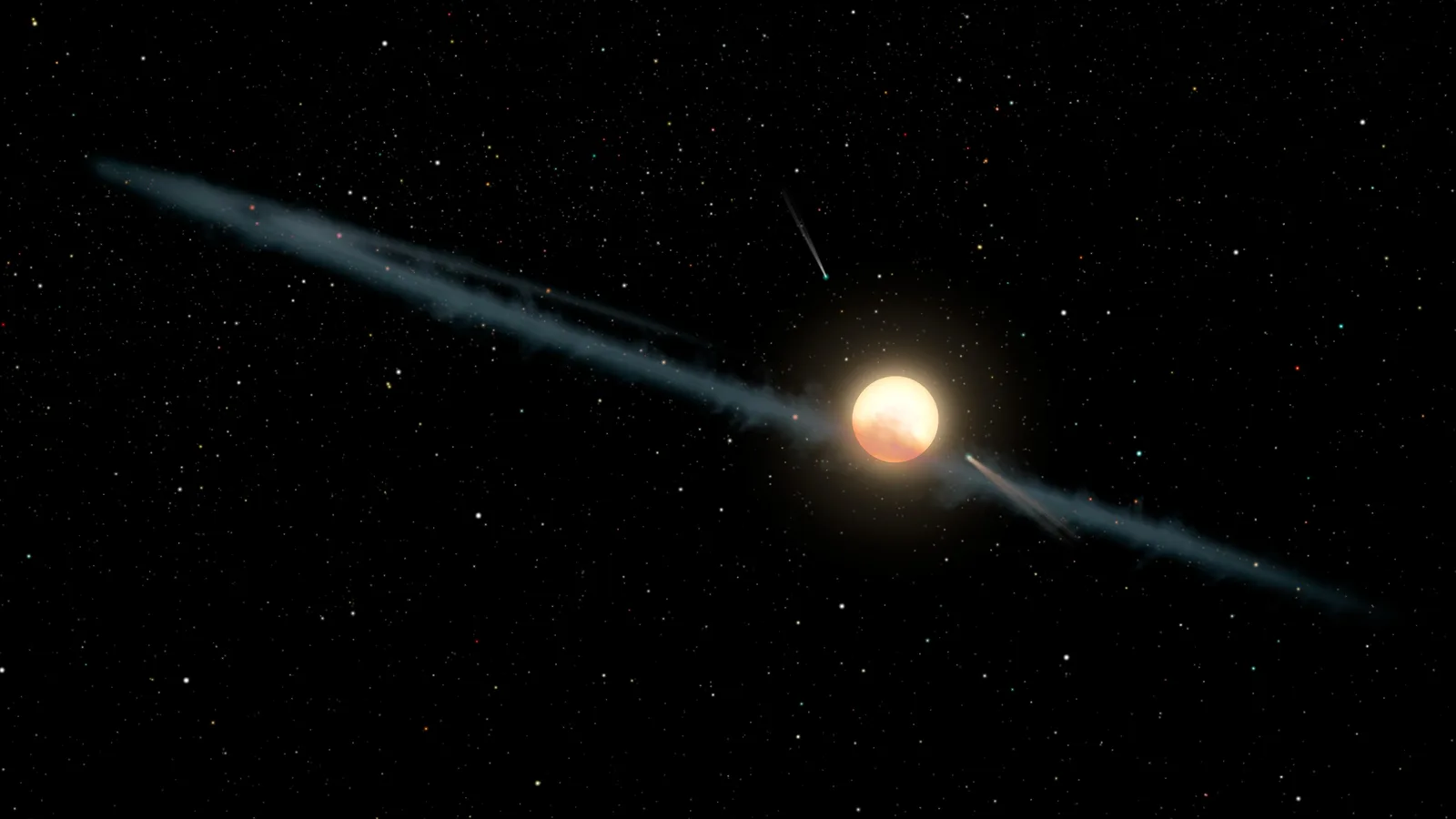
Somewhere in the constellation Cygnus, between the bright stars Deneb and Vega, sits a star you cannot see with the naked eye. It is not unusual to look at. It is slightly larger and hotter than the Sun, a perfectly ordinary F-type star roughly 1,470 light-years away. For four years, NASA's Kepler space telescope stared at it along with 150,000 others, measuring its brightness every half hour. And for four years, this one star did something none of the others did. It flickered like nothing else in the sky.
A light curve that broke the pattern
Kepler was built to find planets by watching for the faint, regular dimming that happens when a world crosses in front of its star. A planet the size of Jupiter blocks about one percent of a Sun-like star's light. The dip is shallow, smooth, and it repeats on a strict schedule, once per orbit, like clockwork. Out of more than a hundred thousand stars, the patterns are almost always the same shape. Astronomers learned to read them at a glance.
KIC 8462852 did not fit. Its brightness held steady for long stretches, then collapsed without warning. One drop in 2011 erased about 15 percent of the star's light. Two years later came a chaotic series of plunges, one of them more than 20 percent deep. These were not the neat U-shaped curves of a transiting planet. They were jagged and asymmetric, some lasting a few days, others dragging on for weeks. And they obeyed no schedule at all. A dip might arrive, then nothing for hundreds of days, then a cluster of them stacked together.
To block a fifth of a star's light, an object would have to be enormous. A planet that large does not exist in this galaxy. Even a star passing in front would not produce edges that ragged. The data were so strange that the team running Planet Hunters, a citizen-science project where volunteers comb through Kepler light curves by eye, flagged the star repeatedly. The volunteers had a private nickname for it long before the journals did: the bizarre one.
It held steady, then collapsed without warning, erasing up to a fifth of its light in jagged plunges that obeyed no schedule at all.
Where's the flux?
In September 2015, Yale astronomer Tabetha Boyajian and a long list of co-authors published the first formal description of the star in Monthly Notices of the Royal Astronomical Society. The paper carried a title that doubled as a confession of bewilderment: "Planet Hunters IX. KIC 8462852, where's the flux?" Flux is the astronomer's word for the amount of light arriving from an object. The star kept losing it, and no one could say where it went.
The paper worked through the suspects one by one. Instrument error was ruled out, because the dips appeared in carefully calibrated data and in follow-up observations from the ground. A close-in disk of warm material, the kind young stars carry, should glow in the infrared, and this star showed no such excess heat. A recent collision between planets might throw up debris, but the odds of catching such an event in a four-year window, on this particular star, were vanishingly small. The star itself looked mature and stable, not the kind that pulses or erupts.
The explanation the authors landed on, cautiously, was a swarm of comets. A family of icy bodies, perhaps disturbed by a passing star, could fall toward KIC 8462852 on long elliptical paths. As each comet neared the heat of the star, it would shed gas and dust, trailing a ragged cloud that crossed our line of sight. A train of such fragments could, in principle, produce dips of arbitrary depth and shape, at irregular intervals. It was the best natural fit. It was also, the authors admitted, not entirely satisfying. The comets would have to be unusually numerous, and unusually well-timed.
The hypothesis that made it famous
A second paper, written in parallel, made the star a household name. Jason Wright of Penn State and his colleagues had been developing a framework for what an advanced civilization's energy infrastructure might look like from a distance. A truly ambitious civilization, the reasoning goes, might build a swarm of structures around its star to capture sunlight, a concept named after the physicist Freeman Dyson who first explored it in 1960. Such a swarm would not be a solid shell. It would be a cloud of separate collectors in separate orbits, and as they passed in front of the star they would produce dips of almost any depth, duration, and shape, arriving without a fixed period.
That description matched the light curve of KIC 8462852 uncomfortably well. Wright's group, publishing in The Astrophysical Journal, argued that the star was the most promising target yet identified for the search for extraterrestrial intelligence, precisely because even contrived natural explanations seemed to strain. They were careful with their language. They were not claiming aliens. They were saying that if you wanted to look for a megastructure, this was where you would point your instruments first.
The press did not stay careful. "Alien megastructure star" became the headline, and the nickname stuck. Radio telescopes, including the giant dish at Green Bank, listened for artificial signals. They heard nothing. Searches for stray laser light came up empty. The civilization hypothesis was never confirmed by anything other than the strangeness of the dips themselves, and strangeness, on its own, is not evidence of engineering.
They were not claiming aliens. They were saying that if you wanted to look for a megastructure, this was where you would point your instruments first.
The slow fade
Then the mystery deepened in a different direction. Beyond the sharp dips, two researchers found a slower trend hidden in the Kepler record. Benjamin Montet and Joshua Simon went back to the telescope's full-frame images, the raw calibration snapshots taken once a month, and tracked the star's average brightness across the entire four-year mission. It was not constant. Over the first roughly 1,000 days, KIC 8462852 faded at a steady rate of about a third of a percent per year. Then, over the next 200 days, it dropped more sharply, losing more than 2 percent. By the end of the mission it had dimmed by about 3 percent overall. Among hundreds of comparison stars with similar properties, not one behaved this way.
An even older claim pushed the timescale to a century. Bradley Schaefer examined photographic plates of the sky dating back to the 1890s, archived at Harvard, and reported that the star appeared to have faded by roughly 14 percent over a hundred years. That result was sharply contested. Other astronomers re-analyzed the same plates and argued the apparent dimming was an artifact of how the old photographic archive was calibrated, a systematic step between two eras of plates rather than a real change in the star. The century-long fade remains disputed. The Kepler-era fade, measured by a modern digital instrument, is harder to wave away.
Whatever was crossing in front of the star was not only producing brief dips. Something seemed to be dimming it over years, perhaps longer. Any explanation now had to account for both the flickers and the fade.
Following the color of the light
The decisive clue came from an idea that is almost embarrassingly simple. If a solid object passes in front of a star, it blocks every color of light equally. A wall is a wall, whether the light is red or blue. But fine dust does not behave like a wall. Small particles scatter blue light more strongly than red, the same physics that reddens the setting Sun. So if you watch a dimming star in several colors at once and find that it dims more in blue than in red, the thing in front of it cannot be solid. It has to be made of small grains.
Catching the next dip in multiple colors required a telescope watching constantly, and Kepler had moved on. So Boyajian's team turned to the public. In 2016 they launched a Kickstarter campaign to buy time on the Las Cumbres Observatory, a global network of robotic telescopes that can track a target around the clock as the Earth turns. More than 1,700 backers pledged in excess of 100,000 dollars. For the first time, the star was under continuous watch.
In 2017 the patience paid off. A fresh series of dips arrived, and the team caught them in real time, in several wavelengths at once. They gave the events names: Elsie, Celeste, Skara Brae, Angkor. These dips were shallower than the Kepler giants, in the range of 1 to 2.5 percent, but they were measured with a precision the original data never had. And the colors told the story. The dimming was not the same in every band. The star reddened as it dimmed, exactly the signature of dust. Publishing in The Astrophysical Journal Letters in 2018, the team concluded that the occulting material was inconsistent with any optically thick, solid object. It was, instead, ordinary dust, much of it in grains smaller than a micron, finer than smoke.
A separate study using NASA's Spitzer and Swift space telescopes, led by Huan Meng, reached the same verdict from another angle. The star dimmed more in ultraviolet light than in the infrared. Grains large enough to be a planet or a panel would block both equally. Only small dust particles, a few micrometers across at most, fit the pattern. As one of the researchers put it, this pretty much rules out the alien megastructure, because a megastructure cannot explain why the dimming depends on color.
A wall is a wall, whether the light is red or blue. But the star reddened as it dimmed, and that is the fingerprint of dust, not engineering.
A natural answer that is not quite finished
So the megastructure is gone, ruled out not by disappointment but by the color of the light. What remains is dust, almost certainly. The leading picture is a swarm of dusty debris, most likely from disrupted comets or the fragments of a shattered body, orbiting the star on uneven paths. When a clump crosses our sightline, the star dips. When the broader cloud thickens, it fades. It is a natural answer, and a satisfying one, and it returns the star to the ordinary universe of rock and ice and gravity.
It is also not quite finished. Astronomers still debate exactly where the dust comes from and how it stays organized into clumps dense enough to produce 20 percent dips. Some models invoke a single large body grinding itself apart. Others favor a steady drizzle of comets. The roughly 1,600-day spacing that some researchers see in the dip timing, if real, points to a parent body on a long orbit, but the pattern is not airtight. The star has kept dipping in the years since, sometimes faintly, sometimes not at all, and each new event adds a data point to a picture that is still being assembled.
That is, in the end, the honest shape of the story. KIC 8462852 was never proof of anything beyond itself. It was a reminder that the sky still holds objects we cannot immediately explain, and that the right response to strangeness is not to invent a marvel but to keep watching, in more colors, for longer, until the light gives up its secret. The star in Cygnus is still flickering. We finally know what it is made of. We are still learning exactly what it is doing.
The star in Cygnus is still flickering. We finally know what it is made of. We are still learning exactly what it is doing.
Frequently Asked Questions
What is Tabby's Star?
Tabby's Star is the nickname for KIC 8462852, an F-type star about 1,470 light-years away in the constellation Cygnus. It is named after astronomer Tabetha Boyajian, who led the first study of its unusual dimming. It is slightly larger and hotter than the Sun and otherwise unremarkable, except for how its brightness behaves.
Why did people think it was an alien megastructure?
NASA's Kepler telescope recorded irregular dips in the star's brightness of up to about 22 percent, far deeper than any planet could cause, with no fixed schedule and ragged, asymmetric shapes. A 2016 paper noted that a swarm of artificial structures built to harvest a star's energy, a Dyson swarm, could in principle produce exactly that kind of pattern. The idea was offered as a hypothesis worth investigating, not a conclusion, but the press turned it into the star's famous nickname.
How was the alien megastructure idea ruled out?
By watching the dimming in different colors of light. A solid object blocks all colors equally. When astronomers caught fresh dips in 2017 using the Las Cumbres Observatory network, the star dimmed more in blue and ultraviolet light than in red and infrared. That color dependence is the signature of fine dust, not a solid structure, which would dim every color the same amount.
What is actually causing the dips?
The leading explanation is a swarm of fine dust, most likely from disrupted comets or fragments of a broken-up body, orbiting the star on uneven paths. When a clump of this debris crosses our line of sight, it blocks part of the star's light. The grains are very small, much less than a micron in many cases, which is why the dimming depends on color.
Did the star really fade over a century?
That claim is disputed. A 2016 study of old photographic plates suggested the star faded by roughly 14 percent over a hundred years, but other researchers argued the effect came from inconsistencies in how the historical archive was calibrated. The fade measured by Kepler during its four-year mission, about 3 percent, was recorded by a modern digital instrument and is more firmly established.
Is the mystery of Tabby's Star solved?
Largely, but not completely. Dust is the clear answer to what blocks the light, and the alien megastructure is ruled out. What remains debated is the precise origin of the dust, how it stays clumped enough to cause deep dips, and whether the dip timing follows a real long-period pattern. The star continues to be monitored, and each new event refines the picture.
Sources
- Boyajian et al. (2016). "Planet Hunters IX. KIC 8462852, where's the flux? (MNRAS 457, 3988)." link.
- Wright et al. (2016). "The Search for Extraterrestrial Civilizations IV: Signatures of Transiting Megastructures (ApJ 816, 17)." link.
- Montet & Simon (2016). "KIC 8462852 Faded Throughout the Kepler Mission (ApJL 830, L39)." link.
- Boyajian et al. (2018). "The First Post-Kepler Brightness Dips of KIC 8462852 (ApJL 853, L8)." link.
- Meng et al. (2017) / NASA JPL. "Mysterious Dimming of Tabby's Star May Be Caused by Dust." link.
- Boyajian (2016). "The Most Mysterious Star in the Galaxy (Kickstarter / Las Cumbres Observatory campaign)." link.