In January 2024, a piece of software paused over a point of light that nothing about the data flagged as urgent. The explosion it belonged to had been catalogued months earlier, filed away among the thousands of supernovae that a robotic telescope in California sweeps up every year. By every ordinary measure it was finished, fading on schedule into the background. But the algorithm had been trained to notice the things that do not fit, and this one did not fit. It pulled the object out of the stream and marked it as anomalous. No astronomer had looked twice. The machine had, and it was right to.
A telescope that never sleeps, and the problem it created
The Zwicky Transient Facility, a wide-field camera mounted on the Samuel Oschin Telescope at Palomar Observatory, photographs the entire visible northern sky every two nights. It is built to catch things that change: asteroids drifting against the stars, variable stars pulsing, and above all supernovae, the brief brilliant deaths of stars that flare for weeks and then go dark. Each night the facility generates hundreds of thousands of alerts. The catch rate is the triumph and the trap. There are far more transient events than there are astronomers to inspect them, and the most interesting object of the decade can slide past unexamined simply because nothing about its first few data points screams for attention.
SN 2023zkd was one of those. The Zwicky Transient Facility detected it in July 2023, in a galaxy roughly 730 million light-years away. It entered the catalogue as another Type IIn supernova, a known if uncommon class, and there it would likely have stayed. What changed its fate was not a person but a program named LAISS, the Lightcurve Anomaly Identification and Similarity Search, developed within the Young Supernova Experiment collaboration and led at analysis by Alexander Gagliano, a fellow at the NSF Institute for Artificial Intelligence and Fundamental Interactions.
LAISS works less like a classifier that sorts objects into known bins and more like a recommendation engine that knows what normal looks like and reacts to its absence. It compares the features of each new transient against a large reference library of well-understood objects and surfaces the statistical outliers, the events that do not resemble anything the catalogue has seen often. The comparison borrows the logic of music recommendation: where a streaming service maps songs into a space of shared features to find neighbors, LAISS maps supernovae into a feature space and flags the ones with no close neighbors at all.
Humans are reasonably good at finding things that are not like the others, but the algorithm can flag things earlier than a human may notice. This is critical for these time-sensitive observations.
That last point, made by Ryan Foley of UC Santa Cruz, is the whole reason the system matters. A supernova is a deadline. Its spectrum, the fingerprint that reveals what the dying star was made of and what surrounds it, evolves over days and weeks and then is gone. Flag an object late and the window has closed. By catching SN 2023zkd while it was still doing something, LAISS bought the time to point larger telescopes at it and gather the data that ordinary triage would have skipped.
The distinction is worth dwelling on, because it is easy to assume that more telescope time simply means more discoveries. It does not. The bottleneck in modern transient astronomy is no longer the camera; it is attention. A wide-field survey can record a galaxy's death rattle perfectly and still lose it, because the alert lands in a queue alongside hundreds of thousands of others and no one happens to scroll to it before the spectrum decays past usefulness. What LAISS provides is not new light but a way of allocating scarce human and instrumental attention toward the few objects that are worth it. The supernova was always there in the data. The question was whether anyone would notice in time, and the answer, for the first time on an object like this, was a program.
What made the explosion strange
Once human astronomers looked, the oddities accumulated. The first was timing. A supernova has a characteristic shape: a rise to a single peak over weeks, then a long decline as the radioactive elements forged in the blast burn out. SN 2023zkd did not fade and stay faded. After its first peak it dimmed, and then, roughly 240 days later, it brightened a second time to nearly the same luminosity. Two peaks of comparable brightness, separated by eight months. That is not the signature of one explosion running its course. It is the signature of an explosion that ran into something, twice.
The second oddity was visible only in archival data, the years of images the Zwicky Transient Facility and earlier surveys had quietly accumulated of that patch of sky before anyone cared about it. Gagliano's team dug back through them and found that the object had not been dark before July 2023. It had been slowly brightening for about four years, roughly 1,500 days, glowing at a luminosity that for a pre-explosion star is extraordinary. Stars are not supposed to announce their deaths that loudly, that early, for that long. Something was already going wrong with this one years before the end.
The third clue came from spectroscopy. The light of SN 2023zkd carried the imprint of gas moving at very different speeds in very different directions: fast helium-rich material streaming outward at 1,000 to 2,000 kilometers per second along the poles, and slower hydrogen-rich material, around 400 kilometers per second, spread around the equator. This is what astronomers call circumstellar material, gas the star shed before it died, and the explosion was lighting it up from the inside as the blast wave plowed into it. The geometry mattered. The material was not a uniform shell. It was structured, dense in some directions and thin in others, with a disk-like distribution around the star's waist.
Something exactly like this supernova has not been seen before, so it might be very rare.
Reading the shells the star shed
The double peak and the dense gas turned out to be the same story told twice. Each brightening, the modeling showed, came from the explosion's debris slamming into a shell of previously ejected material and converting the collision into light. Shock-driven models fit to the multi-band observations point to roughly five to six solar masses of circumstellar material in total, with two to three solar masses tied to each peak. The two shells were not shed at the same time. One was expelled about three to four years before the explosion, the other one to two years before, in distinct episodes of violent mass loss.
That is the chronology the precursor brightening was recording. For four years the star was convulsing, throwing off material in great gusts, growing brighter as it did. Each gust laid down a shell. When the star finally exploded, the blast caught up first to the inner shell and then, months later, to the outer one, producing two flashes of light from a single death. The supernova was effectively reading back its own history, each peak a receipt for an earlier eruption.
The asymmetry of the gas adds a further detail to the scene. The helium-rich material moving fast along the poles and the hydrogen-rich material drifting slowly around the equator describe a star that was not shedding mass evenly in all directions but funneling it, like a top spinning off matter from its waist while jetting it from its caps. That kind of structured, disk-shaped outflow is exactly what a close binary tends to sculpt, with the companion's gravity stirring the gas into a flattened distribution rather than a uniform bubble. The geometry, in other words, was already hinting at a second body before the modeling named one.
The trouble is that ordinary massive stars are not known to do this. The rate at which SN 2023zkd's progenitor was hemorrhaging mass, and the luminosity of its years-long precursor, sit beyond anything cleanly explained by a single star shedding its outer layers as it ages. The energy budget demands a more violent bookkeeper. Two candidates fit: super-Eddington accretion onto a black hole, meaning matter falling onto a compact object faster than radiation pressure should normally allow, or a series of long-lived eruptions from a massive star reaching luminosities never previously observed. Both point in the same uncomfortable direction. A lone star was probably not doing this alone.
The black hole in the picture
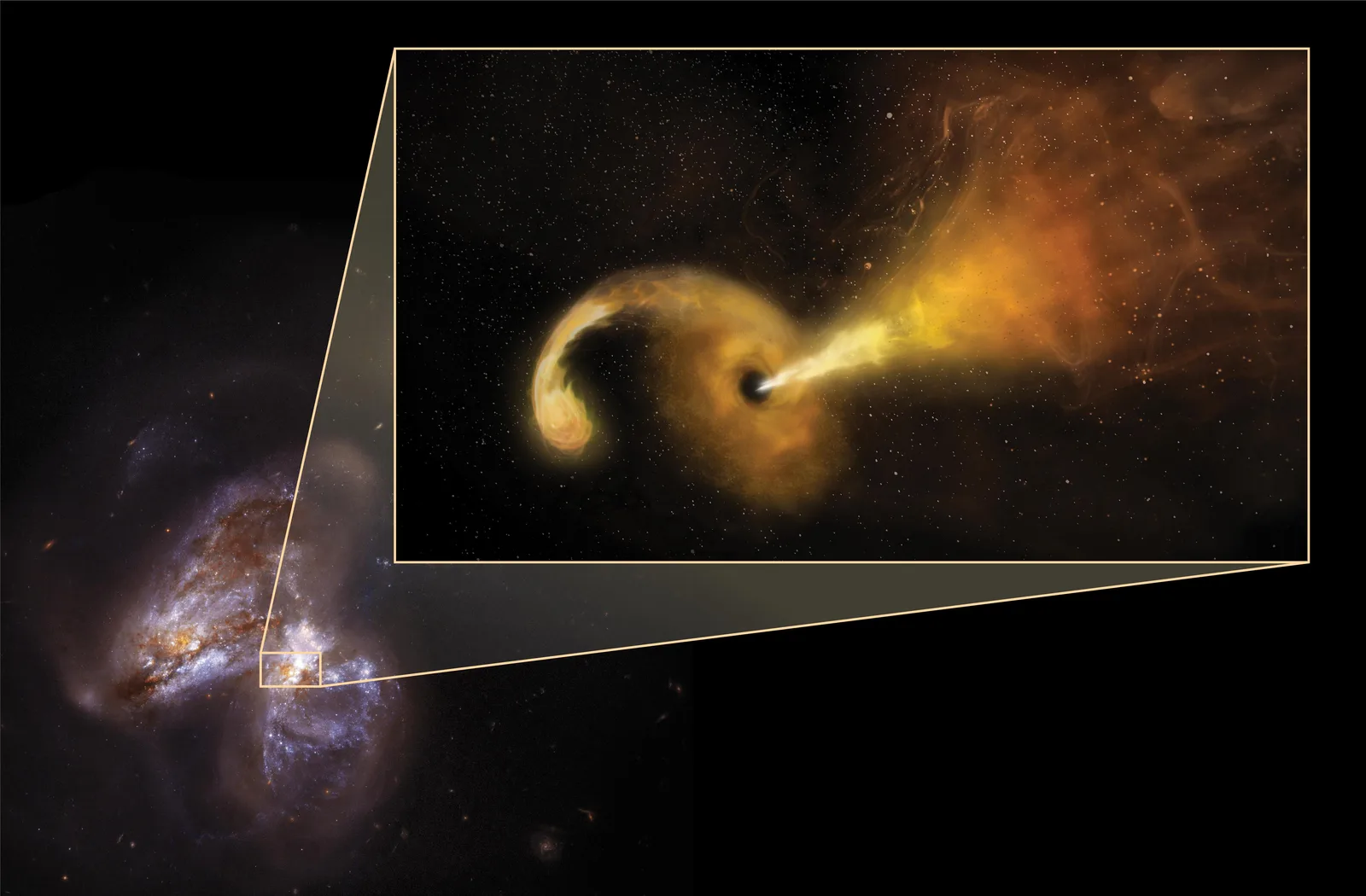
The interpretation that best ties the threads together, the one the authors favor, is a binary. In their reading, the progenitor was a massive helium star, born with at least 30 times the mass of the Sun and stripped of much of its outer hydrogen, orbiting a black hole companion. Over years the two spiraled inward, an instability driving the star to dump mass and brighten as the orbit decayed, until the system reached a catastrophic merger. The explosion was not a star quietly reaching the end of its fuel. It was a collision.
Here the language has to stay careful, because this is where observation ends and inference begins. What is observed is the light: the four-year precursor, the two peaks, the structured fast and slow gas, the spectral evolution. What is inferred, from fitting physical models to that light, is the cause: a partially stripped massive star undergoing an instability-induced merger with a black hole companion. The paper does not claim a direct image of a black hole eating a star. It claims that, among the scenarios tested, this one accounts for the data best.
Within that framework, two endings remain possible. In one, the black hole's gravity stresses and detonates the star as the two merge, and the supernova we see is the star itself exploding. In the other, the black hole tears the star apart entirely, and the light we record comes not from a stellar explosion at all but from the shredded debris falling into an accretion disk, a death that mimics a supernova without quite being one. The data so far cannot cleanly separate the two. Either way, the agent of destruction was the companion.
Our analysis shows that the blast was sparked by a catastrophic encounter with a black hole companion, and is the strongest evidence to date that such close interactions can actually detonate a star.
The phrase "strongest evidence to date," from Gagliano, is doing precise work. Astronomers have long suspected that a star and a black hole locked in a tight orbit could end in a violent merger, and theory allows it. What had been missing was a real event that looked the part. SN 2023zkd is that candidate: a single object whose every strange feature, taken together, is hard to explain without invoking a compact companion driving the show.
Why a machine was the right instrument
The deeper significance of SN 2023zkd may be less about the one star than about how it was found. Nothing in the early data marked it as special. A human triaging the night's alerts would have had no reason to linger, and almost certainly would not have. The features that made it remarkable, the long precursor and the second peak, only became visible over many months, by which point the moment for the most informative observations could easily have passed. LAISS did not understand the physics of a stellar merger. It understood only that this object had few neighbors in the space of known supernovae, and that was enough to pull it from the stream in time.
This matters because the firehose is about to widen. The Vera C. Rubin Observatory, beginning its decade-long survey of the southern sky, is expected to discover on the order of 100,000 supernovae a year, an increase that no team of humans can inspect by hand. The rare events, the ones that rewrite a chapter, will not announce themselves. They will be buried in a torrent of the ordinary. Tools like LAISS are not a convenience in that future. They are the only plausible way to find the strange before it fades, the difference between a discovery and a missed alert no one ever reads.
SN 2023zkd is a single case, and the case is not closed. The merger interpretation is the best current reading, not a verdict, and competing explanations for some of its features will be tested as more such objects are found. That is how it should work. But the object stands as a clean demonstration of a new kind of discovery, one in which the first observer of the most interesting star in the catalogue was not a person at all.
The most interesting star in the catalogue had been sitting there for months, fading on schedule, attracting no attention. It took a machine, built only to notice the absence of the familiar, to look twice and find a death no one had seen before.
Frequently Asked Questions
What is SN 2023zkd?
SN 2023zkd is a supernova detected in July 2023 by the Zwicky Transient Facility in a galaxy about 730 million light-years away. It is classified as a helium-rich Type IIn supernova and is unusual for its four-year precursor brightening and its double-peaked light curve, with two comparable peaks separated by roughly 240 days.
What is LAISS, the AI that flagged it?
LAISS stands for Lightcurve Anomaly Identification and Similarity Search, an algorithm developed within the Young Supernova Experiment collaboration. It compares each new transient against a large reference library of known objects and flags statistical outliers, surfacing events that do not resemble anything common in the data. It marked SN 2023zkd as anomalous in January 2024.
Did a black hole really cause the explosion?
That is the leading interpretation, not a direct observation. Astronomers infer, by fitting physical models to the light, that the progenitor was a massive helium star merging with a black hole companion. No image shows a black hole consuming a star. The claim is that this scenario explains the observed data, the long precursor, the two peaks, and the structured gas, better than the alternatives.
Why did the supernova brighten twice?
Each peak came from the explosion's debris colliding with a shell of gas the star had shed before it died. The star expelled roughly two to three solar masses of material three to four years before the blast, and a second similar amount one to two years before. The blast wave hit the inner shell first and the outer shell about 240 days later, producing two separate flashes of light.
How massive were the star and the black hole?
The progenitor is estimated to have begun life with at least 30 times the mass of the Sun, as a partially stripped helium star. The companion is interpreted as a black hole, with secondary reports citing roughly 10 solar masses, though the precise mass is model-dependent and not pinned down by the observations alone. Around five to six solar masses of gas were shed before the explosion.
Why does it matter that AI made the discovery?
A human reviewing the night's alerts would have had no reason to flag SN 2023zkd early, and the most informative observations are time-sensitive. As surveys like the Vera C. Rubin Observatory begin finding on the order of 100,000 supernovae a year, no team can inspect them by hand. Anomaly-detection systems like LAISS are becoming the only practical way to catch rare events before they fade.
Continue Exploring
- The Star We Saw Before It DiedFor the first time, JWST identified the exact star that would become a supernova: a red supergiant hidden inside a...
- The Census of Colliding Black HolesIn one release, the number of gravitational-wave detections more than doubled. The fourth LIGO-Virgo-KAGRA catalog...
Sources
- Gagliano et al. (2025). "Evidence for an Instability-induced Binary Merger in the Double-peaked, Helium-rich Type IIn Supernova 2023zkd, The Astrophysical Journal." link.
- Gagliano et al. (2025). "Preprint: Evidence for an Instability-Induced Binary Merger in SN 2023zkd (arXiv)." link.
- UC Santa Cruz (2025). "UC Santa Cruz-based survey uses AI to spot explosive stellar death by black hole." link.
- Gagliano et al. (2024). "LAISS: Lightcurve Anomaly Identification and Similarity Search (Zenodo)." link.