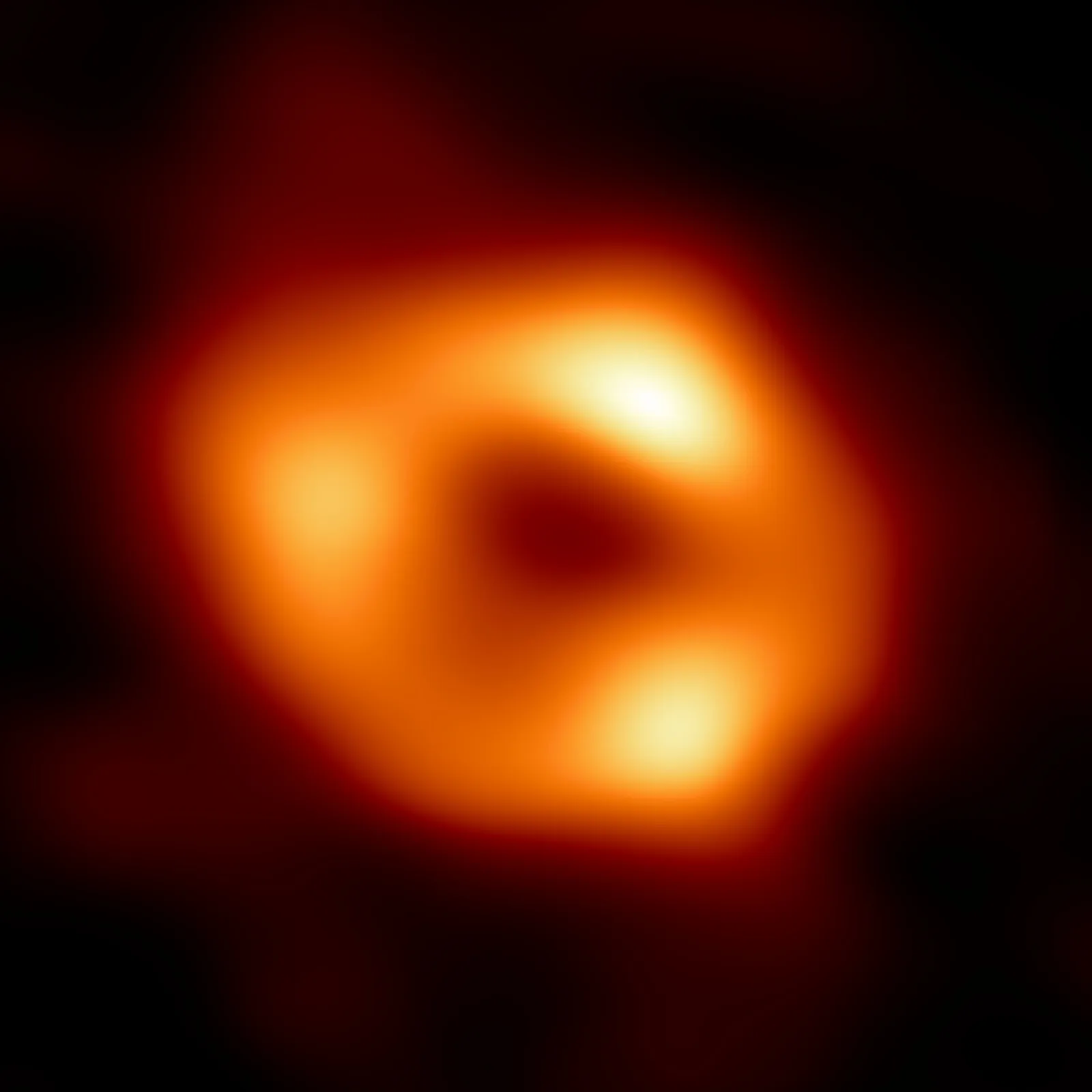
There is a black hole at the center of the galaxy you live in. It sits 27,000 light-years away, in the direction of the constellation Sagittarius, behind so much interstellar dust that no ordinary telescope can see through to it. It weighs about 4.3 million times the mass of the Sun, all of it crushed into a region that would fit comfortably inside the orbit of Mercury. For most of the twentieth century, it was a suspicion. By 2022, it was a photograph.
The object is called Sagittarius A*, written Sgr A* and pronounced "Sagittarius A-star." The asterisk is a borrowed convention from atomic physics, where it marks an excited state. Here it marks something stranger: the most extreme gravitational object in our cosmic neighborhood, the silent anchor around which a hundred billion stars, including the Sun, slowly turn.
The case for an invisible mass
You cannot photograph a black hole directly. By definition it emits no light. What you can do is watch how it moves everything around it, and for thirty years that is exactly what two rival teams of astronomers did, with a patience that bordered on the obsessive.
Starting in the early 1990s, Reinhard Genzel's group at the Max Planck Institute for Extraterrestrial Physics in Germany and Andrea Ghez's group at UCLA began tracking individual stars near the galactic center using the largest telescopes on Earth. The problem was brutal. The center of the galaxy is shrouded in dust that blocks visible light almost completely, so both teams worked in the infrared, where the dust is more transparent. Even then, Earth's atmosphere smears starlight into a useless blur. They beat the blur with adaptive optics, deformable mirrors that flex hundreds of times per second to cancel atmospheric turbulence in real time, and with a technique called speckle imaging that freezes the distortion in very short exposures.
Year after year, they mapped the positions of a swarm of stars orbiting an unseen point. The stars were not drifting. They were orbiting, on closed ellipses, the way planets orbit the Sun. And to swing a star through an orbit that tight, the central object had to be staggeringly massive and staggeringly compact.
The patience this demanded is hard to overstate. A star near the galactic center can take decades to complete a single loop, and the measurements that mattered were fractions of an arcsecond, the apparent width of a human hair seen from across a stadium. Both teams returned to the same patch of sky season after season, refining instruments, cross-checking each other's results, and slowly stripping away every explanation for the motion except the one nobody could quite believe at first. The rivalry between the two groups, separated by an ocean, made the conclusion sturdier: when two competing teams using different telescopes and different methods converge on the same answer, the answer tends to hold.
The stars were not drifting past the galactic center. They were orbiting it, the way planets orbit a sun, around something that gave off no light at all.
The star that proved it
One star did more to settle the question than any other. It is called S2 (the same object is labeled S0-2 by the UCLA group), and it is on a wildly elongated orbit with an eccentricity of 0.88, meaning it swings from far out to a close grazing pass and back again every 16 years. That short period was a gift. A 16-year orbit can be watched in full, more than once, within a single career.
At its closest approach, called pericenter, S2 comes within roughly 120 astronomical units of Sgr A*, about four times the distance from the Sun to Neptune, and whips around at nearly 7,650 kilometers per second. That is about 2.5 percent of the speed of light, fast enough that Einstein's physics stops being a footnote and becomes the main event.
By fitting the full orbit of S2, astronomers could weigh the central object the way you weigh the Sun from a planet's orbit. The answer was an object of about four million solar masses packed inside the pericenter distance of S2. No cluster of dim stars, no swarm of dead neutron stars, no clump of dark matter could be that massive and that small without collapsing into a black hole. The orbit of one star had cornered the alternatives until only one remained.
For this work, Genzel and Ghez shared half of the 2020 Nobel Prize in Physics, awarded "for the discovery of a supermassive compact object at the centre of our galaxy." The other half went to the mathematician Roger Penrose, who had proved decades earlier that black hole formation is an unavoidable consequence of Einstein's general relativity. Ghez became only the fourth woman to win the physics Nobel.
It is worth pausing on what the orbit actually rules out. A heavy but ordinary object, a dense cluster of faint stars or burned-out stellar remnants, would have its own size and would slowly disrupt under its own gravity. As the measurements tightened, the allowed region for the central mass shrank and shrank until it was smaller than the pericenter of S2 itself, a volume that a swarm of normal objects simply cannot occupy without collapsing. General relativity offers exactly one stable configuration for that much mass in that little space, and it is a black hole. The stars did not show astronomers the black hole. They showed them that nothing else was possible.
Einstein at the galactic center
Once the instruments grew sharp enough, S2 stopped being merely a scale to weigh the black hole and became a laboratory for testing gravity itself. The breakthrough came from GRAVITY, an instrument at the European Southern Observatory that combines the light of all four 8-meter telescopes of the Very Large Telescope in Chile into a single virtual instrument, achieving a precision that no one telescope could reach.
In 2018, as S2 made its pericenter passage, the GRAVITY Collaboration measured an effect Einstein predicted but Newton never could: gravitational redshift. Light climbing out of the black hole's gravity well loses energy, stretching toward redder wavelengths. The team detected the shift in S2's light, a deviation from Newtonian gravity equivalent to about 200 kilometers per second, exactly the size general relativity predicts.
Two years later, with data running through the end of 2019, the same team detected a second relativistic effect: the Schwarzschild precession of S2's orbit. Unlike a Newtonian ellipse, which traces the same closed loop forever, an orbit in general relativity slowly rotates, so the long axis swings around the black hole over time. It is the same effect that famously nudges Mercury's orbit around the Sun, but here it is far larger, about 12 arcminutes per orbit, and it bends in the direction Einstein requires. The orbit of S2, measured over a quarter century, kept agreeing with general relativity to within the error bars.
Those same measurements pinned down the numbers with remarkable precision. By 2022, combining the orbits of S2 and three other stars, GRAVITY reported a mass for Sgr A* of 4.297 million solar masses and a distance to the galactic center of 8,277 parsecs, about 27,000 light-years, both known to better than one percent.
The orbit of a single star, watched for a quarter of a century, kept agreeing with Einstein's general relativity to within the error bars, in a gravitational field a thousand times stronger than anywhere the theory had been tested before.
Photographing a shadow
An orbit can prove a black hole exists. It cannot show you one. To do that you need to resolve the dark silhouette the black hole casts against the glowing gas falling onto it, a feature astronomers call the shadow, ringed by light bent around the event horizon. For Sgr A*, that shadow spans only about 52 micro-arcseconds on the sky, an angle so small it is like trying to read the date on a coin in New York from a cafe in Paris.
No single telescope on Earth can resolve that. So the Event Horizon Telescope did not use one. It used eight, scattered from Hawaii to Spain to the South Pole, all observing the same source at the same 1.3-millimeter wavelength at the same moment in April 2017, then combining their data through a technique called very long baseline interferometry. The result is a virtual telescope effectively the size of the planet, with the resolving power to match.
In 2019 that array delivered the first image of any black hole: M87*, the monster at the center of the galaxy M87, 55 million light-years away. Sgr A* was the obvious next target, closer by a factor of two thousand. It should have been easier. It was not.
Why our own black hole was the hard one
The difficulty came down to time. M87* is more than a thousand times more massive than Sgr A*, and the bigger a black hole is, the more slowly gas circles it. Around M87*, gas takes days to complete an orbit, so during a night of observing the source barely changes, like photographing a mountain. Around Sgr A*, the same gas completes an orbit in minutes. The black hole flickers and reshapes itself faster than the telescope can build up a single picture, like trying to photograph a running puppy with a long exposure: the result is a smear.
It took the collaboration five years and a battery of new techniques to disentangle the structure from the variability. They generated thousands of synthetic images and averaged across them, building a picture that captured the persistent ring while letting the fast flickering blur out. When the image finally arrived, on May 12, 2022, it showed a bright, thick ring of plasma, 51.8 micro-arcseconds across, surrounding a central darkness. The ring is light from hot gas bent by gravity around the unseen event horizon. The size of the shadow matched what general relativity predicts for a 4.3-million-solar-mass black hole almost exactly. Our galaxy's central black hole now had a face.
The agreement was more than a confirmation. Sgr A* and M87*, two black holes that differ in mass by a factor of more than a thousand and sit in galaxies of wildly different character, both produced shadows of exactly the size general relativity demands for their measured masses. A theory written in 1915, on a chalkboard, to explain a small wobble in Mercury's orbit, had just predicted the appearance of two objects no one in Einstein's lifetime believed could be seen. The same equations governed both the smallest and the largest gravitational fields ever tested.
The flickering that made the image so hard is itself a window into the physics. Sgr A* erupts in bright flares of infrared and X-ray light, sometimes several times a day, as knots of superheated gas spiral inward. In 2018, GRAVITY watched one such flare and tracked the emitting hot spot as it swept around the black hole at about 30 percent of the speed of light, on an orbit just outside the innermost stable circular orbit, the closest a particle can circle before falling in. The team was watching gas in its final hours before crossing the point of no return.
A quiet giant
For all its mass, Sgr A* is a remarkably calm black hole. It consumes very little, the equivalent of a small fraction of an Earth mass per year, which is why our galaxy does not host the blazing quasar that more active supermassive black holes power in distant galaxies. The center of the Milky Way is luminous in radio and X-rays but it is, by black hole standards, nearly dormant. There is evidence in the surrounding gas that it was far more active in the past, and may flare to life again. For now, it broods.
The flares hint at how that gas behaves in the final moments. As the GRAVITY hot spots traced their loops at a third of light speed, they were sampling the region where space itself is whipped around by the black hole's gravity, just outside the radius where no stable orbit exists. Watch long enough and the polarization of the flare light even reveals the geometry of the magnetic fields threading the infalling plasma, fields strong enough to launch some of that gas back out before it ever crosses the horizon. Sgr A* eats slowly in part because it is a messy eater, flinging away much of what falls toward it.
What makes Sgr A* uniquely valuable is not its drama but its proximity. It is the only supermassive black hole close enough that we can watch individual stars orbit it, time the passage of light through its gravity, and resolve the glow at its edge. Every other black hole in the universe is a point of inference. This one we can interrogate. The next generation of the Event Horizon Telescope aims to do better still, eventually capturing not a single frozen frame but a movie of gas circling the horizon in real time, turning the most patiently won portrait in astronomy into something that moves.
Every other supermassive black hole in the universe is a point of inference. This one, the one in our own galaxy, we can interrogate.
For most of human history the center of the galaxy was a smear of light in a summer sky. Now it has a measured mass, a tested theory of gravity wrapped around it, and a photograph. The suspicion became a portrait.
Frequently Asked Questions
How big is the black hole at the center of the Milky Way?
Sagittarius A* has a mass of about 4.297 million times the mass of the Sun, measured by the GRAVITY Collaboration in 2022 from the orbits of stars around it. Despite that mass, its event horizon is small enough to fit inside the orbit of Mercury.
How far is Sagittarius A* from Earth?
It lies about 8,277 parsecs away, which is roughly 27,000 light-years, in the direction of the constellation Sagittarius. This distance is now known to better than one percent thanks to precise tracking of stellar orbits at the galactic center.
How did astronomers prove Sagittarius A* is a black hole?
Two teams, led by Reinhard Genzel and Andrea Ghez, tracked stars orbiting the galactic center for nearly three decades. The tight, fast orbit of the star S2 required a central object of about four million solar masses packed into a space smaller than our solar system, which only a black hole can be. The work earned the 2020 Nobel Prize in Physics.
When was Sagittarius A* photographed?
The Event Horizon Telescope released the first image on May 12, 2022. The data were collected in April 2017 by eight radio observatories around the world working together as a single planet-sized telescope.
Why was Sgr A* harder to image than the M87 black hole?
Sgr A* is much smaller, so gas orbits it in minutes rather than days. The source changes shape faster than a telescope can build up one image, blurring the result. Imaging M87*, a far larger and slower black hole, was comparatively straightforward.
Is the black hole at the center of the galaxy dangerous to Earth?
No. At 27,000 light-years away, Sagittarius A* has no effect on the solar system. The Sun orbits the galactic center at a safe distance, completing one circuit roughly every 230 million years, just as it has for billions of years.
Continue Exploring
- The Giant Lobes Rising From the Milky WayIn 2010, a space telescope revealed two colossal balloons of energy tens of thousands of light-years above and below...
- When a Black Hole Shreds a StarWander too close to a supermassive black hole and gravity becomes a weapon. The star is stretched into a stream of gas...
- The Supernova That Chirped Like a Black Hole MergerA billion light-years away, one of the brightest explosions in the universe pulsed with a rhythm that kept speeding up....
- The Brightest Object in the Universe Was Hiding as a StarJ0529-4351 outshines five hundred trillion Suns, yet for forty years our telescopes filed it away as an ordinary point...
Sources
- EHT Collaboration (2022). "First Sagittarius A* Event Horizon Telescope Results. I. The Shadow of the Supermassive Black Hole in the Center of the Milky Way (ApJL 930, L12)." link.
- GRAVITY Collaboration (2018). "Detection of the gravitational redshift in the orbit of the star S2 near the Galactic centre massive black hole (A&A 615, L15)." link.
- GRAVITY Collaboration (2020). "Detection of the Schwarzschild precession in the orbit of the star S2 near the Galactic centre massive black hole (A&A 636, L5)." link.
- GRAVITY Collaboration (2022). "Mass distribution in the Galactic Center based on interferometric astrometry of multiple stellar orbits (A&A 657, L12)." link.
- Nobel Prize in Physics (2020). "Press release: the discovery of a supermassive compact object at the centre of our galaxy." link.
- GRAVITY Collaboration (2018). "Detection of orbital motions near the last stable circular orbit of the massive black hole SgrA* (A&A 618, L10)." link.