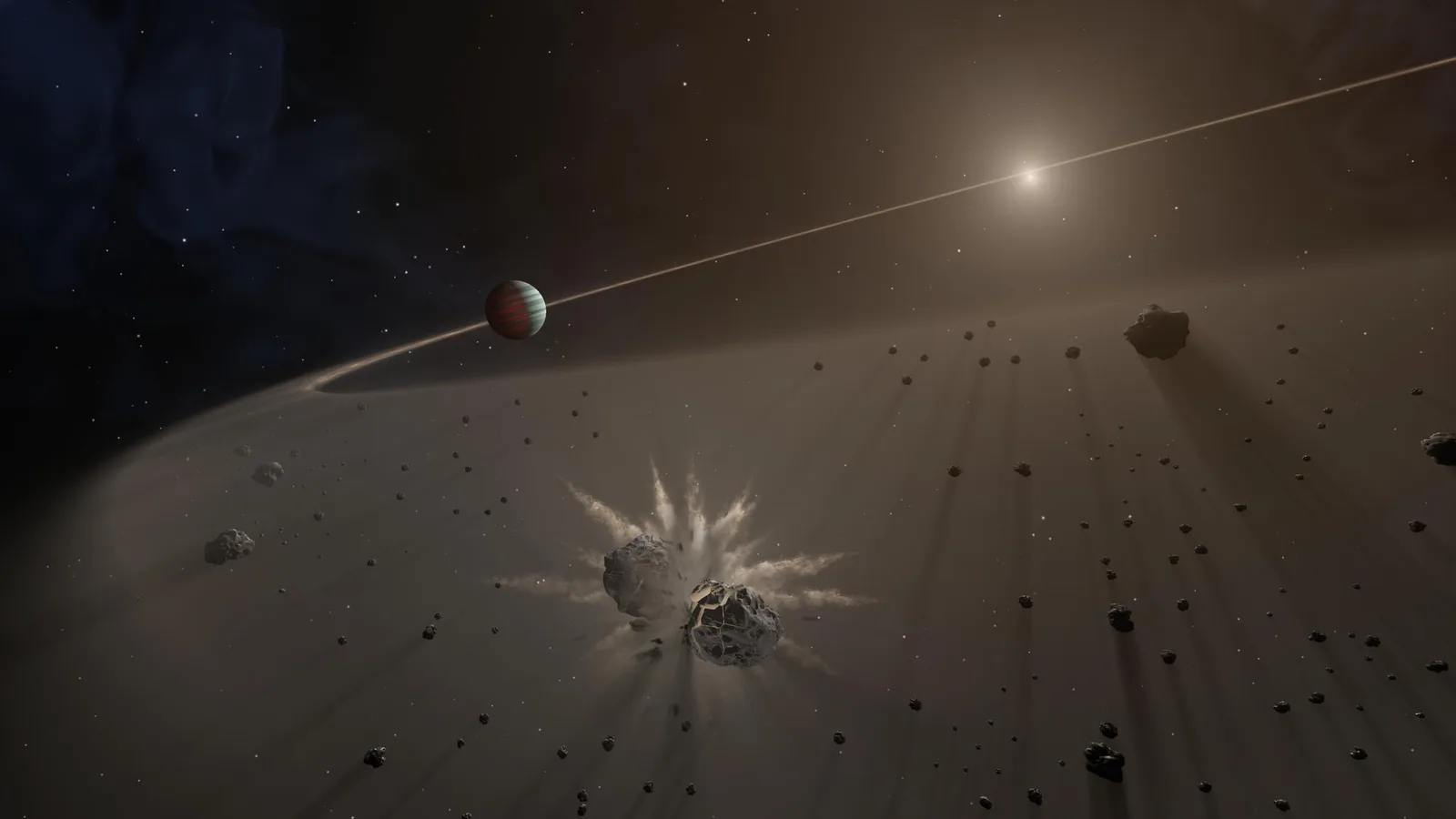
Somewhere in the dark between the stars, a planet is falling through space toward nothing in particular. It has no sunrise. It has had none for a billion years, and it will have none for a billion more. Above its frozen surface there is no star to fix a year to, no warmth, no shadow that moves. It is roughly the mass of Jupiter, and it answers to no sun. It is simply adrift, one of an uncounted multitude of worlds that wander the galaxy alone.
For most of the history of astronomy, such objects were a contradiction in terms. A planet was, by definition, a thing that went around a star. The word itself comes from the Greek for wanderer, but the ancients meant a wanderer against the fixed stars, not a wanderer between them. The idea that a world could exist with no sun at all, drifting through the cold for the age of the universe, belonged to fiction.
It does not anymore. Over the past fifteen years, astronomers have built the tools to detect these starless worlds, and what they have found is unsettling in its scale. The galaxy may contain more rogue planets than it contains stars.
How a world loses its sun
There are two ways to make a planet that has no star, and they pull in opposite directions.
The first is ejection. Planetary systems are not the serene clockwork they appear to be in textbook diagrams. In their youth, before orbits settle, planets jostle and tug at one another, and gravity is unforgiving. A close pass between two giant planets can fling one of them outward at a speed the host star can no longer contain. The ejected world tears free of its orbit and sails off into the galaxy, carrying with it the heat of its formation and nothing else. Computer simulations of young systems suggest this happens often. Most stars are thought to lose at least one planet this way.
The second route is stranger. Some of these objects may never have had a star to begin with. Stars form when a cloud of gas and dust collapses under its own gravity, and the same process can, in principle, run at a much smaller scale, collapsing directly into an object too light to ignite as a star but still forming on its own rather than inside a disk around a sun. Whether nature actually does this at planetary masses is one of the central questions in the field, because the answer tells us whether a rogue planet is a refugee or a thing born free.
The galaxy may contain more rogue planets than it contains stars. They were always there. We simply could not see them.
The distinction matters because it leaves a fingerprint. Ejection should produce mostly lower-mass planets, because giant planets are harder to throw out and rarer to begin with. Direct collapse should produce a different distribution, with its own characteristic spread of masses. By counting rogue planets and measuring how their numbers fall off with mass, astronomers can read which process dominates. The trouble is the counting, because a planet with no star gives off almost no light.
Seeing the invisible
You cannot photograph most rogue planets. They are cold, faint, and far away, lost in the glare of the crowded star fields toward the center of the galaxy. So astronomers do not look for the planet. They look for what its gravity does to the light of a star behind it.
Einstein's general relativity predicts that mass bends space, and that light passing close to a mass is deflected. When a rogue planet drifts directly between Earth and a distant background star, the planet's gravity acts as a lens, briefly focusing and brightening the background star's light. The effect is called gravitational microlensing, and for a planetary-mass lens it is fleeting. A star lens brightens a background source for weeks. A Jupiter-mass rogue planet does it for roughly a day. An Earth-mass one for only a few hours.
Two long-running surveys have spent decades watching hundreds of millions of stars toward the galactic bulge precisely to catch these flickers: the Optical Gravitational Lensing Experiment, known as OGLE, and Microlensing Observations in Astrophysics, known as MOA. They photograph the same dense star fields night after night, year after year, waiting for one star in millions to flare and fade on the timescale of a passing world.
The technique has a brutal asymmetry built into it. A microlensing event is a one-time alignment. The planet, the background star, and Earth fall briefly into a line, and then the geometry breaks and never repeats. There is no second chance to confirm the detection, no way to point another telescope at the same world an hour later, because by then the planet has moved on and the background star has dimmed back to normal. Each rogue planet announces itself exactly once and then is gone. Everything astronomers can say about it must be wrung from the shape of that single brightening curve, its height and its duration, which together encode the lens's mass and distance. It is a little like trying to weigh a stranger from the length of the shadow they cast as they walk past a streetlamp, once, in the dark.
The first hint of a hidden population came in 2011. Takahiro Sumi and the MOA and OGLE teams reported in Nature an excess of very short microlensing events, lasting under two days, that pointed to a population of unbound or distant Jupiter-mass objects roughly as common as the main-sequence stars themselves. The headline result, that such worlds might outnumber ordinary stars, electrified the field and also drew immediate scrutiny, because the signal lived at the very edge of what the surveys could measure.
The recount
Extraordinary claims invite re-examination, and the rogue planet population got it. In 2017, Przemek Mroz and collaborators reanalyzed nearly six years of OGLE data, some 2,617 microlensing events, with better statistics and a sharper eye for the shortest signals.
Their verdict was more careful. They found no significant excess of Jupiter-mass rogue planets, placing an upper limit of roughly one such planet for every four stars, well below the earlier estimate. But they did detect a handful of events shorter still, lasting only a fraction of a day, the signatures not of giants but of Earth-mass and super-Earth-mass worlds. The rogue population was real. It was simply made of smaller things than the first results suggested.
The smallest of these arrived in 2020, when Mroz and colleagues reported the shortest microlensing event ever recorded, brightening and fading in well under an hour. The most natural explanation was a terrestrial-mass rogue planet, a world perhaps as light as Earth, wandering alone and announcing itself for a single hour in the history of the galaxy before vanishing again into the dark.
A star lens brightens a background star for weeks. A planet does it for a day. An Earth-mass world, for less than an hour, once, and never again.
By 2023, the MOA team had assembled nine years of survey data and a more complete census. Their analysis suggested that rogue or wide-orbit planets are genuinely common, on the order of several objects more massive than Earth for every star in the galaxy, with the population growing steeply toward lower masses. The number of small rogue worlds is not a handful. It is a flood.
The pairs in Orion
Microlensing detects rogue planets by gravity alone, one fleeting event at a time, and tells us almost nothing about any individual world. But there is one place in the sky young enough and close enough to photograph free-floating worlds directly: the Orion Nebula, a stellar nursery roughly 1,300 light-years away where stars are still being born and any planet ejected recently would still glow with its birth heat.
In 2023, Samuel Pearson and Mark McCaughrean turned the James Webb Space Telescope on the inner Orion Nebula and the Trapezium Cluster at its heart. Over about 35 hours of observation across a small patch of the nebula, Webb's infrared cameras picked out roughly 540 planetary-mass objects, free-floating worlds with masses running down to below the mass of Jupiter, untethered to any star.
That alone was striking. But the genuine surprise was hiding in the data. Around 40 of these planetary-mass objects were not solitary. They came in pairs, two Jupiter-mass worlds orbiting each other with no star anywhere near, separated by tens to a few hundred times the Earth-Sun distance. The team named them Jupiter-mass binary objects, or JuMBOs.
The problem is that no current theory comfortably explains them. Ejection should not work, because flinging a planet out of a system violently enough to free it should also rip apart a loosely bound pair. Direct collapse of a gas cloud does not obviously favor making planetary-mass objects in gently orbiting twos. The JuMBOs sit in a gap between our two stories of how rogue worlds are made, and for now they are an anomaly waiting for an explanation. Some researchers have questioned the analysis; follow-up work continues. That is how the field moves: a strange detection, a careful re-examination, a slow convergence on what is real.
An ocean in the dark
It is tempting to assume a planet with no star is a dead planet. No sunlight means no warmth, no liquid water, no photosynthesis, nothing. For the surface, that is almost certainly true. A rogue world's surface sits within a few degrees of the cold of deep space, far below the freezing point of every familiar substance.
But the surface is not the only place a world keeps heat. Earth itself runs a furnace in its interior, powered by the slow radioactive decay of elements like uranium, thorium, and potassium locked in its rock. That heat does not depend on the Sun at all. It would keep flowing if the Sun vanished tomorrow.
In 2011, Dorian Abbot and Eric Switzer worked through the consequences in a paper they called Steppenwolf, after the lone wanderer. They showed that a rogue planet a few times Earth's mass could, in principle, hold a liquid ocean beneath a thick shell of insulating ice, kept warm from below by its own geothermal heat alone. The ice cap would seal the heat in the way a closed lid keeps a pot warm. An even older idea, from David Stevenson, proposed that a rogue world wrapped in a dense hydrogen atmosphere could trap enough internal heat to keep liquid water on its actual surface, in permanent starless dark.
This is not a claim that rogue planets are inhabited. It is a narrower and stranger point. The conditions that life on Earth needs most, liquid water and a source of energy, do not strictly require a star. They can be supplied by a planet to itself. If life can begin and persist in such a place, then the habitable galaxy is far larger than the thin warm rings around stars, and the dark between the suns is not as empty as it looks.
The census to come
Every number in this story carries an uncertainty, and the honest summary is that we still do not know how many rogue planets there are to within a large factor. The microlensing surveys see flickers lasting hours; reading a population from them is delicate statistical work, and reasonable teams have disagreed by factors of several. The JuMBOs are real detections whose interpretation is still contested. What is no longer in doubt is that the rogue population is enormous, and weighted toward small worlds.
The instrument that should settle much of this is already being built. The Nancy Grace Roman Space Telescope, a NASA observatory with a field of view far wider than Hubble's, will stare at the galactic bulge for a dedicated microlensing survey. Predictions by Samson Johnson and colleagues suggest Roman could detect on the order of 250 free-floating planets down to the mass of Mars, including dozens lighter than Earth. For the first time, the rogue population will be measured rather than glimpsed.
When that census is complete, we will know something we have never known: roughly how many worlds drift through our galaxy with no sun, and whether they outnumber the stars, as the first results dared to suggest.
Somewhere in the dark between the stars, a planet is still falling toward nothing in particular. It has no sunrise, and it never will. But beneath its frozen shell, kept warm by the slow fire of its own making, an ocean may yet be waiting in the night.
Frequently Asked Questions
What is a rogue planet?
A rogue planet, also called a free-floating or starless planet, is a planetary-mass object that does not orbit any star. It drifts through the galaxy on its own. Some were likely ejected from the systems where they formed, while others may have formed in isolation directly from collapsing gas, without ever belonging to a star.
Do rogue planets really outnumber the stars?
Possibly. The first microlensing results in 2011 suggested Jupiter-mass rogue planets might be roughly as common as stars, but later reanalysis lowered the count of giants while revealing many more Earth-mass rogue worlds. Recent surveys indicate there may be several rogue planets more massive than Earth for every star, so by total count they may indeed outnumber stars, though the figure remains uncertain.
How do astronomers detect a planet with no star?
Mainly through gravitational microlensing. When a rogue planet passes directly between Earth and a distant background star, its gravity briefly bends and magnifies the background star's light. A planetary-mass lens produces a brightening lasting only hours to a day. Surveys like OGLE and MOA watch hundreds of millions of stars to catch these brief events. Very young rogue worlds can also be imaged directly in nearby star-forming regions like the Orion Nebula.
What are JuMBOs?
JuMBOs, or Jupiter-mass binary objects, are pairs of free-floating planetary-mass worlds that orbit each other with no star nearby. The James Webb Space Telescope found about 40 such pairs in the Orion Nebula in 2023. They are puzzling because neither planet ejection nor the direct collapse of gas clouds easily explains how two planet-mass objects end up gently orbiting each other without a star.
Could a rogue planet support life?
It is conceivable, though entirely unproven. A rogue planet's surface is frozen, but its interior can stay warm for billions of years from radioactive decay, just as Earth's does. Studies suggest a sufficiently massive rogue world could maintain a liquid ocean beneath an insulating ice shell, or even on its surface under a thick hydrogen atmosphere, powered by internal heat alone. Liquid water and an energy source do not strictly require a star.
How will we learn more about rogue planets?
The Nancy Grace Roman Space Telescope, a NASA mission, will conduct a dedicated microlensing survey of the galactic bulge with a very wide field of view. It is predicted to detect hundreds of free-floating planets down to the mass of Mars, including dozens lighter than Earth, allowing astronomers to measure the true abundance and mass distribution of rogue worlds for the first time.
Continue Exploring
- How to Spot a Civilization From Light-Years AwayAn advanced civilization might betray itself not with a message but with its machinery: the waste heat of a star...
- Two Planets Caught in the Act of Being BornAround a young Sun-like star called WISPIT 2, astronomers have directly imaged a gas giant glowing inside a dark gap in...
Sources
- Sumi et al. (2011). "Unbound or distant planetary mass population detected by gravitational microlensing (Nature)." link.
- Mroz et al. (2017). "No large population of unbound or wide-orbit Jupiter-mass planets (Nature)." link.
- Mroz et al. (2020). "A terrestrial-mass rogue planet candidate detected in the shortest-timescale microlensing event (ApJL)." link.
- Sumi et al. (2023). "Free-floating planet mass function from the MOA-II 9-year survey toward the Galactic Bulge (AJ)." link.
- Pearson & McCaughrean (2023). "Jupiter Mass Binary Objects in the Trapezium Cluster." link.
- Johnson et al. (2020). "Predictions of the Roman Galactic Exoplanet Survey II: Free-Floating Planet Detection Rates (AJ)." link.
- Abbot & Switzer (2011). "The Steppenwolf: A proposal for a habitable planet in interstellar space (ApJL)." link.