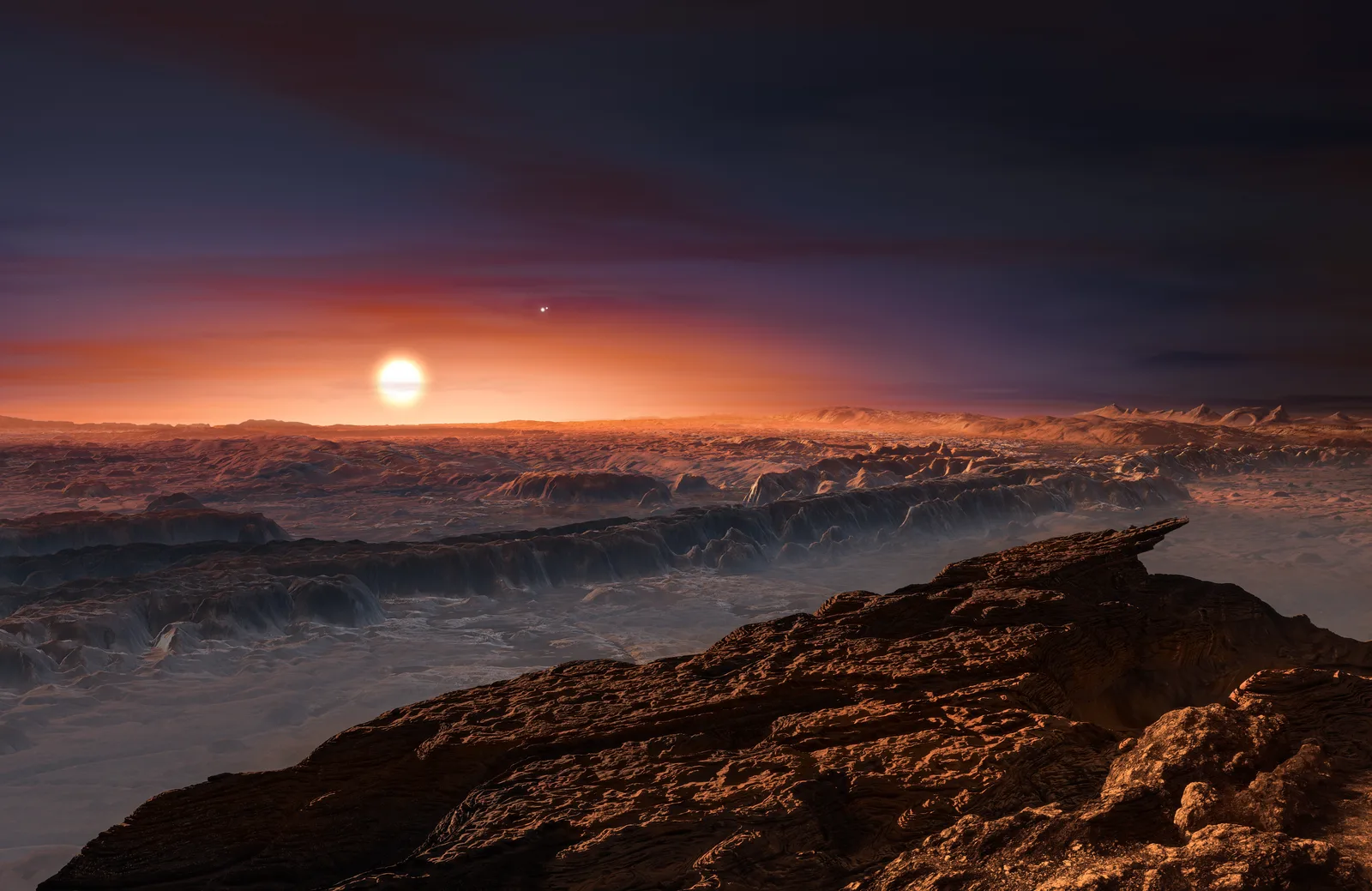
Four and a quarter light-years away, closer than any other star to our Sun, a faint red ember burns in the southern sky. Around it, every eleven days, a world roughly the mass of Earth completes an orbit. It sits at exactly the right distance for liquid water to pool on rock. By the cold arithmetic of the habitable zone, it is the most promising place we know of for life beyond the solar system. And it may be a scorched, airless husk.
A signal hidden in starlight
For decades, the nearest star to the Sun kept its secret. Proxima Centauri is a red dwarf, a star with roughly an eighth of the Sun's mass, so dim that it cannot be seen without a telescope despite being our closest stellar neighbor. Astronomers had long suspected that small, cool stars like it should host planets. Proving it required catching the star in the act of being tugged.
That is the radial velocity method: as a planet orbits, its gravity pulls the star in a small circle, and that motion shifts the wavelengths of the starlight toward the blue as the star approaches and toward the red as it recedes. The shifts are minuscule. For Proxima, the planet's pull moves the entire star at walking speed, a wobble of about 1.4 meters per second buried inside a star that constantly seethes with magnetic activity.
In 2016, a team led by Guillem Anglada-Escude ran a dedicated campaign called Pale Red Dot, a deliberate echo of Carl Sagan's pale blue dot, pointing the HARPS spectrograph at the European Southern Observatory's La Silla site at Proxima night after night. Combined with archival data, the observations revealed a clean periodic signal at 11.2 days. The result, published in Nature, announced a terrestrial planet candidate in a temperate orbit around the closest star to the Sun.
Searching for the closest potential Earth-analogue and succeeding has been the experience of a lifetime for all of us.
The planet was named Proxima Centauri b. By cosmic standards it is on our doorstep, at 4.2426 light-years. By any human standard it remains impossibly far, a distance that light itself takes more than four years to cross and that no spacecraft we have ever built could reach in less than tens of thousands of years.
What we actually know about Proxima b
The honest answer is: less than the headlines suggest. The radial velocity method measures only the minimum mass of a planet, because it cannot tell the difference between a light planet on an edge-on orbit and a heavier one tilted toward us. For Proxima b, that minimum mass is about 1.07 times the mass of Earth. The true mass is almost certainly higher, but probably not by a great deal.
The orbit is tight, with a semi-major axis of roughly 0.05 astronomical units, about five percent of the Earth-Sun distance and a fifth of Mercury's distance from the Sun. A planet that close to a Sun-like star would be a furnace. But Proxima is so faint that the same orbit places the planet squarely inside the habitable zone, the band where a rocky world with the right atmosphere could hold liquid water. The estimated equilibrium temperature, before accounting for any atmosphere, is around 234 kelvin, roughly minus 39 degrees Celsius, comparable to a cold Earth.
What we do not have is a direct view. Proxima b does not transit its star from our line of sight, so we cannot watch it cross the stellar disk to measure its radius or sample its atmosphere in transmitted light. Multi-year transit searches have found nothing. Everything we know about Proxima b comes from the gravitational nudge it gives its star, plus the physics we can infer from there. We do not know its size, its composition, whether it has an atmosphere, or whether it has water. We know it is there, it is small, and it is in the right place.
That uncertainty about size matters more than it might seem. A minimum mass of about 1.07 Earth masses is consistent with a rocky planet, but it does not rule out a world wrapped in a deep hydrogen envelope or a thick steam atmosphere, which would change everything about its surface. Whether Proxima b is a true Earth analogue, a miniature Neptune, or something stranger depends on a radius we have no way to measure today. The phrase Earth-like, attached so readily to the planet in headlines, rests on a single measured number and a great deal of hope.
The trouble with red dwarfs
The habitable zone is a seductively simple idea, a Goldilocks band where temperatures allow liquid water. Around a red dwarf, that simplicity breaks down. Because the star is so dim, the habitable zone sits extremely close in, and proximity carries consequences that have nothing to do with temperature.
The first is tidal locking. A planet orbiting that near to its star is gripped by tides strong enough to slow its rotation until one hemisphere faces the star permanently and the other faces eternal night. If Proxima b is tidally locked, as most models expect, it has no day and night cycle in the familiar sense. One side bakes under a fixed red sun; the other freezes in perpetual darkness. Whether such a world can remain habitable depends entirely on its atmosphere. A thick enough envelope of air could circulate heat from the day side to the night side and prevent the atmosphere from freezing out as ice on the dark hemisphere. Without it, the planet's air would migrate to the cold side and collapse.
The same proximity that warms the planet into the habitable zone also places it directly in the path of the star's fury.
The second consequence is the star's temperament. Red dwarfs are not the placid, slow-burning furnaces they are sometimes made out to be. They are magnetically violent, especially when young, and they stay active for billions of years. Proxima Centauri is a known flare star, and the flares are not small.
The day Proxima brightened fourteen thousand times
On May 1, 2019, a coordinated set of telescopes happened to be watching Proxima Centauri across the electromagnetic spectrum at once, from radio and millimeter wavelengths through the optical and into the far ultraviolet. They caught one of the most extreme stellar flares ever recorded from any star.
In a study led by Meredith MacGregor and published in the Astrophysical Journal Letters in 2021, the team reported that the star brightened by a factor of more than fourteen thousand in the far ultraviolet, as measured by the Hubble Space Telescope. The most violent burst lasted less than ten seconds. A flare like that, from a star that small, is a staggering release of energy aimed squarely at a planet orbiting only seven million kilometers away.
This matters because ultraviolet light and the energetic particles that often accompany flares are corrosive to atmospheres and to the molecules life would need. Repeated large flares can strip away a planet's protective ozone, then attack the atmosphere itself. The MacGregor team noted plainly that such events raise hard questions about whether planets around active red dwarfs can hold onto the conditions life requires.
Flares are only part of the assault. Red dwarfs drive dense, fast stellar winds, and a close-in planet sits inside that wind like a stone in a river. Modeling work by groups including those led by Ignasi Ribas and Cecilia Garraffo has shown that the stellar wind pressure on Proxima b can vary dramatically over a single orbit, repeatedly compressing whatever magnetic shield the planet might have. Over the lifetime of the system, ion-pickup erosion could carry off enormous quantities of atmospheric gas, potentially the equivalent of many Earth oceans' worth of hydrogen. Whether Proxima b began with enough atmosphere and water to survive that erosion, and whether it could replenish what it lost through volcanism, remains genuinely unknown.
There is also the matter of time. Red dwarfs spend hundreds of millions of years as bright, hyperactive stars before settling down, far longer than the Sun did. During that early phase, Proxima would have been more luminous and far more violent, and any planet in today's habitable zone would have been baked by intense radiation while its star was still contracting. A world might emerge from that gauntlet with its volatiles boiled off, its water lost to space as hydrogen escaped and oxygen was dragged away. Or it might survive with its inventory intact, or be resupplied by comets and asteroids from the outer system. The same red dwarf that offers a planet billions of years of stable warmth, far more than the Sun will ever grant Earth, may first force it to run a brutal early gauntlet that decides whether it can be habitable at all.
Proxima is not alone
The story grew more interesting as astronomers kept watching. Proxima b, it turns out, may have siblings.
In 2020, a team led by Mario Damasso reported a candidate second planet, Proxima c, from a long-period signal in the radial velocity data. The proposed world was a super-Earth of around six Earth masses on a wide orbit of roughly five years, far outside the habitable zone in the frigid outer reaches of the system. Independent astrometric analyses by Pierre Kervella and others, using the tiny side-to-side motion of the star, found tentative support and suggested a true mass somewhere in the range of a small Neptune. Yet Proxima c has never been confirmed. More recent campaigns, including infrared spectroscopy with the NIRPS instrument, have failed to reproduce the original signal cleanly, and its status remains uncertain.
The third candidate is on firmer footing. In 2022, a team led by Joao Faria, observing with the ultra-precise ESPRESSO spectrograph on ESO's Very Large Telescope, reported a signal at 5.12 days corresponding to a candidate sub-Earth, Proxima d. Its minimum mass is only about a quarter of Earth's, around twice the mass of Mars, making it one of the lightest exoplanets ever detected by radial velocity. The semi-amplitude of its signal is a mere 39 centimeters per second, slower than a stroll. Proxima d orbits even closer to the star than b, too hot for habitability, but its detection is a triumph of instrumental precision.
If all three hold up, the nearest star to the Sun hosts a compact planetary system: a sub-Earth, an Earth-mass world in the habitable zone, and possibly a cold outer super-Earth. The closest stellar neighbor we have is not a barren point of light. It is a place.
How do you study a world you cannot see?
Here is the frustration at the heart of Proxima b. It is the nearest exoplanet there is or ever can be, and we still cannot tell whether it has air. Because it does not transit, the most powerful technique for reading exoplanet atmospheres, watching starlight filter through them, is closed to us.
Astronomers are pursuing other routes. The James Webb Space Telescope can hunt for thermal emission, looking for the heat signature a substantial atmosphere would smear from the day side toward the night side, the same trick recently used to show that some other nearby rocky worlds are likely bare rock. Future giant ground-based observatories, including the Extremely Large Telescope now under construction in Chile, aim to image planets like Proxima b directly, separating the planet's faint reflected light from the glare of its star and reading its spectrum for oxygen, water, and other clues.
And then there is the most audacious idea of all: going there. The Breakthrough Starshot initiative has proposed accelerating gram-scale probes carried on light sails to around twenty percent of the speed of light, using an enormous ground-based laser array. At that speed, a probe could in principle cross the gulf to Proxima in roughly twenty years, then beam back images during a fleeting flyby. The engineering challenges are immense and largely unsolved, from the laser power required to the problem of surviving interstellar dust at relativistic speed. A probe moving at a fifth of light speed would cross the entire Proxima system in hours, with no chance to slow down, so any science would have to be gathered in a single high-speed pass and then transmitted back across four light-years on a sliver of power. It is a proposal, not a mission. But it is the first serious attempt to imagine reaching another star within a human lifetime, and its target is the world next door.
For now, Proxima b sits at the precise edge of what astronomy can do. It is close enough to obsess over and too far to resolve, a planet defined almost entirely by what we cannot yet measure. Every improvement in spectrographs, every new telescope, every modeled scenario of its atmosphere is in some sense a rehearsal for the day we can finally answer the question its discovery posed: is the nearest world to our own alive, dead, or something we do not yet have a word for.
The nearest possibly-living world to our own may already be dead, killed by the very star that warms it. We will not know until we look closer, and looking closer at a world we can barely detect is the defining challenge of the next century of astronomy.
Frequently Asked Questions
How far away is Proxima Centauri b?
Proxima Centauri b orbits Proxima Centauri, the closest star to the Sun, at a distance of 4.2426 light-years. That is the nearest any known exoplanet can be, because Proxima is itself the nearest star. Even so, the distance is about 40 trillion kilometers, far beyond the reach of any current spacecraft.
Is Proxima Centauri b habitable?
It is uncertain, and habitability is not confirmed. The planet orbits within the zone where liquid water could exist on a rocky surface, but its host star is a violently active red dwarf whose flares and stellar wind may have stripped away any atmosphere. Without an atmosphere, the planet cannot be habitable. We do not yet know whether it has one.
Could life survive Proxima Centauri's flares?
That is the central open question. In 2019, the star brightened more than fourteen thousand times in the ultraviolet during a single flare. Repeated events like that can destroy a planet's ozone and erode its atmosphere, which would be hostile to surface life. Whether life could persist underground, under ice, or under a thick protective atmosphere is unknown.
How many planets orbit Proxima Centauri?
One is confirmed, Proxima b, an Earth-mass planet in the habitable zone. A candidate sub-Earth called Proxima d, with about a quarter of Earth's mass, was reported in 2022 and is well supported. A third candidate, the super-Earth Proxima c on a wide orbit, remains unconfirmed and recent observations have not reliably reproduced its signal.
Why can't we see Proxima Centauri b directly?
Proxima b does not pass in front of its star from our viewpoint, so we cannot study it by transit. It is also far too faint and too close to its bright star to image with current telescopes. We know it exists only from the small gravitational wobble it induces in Proxima Centauri, measured through tiny shifts in the star's light.
Can we send a spacecraft to Proxima Centauri b?
Not yet. The Breakthrough Starshot concept proposes laser-driven light sails reaching about twenty percent of the speed of light, which could cross the distance in roughly twenty years. The technology does not exist today and faces severe engineering hurdles. With conventional rockets, a journey would take tens of thousands of years.
Continue Exploring
- The Coldest World We Have Ever PhotographedAlmost every planet we have imaged directly is a young, glowing furnace. Then JWST captured a mature, frigid...
- Two Planets Caught in the Act of Being BornAround a young Sun-like star called WISPIT 2, astronomers have directly imaged a gas giant glowing inside a dark gap in...
- The World That Breathes SulfurThirty-five light-years away, the super-Earth L 98-59 d has no solid ground. A permanent ocean of magma feeds a sky...
- The Planets That Drift Through the DarkUntethered to any star, rogue worlds may outnumber the suns of the Milky Way. Here is how astronomers find the...
Sources
- Anglada-Escude et al. (2016). "A terrestrial planet candidate in a temperate orbit around Proxima Centauri (Nature)." link.
- ESO (2016). "Planet Found in Habitable Zone Around Nearest Star (eso1629)." link.
- MacGregor et al. (2021). "Discovery of an Extremely Short Duration Flare from Proxima Centauri (ApJL 911, L25)." link.
- Faria et al. (2022). "A candidate short-period sub-Earth orbiting Proxima Centauri (A&A 658, A115)." link.
- Damasso et al. (2020). "A low-mass planet candidate orbiting Proxima Centauri at a distance of 1.5 AU (Science Advances)." link.
- Ribas et al. (2016). "The habitability of Proxima Centauri b I. Irradiation, rotation and volatile inventory (A&A 596, A111)." link.
- Breakthrough Initiatives. "Breakthrough Starshot mission overview." link.