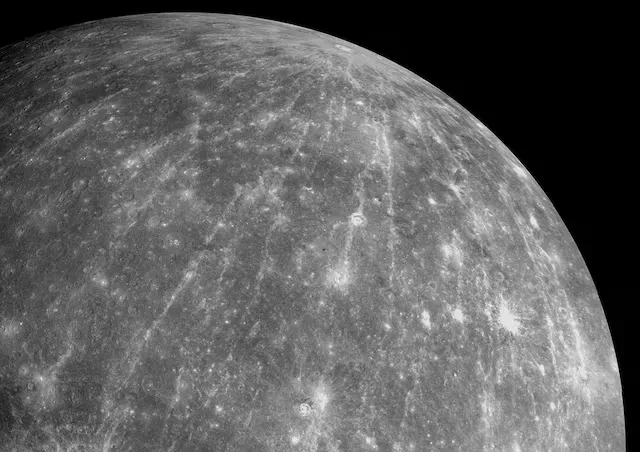
Forty-eight and a half light-years from here, a world the size of a slightly oversized Earth turns one face forever toward its star. There is no dawn on that face and no dusk on the other. The dayside is hot enough to soften stone. The nightside is a frozen vault that has never seen light. Between them, no wind moves, because there is no air to move. For years, astronomers suspected this was the case. In the spring of 2026, the James Webb Space Telescope did something no instrument had done before: it looked past the suspicion and read the planet's actual surface, mineral by mineral, and found exactly what the absence of an atmosphere implied. A dark, hot, barren rock.
A Planet We Knew Almost Nothing About
The story of LHS 3844 b begins in 2018, when NASA's Transiting Exoplanet Survey Satellite caught a faint, repeating dip in the light of a small red star. Roland Vanderspek of MIT and a large team reported the find that September: an ultra-short-period planet circling a nearby M dwarf, completing a full orbit every eleven hours. The planet measured 1.32 times the radius of Earth, a so-called super-Earth, and it sat so close to its star that its surface temperature should be brutal. The star itself, LHS 3844, is a cool red dwarf of spectral class roughly M4.5 to M5, carrying only about fifteen percent of the Sun's mass, and it lies about fifteen parsecs away, which works out to 48.5 light-years.
That was the entire picture for a while. A size, an orbit, a star. What lay on the planet's surface, whether it held any air at all, remained a blank. And for a world this close to a small, active star, the question of air is not a footnote. It is the whole story.
Red dwarfs are the most common stars in the galaxy, and they are also temperamental. They flare. They throw out stellar wind. A planet locked in an eleven-hour orbit sits inside that storm, and whether it can hold an atmosphere against that erosion is one of the central questions in the search for habitable worlds. Most potentially Earth-like planets we can study orbit red dwarfs, because those small stars make small planets easy to detect. If red dwarf planets cannot keep their air, the field narrows dramatically. The same question hangs over the seven rocky worlds of TRAPPIST-1, the most studied red-dwarf system of all.
The First Hard Answer Came From a Dying Telescope
In 2019, before Webb existed in orbit, the aging Spitzer Space Telescope took the first serious measurement of LHS 3844 b. Laura Kreidberg, then at Harvard and now a director at the Max Planck Institute for Astronomy, led the work, published in Nature. The technique was elegant. Rather than try to catch starlight filtering through an atmosphere, the team watched the planet's own heat as it swept around its star, building what astronomers call a thermal phase curve.
The logic is simple. If a planet has a thick atmosphere, winds carry heat from the scorching dayside around to the nightside, smearing the temperature out and shifting the planet's brightest point away from the substellar spot. If it has no atmosphere, the dayside bakes in place and the nightside stays dark and cold, and the heat map stays sharp and symmetric.
LHS 3844 b's heat map was sharp. Spitzer measured a dayside brightness temperature of 1,040 kelvin, give or take 40, an essentially undetectable glow from the nightside, and a phase curve offset consistent with zero. The data fit a bare rock with low reflectivity, a Bond albedo below 0.2. Thick atmospheres, anything above ten bar of surface pressure, were ruled out. The paper's conclusion was careful but unmistakable: any substantial atmosphere this planet might once have had was likely scoured away by its star's wind.
The dayside baked in place and the nightside stayed dark. There was no wind to move the heat, because there was no air.
That was a powerful result, but it left a gap. Spitzer measured temperature. It inferred the absence of air. It could not say what the rock itself was made of, and it could not fully close the door on a thin, wispy envelope of gas hiding below its sensitivity. Reading the surface required a different machine.
What Webb Actually Did
In May 2026, a team led by Sebastian Zieba of the Center for Astrophysics, Harvard and Smithsonian, together with Kreidberg and an international group, published in Nature Astronomy what amounts to the first direct spectroscopic look at the surface of a rocky world beyond our solar system. They used Webb's Mid-Infrared Instrument, MIRI, to capture the planet's thermal emission across roughly five to twelve microns, the band where warm minerals reveal their chemical fingerprints.
Different rocks emit infrared light differently. A surface rich in silica, the stuff of granite and Earth's continents, leaves one kind of signature. A dark, low-silica surface, the kind you get from basalt or olivine-rich mantle rock, leaves another. By spreading the planet's glow into a spectrum, the team could ask not just how hot the surface is but what it is.
The answer: a dark, low-silica surface, best matched by basalt or other olivine-rich materials. Not the granitic continental crust of Earth. Something closer to a cooled lava plain, or to the volcanic plains of the Moon and Mercury. The spectrum is featureless and dark, the signature of an old, weathered rock rather than fresh mineral powder.
The Atmosphere Question, Closed
The thermal data did more than identify rock. The temperature distribution across the dayside matched a bare rock model with no atmospheric heat redistribution, confirming and sharpening the Spitzer result. This time the constraints were tighter. The data disfavored even trace amounts of gas, setting upper limits of 100 millibar on carbon dioxide at the five-sigma level and just 10 microbar on sulfur dioxide at three sigma.
To put that in perspective, ten microbar is about a hundred-millionth of Earth's sea-level pressure. The team was not merely ruling out a thick atmosphere; they were ruling out the faint volcanic exhalations that an active rocky planet might leave hanging above its surface. LHS 3844 b shows no sign of accumulated volcanic gas, no whisper of an envelope. It is, as Kreidberg put it, a dark, hot, barren rock, devoid of any atmosphere.
We see a dark, hot, barren rock, devoid of any atmosphere.
There is a subtlety worth holding onto. The featureless, dark spectrum could in principle come from a surface ground into fine powder, but fresh powder tends to be too bright and reflective to match the data. The reconciliation is space weathering. With no air to shield it, the surface has been bombarded for ages by cosmic radiation, stellar particles, and micrometeorite impacts, the same processes that darken and chemically alter the lunar regolith. Weathering darkens the powder until it fits what Webb sees. The planet's surface, in other words, carries the visible scars of having no atmosphere to hide behind.
A Mirror Held Up to the Search for Life
It would be easy to file LHS 3844 b under disappointment. No air, no water, no chance of life, a dead slab orbiting an unremarkable red star. But that reading misses why the result matters. This planet is a controlled experiment the galaxy ran for us.
The biggest open question hanging over the search for life is whether rocky planets around red dwarfs can keep their atmospheres. If they cannot, then the most numerous worlds in the galaxy, including many in the so-called habitable zones of their stars, may be airless and sterile regardless of where they orbit. LHS 3844 b is an extreme test case: very close to its star, drenched in radiation, with an eleven-hour year. It lost. And by losing in a way we can now measure down to micro-bar precision, it tells us what total atmospheric stripping actually looks like in a JWST spectrum.
That template is the real prize. When Webb turns to cooler, less irradiated red dwarf planets, the ones in temperate orbits where an atmosphere might survive, astronomers will need to know how to tell a truly bare rock from a planet clinging to a thin shell of gas. LHS 3844 b is the calibrated example of the first case. It is the bare rock against which every ambiguous future spectrum will be compared.
It also extends a method. For decades, exoplanet science has been an atmospheric science, reading worlds by the gases above them. Now, for the first time, we can read a world by its ground. Surface mineralogy joins the toolkit. A dark basalt plain on a planet half a hundred light-years away is no longer an inference. It is a measurement.
The World That Tells Us What to Look For
Stand on LHS 3844 b's dayside, if you somehow could, and you would find no sky in any familiar sense. The star would hang motionless overhead, never rising, never setting, a deep red disk pinned to a black vault. The rock beneath your feet would glow near a thousand kelvin, hot enough to soften certain minerals. Behind you, beyond the line where the star never reaches, the nightside would fall away into a cold so deep and so old it has been undisturbed since the planet formed. Nothing would move. No breath of wind, no drifting cloud, no weather of any kind, because the one thing every living world needs, an atmosphere to carry heat and shield the ground, was stripped away long ago and never returned.
We have now seen that surface with our own instruments. We have read its rock and confirmed its silence. And in that silence is a lesson sharper than any habitable-world headline: we now know, in precise detail, what a planet looks like when it has lost everything. That knowledge is exactly what we will need when we find one that has not.
For the first time, we have read a planet by its rock rather than its air. And the bare, silent ground of LHS 3844 b is exactly the measuring stick we will hold up to the next world that still has something to lose.
Frequently Asked Questions
What is LHS 3844 b?
LHS 3844 b is a rocky super-Earth about 1.3 times the radius of Earth, orbiting a cool red dwarf star roughly 48.5 light-years away. It circles its star every eleven hours and is tidally locked, with one side in permanent daylight and the other in permanent night.
Why is the 2026 JWST result a first?
It is the first time astronomers have directly characterized the surface composition of a rocky exoplanet using mid-infrared spectroscopy. Earlier studies inferred conditions from a planet's heat or its atmosphere. Webb's MIRI instrument read the actual mineral fingerprint of LHS 3844 b's ground, identifying it as dark, low-silica basalt or olivine-rich rock.
Does LHS 3844 b have an atmosphere?
No. The Webb data match a bare rock model and rule out even trace gases, with upper limits of 100 millibar of carbon dioxide and just 10 microbar of sulfur dioxide. This confirms and tightens a 2019 Spitzer result that had already ruled out any thick atmosphere.
What did the earlier Spitzer study find?
In 2019, a team led by Laura Kreidberg used the Spitzer Space Telescope to measure the planet's thermal phase curve. They found a dayside temperature of about 1,040 kelvin, no detectable heat on the nightside, and a symmetric heat map, all signs of a planet with little or no atmosphere likely eroded by its star's wind.
Why does an airless dead planet matter for the search for life?
Most potentially Earth-like planets we can study orbit red dwarfs, and the central question is whether such planets can keep their atmospheres against stellar radiation. LHS 3844 b is a clear case of total atmospheric loss, giving scientists a precise template for what a truly bare rock looks like, which they will need to recognize when studying more temperate worlds that may still hold air.
What is space weathering and why does it appear here?
Space weathering is the gradual darkening and chemical alteration of a surface exposed to cosmic radiation, stellar particles, and micrometeorite impacts, with no atmosphere for protection. It is the same process that darkens the Moon's soil, and it explains why LHS 3844 b's surface appears so dark and featureless in Webb's spectrum.
Continue Exploring
- The Planet That Almost Had a Sign of LifeIn 2025, a team announced a gas in a distant world's air that, on Earth, is made almost only by living things. Then the...
- Two Planets Caught in the Act of Being BornAround a young Sun-like star called WISPIT 2, astronomers have directly imaged a gas giant glowing inside a dark gap in...
- The Habitable World Next Door That Its Star May Have SterilizedProxima Centauri b orbits the closest star to the Sun, inside the zone where liquid water could exist. The problem is...
- The Planet That Webb Actually PhotographedAround a bright star in Cygnus, the James Webb Space Telescope blocked the glare of the star itself and captured the...
- The Planets That Drift Through the DarkUntethered to any star, rogue worlds may outnumber the suns of the Milky Way. Here is how astronomers find the...
Sources
- Zieba, Kreidberg et al. (2026). "The dark and featureless surface of rocky exoplanet LHS 3844 b from JWST mid-infrared spectroscopy, Nature Astronomy." link.
- Zieba, Kreidberg et al. (2026). "Preprint: The dark and featureless surface of rocky exoplanet LHS 3844 b (arXiv:2605.00100)." link.
- Max Planck Institute for Astronomy (2026). "A barren, rocky exoplanet with no protection from cosmic radiation." link.
- Kreidberg et al. (2019). "Absence of a thick atmosphere on the terrestrial exoplanet LHS 3844b, Nature 573, 87-90." link.
- Kreidberg et al. (2019). "Preprint: Absence of a thick atmosphere on the terrestrial exoplanet LHS 3844b (arXiv:1908.06834)." link.
- Vanderspek et al. (2019). "TESS Discovery of an Ultra-short-period Planet around the Nearby M Dwarf LHS 3844 (arXiv:1809.07242)." link.
- Harvard Gazette (2019). "Harvard astronomer shows exoplanet has no atmosphere." link.