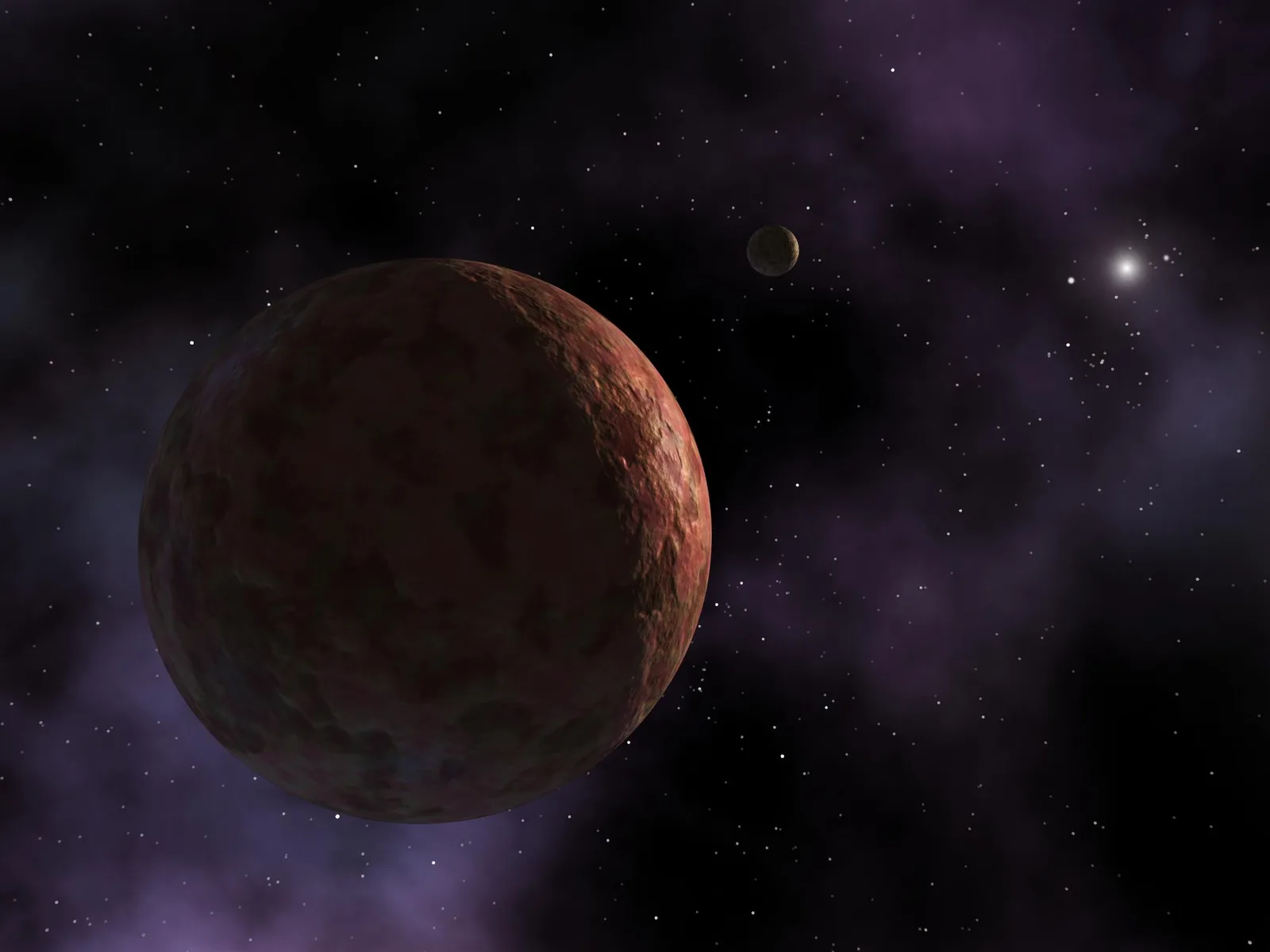
In the cold dark beyond Neptune, a few dozen frozen worlds drift along orbits so vast that a single lap around the Sun can take ten thousand years or more. They are too faint to see without the largest telescopes, too distant to feel any meaningful tug from the known planets. And yet, when astronomers plotted the most remote of them, something strange emerged. Their long elliptical orbits do not point in random directions. They lean the same way, like compass needles answering to a magnet no one can find.
A clue written in orbits
The objects in question are extreme trans-Neptunian objects, or ETNOs: icy bodies whose closest approach to the Sun keeps them well outside Neptune's gravitational reach, on orbits stretched so far that the Sun becomes a bright star rather than a disk. Because Neptune does not herd them, their orbits should drift apart over billions of years, scattering into every orientation. Random is what physics predicts. Random is not what the sky shows.
In January 2016, Konstantin Batygin and Michael Brown of the California Institute of Technology published a paper in The Astronomical Journal arguing that the alignment was real and that it demanded an explanation. They noticed that the most distant ETNOs cluster in two ways at once. Their longitudes of perihelion, the direction in which each orbit reaches its closest point to the Sun, were grouped together. And the planes of their orbits were tilted in a shared direction, their angular momentum vectors pointing roughly the same way. Two coincidences stacked on top of each other are harder to dismiss than one.
Their long elliptical orbits do not point in random directions. They lean the same way, like compass needles answering to a magnet no one can find.
Batygin and Brown proposed a cause. A massive, distant planet, they argued, could gravitationally shepherd these small bodies, locking their orbits into the observed pattern over the age of the solar system. The idea was not new in spirit. Astronomers had hunted for planets beyond Neptune since before Pluto was found in 1930. But this was the first time the case rested not on a wobble in a known planet's motion but on the collective geometry of a population of distant debris. The unseen world acquired a name: Planet Nine.
The mechanism they described is subtle. A distant planet on a tilted, eccentric orbit does not simply drag the small bodies along behind it. Instead, over millions of orbits, its gravity slowly torques their orbits, nudging the orientations into a stable configuration that resists the scattering that randomness would otherwise impose. Some of the distant bodies end up with orbits anti-aligned to the planet, swept into resonances that protect them from close encounters. The pattern that emerges is not arbitrary. It is the signature a particular kind of planet, on a particular kind of orbit, would be expected to leave behind. That specificity is what gives the hypothesis testable teeth.
The shape of a ghost
A hypothesis is stronger when it makes specific predictions, and Planet Nine does. Over the years that followed, Brown and Batygin refined their estimate of what the planet would have to be to produce the observed clustering. In their 2021 analysis, also published in The Astronomical Journal, they put its mass at about 6.2 times that of Earth, with an uncertainty that allows for a few Earth masses more or less. That places it in the category of a small Neptune or a large super-Earth, the most common size of planet found around other stars and, conspicuously, a size missing from our own solar system.
The predicted orbit is enormous. The 2021 estimate gives a semimajor axis of roughly 380 astronomical units, where one astronomical unit is the distance between Earth and the Sun. Its closest approach to the Sun, the perihelion, sits near 300 astronomical units, almost ten times farther than Neptune. The orbit is tilted about 16 degrees from the plane in which the major planets travel. A world on such a path would take something like ten thousand years to complete a single orbit, and for most of that time it would be far enough out to receive almost no sunlight at all.
That distance is precisely why Planet Nine, if it exists, has gone undetected. Sunlight falls off with the square of distance on the way out, then is reflected and falls off again on the way back, so the brightness of a sunlit body in the outer solar system drops with the fourth power of its distance. A planet four hundred times farther than Earth would be hundreds of millions of times fainter in reflected light than it would be up close. It would hide not in the dark between the stars but in plain sight, a dim point lost among countless background sources, moving so slowly across the sky that a single night's observation could not separate it from a fixed star.
The case against a planet
For every argument that the clustering reveals a hidden world, there is a counterargument that it reveals something about the astronomers instead. The most serious challenge is observational bias. We do not survey the whole sky uniformly. Telescopes point where it is convenient, during seasons and at times that favor certain regions, and a faint distant object is easiest to catch near the part of its orbit where it is closest to the Sun and therefore brightest. If the surveys that found these objects happened to look hardest in particular directions, they could manufacture an apparent clustering out of a population that is actually spread evenly.
This is not a hypothetical worry. The Outer Solar System Origins Survey, or OSSOS, was designed from the start to track its own biases with precision, recording exactly where and when it looked so that the selection effects could be modeled rather than guessed. In 2017, Cory Shankman and colleagues published an analysis in The Astronomical Journal of the large, distant objects OSSOS had found. Their detections, an independent sample of comparable size to the ones Batygin and Brown relied on, showed no statistically significant clustering once the survey's biases were accounted for. The authors concluded that the apparent alignment could be an artifact of where humans had chosen to look.
The clustering could reveal a hidden world. Or it could reveal something about the astronomers instead.
There is a second alternative that requires no large planet at all. In 2019, Antranik Sefilian and Jihad Touma proposed in The Astronomical Journal that the combined gravity of a massive disk of small trans-Neptunian bodies, a few to ten times the mass of Earth spread between roughly 40 and 750 astronomical units, could shepherd the distant orbits into their observed pattern through self-gravity alone. In this picture there is no single dominant world doing the herding. The crowd herds itself. The trade is that such a disk would need far more mass in small bodies than current estimates of the outer solar system suggest, which is its own difficulty.
Brown and Batygin have pushed back on the bias argument. In their 2021 work they recalculated the observational selection effects for the objects in their sample and reported that the clustering survived, remaining significant at roughly the 99.6 percent confidence level. The disagreement is not about the data so much as about how thoroughly the surveys that produced it can be trusted to be unbiased. That is a hard question to settle with the patchwork of observations made so far. It is the kind of question that only a uniform survey of the whole sky can answer.
Candidates in the cold
While the statistical debate continued, other teams went looking for the planet directly, and they tried a clever inversion of the brightness problem. A planet that is nearly invisible in reflected sunlight would still glow faintly in the far infrared from its own internal and residual heat. Crucially, that thermal glow fades only with the square of distance, not the fourth power, because the planet is the source rather than a mirror. The infrared sky, surveyed decades ago, might already hold the planet's fingerprint if anyone looked carefully enough.
In 2025, a team led by Amos Chen searched the all-sky data from the Japanese AKARI satellite, a far-infrared survey sensitive to exactly the kind of cold thermal emission Planet Nine would produce. The strategy was to find a source that stayed put over a single day, ruling out fast-moving asteroids, but shifted position over months as it crept along its orbit. The team reported two candidate sources whose brightness and location fell within the range theory predicts for Planet Nine. A related effort compared AKARI data against the older IRAS survey from 1983, looking for a point of light that had moved across the more than two decades separating the two missions.
It is important to be precise about what these candidates are. They are not a discovery. The teams themselves stress that the physical properties of the sources are poorly constrained, because the observed infrared brightness depends on a tangle of unknown factors, the planet's size, temperature, and exact distance among them. The candidates warrant follow-up, nothing more. A single confirmed detection at a second epoch, showing the right slow motion against the fixed stars, would change everything. So far, that confirmation has not come.
The history of the outer solar system is littered with such tantalizing near-misses. Decades of searches have turned up plausible candidates that dissolved on closer inspection, revealed as background galaxies, image artifacts, or known objects misidentified. The infrared approach is genuinely promising precisely because it sidesteps the fourth-power brightness penalty that cripples optical searches, but it inherits its own problem: the far-infrared sky is crowded with cold dust and faint sources, and pulling a single slow-moving planet out of that haze demands extraordinary care. A candidate that survives that scrutiny is worth pursuing. It is not the same as a planet found.
The telescope built to settle it
The instrument most likely to end the argument one way or the other is now open. The Vera C. Rubin Observatory in Chile, which captured its first light images in June 2025, is built to photograph the entire visible southern sky every few nights, again and again, for ten years. Its central method is exactly what finding Planet Nine requires: take an image, compare it to every previous image of the same patch of sky, and flag anything that has moved. A faint planet creeping along its orbit would reveal itself not by its brightness but by its motion, the same way Clyde Tombaugh found Pluto in 1930 by comparing photographic plates taken nights apart.
Astronomers estimate that if Planet Nine exists within the predicted range of distances and brightnesses, Rubin has a strong chance, by some assessments on the order of 70 to 80 percent, of detecting it within the first years of its survey. The caveats are real. If the planet is smaller, darker, or farther than expected, it could sit at the very edge of Rubin's reach or beyond it. But the survey will not only look for the planet itself. By cataloging thousands of new distant objects with carefully characterized biases, it will test whether the orbital clustering is real or an illusion. Either outcome advances the question. A clean, unbiased sample that still shows alignment would strengthen the case for an unseen mass. A sample that shows none would dissolve the central evidence.
A faint planet would reveal itself not by its brightness but by its motion, the same way Pluto was found in 1930.
What an absence would mean
It is worth holding both possibilities in mind. If Rubin finds Planet Nine, the solar system gains a fifth giant, a world that has been part of our system since its formation and that we simply never noticed, hiding in the dark for the entire span of human astronomy. It would reshape models of how the planets formed and migrated, and it would explain the strange size gap between Earth and Neptune by filling it with a body that was flung to the outer dark early in the solar system's history.
If Rubin looks and finds nothing, that is not failure but resolution. It would mean the clustering was a trick of the light, a pattern our partial view of the sky painted onto a population that is actually scattered at random, or that the orbits are shaped by a self-gravitating disk rather than a single planet. The Sun would keep its eight planets, and the mystery would migrate from the outer solar system into the methods we used to study it. Both answers are valuable. Only one thing is certain: after a decade of argument conducted across statistics and simulations, the question is finally passing into the hands of an instrument that can look the whole sky in the eye. The frozen worlds will keep leaning the same way regardless. Soon we will know whether anything is pulling them.
The frozen worlds will keep leaning the same way regardless. Soon we will know whether anything is pulling them.
Frequently Asked Questions
What is Planet Nine?
Planet Nine is a hypothesized planet, not yet observed, proposed to orbit far beyond Neptune in the outer solar system. Astronomers Konstantin Batygin and Michael Brown introduced it in 2016 to explain why a group of distant icy bodies trace orbits that appear to be aligned. It remains an open question rather than a confirmed discovery.
How big is Planet Nine supposed to be?
The leading 2021 estimate from Brown and Batygin puts its mass at about 6.2 times that of Earth, give or take a few Earth masses. That would make it a small Neptune or large super-Earth, the most common planet size found around other stars but absent from our own solar system.
How far away would Planet Nine be?
The predicted orbit has a semimajor axis near 380 astronomical units, where one astronomical unit is the Earth-Sun distance, and a closest approach to the Sun near 300 astronomical units. That is roughly ten times farther than Neptune, and a single orbit would take on the order of ten thousand years.
Why has no one seen it yet?
At hundreds of times Earth's distance, a sunlit body's brightness drops with the fourth power of distance, making Planet Nine hundreds of millions of times fainter than it would be up close. It would appear as a dim point moving very slowly against the background stars, easily mistaken for a fixed object in any single observation.
Could the aligned orbits have another explanation?
Yes. One leading alternative is observational bias: surveys that look hardest in particular directions could create an apparent clustering from a randomly spread population. The 2017 OSSOS analysis by Shankman and colleagues found no significant clustering in its own well-characterized sample. A 2019 study by Sefilian and Touma proposed that the self-gravity of a massive disk of small distant bodies could shepherd the orbits with no large planet required.
Can the Vera Rubin Observatory find Planet Nine?
It has a strong chance. The observatory, which reached first light in 2025, images the entire southern sky repeatedly and flags anything that moves between exposures, the ideal method for spotting a slow-moving planet. If Planet Nine sits within its predicted brightness range, estimates give Rubin roughly a 70 to 80 percent chance of detecting it within the first years of its decade-long survey.
Continue Exploring
- The Comet That Was Almost GreatIt was billed as the great comet of 2026, a naked-eye visitor from the deep. It delivered a modest glow instead, and in...
- The Third Zone of the Solar SystemBeyond Neptune lies a broad ring of icy worlds that no one confirmed until 1992. It reset the definition of a planet...
- The Dust That May Solve the Sun's Hottest MysteryThe Sun's outer atmosphere is hundreds of times hotter than its surface, and nobody is sure why. Parker Solar Probe...
- The Frozen Shell at the Edge of the Sun's ReachFar beyond Pluto and the Kuiper Belt, the solar system may end in a vast spherical cloud of icy bodies reaching nearly...
- We Live Inside the Wreckage of Exploded StarsA thousand light-years across, the Local Bubble is a cavity blown into the galaxy by a string of ancient supernovae....
Sources
- Batygin & Brown (2016). "Evidence for a Distant Giant Planet in the Solar System (AJ 151, 22)." link.
- Brown & Batygin (2021). "The Orbit of Planet Nine (AJ 162, 219)." link.
- Shankman et al. (2017). "OSSOS VI. Striking Biases in the Detection of Large Semimajor Axis Trans-Neptunian Objects (AJ 154, 50)." link.
- Sefilian & Touma (2019). "Shepherding in a Self-gravitating Disk of Trans-Neptunian Objects (AJ 157, 59)." link.
- Chen et al. (2025). "A Far-Infrared Search for Planet Nine Using AKARI All-Sky Survey (PASA)." link.
- NPR / Vera C. Rubin Observatory (2025). "If Planet Nine is out there, this telescope might actually find it." link.