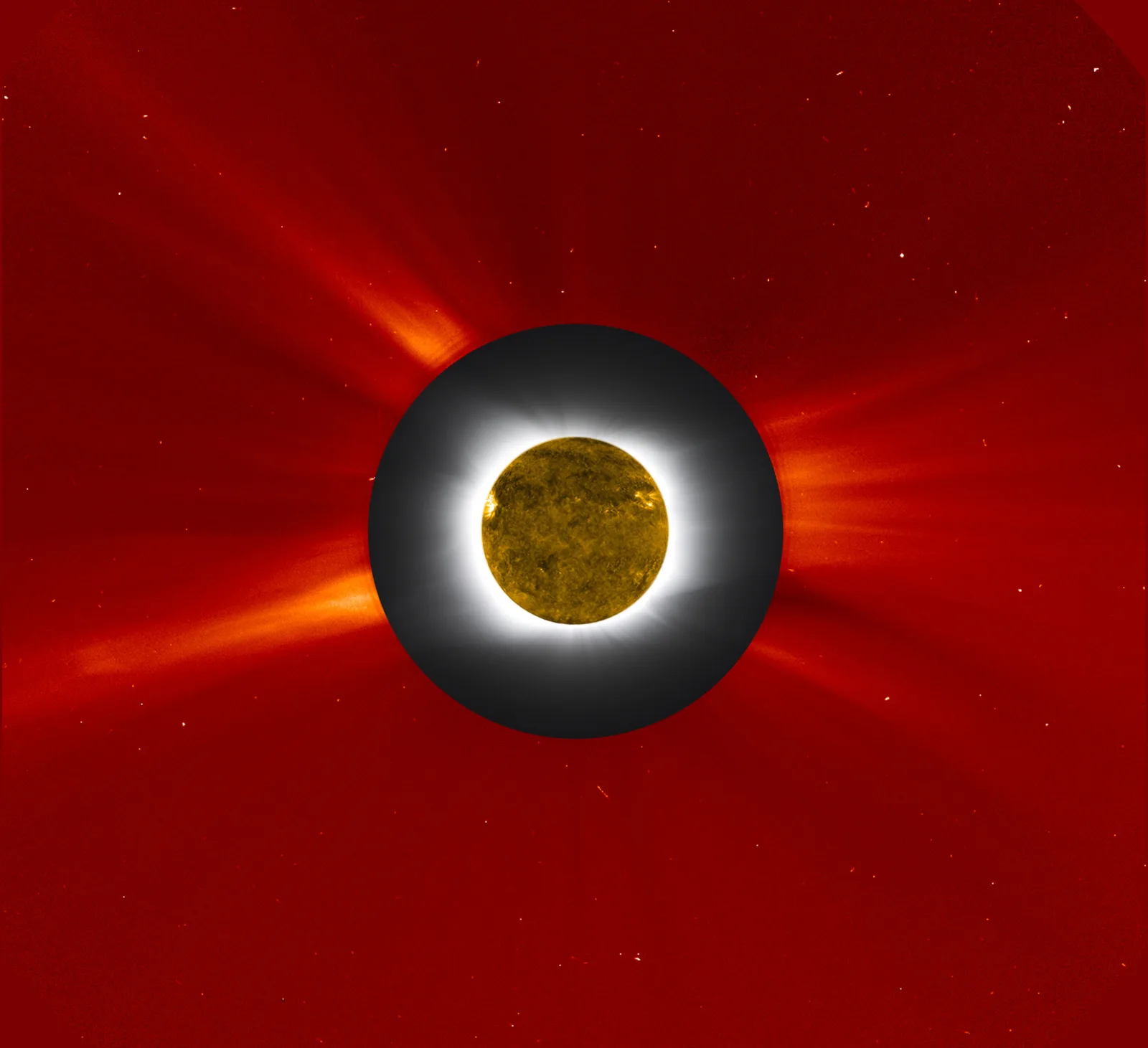
Move away from a fire and it gets cooler. This is one of the most basic intuitions we have about heat. The Sun breaks it. Its visible surface simmers at around 5,500 degrees Celsius, hot enough to boil any material we know. But rise up into the wispy outer atmosphere above it, the pearly halo called the corona that you can see during a total eclipse, and the temperature does not fall. It soars, to one, two, even three million degrees. The farther you get from the surface, the hotter it becomes. Something up there is pumping in energy, and for more than eighty years, no one has been able to say exactly what.
The puzzle is called the coronal heating problem, and it is one of the great unsolved questions in the physics of stars. In 2026, a team working with data from NASA's Parker Solar Probe, the spacecraft that has flown closer to the Sun than any object in history, proposed a new ingredient that earlier work had almost entirely ignored: dust.
A fire that burns hotter above the flames
The corona should not be hotter than the surface. Heat, left to itself, flows from hot to cold, so a corona heated only by the surface below it could never exceed that surface's temperature. The gap of nearly a million degrees means energy is being delivered to the corona by some other route, and then dumped there as heat. The two leading suspects have long been the Sun's magnetic field, which can store and release enormous energy, and waves rippling through the electrically charged gas, or plasma, that fills the corona.
Among those waves, one kind matters most for carrying energy outward: kinetic Alfvén waves, disturbances that travel along magnetic field lines like vibrations along a plucked string. If you can explain how those waves deposit their energy into the plasma, you go a long way toward explaining the corona's impossible heat. For decades, the models focused almost exclusively on the plasma's protons, electrons, and magnetic fields. They left something out.
The farther you rise above the Sun's surface, the hotter it gets. Heat is not supposed to work that way.
The dust nobody accounted for
Space near the Sun is not empty. It is threaded with fine grains of dust, the debris of comets and asteroids ground down over the age of the solar system. Parker Solar Probe does not carry a dedicated dust detector, but it senses the grains anyway. Its FIELDS instrument registers sharp voltage spikes each time a dust particle slams into the spacecraft and vaporizes, a tiny flash of plasma the electronics can read. Flying through the corona, Parker has effectively been counting dust the whole time.
The new study, led by Syed Ayaz and Gary Zank of the University of Alabama in Huntsville and published in The Astrophysical Journal, asked what that dust does to the waves carrying heat through the corona. The answer is that dust is not a passive bystander. Because the grains pick up electric charge in the plasma, they couple to the kinetic Alfvén waves and change how those waves behave.
How a speck of dust heats a star's atmosphere
The team found that dust pulls in two directions at once. On one hand, the mass of the grains acts like added inertia, a heaviness that slows the kinetic Alfvén waves down and lets them carry their energy farther before releasing it. On the other, the charge on the grains strengthens the interaction between the wave, its electric field, and the surrounding charged particles, which can concentrate energy and drive localized heating. Dust, in other words, can both spread heat out and pump it into specific spots, tuning where and how the corona warms.
It is a small effect from a small thing, but the corona is vast, and even a modest new channel for moving and depositing energy changes the accounting. For a problem this stubborn, adding a genuinely new variable, one that had been assumed too minor to bother with so close to the Sun, is a meaningful shift.
Not the whole answer, but a new piece
No one is claiming dust alone solves the coronal heating problem. The Sun's magnetism and its plasma waves remain at the center of the story. What the Parker result does is widen the frame. It shows that the tenuous dust drifting through the Sun's atmosphere is not just passive litter but an active participant in the plasma physics, capable of nudging the very waves that keep the corona blazing. Decades of models built around clean plasma may need to make room for the grit.
That is fitting for a mission built to fly into the fire and report back. Parker Solar Probe was sent to touch the Sun precisely because the corona could not be understood from a distance. Each pass returns data no telescope on Earth could gather, and each surprise, even one as humble as dust, chips away at a mystery that has outlasted generations of solar physicists.
The answer to why a star's atmosphere burns hotter than its surface may lie, in part, in the ash drifting through it.
Frequently Asked Questions
What is the coronal heating problem?
It is the long-standing puzzle of why the Sun's corona, its outer atmosphere, reaches temperatures of 1 to 3 million degrees Celsius while the surface below is only about 5,500 degrees. Heat should not flow from the cooler surface to the hotter corona, so some other mechanism must be delivering energy upward.
How does dust affect the Sun's corona?
Fine dust grains in the corona pick up electric charge and interact with kinetic Alfvén waves, the plasma waves that carry energy through the Sun's atmosphere. According to a 2026 study, the grains' mass slows the waves and spreads their energy, while their charge can concentrate energy and drive localized heating.
How does Parker Solar Probe detect dust?
Parker has no dedicated dust detector. Its FIELDS instrument records sharp voltage spikes when a dust grain strikes the spacecraft and vaporizes into a small burst of plasma. By counting these impacts, scientists infer the dust environment around the Sun.
Does dust fully explain the corona's heat?
No. The Sun's magnetic field and plasma waves remain the leading factors. The dust finding adds a new, previously overlooked variable to the models rather than replacing the existing explanations. It shows dust is an active participant in the physics, not just passive debris.
Why does Parker Solar Probe fly so close to the Sun?
The corona cannot be fully understood from a distance, so Parker was built to fly directly through it, closer to the Sun than any spacecraft in history. Its instruments sample the plasma, magnetic fields, and dust in place, returning measurements no remote telescope can obtain.
Sources
- Ayaz & Zank et al. (2026). Charged dust and kinetic Alfvén waves in the solar corona. The Astrophysical Journal. DOI 10.3847/1538-4357/ae77f7. journal.
- NASA. Parker Solar Probe mission. link.
- Phys.org (2026). "Cosmic dust could play key role in cracking long-standing mystery of solar corona heating." summary.